
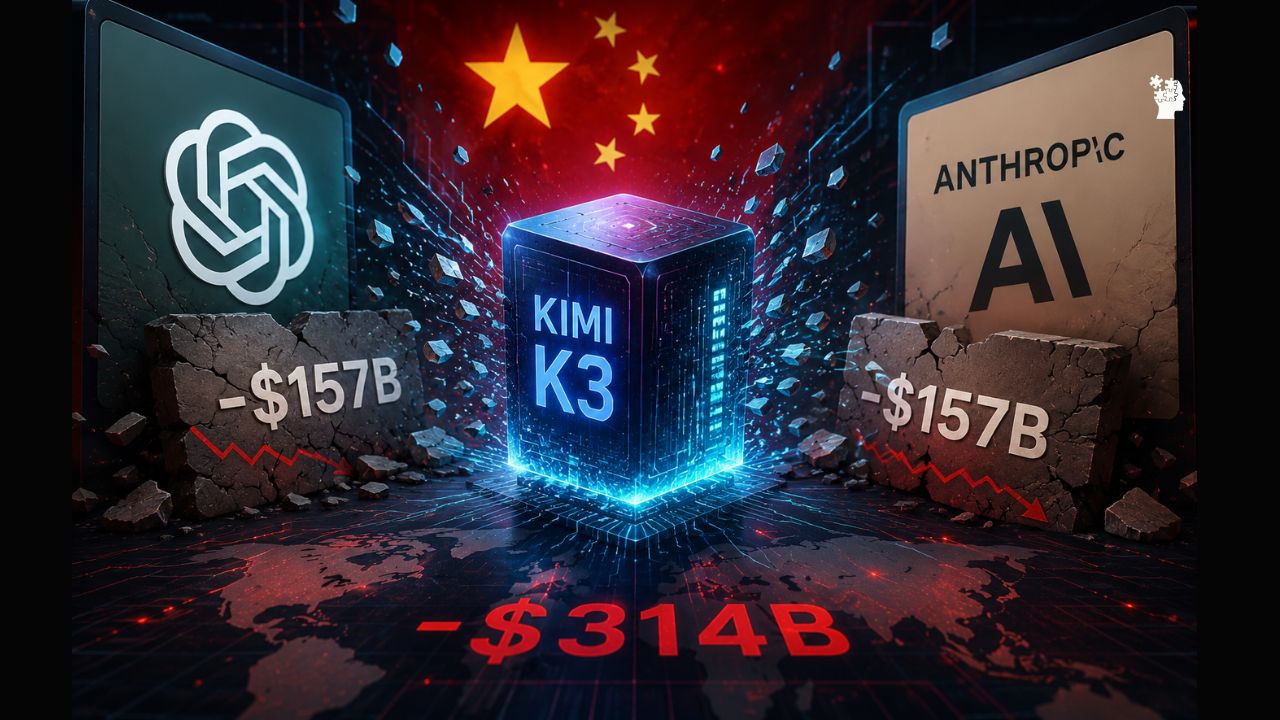
Kimi K3 is changing the AI race. Here’s why analysts believe Moonshot AI’s open-weight model could reshape OpenAI, Anthropic, pricing, and the future of artificial intelligence.
Table of Contents
Kimi K3 Isn’t Just Another AI Model—It’s a Warning Shot to Silicon Valley
For nearly three years, the AI conversation has revolved around one assumption:
The most powerful AI models would remain locked behind expensive APIs controlled by a handful of American companies.
Moonshot AI may have just challenged that assumption.
Its latest model, Kimi K3, isn’t simply another chatbot. It represents something potentially more disruptive: a frontier-scale open-weight model that anyone can download, modify, deploy, and improve.
That single decision is forcing investors, developers, enterprises, and governments to rethink what the AI industry could look like over the next five years.
One analyst even estimated that Kimi K3 erased an astonishing $314 billion in implied valuation from OpenAI and Anthropic.
Whether that number ultimately proves accurate is almost beside the point.
The market reaction reveals something much bigger:
Investors are no longer assuming proprietary AI companies will dominate forever.
Why Everyone Is Suddenly Talking About Kimi K3
Moonshot AI officially introduced Kimi K3 on July 16, positioning it among the world’s largest publicly available AI models.
The model reportedly contains around 2.8 trillion parameters, placing it in a class previously reserved for closed systems from OpenAI, Anthropic, and Google.
But the headline isn’t simply its size.
It’s that Moonshot plans to release the full model weights, allowing developers to run, customize, and fine-tune the model independently.
That’s a dramatic shift from the API-only approach taken by most frontier AI companies.
For startups, enterprises, universities, and independent researchers, this dramatically lowers barriers to building advanced AI products.
The Real Story Isn’t Performance—It’s Economics
Many headlines focus on benchmark comparisons.
Those numbers matter.
But investors care about something even more important:
Can companies continue charging premium prices if comparable open models become widely available?
That’s where Kimi K3 becomes disruptive.
According to published pricing, K3’s API costs are significantly below comparable frontier models.
Lower prices don’t just attract developers.
They pressure competitors to reduce pricing as well.
If enterprises can obtain similar performance for half the cost—or deploy an open model themselves—the economics of AI infrastructure begin to change.
That’s exactly why valuation assumptions are suddenly under scrutiny.
Understanding the “$314 Billion” Headline
One figure has dominated discussions:
$314 billion erased from OpenAI and Anthropic.
Here’s what readers need to understand.
This number comes from IG market analyst Tony Sycamore, who estimated how much the implied valuations of these private companies might decline if investors reprice future expectations.
It is not:
- an official valuation cut
- a funding round
- a stock market loss
- a confirmed investor markdown
Instead, it’s an analytical estimate based on changing competitive dynamics.
That distinction matters.
The estimate reflects shifting expectations—not actual transactions.
Still, even hypothetical valuation changes can influence investor sentiment and future fundraising.
Why Open-Weight AI Could Change Everything
The AI industry may be entering its “Linux moment.”
In operating systems, Linux proved that open software could compete with proprietary platforms.
AI may now be approaching a similar turning point.
Open-weight models offer several advantages:
- complete customization
- private deployment
- lower long-term operating costs
- greater transparency
- faster community innovation
- independence from API providers
For many businesses, these benefits outweigh having access to the absolute best benchmark scores.
If performance is “good enough,” cost often becomes the deciding factor.
The Biggest Threat Isn’t Better AI—It’s Commoditization
OpenAI, Anthropic, Google, and others have invested billions creating frontier models.
Their business models depend heavily on premium subscriptions and API revenue.
But history shows that technology eventually becomes cheaper.
Cloud computing.
Storage.
Internet bandwidth.
Smartphones.
Eventually, competition compresses margins.
AI could follow the same pattern.
As more powerful open models emerge, premium providers may need to compete not only on intelligence but also on:
- reliability
- enterprise security
- integrations
- compliance
- customer support
- proprietary tools
- ecosystem advantages
The AI race is evolving beyond raw benchmark scores.
Markets Reacted Faster Than Many Expected
Financial markets often price future expectations before they become reality.
Following Kimi K3’s unveiling, technology stocks experienced notable volatility.
Semiconductor companies were hit particularly hard because AI infrastructure spending has become one of the largest drivers of chip demand.
The logic is straightforward.
If cheaper AI becomes widely available, investors wonder whether companies will spend as aggressively on expensive compute infrastructure.
Even if that concern proves temporary, markets rarely wait for certainty.
What This Means for OpenAI
OpenAI remains one of the world’s strongest AI companies.
It still possesses enormous advantages:
- GPT ecosystem
- enterprise relationships
- ChatGPT’s massive user base
- Microsoft partnership
- multimodal capabilities
- deep research infrastructure
However, Kimi K3 highlights a growing challenge.
Being the smartest model may no longer guarantee the strongest business model.
If open alternatives continue improving rapidly, OpenAI will need to differentiate through products—not just models.
That transition is already underway with AI agents, productivity tools, enterprise workflows, and developer platforms.
Anthropic Faces a Different Challenge
Anthropic has built its reputation around safety, reasoning quality, and enterprise reliability.
Many large organizations trust Claude because of those strengths.
Yet pricing pressure could become increasingly difficult to ignore.
Businesses evaluating AI solutions rarely compare only benchmark scores.
They compare:
- total cost
- deployment flexibility
- compliance
- ownership
- scalability
If open-weight systems narrow the performance gap, purchasing decisions become far more competitive.
China’s AI Ecosystem Is Moving Faster Than Many Expected
Moonshot AI is only one part of a much broader trend.
China’s AI ecosystem has accelerated dramatically over the past year.
Instead of copying Silicon Valley’s strategy, many Chinese companies are embracing:
- open-weight releases
- lower pricing
- faster iteration cycles
- aggressive commercialization
This creates pressure not only on U.S. companies but also on AI startups worldwide.
Innovation is becoming increasingly global.
Why Governments Are Paying Close Attention
The rise of advanced Chinese open-weight models has expanded beyond technology into geopolitics.
U.S. policymakers are debating how much frontier AI should remain openly available.
Some argue open models accelerate innovation.
Others warn they may increase national security risks.
Kimi K3 has intensified that debate because its capabilities reportedly approach the frontier while remaining broadly accessible.
The discussion is no longer purely technical.
It is becoming a strategic issue involving economics, security, and technological leadership.
The Next Big Test: July 27
Perhaps the most important milestone hasn’t happened yet.
Moonshot plans to release Kimi K3’s complete model weights.
If developers confirm the reported performance through independent testing, adoption could accelerate rapidly.
The real verdict won’t come from benchmark charts.
It will come from developers.
History shows that successful platforms are often chosen because they’re practical—not because they’re perfect.
The Bigger Picture
The AI race is entering a new phase.
The first phase rewarded companies that built the smartest models.
The next phase may reward those that deliver the greatest value.
OpenAI, Anthropic, Google, Meta, and Moonshot AI are no longer competing solely on intelligence.
They’re competing on:
- accessibility
- affordability
- ecosystem
- developer adoption
- enterprise trust
- long-term sustainability
Kimi K3 may not replace today’s leading AI systems overnight.
But it has accomplished something equally important.
It has forced the industry to ask whether frontier AI should remain proprietary—or become as accessible as open-source software once did.
That question could define the next decade of artificial intelligence.
Key Takeaways
- Kimi K3 is one of the largest open-weight AI models announced to date.
- An analyst estimated it reduced OpenAI and Anthropic’s implied valuations by $314 billion, though this is not a confirmed market loss.
- Lower pricing and open-weight access could intensify pressure on proprietary AI business models.
- The upcoming public release of Kimi K3’s weights could become a defining moment for enterprise AI adoption.
- The AI race is shifting from “who has the smartest model” to “who delivers the best value.”
SEO FAQs
What is Kimi K3?
Kimi K3 is a large open-weight AI model developed by Chinese startup Moonshot AI. It aims to compete with leading proprietary models while allowing developers to download and customize it.
Did Kimi K3 really wipe $314 billion from OpenAI and Anthropic?
No confirmed valuation loss occurred. The $314 billion figure is an analyst’s estimate of how implied valuations could change based on increased competition.
Why is Kimi K3 important?
Its combination of frontier-scale performance, lower pricing, and planned open-weight release could reshape enterprise AI adoption and increase competition in the AI market.
What makes Kimi K3 different from GPT-5.5 or Claude?
Unlike proprietary models that are primarily accessed through paid APIs, Kimi K3 is expected to make its model weights publicly available under a modified MIT license, giving developers greater control over deployment and customization.
Recommended for you: