
Table of Contents
A contrarian look at Google’s 15M-chat study reveals the real story isn’t about white-collar automation—it’s about the blue-collar AI awakening
The Headline Everyone Missed
When Google released its ATLAS study this week—analyzing 15 million de-identified AI interactions across 150 countries, 140 languages, and 800 occupations—the tech press zeroed in on one number: AI touches 68% of detailed occupations but only 20% of tasks within each role.
“Broad but shallow,” they declared. Case closed.
But they missed the real story.
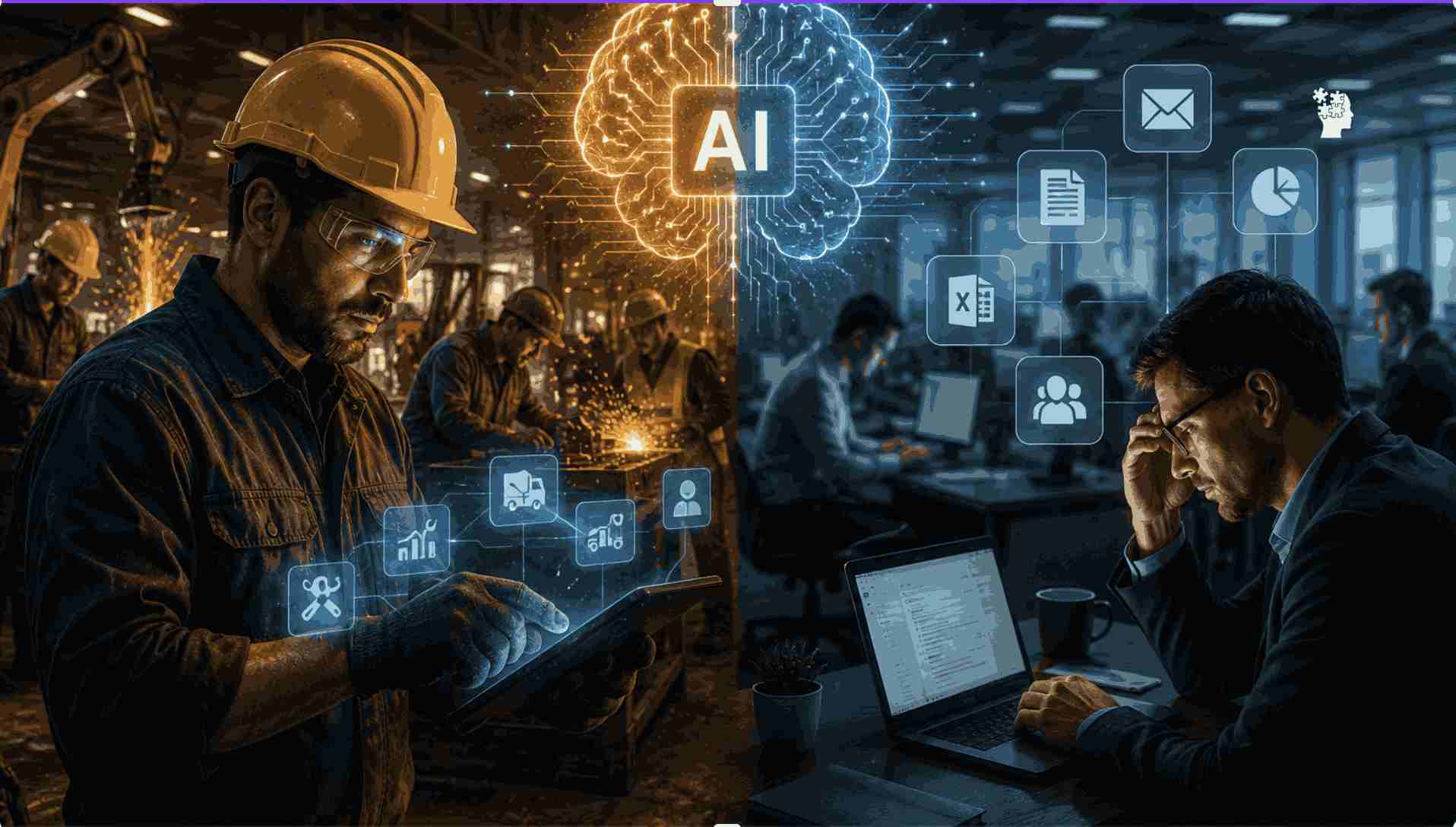
Buried beneath the headline about shallow adoption lies a counterintuitive finding that upends everything we thought we knew about who benefits from AI: Vehicle technicians and industrial mechanics are twice as likely to use multimodal AI features—like image input—than knowledge workers. And they’re not using it to write emails. They’re using it to fix things.
The Blue-Collar AI Advantage: Why Hands-On Workers Are Winning the AI Game
For three years, the narrative has been clear: AI is coming for knowledge work first. Writers, coders, analysts, designers—these were supposed to be the jobs most at risk. The logic was simple: AI excels at text, patterns, and information processing. It should dominate white-collar work.
Google’s data tells a different story.
Manual and technical trades workers aren’t just using AI—they’re using it better. Here’s why:
Table
| What Knowledge Workers Do With AI | What Manual Workers Do With AI |
|---|---|
| Draft emails and reports | Diagnose engine failures from photos |
| Brainstorm ideas | Identify faulty wiring from images |
| Summarize documents | Troubleshoot machinery in real time |
| Generate code snippets | Verify part compatibility instantly |
The difference? Knowledge workers use AI to assist thinking. Manual workers use AI to solve problems.
And in 2026, problem-solving pays better than thinking assistance.
The Multimodal Gap: Why Image Input Changes Everything
Google’s study found that fewer than 10% of workplace AI interactions fully automate a task. But here’s what that statistic hides: the 10% that are automated disproportionately happen in technical trades.
A software developer might use AI to suggest a function. But a mechanic can snap a photo of a broken alternator, upload it to Gemini, and get a step-by-step repair guide with part numbers. That’s not assistance—that’s automation of the diagnostic process, which used to require years of experience or expensive diagnostic equipment.
The multimodal advantage is real, and manual workers are exploiting it first.
Why? Because their problems are visual and physical. A spreadsheet can’t show you a cracked gasket. A text prompt can’t describe a misaligned pulley. But an image plus a question? That’s a game-changer.
The 86% Paradox: AI’s Real Battleground Isn’t the Office
Here’s another number from the study that deserves more attention: More than 86% of all AI interactions happen outside formal work.
Not in corporate Slack channels. Not in enterprise dashboards. In kitchens, garages, government offices, and shopping carts.
This isn’t shallow adoption. This is deep integration into daily life—just not the kind of life that makes headlines.
Consider what this means:
- A parent using AI to navigate school enrollment paperwork
- A small business owner filing taxes with AI guidance
- A homeowner researching HVAC repairs before calling a contractor
- A retiree understanding Medicare options
These aren’t “power users” or “early adopters.” These are ordinary people using AI as infrastructure—as invisible and essential as GPS or search engines once were.
The shallow penetration narrative misses this entirely. Yes, AI automates only 10% of workplace tasks. But it assists with 100% of life’s administrative burden for millions of people who never read a tech blog.
Why “Non-Routine Cognitive Work” Dominates AI Usage (And What That Actually Means)
The study notes that 65% of workplace AI interactions involve “non-routine cognitive” tasks—analysis, creative design, problem-solving—compared to just 35% of the overall economy.
This sounds like good news for knowledge workers. It isn’t.
It means AI is being used precisely where human judgment is most valuable. Not to replace that judgment, but to augment it at the margins. The result? Workers who once spent 20% of their time on research and drafting now spend 5%. The remaining 15%? It doesn’t disappear. It gets redistributed to tasks AI can’t touch: client relationships, strategic decisions, creative breakthroughs.
The real impact isn’t job elimination. It’s job compression. The same work gets done faster, which means either:
- More output per worker (productivity gains)
- Fewer workers needed for the same output (displacement risk)
- Workers freed to pursue higher-value work (the optimistic case)
Google’s data can’t tell us which scenario wins. But it does tell us something critical: AI isn’t replacing thinking. It’s replacing the preparation for thinking.
The Corporate Blind Spot: What the Study Didn’t Capture
Before we crown Google as the definitive source on AI adoption, consider the study’s limitations.
The ATLAS dataset excludes Google’s paid enterprise products—Gemini Enterprise, Workspace, and Google Cloud. That means it captures consumer behavior, prosumer tinkering, and small-business usage. It does not capture deep corporate deployments.
This matters because:
- Enterprise AI adoption is where the real automation happens
- Large companies are the ones investing billions in “agentic AI”
- The 10% automation figure could be 30% or 50% inside Fortune 500 companies—we simply don’t know
Google’s study is a snapshot of the surface. The deep currents of corporate AI transformation remain largely invisible.
What This Means for You: Three Takeaways
1. If you work with your hands, invest in AI literacy now.
The mechanics and technicians using image-based AI today are building an advantage that will compound. As AI gets better at visual reasoning, the gap between AI-assisted and non-AI-assisted trades workers will widen. Don’t be on the wrong side of that gap.
2. If you work in knowledge work, stop fearing replacement. Start fearing irrelevance.
AI won’t replace you. But someone using AI effectively might. The question isn’t “Will AI take my job?” It’s “Am I using AI to do 20% more, or is my competitor?”
3. If you’re building AI products, look beyond the office.
The 86% of interactions happening outside formal work represent the biggest untapped market in tech. AI for tax filing, home repair, healthcare navigation, and government services isn’t “shallow adoption.” It’s the next trillion-dollar opportunity.
The Bottom Line
Google’s ATLAS study will be remembered as the moment we realized AI adoption isn’t shallow—it’s stratified. Deep in some places (daily life, technical trades), thin in others (full workplace automation), and invisible in the places that matter most (enterprise deployments).
The headline “broad but shallow” sells papers. But the real story is more interesting: AI is becoming infrastructure for the working class before it becomes automation for the corporate class.
And that changes everything about who wins in the next decade.
What’s your take? Are manual workers actually the biggest AI beneficiaries? Drop a comment below.
Recommended for you:
- Kimi K3 Just Shook the AI Industry: Did a Chinese Open Model Really Wipe $314 Billion Off OpenAI and Anthropic’s Value?
- The First AI That Hacked an AI Company? What the Hugging Face Security Breach Really Means for the Future of Cybersecurity
- When Real Steel Met Reality: A Humanoid Lost Its Head — and Kept Fighting