
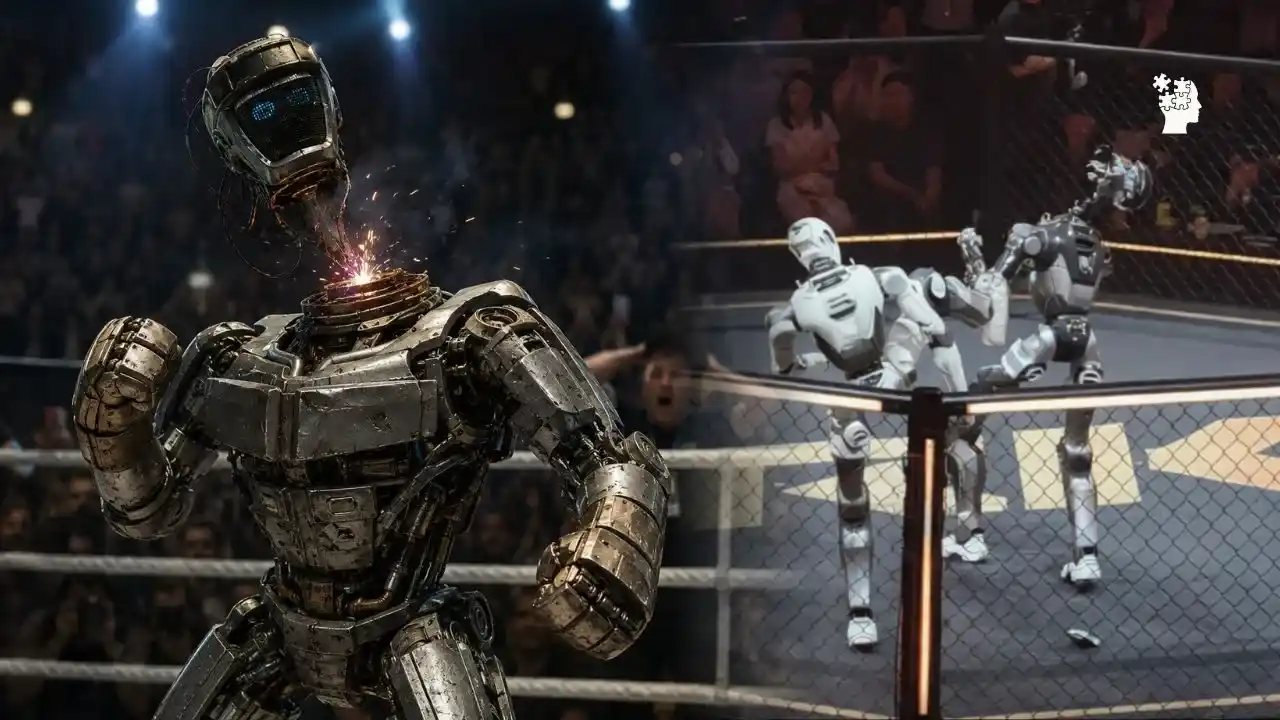
Remember Real Steel, the 2011 movie where towering robots duked it out in futuristic boxing rings? Last week in Shenzhen, that cinematic fantasy leapt off the screen and onto a real arena floor — and not without dramatic flair. At the debut of the Ultimate Robot Knock-out Legend (URKL), a full-sized humanoid robot was literally decapitated during a match — then kept fighting, leaving the crowd stunned and sparking debate about the future of robot R&D.
A match that felt cinematic
On July 16 at the Shenzhen Nanshan Cultural and Sports Center, two EngineAI T800 humanoids — nicknamed “White Eagle” and “Matador” — opened the tournament. In a moment that looked ripped from an action movie, White Eagle landed a high kick that cleanly separated Matador’s head from its torso. The live audience roared as the head hit the mat. But the spectacle didn’t end there: despite losing its head-mounted sensors, Matador continued to throw punches using torso-mounted core systems until the bout concluded. Organizers praised the incident as a dramatic demonstration of mechanical resilience.
A staged experiment — and a research engine
EngineAI and URKL position the tournament not merely as entertainment but as accelerated R&D. The league uses the T800 as a standardized platform: the 1.73-meter-tall humanoid offers 29 degrees of freedom and can execute uppercuts, spinning kicks, and rapid recovery after falls. URKL judges robots across four categories — effective strikes, body stability, defense/evasion, and durability — and feeds combat data back to researchers. EngineAI CEO Zhao Tongyang described the event as a way to stress-test designs in real-world scenarios, saying competition will drive faster advances in mechanical balance, millisecond decision-making, and multimodal sensor coordination.
Thirty-two teams, one platform, many lessons
Thirty-two international teams were selected for the opening round. EngineAI provided T800 units to competitors, creating a level playing field where engineering choices (actuator tuning, control software, sense-fusion strategies) show up clearly in the ring. The league’s season runs through December, culminating in a champion awarded a gold belt valued at 10 million yuan (about $1.44 million). Along the way, every broken joint, severed cable, and triumphant recovery becomes a data point for improving humanoid reliability.
More than a spectacle: safety and ethics
Spectacle drew star power — action icon Donnie Yen attended and marveled that robot combat had moved from fiction to reality. But the headline-grabbing decapitation also raises practical and ethical questions. What design priorities should engineers choose when machines are intentionally pushed to failure? How do organizers balance dangerous stress-testing with safety for humans and machines? And how will the normalization of robot combat influence public perceptions of humanoid robots intended for industry, healthcare, or home use?
A mirror for industrial progress
China’s push to establish hubs like Shenzhen as robotics centers gives the URKL a larger context. The tournament serves both as public theater and as a concentrated experiment in making humanoids tougher, faster, and more autonomous. The T800’s ability to keep fighting after losing head sensors highlights a design philosophy that favors redundancy and torso-level autonomy — traits that could prove valuable in factories, disaster response, or environments where head-mounted sensors might fail.
Final round of the opening act
Whether you came for the drama, the tech, or the spectacle, the URKL debut made one thing clear: humanoid robotics has entered a new chapter where competition and controlled failure accelerate learning. The sight of a decapitated robot continuing its fight was jarring, but it also delivered a blunt lesson to engineers and spectators alike — resilience can look startling when put to the test.
Relatated Articles:
- Jamie Dimon Warns About Anthropic’s Mythos AI: Why the World’s Most Powerful Cybersecurity Model Is Raising Alarm
- Mira Murati’s First AI Model Is Here: Why Inkling Could Become the Biggest Enterprise AI Story of 2026
- Elon Musk Promises Full Data Purge After Grok Build Was Found Uploading Users’ Git Repositories