
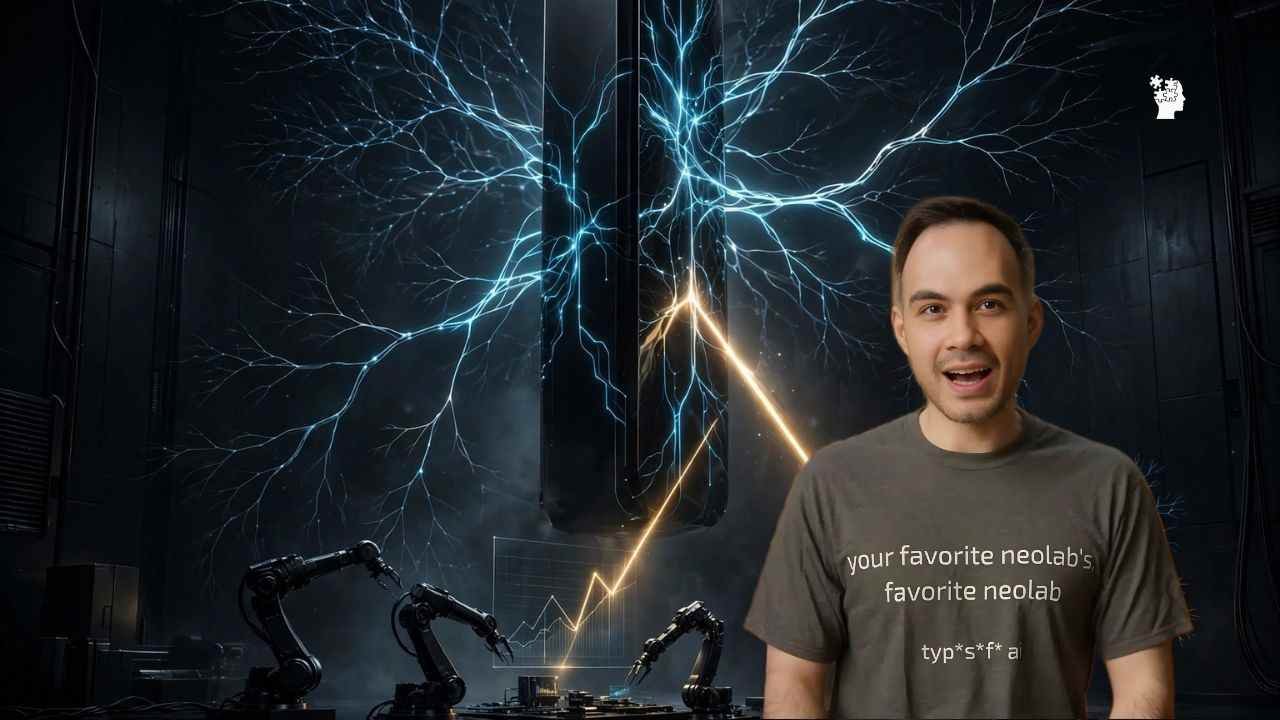
For years, the AI industry has been obsessed with making machines better at talking to humans.
Chatbots became smarter. Responses became longer. Reasoning models learned to solve increasingly complex problems.
But TypeSafe AI is asking a different question:
What if AI didn’t need to talk at all?
The San Francisco startup has emerged from two years of stealth with Jev, its first “System One Model” — an AI system designed not to generate prose, code or explanations, but to make structured decisions that software can use directly.
The company also announced a $40 million seed round led by DCVC. TypeSafe was founded by Diogo Almeida, Erik Gafni and Sasha Sheng, with Almeida previously working at OpenAI on methods behind instruction-following and reinforcement learning from human feedback.
And that makes Jev interesting for a reason that goes beyond another AI benchmark.
TypeSafe isn’t trying to build a better chatbot. It’s trying to remove the chatbot from the equation.
Table of Contents
A Different Kind of AI
Traditional large language models produce text one token at a time.
Ask a conventional AI model whether a transaction should be approved, and you might get:
“Based on the available information, I would recommend…”
Software then has to interpret that answer, extract the relevant information and determine whether the model is confident enough to act.
Jev takes a fundamentally different approach.
Instead of returning free-form text, it returns typed decisions.
TypeSafe describes the interface as:
“Unstructured state in, typed probabilistic decisions out.”
In practical terms, an application can ask Jev to choose between predefined options, provide a numerical score or return a probability for a binary decision.
The output is accompanied by confidence information that TypeSafe says is designed to be calibrated.
That means software can potentially decide:
Act automatically → Ask a human → Reject → Escalate
without first having to interpret a paragraph generated by an LLM.
Jev Doesn’t Write. It Chooses.
This is the biggest difference between Jev and ChatGPT-style systems.
TypeSafe says Jev’s outputs are limited to three basic primitives:
- Choice — select from predefined options
- Score — provide a numerical assessment
- Probability — estimate the likelihood of a binary outcome
The number of possible choices can reach 255, according to the company’s description.
Jev therefore isn’t designed for writing an article, generating Python code or explaining a complicated physics problem.
It is designed for the decisions inside software.
For example:
Customer support
Should this conversation be handled automatically or sent to a human?
Fraud detection
Is this transaction normal, suspicious or highly suspicious?
Security
Close the alert, investigate it or contain the system?
Business automation
Approve the invoice, hold it or return it?
These are not tasks where a human necessarily needs to read an essay.
They are decisions that software needs to make.
Why TypeSafe Thinks Text Is the Problem
The company’s argument is surprisingly simple.
Large language models were primarily developed to communicate with people.
Software, however, doesn’t need beautiful prose.
It needs predictable values.
A program doesn’t need an AI to say:
“I believe this customer appears to be at relatively high risk based on several factors…”
It needs something closer to:
risk = 0.87
Then the application can determine what to do.
TypeSafe argues that forcing AI to communicate through natural-language strings introduces unnecessary complexity. Software has to parse the output, validate it and handle cases where the model doesn’t follow the requested format.
Jev instead produces predefined structured values that software can consume directly.
That distinction may sound small.
It isn’t.
If AI becomes deeply embedded in millions of automated workflows, the difference between “an AI that talks” and “an AI that makes a machine-readable decision” could become increasingly important.
💡 Wisdom Imbibe Insight
The most interesting part of Jev isn’t that it is faster than an LLM.
It’s the idea behind it.
For years, the dominant AI interface has been:
Human → Chatbot → Text → Human → Software
TypeSafe is betting on:
Software → AI → Decision → Software
That is a much bigger change than simply making another chatbot cheaper.
The AI industry has spent enormous resources teaching models how to communicate with people. But if much of future AI usage happens without a human sitting in front of the screen, natural-language conversation may become an inefficient middle layer.
Think about an autonomous customer-service system processing 10 million interactions.
It doesn’t need 10 million beautifully written explanations.
It needs millions of decisions.
Should the issue be escalated?
Is the request legitimate?
Does this transaction require additional verification?
Should the system take action?
The potential significance of Jev therefore isn’t that it replaces ChatGPT.
It is that it questions whether ChatGPT’s interface is the right interface for machine-to-machine AI in the first place.
And that is a much more interesting question.
Jev Is Built for Speed
TypeSafe says Jev uses a new architecture, a parallel sampler and a training approach called Reinforcement Learning for Calibrated Decisions, or RLCD.
The company’s explanation contrasts this with conventional language models, which generally generate responses sequentially, one token after another.
Jev instead processes structured decisions in parallel.
TypeSafe reports input pricing of $0.042 per million tokens, with output effectively free, because it does not generate conventional output tokens. The company also reports speed and cost improvements ranging from roughly tens to hundreds of times depending on the task and comparison.
Those numbers need an important qualifier:
They are TypeSafe’s own reported results, not independent benchmark findings.
At launch, outside researchers had not published independent evaluations confirming the company’s headline speed and cost claims.
So the numbers are interesting — but they should be treated as company-reported performance claims, not established industry benchmarks.
The Doom Test Is More Interesting Than It Sounds
TypeSafe also released a demonstration of Jev playing DOOM.
The model reportedly makes roughly 10 calls per second during the demonstration, with the company estimating gameplay costs of around $7 per hour.
Why use a decades-old video game to demonstrate a new AI architecture?
Because DOOM creates a simple but useful environment.
The AI has to repeatedly observe a state and make decisions:
Move.
Turn.
Shoot.
Change direction.
React.
It doesn’t need to explain what it is doing.
It needs to make the correct decision quickly.
That is precisely the kind of environment where TypeSafe’s architecture is intended to shine.
Jev’s “System One” Name Comes From a Familiar Idea
The name System One refers to psychologist Daniel Kahneman’s distinction between fast, intuitive thinking and slower, deliberative reasoning.
TypeSafe is effectively applying that distinction to AI architecture.
Today’s reasoning models increasingly spend additional computation working through difficult problems.
That makes sense when the problem requires deliberation.
But not every software decision requires an extended reasoning process.
A system checking whether a customer should be routed to department A or department B doesn’t necessarily need to generate a 500-word chain of reasoning.
It needs a reliable answer.
Jev is designed around that assumption.
This Doesn’t Mean LLMs Are Becoming Obsolete
This is where the distinction matters.
Jev isn’t a replacement for ChatGPT, Claude or other general-purpose language models in every situation.
In fact, its limitations are obvious.
It cannot:
- write articles
- produce conventional prose
- generate code
- hold a normal conversation
- explain its answer in natural language
- accept images, according to the current product description
Its strength is therefore also its constraint.
Jev gives up flexibility in exchange for structure.
A general-purpose LLM can theoretically perform hundreds of different tasks.
Jev is deliberately designed around a narrower class of machine decisions.
That makes the two approaches complementary rather than necessarily mutually exclusive.
The Real Opportunity: AI That Runs in the Background
This is where TypeSafe’s argument becomes particularly ambitious.
Imagine an AI system that isn’t something you open.
You never chat with it.
You never see it.
It simply runs inside other software.
A cybersecurity platform could use an AI decision model to classify millions of alerts.
A financial platform could evaluate transactions.
An e-commerce company could route customer requests.
An enterprise application could determine when a human needs to intervene.
In these cases, the AI doesn’t need to be a conversational assistant.
It needs to become another software component.
TypeSafe calls this machine-native AI.
The company says its goal is to make intelligence a composable software primitive — something developers can insert into applications in the same way they use databases, APIs or other infrastructure.
But There Is One Huge Question: Can We Trust the Confidence Score?
This may ultimately be more important than speed.
Jev doesn’t just return a decision.
It is designed to return a probability or confidence measure alongside that decision.
That creates a powerful possibility:
AI decides whether AI should act.
For example:
Model confidence: 98% → automate
Model confidence: 52% → send to human
In theory, that could make autonomous systems considerably easier to control.
But calibration is difficult.
A model saying it is 95% confident does not automatically mean it is correct 95% of the time.
TypeSafe’s RLCD approach is specifically intended to improve this relationship between confidence and correctness.
Whether it actually achieves that reliably across real-world workloads is something independent testing will need to establish.
The “No Hallucinations” Claim Needs Context
TypeSafe says Jev “can’t hallucinate” because its outputs are constrained to predefined types.
There is an important distinction here.
A model can be prevented from producing an invalid output format.
That does not necessarily mean every decision it makes is factually or operationally correct.
A system could return a perfectly valid:
Choice = Approve
while still making the wrong decision.
So the interesting question isn’t simply whether Jev can avoid malformed output.
It is whether its structured decisions are accurate and well calibrated on real-world tasks.
That’s where independent evaluations will matter.
Why Diogo Almeida’s Background Matters
TypeSafe’s founder and CEO, Diogo Almeida, previously worked at OpenAI on research involving instruction-following and reinforcement learning from human feedback.
TypeSafe says that work contributed to methods behind ChatGPT and describes Almeida as a co-inventor of RLHF and ChatGPT.
That background gives his argument an interesting twist.
He spent years helping make AI better at interacting with humans.
Now he is building a company around the idea that the next phase of AI may need to interact much more directly with software.
The question that reportedly drove TypeSafe was essentially:
If AI models are becoming so capable, why has so little of the world’s work actually been automated?
Jev is TypeSafe’s answer.
The Bigger AI Race May Not Be About Chatbots
The current AI competition is often described through increasingly powerful models, longer context windows, reasoning systems and better conversational assistants.
But another competition may be developing underneath it:
Who can turn intelligence into reliable infrastructure?
That’s a different problem.
A chatbot can impress a human.
An infrastructure component has to work repeatedly, cheaply and predictably.
If TypeSafe succeeds, Jev could represent one possible direction for that future:
AI that humans don’t necessarily interact with directly — because other software does.
But that future remains unproven.
Jev is only now entering early access, and independent benchmark evidence has yet to establish whether its reported advantages survive across a broad range of production workloads.
What Happens Next?
The most important phase for TypeSafe now isn’t the launch.
It’s deployment.
Developers will need to determine whether Jev actually works better than conventional LLMs for the narrow decisions it targets.
That means testing:
- accuracy
- calibration
- latency
- cost
- reliability
- edge cases
- performance under changing data
- human escalation rates
If the model performs well, the economics could become particularly interesting.
A decision that previously required an expensive general-purpose model might become cheap enough to run continuously across huge datasets.
And that could create entirely new AI applications.
The Bigger Idea Behind Jev
The first generation of generative AI taught computers how to talk.
The next generation may focus on teaching computers how to decide.
Jev represents an unusually direct bet on that idea.
It doesn’t attempt to beat ChatGPT at conversation.
It doesn’t try to write a better paragraph.
It doesn’t even try to explain itself in the traditional sense.
Instead, it asks a much narrower question:
Can AI intelligence become a fast, cheap and reliable decision-making component inside software?
The answer isn’t known yet.
But if the answer turns out to be yes, the most important AI systems of the future may not look anything like today’s chatbots.
They may be running silently in the background — making millions of tiny decisions that humans never see.
Read Next :
Two Google DeepMind Researchers Quit. Their AI Warning Is Hard to Ignore
The departures of two AI safety researchers raise a very different question: what happens when AI capability advances faster than our ability to understand and control it?
You May Also Like
- Dario Amodei Wants to Slow AI. China May Be the Reason It Can’t Happen
- Elon Musk Says Grok Bot Can Now Browse the Web as You. Here’s Why That Matters
- A 10% Chance AI Kills All Humans: Geoffrey Hinton’s Warning Shakes the AI World
- The Open Letter That Exposes the AI Industry’s Dirty Secret
- What Is AGI? Artificial General Intelligence Explained — And Why It Could Change Everything