
Apple could be preparing to return to a market it abandoned more than a decade ago — this time with artificial intelligence at the center of the strategy.
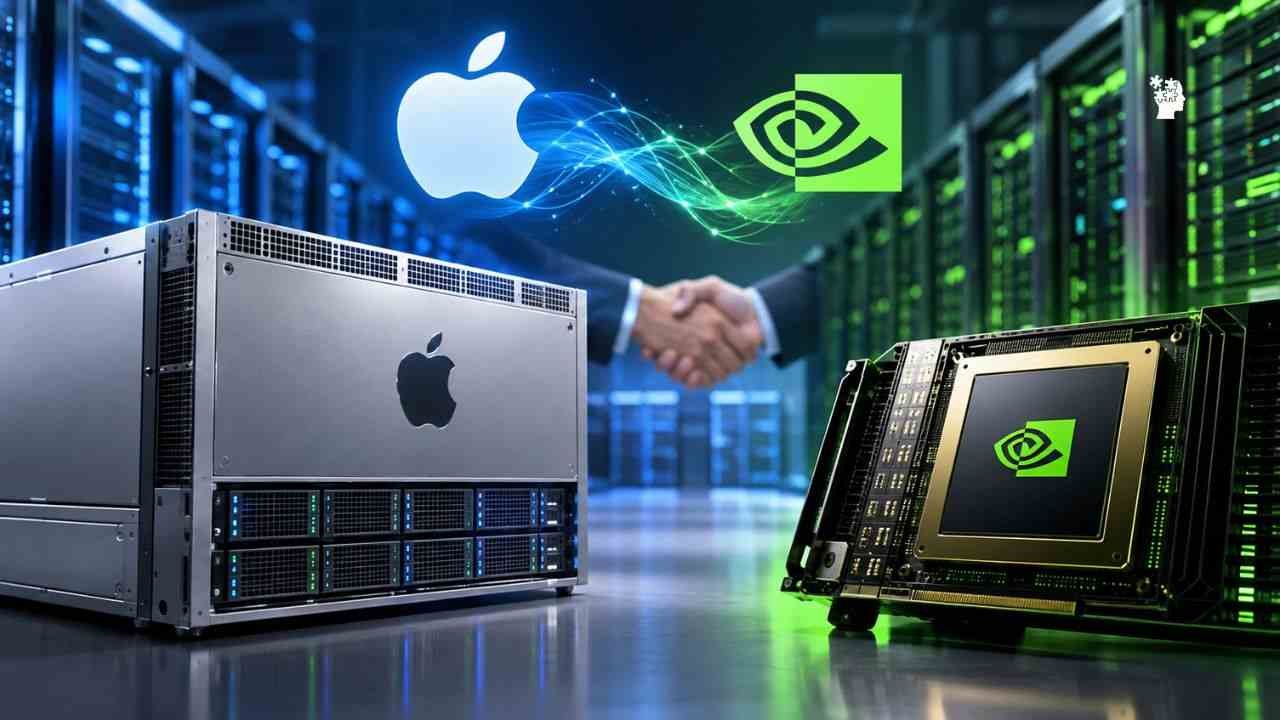
According to a report from The Information, Apple is developing an enterprise AI server built around its future M8 Ultra chips and has discussed using Nvidia’s NVLink Fusion technology to connect the processors.
The proposed machines could be sold to AI developers, businesses and governments, with a potential launch no earlier than 2029.
But there is an important caveat: Apple has not announced the server, Nvidia has not confirmed an agreement, and the project could still be canceled or proceed without Nvidia technology. Reuters likewise reported that it could not independently verify the details.
And that uncertainty is precisely what makes the report interesting.
Apple may be preparing to enter the AI infrastructure business — while potentially relying on technology from a company with which it has had a complicated history.
Table of Contents
Apple Is Thinking Beyond the Mac
For years, Apple’s custom silicon strategy has largely been associated with consumer devices and professional Macs.
The reported server project would take that strategy somewhere very different.
The Information says Apple is considering a purpose-built enterprise machine designed primarily for AI inference — the stage where trained AI models actually generate responses and perform tasks for users.
The proposed system would reportedly come in two configurations:
- Two M8 Ultra chips for the smaller system
- Four M8 Ultra chips for the larger configuration
The machines would be intended for customers that want to run AI workloads on their own infrastructure rather than relying entirely on cloud providers.
That could include AI developers, companies and government organizations.
The reported target date is 2029, although that is not an official Apple product timetable.
Why Would Apple Need Nvidia Technology?
This is the most intriguing part of the story.
Apple reportedly wants to use its own M8 Ultra processors. But putting multiple powerful processors inside one AI server creates a major engineering challenge:
How do you make those chips communicate with each other quickly enough?
For AI workloads, simply having powerful processors isn’t enough. The processors need extremely fast communication so that workloads can be distributed efficiently.
Apple is reportedly considering Nvidia’s NVLink Fusion for this job.
NVLink Fusion includes switches, chiplets and software designed to allow high-speed communication between processors inside data centers. Nvidia has increasingly positioned the technology as a way for companies developing their own AI accelerators to connect their chips using Nvidia’s interconnect ecosystem.
In other words, Apple could potentially build the brains of the server while using Nvidia technology to help those brains communicate.
That is a very different relationship from Apple simply buying Nvidia GPUs.
💡 Wisdom Imbibe Insight
The fascinating part of Apple’s reported server project isn’t simply that Apple wants to sell another powerful computer.
It is that the AI era is forcing companies to rethink where their competitive advantage actually lies.
Apple has spent years building its own silicon because controlling the processor gives it greater control over performance, power efficiency and the overall hardware-software experience.
But AI servers introduce another layer of complexity.
The chips have to work together.
And at that level, networking and interconnect technology can become almost as strategically important as the processors themselves.
That creates an unusual possibility: Apple could compete with Nvidia at the processor level while simultaneously using Nvidia technology somewhere inside the same system.
It is a reminder that the AI hardware market may not divide neatly into “Apple versus Nvidia.”
A future AI server could involve Apple silicon, Nvidia networking, Apple’s software and infrastructure supplied by other companies — all working together.
The battle may ultimately be less about who makes the fastest chip and more about who controls the complete computing platform.
Apple Has a Reason to Take AI Infrastructure Seriously
There is already evidence that Apple’s computers are being used for increasingly demanding AI workloads.
During Apple’s June quarter, Mac revenue reached $10.4 billion, up 29% from a year earlier. Apple said customers were using Mac mini systems for agentic AI and even deploying clusters of Mac Studio systems to run advanced models locally.
That matters because Apple is seeing something unusual from its traditional customer base.
Developers are not simply buying Macs to write software.
Some are effectively turning Apple’s consumer and professional hardware into local AI infrastructure.
A purpose-built server could be Apple’s attempt to take that behavior to a much larger scale.
Instead of customers assembling clusters of Mac hardware themselves, Apple could potentially sell a machine specifically engineered for enterprise AI workloads.
Apple’s Server History Makes This More Interesting
Apple isn’t new to servers.
It previously sold the Xserve, a rack-mounted server designed for professional and enterprise environments.
Apple discontinued Xserve in 2011, effectively exiting the conventional server hardware market.
The reported AI server would therefore represent a significant change in strategy.
But this wouldn’t simply be Apple bringing back the old Xserve.
The market has changed dramatically.
In 2011, enterprise servers were primarily about things such as databases, web hosting, file storage and traditional computing workloads.
In 2026, one of the fastest-growing reasons for buying enormous amounts of computing infrastructure is AI.
That changes the economics.
The Nvidia Connection Is More Important Than It Looks
Nvidia has traditionally been associated with GPUs, but its data-center business increasingly extends beyond the processors themselves.
Networking has become an important part of the company’s strategy because AI systems require enormous amounts of communication between processors.
The Information reported that networking equipment represented roughly a fifth of Nvidia’s data-center revenue in the April quarter, while networking hardware can account for a meaningful share of AI data-center hardware spending.
That gives Nvidia an interesting strategic position.
Even when another company develops a competing AI processor, Nvidia can potentially participate by supplying the infrastructure that allows those processors to communicate.
NVLink Fusion is designed around precisely that opportunity.
So an Apple deal, if it ultimately happens, would be notable not just because Apple uses Nvidia technology.
It would demonstrate how Nvidia could remain deeply involved in AI infrastructure even when customers develop their own processors.
Apple and Nvidia: From Rivalry to Possible Cooperation?
There is also a historical element here.
Apple and Nvidia have had a complicated relationship stretching back decades. Apple used Nvidia graphics processors in some Macs, but the relationship later deteriorated amid business and hardware disputes.
Now, more than a decade after Apple left the server business, the two companies could potentially find themselves working together again.
The irony is striking.
Apple’s entire custom-silicon strategy is partly about reducing dependence on outside chip suppliers.
Yet its future AI server strategy could involve using Nvidia technology at the networking layer.
That isn’t necessarily contradictory.
It could simply reflect the reality that building every component of an advanced AI data-center system internally is neither necessary nor economically sensible.
John Ternus Is Reportedly Backing the Project
According to The Information, Apple’s new CEO John Ternus supported the server project when it began roughly a year ago while he was leading Apple’s hardware engineering organization.
That support reportedly remains important to the project’s momentum.
Ternus became Apple’s CEO earlier this month, making his reported involvement particularly significant.
Still, it is important not to confuse executive support for an internal project with a finalized commercial product.
Apple has not announced the server publicly.
The Bigger Question: Can Apple Build an AI Server Business?
The technical challenge may actually be only half the problem.
Apple would also have to answer several business questions.
Would companies buy Apple’s servers instead of Nvidia-based systems?
Would Apple’s software ecosystem work well enough in enterprise AI environments?
Would Apple provide the support, deployment tools and compatibility that governments and large companies expect?
And perhaps most importantly:
Would Apple actually want to become a major enterprise infrastructure company again?
The company’s previous experience with Xserve suggests that entering the server market is very different from selling Macs and iPhones.
But AI could change the calculation.
The demand for inference infrastructure is growing, while organizations increasingly want to run AI models closer to their own data.
That creates a potential opening for highly integrated systems built around efficient custom silicon.
Apple Isn’t Trying to Become Nvidia — At Least Not Yet
It would be easy to interpret the report as Apple challenging Nvidia directly in AI data centers.
The reality appears more nuanced.
Apple’s reported system would use Apple processors, while potentially using Nvidia networking technology.
And the proposed machines are reportedly aimed primarily at AI inference, rather than competing head-on with the enormous training clusters used to build the world’s largest models.
That distinction matters.
Apple doesn’t necessarily need to replace Nvidia across the entire AI infrastructure market.
It could instead try to establish a niche around efficient, tightly integrated AI inference hardware.
What Happens Next?
For now, the most important word in this story is “reported.”
Apple has not announced an enterprise M8 Ultra server.
Nvidia has not confirmed that Apple will use NVLink Fusion.
The reported 2029 timeframe is not a guaranteed launch date.
And the project could still be canceled or changed substantially before reaching customers.
But if Apple does eventually launch such a system, it could mark a significant shift.
Apple would once again be selling rack-mounted computing hardware — but this time for an industry being transformed by AI.
And Nvidia could potentially help connect the very chips Apple designed to reduce its dependence on traditional chip suppliers.
That combination is what makes this story worth watching.
Read Next:
ChatGPT Co-Creator Launches Jev: The AI Model That Doesn’t Talk — It Decides
For years, the AI industry has been obsessed with making machines better at talking to humans. Chatbots became smarter. Responses became longer…Read more
You May Also Like
- Two Google DeepMind Researchers Quit. Their AI Warning Is Hard to Ignore
- Dario Amodei Wants to Slow AI. China May Be the Reason It Can’t Happen
- The Open Letter That Exposes the AI Industry’s Dirty Secret
Most Read Posts


1 thought on “Apple May Return to Servers. The Nvidia Twist Is the Real Story”