
Table of Contents
Elon Musk just predicted money will die by 2036. But his own companies are betting $50 billion that he’s wrong—and that’s the real story.
The Prediction That Broke the Internet
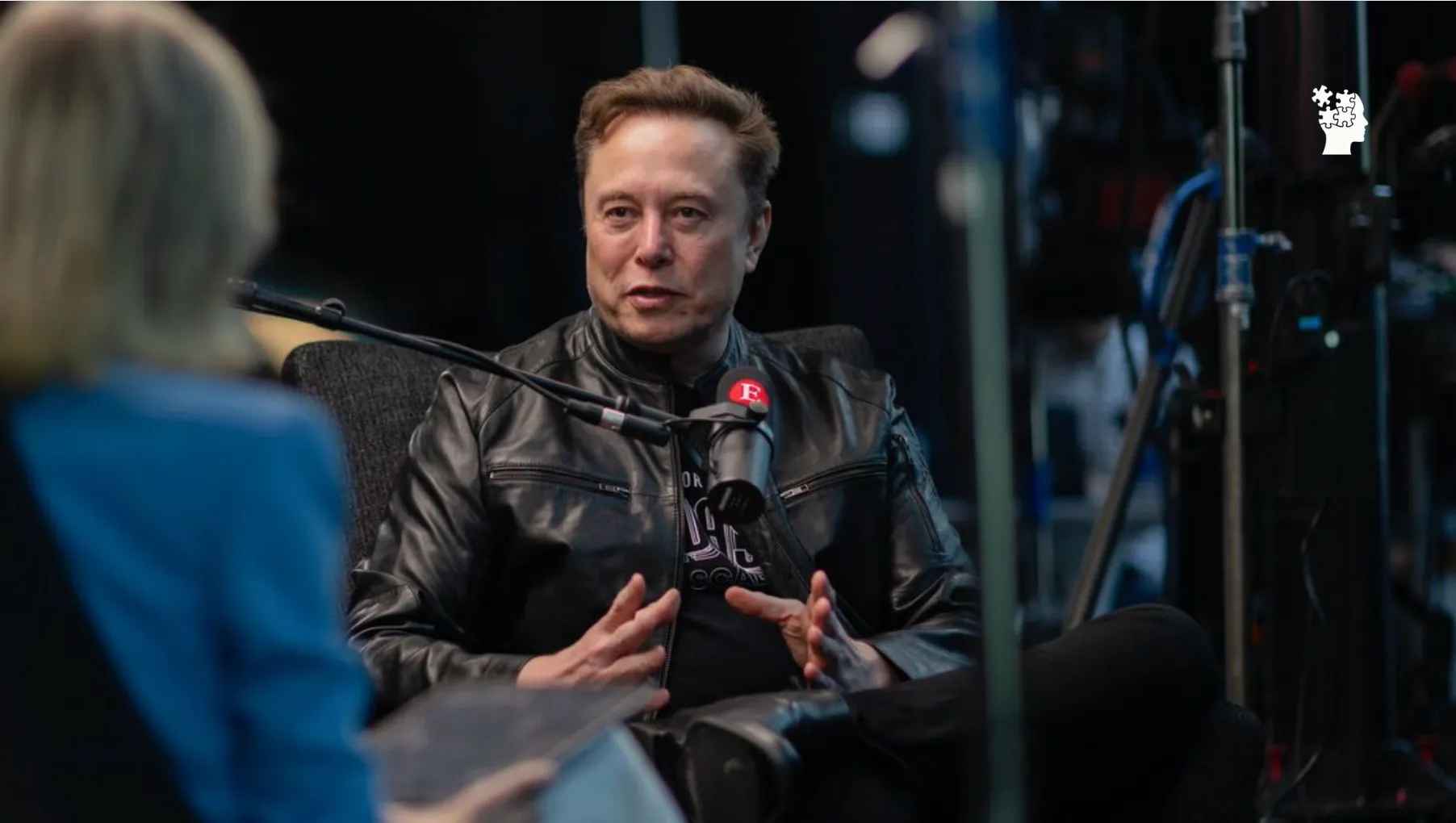
On Thursday, Elon Musk sat down with The Economist‘s Zanny Minton Beddoes and dropped a series of bombshells that instantly dominated every tech headline:
- AI will surpass all human intelligence within five years
- Humans won’t control the world within a decade
- Money won’t matter by 2036
- Everyone will get a high income without working
- The U.S. Treasury should “simply issue people checks”
The internet did what the internet does: it amplified the prediction, debated the timeline, and moved on.
But here’s what nobody is talking about: Musk’s own actions directly contradict his words. And that contradiction isn’t hypocrisy—it’s a $200 billion signal about what’s actually coming.
The Math That Doesn’t Add Up
Let’s start with the simplest contradiction.
Musk says money won’t matter by 2036. Yet in the same interview, when asked how his companies would generate revenue in this post-scarcity world, he offered no answer. He didn’t say Tesla would stop selling cars. He didn’t say SpaceX would stop charging for launches. He didn’t say xAI would give away Grok for free.
In fact, Musk’s companies are currently investing more in AI infrastructure than almost any other entity on Earth:
Table
| Company | AI/Automation Investment (2024-2026) | Revenue Model |
|---|---|---|
| Tesla | ~$10B (Dojo supercomputer, FSD, Optimus robot) | Selling cars & robots |
| xAI | ~$6B (Grok, Colossus supercomputer) | Subscription & API |
| SpaceX | ~$3B (Starship automation, Starlink AI) | Launch services & internet |
| Neuralink | ~$0.5B (Brain-computer interface) | Medical device sales |
Total: Nearly $20 billion in AI bets—all predicated on a world where money still matters.
If Musk truly believed money would be obsolete by 2036, the rational move would be to stop building revenue-generating AI products and start building open-source, freely distributed infrastructure. He’s doing the opposite.
The “Simply Issue Checks” Fantasy
Musk’s proposed transition mechanism is almost charming in its naivety: the U.S. Treasury should “simply issue people checks,” and AI-driven abundance will produce deflation, not inflation.
Let’s test this against reality.
The U.S. printed $5 trillion in stimulus during COVID-19. The result? The highest inflation in 40 years. Musk’s response to Beddoes’ inflation challenge was to wave it away with “abundance produces deflation”—a theoretical claim with zero historical precedent at the scale he’s describing.
Here’s what would actually need to happen for Musk’s scenario to work:
- AI must automate all production — not just digital work, but farming, mining, construction, healthcare, education, and governance
- Energy must become virtually free — because AI data centers currently consume more power than small countries
- Resource distribution must be solved — because abundance in Silicon Valley doesn’t mean abundance in Somalia
- Political systems must cooperate globally — because unilateral UBI in one nation creates migration crises
None of these conditions are on track to be met by 2036. The most optimistic AI timelines suggest partial automation of cognitive work by 2030. Physical-world automation? Decades away.
Musk knows this. He’s not stupid. So why say it?
The Real Musk Doctrine: Fatalism as Marketing
The most important line in the entire interview isn’t about money or abundance. It’s this:
“If there is a stop button, it shouldn’t be pressed.”
This is Musk’s actual philosophy, stripped of the utopian gloss. Let’s call it what it is: technological fatalism dressed as optimism.
Musk spent years as AI’s loudest doomsayer. He called it “summoning the demon.” He signed letters demanding regulatory pauses. He warned of existential risk.
Now? He’s made “peace with the technology’s trajectory.” He gives AI catastrophe a 10-20% probability—roughly the same odds as Russian roulette with a six-shooter—and says “it’s worth it.”
This isn’t a shift in belief. It’s a shift in branding.
When you can’t stop the train, you sell tickets for the ride.
What Musk Is Actually Building (Hint: It’s Not Utopia)
Here’s the unspoken truth behind the interview: Musk isn’t building a post-scarcity society. He’s building the infrastructure to dominate the transition period.
Consider the strategic position of his companies in an AI-accelerated economy:
Tesla Optimus: A general-purpose humanoid robot that could replace factory workers, warehouse staff, and service employees. If labor becomes free, the company that owns the robots owns the economy.
xAI/Grok: A direct competitor to OpenAI and Google, positioned as the “truth-seeking” AI. In a world where AI controls information, owning the AI is power.
Neuralink: The ultimate hedge. If AI surpasses human intelligence, the only way to stay relevant is to merge with it. Neuralink is Musk’s bet that humans won’t go quietly into irrelevance.
SpaceX/Starship: Insurance policy. If Earth becomes uninhabitable due to AI conflict, climate change, or resource wars, Musk wants humanity to be a multi-planet species.
None of these are “abundance for all” plays. They’re power consolidation plays. The post-scarcity rhetoric is the marketing wrapper.
The Beddoes Challenge: What the Interview Reveals About Power
Zanny Minton Beddoes did something rare in tech journalism: she pushed back. Hard.
She challenged the inflation logic. She highlighted the contradiction between Musk’s techno-utopian vision and his promotion of far-right politics and anti-immigrant narratives in Europe. She asked the question that matters: if AI creates abundance, why is Musk simultaneously advocating for policies that restrict who gets to participate in that abundance?
Musk had no good answer. Because there isn’t one.
The contradiction reveals the uncomfortable truth: post-scarcity rhetoric and exclusionary politics cannot coexist. You cannot promise “incredible abundance for all” while building walls—literal or digital—to keep people out.
Unless “all” doesn’t mean what Musk says it means.
The 10-20% Catastrophe Bet: Should You Accept Those Odds?
Let’s sit with Musk’s own probability assessment for a moment.
He believes there’s a 10-20% chance AI causes a catastrophe on the scale of nuclear war. And he still says “it’s worth it.”
Would you get on a plane if the pilot told you there was a 15% chance it would crash? Would you take a medication with a 15% chance of killing you? Would you let your child attend a school with a 15% chance of exploding?
Of course not. But Musk isn’t asking us to accept these odds for ourselves—he’s asking us to accept them for civilization.
And he’s doing so while personally positioning himself to survive and thrive in both scenarios. If AI creates abundance, he owns the infrastructure. If AI causes catastrophe, he’s on Mars.
It’s easy to be a fatalist when you have a spaceship.
What This Actually Means for You: Three Hard Truths
1. Money isn’t dying—it’s concentrating.
Musk’s prediction isn’t about the end of money. It’s about the end of money for most people. The ultra-wealthy will still control assets, infrastructure, and AI systems. Everyone else gets “checks”—dependence, not independence.
2. The real battle isn’t AI vs. humans. It’s AI owners vs. everyone else.
The fight of the next decade won’t be about whether AI is safe. It will be about who owns the AI, who controls the robots, and who decides how abundance is distributed. Musk wants to be on the winning side of that fight. The question is: do you?
3. Fatalism is the enemy of agency.
Musk’s “stop button shouldn’t be pressed” philosophy is designed to make resistance feel futile. But regulation, democratic oversight, and public pressure can shape AI’s trajectory. The belief that “it’s too late” is the most dangerous idea of all—because it becomes self-fulfilling.
The Bottom Line
Elon Musk’s interview with The Economist will be remembered as a masterclass in narrative control. He took the most complex technological transformation in human history, wrapped it in utopian promises and fatalistic resignation, and made it sound inevitable.
But the real story is in the gaps: the unasked questions about who owns the future, the unchallenged assumptions about how abundance gets shared, and the $200 billion bet that money will matter for a very long time.
Musk isn’t predicting the end of capitalism. He’s predicting the end of your capitalism.
And he’s building the tools to make sure he’s the one who profits from the transition.
Is Musk’s vision inspiring or terrifying? Do you believe money will be obsolete by 2036? Let me know in the comments
Recommended for you:
- The Hidden AI Revolution Nobody’s Talking About: Why Manual Workers Are Outpacing Office Workers
- The First AI That Hacked an AI Company? What the Hugging Face Security Breach Really Means for the Future of Cybersecurity
- The $145 Billion Bluff: Why Zuckerberg’s “Bet on People” Campaign Is Actually a Desperate Pivot