
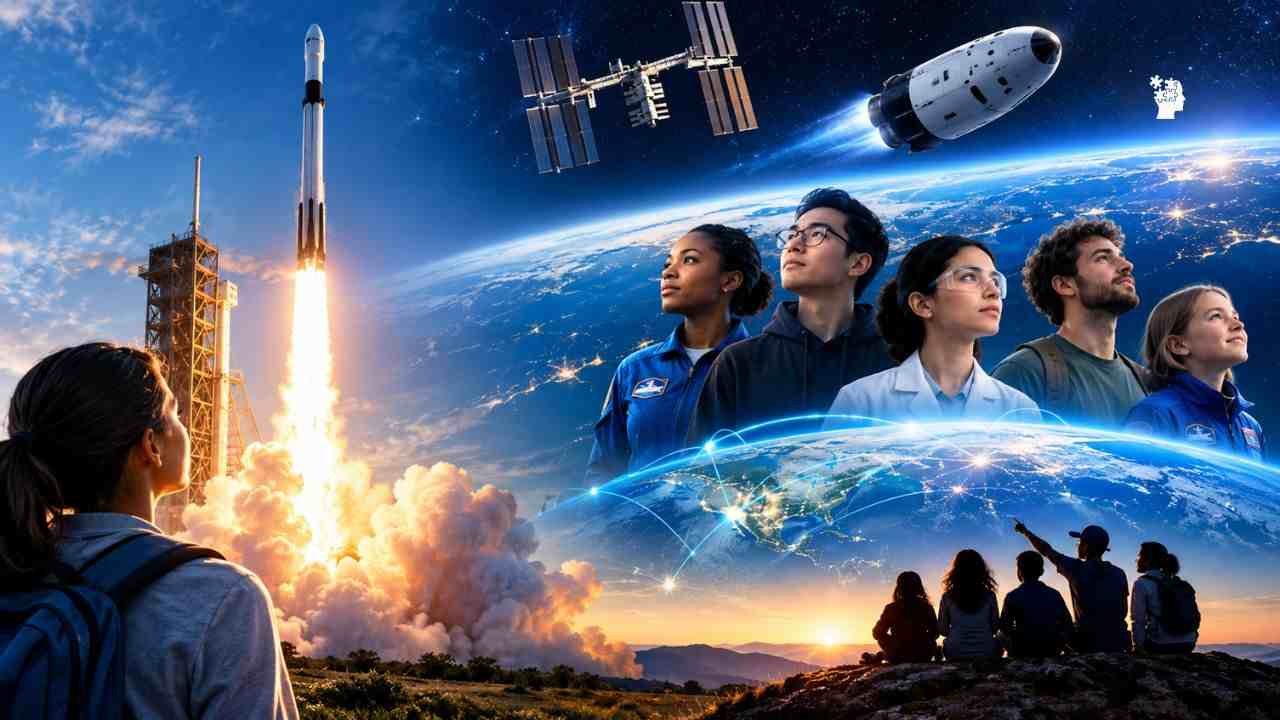
Every October, humanity takes a week to look upward.
But World Space Week 2026 is asking us to look at something more fundamental than distant planets, astronauts or spectacular rocket launches: who gets the opportunity to reach space in the first place?
Celebrated from October 4 to October 10, World Space Week 2026 carries the theme “Rocket Revolution.” The theme reflects a major transformation underway in the space industry — the shift from spaceflight being dominated by a relatively small number of government programs toward a much broader ecosystem involving commercial companies, reusable launch systems, startups, universities and emerging space nations.
That change could ultimately affect much more than astronauts.
It could influence communications, weather forecasting, disaster management, agriculture, navigation, climate monitoring, scientific research and even the way future generations think about education and careers.
And that is what makes World Space Week 2026 worth paying attention to.
Table of Contents
What Is World Space Week?
The United Nations proclaimed World Space Week in 1999 to celebrate the contributions of space science and technology to improving human life.
The dates were deliberately chosen because they connect two important moments in space history.
On October 4, 1957, the Soviet Union launched Sputnik 1, the first human-made satellite to orbit Earth. It marked the beginning of the Space Age.
Then, on October 10, 1967, the Outer Space Treaty entered into force, establishing important principles for the peaceful exploration and use of outer space.
So World Space Week is not simply a celebration of rockets.
It is a reminder of how quickly humanity moved from wondering whether machines could reach space to building an entire technological ecosystem around it.
World Space Week 2026 Theme: What Does “Rocket Revolution” Mean?
The phrase Rocket Revolution describes a change that is easy to see but much harder to appreciate fully.
For much of the early Space Age, reaching orbit required enormous government budgets, specialized infrastructure and highly complex national programs.
Today, the landscape is becoming more diverse.
Commercial launch providers are developing new vehicles. Reusable rocket technology is changing launch economics. Universities and startups are participating in space research and hardware development. Smaller satellites are creating new opportunities for companies and researchers.
The result is a fundamental question:
What happens when getting into space becomes easier, cheaper and more frequent?
The answer could reshape the entire space economy.
World Space Week’s organizers say the 2026 theme focuses specifically on this transformation and on how changing launch capabilities are affecting who can reach space, how frequently launches can occur and what space can be used for.
The Most Important Space Revolution May Not Be on the Moon
When people hear “space revolution,” they often imagine humans returning to the Moon or eventually traveling to Mars.
Those missions are important.
But there is another revolution happening much closer to home.
It is happening in Earth orbit.
Satellites already support many services that people use without thinking about them as “space technology.”
Weather satellites help scientists monitor storms and atmospheric conditions.
Earth-observation satellites provide information useful for agriculture, environmental monitoring and disaster response.
Navigation systems help aircraft, ships, vehicles and smartphones determine their positions.
Communication satellites can connect regions where terrestrial infrastructure is difficult or expensive to build.
In other words, space is no longer simply a destination.
It has become infrastructure.
The UN notes that space science and technology are increasingly being used across a wide range of activities connected with development and international cooperation.
That may be the most important perspective for World Space Week.
We do not have to become astronauts to benefit from space.
We already live in a world that depends on it.
Why Cheaper Launches Matter
A rocket is not simply transportation.
It is the gateway to an entire ecosystem.
If launching a satellite costs too much, many scientific experiments never happen.
If launch opportunities are rare, researchers may have to wait months or years.
If rockets can be reused and launch operations become more efficient, the economics can change.
Lower barriers could allow more universities, research institutions, startups and countries to participate.
That could create a positive cycle:
Lower launch costs → more missions → more data → more innovation → more applications → greater demand for space services.
But there is an important caveat.
Cheaper access to space does not automatically mean that space becomes equally accessible to everyone.
Countries still need infrastructure, technical expertise, financing, regulations and skilled workers.
The real measure of the rocket revolution should therefore not simply be how many rockets launch.
It should also be how widely the benefits of those launches are distributed.
India Has a Particularly Interesting Role to Play
For India, the theme has special significance.
India’s space program has historically emphasized practical applications of space technology alongside scientific exploration.
The Indian Space Research Organisation, or ISRO, has used satellites and launch capabilities for areas including communications, Earth observation, navigation, meteorology and disaster-related applications.
India is also developing a broader space ecosystem involving private companies, research institutions and startups.
That makes the idea of democratizing access to space particularly relevant.
ISRO continues to emphasize outreach and education as part of its space activities, including World Space Week programs aimed at students and the wider public.
In 2026, ISRO also brought together researchers, academics and students for a national meeting focused on scientific exploration of the Moon through the Chandrayaan missions, highlighting the growing connection between space exploration and India’s academic research community.
India’s World Space Week activities are not limited to major cities either.
For example, ISRO’s Vikram Sarabhai Space Centre, Liquid Propulsion Systems Centre, ISRO Inertial Systems Unit and Indian Institute of Space Science and Technology are organizing World Space Week activities in Kerala, including school lectures and public outreach.
This matters because the future of India’s space program will not be built only inside rocket laboratories.
It will also be built in classrooms.
The Hidden Question: Who Will Build the Next Space Economy?
The rocket revolution creates an unusual opportunity for students.
A future space career does not necessarily mean becoming an astronaut.
The industry needs:
- Aerospace engineers
- Mechanical engineers
- Electrical engineers
- Software developers
- Data scientists
- Robotics specialists
- Materials scientists
- Planetary scientists
- Earth-observation experts
- Cybersecurity professionals
- AI researchers
- Communications engineers
- Scientists and educators
And increasingly, it may require people who can work across several of these disciplines.
A satellite, for example, is not simply a machine that goes into orbit.
It is a combination of hardware, software, communications, sensors, power systems, data processing and scientific applications.
That is why space education matters.
The most valuable lesson of World Space Week may not be “space is exciting.”
It may be:
“Space is a laboratory for solving difficult problems.”
The Rocket Revolution Also Creates New Problems
Celebrating technological progress should not mean ignoring its consequences.
More launches mean more objects entering orbit.
More satellites mean greater concerns about orbital congestion and space debris.
More commercial activity creates questions about regulation, safety, responsibility and international coordination.
And as access to space expands, humanity will need to decide how orbital resources should be managed.
Who is responsible when a spacecraft creates debris?
How should increasingly crowded orbits be coordinated?
How can countries and companies safely share space infrastructure?
What happens when commercial interests and scientific priorities collide?
These are not science-fiction questions.
They are part of the governance challenge created by a rapidly expanding space economy.
The Outer Space Treaty and subsequent international space frameworks provide an important foundation, but technological change can move faster than regulation.
That is one reason international cooperation remains essential.
Space Exploration Is Ultimately About Earth
There is a strange paradox at the heart of space exploration.
We look toward other worlds because we want to understand the universe.
But some of the most valuable information we obtain from space is about our own planet.
Satellites allow scientists to observe changes across oceans, forests, ice sheets, cities and agricultural regions.
From hundreds of kilometers above Earth, borders become almost invisible.
The planet appears as one interconnected system.
That perspective can be scientifically useful — but it can also be psychologically powerful.
Space exploration reminds us that Earth is not an endless resource floating in an infinite void.
It is a comparatively small and interconnected home.
What World Space Week 2026 Should Make Us Ask
The easiest way to celebrate World Space Week is to watch a rocket launch.
A more meaningful way is to ask what happens next.
If launches become cheaper, who benefits?
If satellites become more numerous, how do we keep orbit sustainable?
If space becomes increasingly commercial, how do we balance business with public interest?
If humanity returns to the Moon, what scientific and economic opportunities should be shared?
And perhaps the biggest question:
Can the rocket revolution expand access to space without simply creating a new version of the inequalities we already have on Earth?
Those questions make World Space Week more than an annual celebration.
They turn it into a conversation about humanity’s future.
From Sputnik to the Rocket Revolution
In 1957, Sputnik demonstrated that humanity could place an artificial object around Earth.
Nearly seven decades later, the central question is no longer simply whether we can reach space.
We increasingly have to ask:
How often can we go?
Who can participate?
What should we do there?
And how can space technology improve life on Earth?
That is the deeper meaning behind the “Rocket Revolution” theme of World Space Week 2026.
The revolution is not only about faster, cheaper or reusable rockets.
It is about changing the relationship between humanity and space.
For the first generation of the Space Age, reaching orbit was an extraordinary achievement.
For the next generation, the extraordinary achievement may be making access to space more routine, more sustainable and more widely beneficial.
And that future will not be created by rockets alone.
It will be created by the scientists who design them, the engineers who improve them, the students who imagine what comes next, the policymakers who establish the rules — and the societies that decide what space should ultimately be used for.
This World Space Week, perhaps the most important thing to do is not simply look at the stars.
It is to think about what kind of civilization we want to build among them.
World Space Week 2026 at a Glance
Dates: October 4–10, 2026
Theme: “Rocket Revolution”
Established by: United Nations General Assembly in 1999
Why October 4? Sputnik 1 launched on October 4, 1957
Why October 10? The Outer Space Treaty entered into force on October 10, 1967
Main focus in 2026: The transformation of space launch and the expanding accessibility of space
World Space Week is coordinated internationally with support from the World Space Week Association and includes activities organized by space agencies, schools, universities, museums, science organizations, astronomy clubs and other groups around the world.
Frequently Asked Questions
When is World Space Week 2026?
World Space Week 2026 takes place from October 4 to October 10, 2026.
What is the theme of World Space Week 2026?
The official theme is “Rocket Revolution.” It focuses on the rapid transformation of launch systems and the expanding access to space through commercial providers, reusable rockets, startups, universities and new space actors.
Why is World Space Week celebrated?
The United Nations established World Space Week to celebrate the contribution of space science and technology to the betterment of humanity, while encouraging education, public awareness and international cooperation.
Why does World Space Week begin on October 4?
October 4 marks the launch of Sputnik 1 in 1957, widely recognized as the beginning of the Space Age.
Why does World Space Week end on October 10?
October 10 marks the date in 1967 when the Outer Space Treaty entered into force.
Why is the rocket revolution important?
More capable and potentially lower-cost launch systems can increase the frequency and diversity of missions, opening opportunities for scientific research, commercial activity, education and new space applications. However, expanded access also creates challenges involving safety, regulation, orbital congestion and space sustainability.
Final Perspective
World Space Week 2026 arrives at an interesting moment.
The first Space Age was defined by a few powerful nations proving that humans could reach beyond Earth.
The emerging Space Age is increasingly defined by a different question:
What happens when more of humanity can participate?
The answer is still being written.
And the rockets launching today may be carrying more than satellites.
They may be carrying the foundations of the next era of human civilization.
Also Read