
Table of Contents
The Unitree AS2-W isn’t just a gimmick—it’s a blueprint for the future of all mobile robotics, and the West is sleeping on it
The Video That Should Have Changed the Conversation
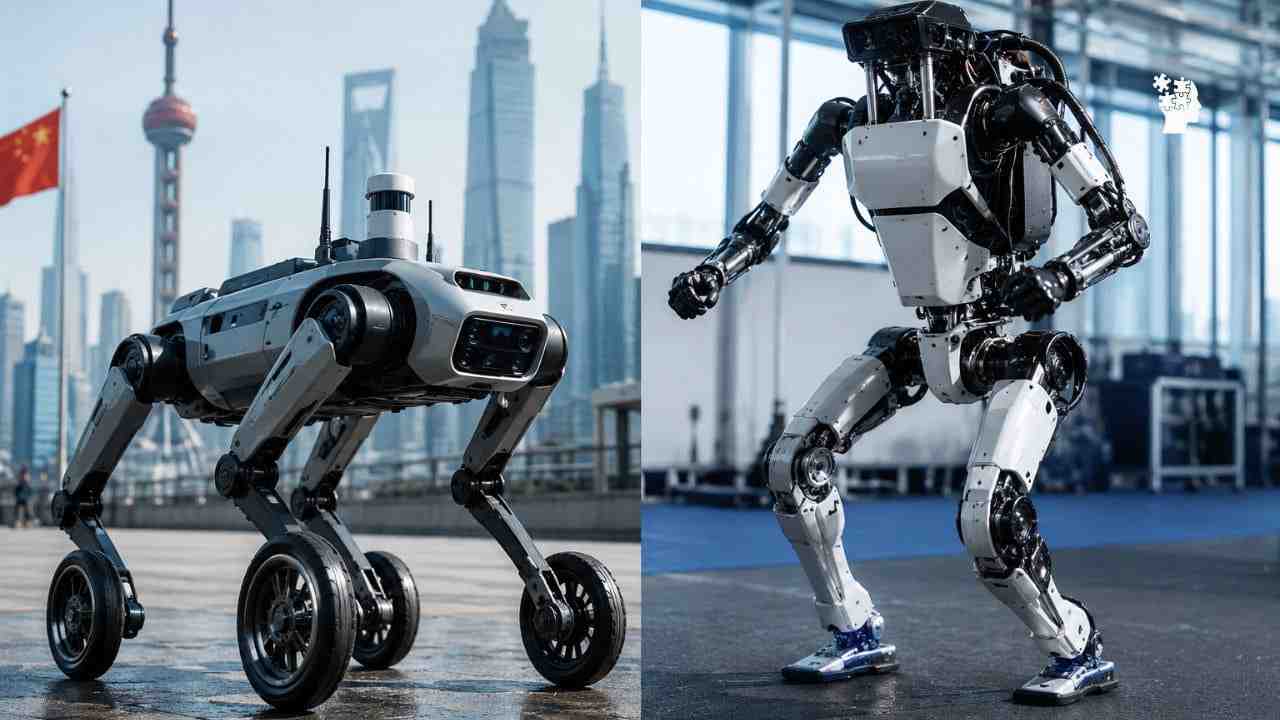
A robot dog rolls across a warehouse floor on four wheels, hitting 6 meters per second—faster than most people jog. It hits a staircase. Without pausing, without a command, without any human in the loop, the wheels retract. Legs deploy. It climbs. At the top, legs fold, wheels drop, and it rolls on.
This isn’t science fiction. This is Unitree’s AS2-W, unveiled this week, and if you’re still comparing it to Boston Dynamics’ Spot, you’re missing the point entirely.
The AS2-W isn’t a better robot dog. It’s a fundamentally different category of machine—one that solves the single biggest problem in mobile robotics: the efficiency-terrain tradeoff.
And here’s what should worry Western tech observers: China didn’t just build it first. China built it practical.
The Tradeoff That Broke Robotics (Until Now)
For decades, mobile robots faced an impossible choice:
Table
| Wheeled Robots | Legged Robots |
|---|---|
| Fast and efficient on flat ground | Slow and energy-hungry everywhere |
| Helpless on stairs, rocks, debris | Capable on any terrain |
| Simple mechanics, long range | Complex mechanics, short range |
| Perfect for warehouses, roads | Perfect for nothing practical |
Boston Dynamics’ Spot is a marvel of engineering. But it’s a legged robot. It walks everywhere—even where wheels would work better. That makes it slow (1.6 m/s max), energy-hungry, and range-limited. It’s a specialist tool for specialist jobs.
The AS2-W says: Why choose?
By autonomously switching between wheels and legs based on terrain, it combines the speed and efficiency of wheeled transport with the versatility of legged locomotion. On flat ground, it’s a 6 m/s ground vehicle. On stairs, it’s a sure-footed climber. In mud, water, or steep faces, it adapts in real time.
This isn’t incremental improvement. This is category creation.
The Specs That Tell a Bigger Story
Table
| Feature | AS2-W | Spot (for comparison) |
|---|---|---|
| Weight | 25 kg | ~32 kg |
| Payload (walking) | 16 kg | 14 kg |
| Top Speed | 6 m/s (~21.6 km/h) | 1.6 m/s (~5.8 km/h) |
| Range | 30+ km | ~90 min runtime |
| Operating Temp | -20°C to 55°C | -20°C to 45°C |
| Terrain Switching | Autonomous, real-time | N/A (always legged) |
The numbers reveal a design philosophy difference, not just an engineering gap.
Boston Dynamics optimized for stability and control. The AS2-W optimizes for mission versatility. It’s lighter despite carrying more payload relative to its weight. It’s nearly 4x faster. It operates in temperature extremes that would challenge most military equipment.
But the most important spec isn’t on this table: autonomous mode switching.
The AS2-W doesn’t need a human operator to decide “wheels now, legs now.” It senses terrain and adapts. That means it can operate in semi-structured environments—construction sites, disaster zones, industrial facilities—without constant human attention.
This is the difference between a remote-controlled tool and an autonomous asset.
Why the Military Is Quietly Panicking (And Should Be)
The tech press covered the AS2-W as a “cool demo.” Defense analysts saw something else.
A 25 kg platform that moves at 21 km/h on roads, climbs stairs, crosses streams, and operates from -20°C to 55°C isn’t a toy. It’s a reconnaissance platform. It’s a supply mule for infantry. It’s a sensor carrier for hazardous environments.
Consider the implications:
- Urban warfare: Stairs, rubble, and flat streets in the same mission. Current robots need different platforms for each. The AS2-W handles all three.
- Logistics: A squad can’t carry 30 kg of batteries, ammo, and medical supplies. A robot that keeps pace on roads and follows into buildings changes infantry math.
- Cost: Unitree’s consumer robot dogs start under $2,000. Even at 10x for the AS2-W, you’re looking at a platform that costs less than a single missile.
The West’s answer? We’re still debating whether to fund more Boston Dynamics contracts.
China isn’t just building better robots. It’s building robots at a cost and scale that makes mass deployment thinkable.
The Industrial Angle Everyone Ignored
While Twitter debates military applications, the real money is elsewhere.
The AS2-W’s 30+ km range and autonomous terrain adaptation make it ideal for infrastructure inspection—power lines, pipelines, railway tracks—where robots must cover long distances on roads or paths, then climb, crawl, or wade to reach specific assets.
Current solutions? Either:
- Wheeled drones that can’t reach the asset
- Legged robots that run out of battery before reaching it
- Humans who cost money, take risks, and can’t work 24/7
The AS2-W eliminates the compromise. One platform. One mission. No handoffs.
Similarly, in search and rescue, the ability to rapidly cover ground (wheels) then access collapsed structures (legs) without swapping equipment or waiting for a different robot could mean the difference between life and death.
This isn’t about replacing workers. It’s about making impossible missions possible.
The “China Is Copying” Narrative Is Dead. Here’s What Replaced It.
For years, Western observers dismissed Chinese robotics as “copying” or “cheap manufacturing.” The AS2-W should kill that narrative permanently.
Consider what Unitree achieved:
- Mechanical innovation: A wheel-leg hybrid that deploys and retracts reliably in harsh conditions
- Control systems: Real-time terrain classification and mode switching without human input
- Integration: All of this in a 25 kg package that costs a fraction of Western equivalents
- Speed to market: From concept to working demo faster than most Western R&D cycles
This isn’t copying. This is parallel innovation—solving the same problems with different constraints and arriving at different, sometimes better, solutions.
The West optimized for precision and control. China optimized for versatility and cost. Both are valid. But only one scales.
What This Means for the Future of Robotics
The AS2-W isn’t an endpoint. It’s a template.
Expect to see this hybrid approach spread:
- Larger platforms: Wheel-legged cargo robots for logistics
- Smaller platforms: Hybrid drones that roll on ground and fly for aerial survey
- Humanoid variants: Bipedal robots with deployable wheels for rapid transit
The core insight—modalities should adapt to terrain, not be fixed by design—will reshape how we think about mobile machines.
Boston Dynamics built the best legged robot. Unitree built the best mobile robot. The distinction matters.
Three Takeaways for Builders, Buyers, and Observers
1. If you’re investing in robotics, bet on versatility, not specialization.
The future belongs to platforms that handle diverse environments without human intervention. Single-mode robots are the flip phones of this era.
2. If you’re in defense or industrial planning, the procurement model is broken.
Buying $200,000 specialist robots for every scenario is unsustainable. The AS2-W proves one platform can do 80% of missions at 10% of the cost.
3. If you’re a Western policymaker, this is a wake-up call.
China isn’t just ahead in manufacturing. It’s ahead in robotic system design—the integration of mechanics, AI, and cost engineering. That’s a harder gap to close than factory capacity.
The Bottom Line
The Unitree AS2-W will be remembered as the robot that made us stop asking “wheels or legs?” and start asking “why not both?”
It’s not the fastest robot, the strongest robot, or the smartest robot. It’s the first robot that refuses to compromise—and in doing so, it renders every robot that does compromise suddenly obsolete.
Boston Dynamics made us believe robots could walk. Unitree just proved they don’t have to choose.
What’s your take? Is the hybrid approach the future, or will pure-legged robots win in the long run? Let us know in the comments.