
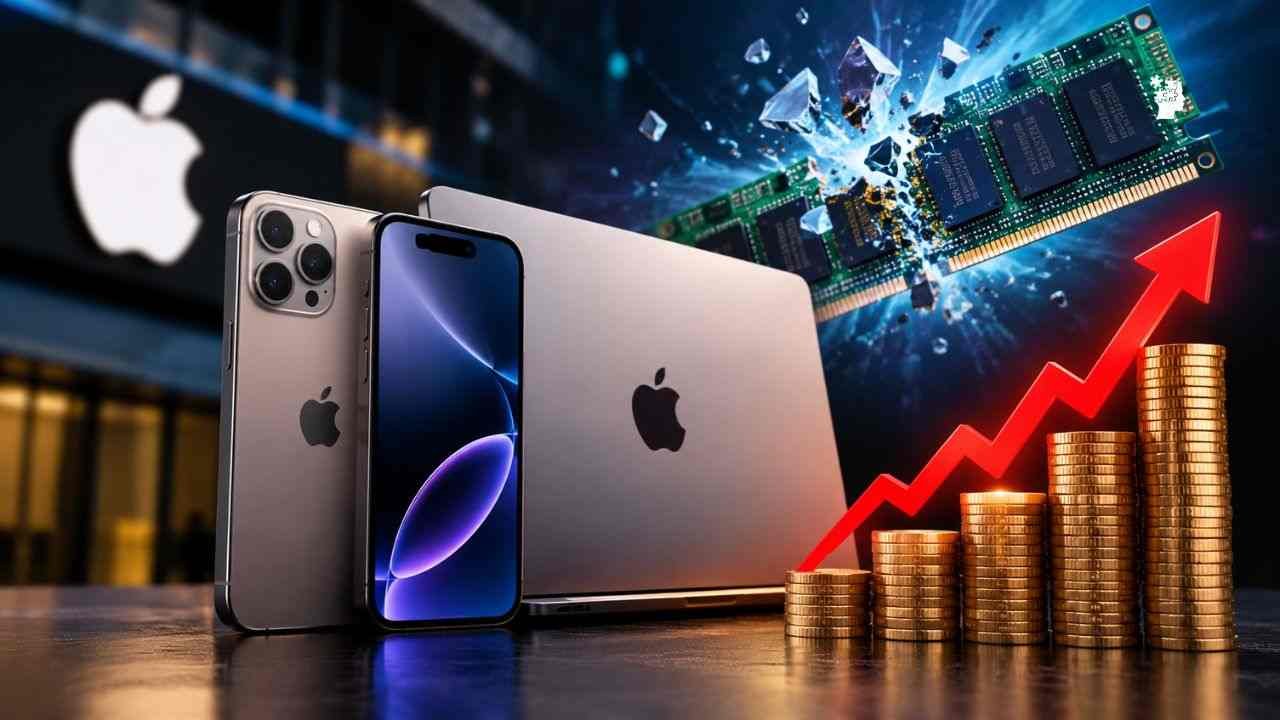
Apple is raising the price of its latest iPhones and Mac computers as a global memory-chip squeeze collides with the explosive demand created by AI data centers. The new Mac mini starts at $899, while the iPhone 18 Pro starts at $1,199 in the U.S. Here’s why the memory shortage could affect the price of consumer electronics for years.
Apple’s latest hardware launches are revealing a problem that goes far beyond one company.
The company has introduced its iPhone 18 Pro and iPhone 18 Pro Max, while its new M6 Mac mini has also gone on sale. But alongside the performance improvements comes a less welcome development for consumers: higher prices.
Apple’s new Mac mini with M6 starts at $899 in the United States, compared with the $599 launch price of the previous M4 generation. Apple has also introduced the iPhone 18 Pro at $1,199, $100 above the previous Pro generation’s starting price.
The common thread behind the pricing pressure is memory.
The technology industry is facing a severe shortage of DRAM and NAND memory as manufacturers redirect capacity toward the enormous requirements of artificial-intelligence infrastructure. The situation has become widely described as “RAMageddon.”
And this could be more than a temporary price spike.
Table of Contents
Apple’s New Prices Put the Memory Crisis in the Spotlight
Apple officially announced the iPhone 18 Pro and iPhone 18 Pro Max on September 9, 2026.
The iPhone 18 Pro starts at $1,199, while the iPhone 18 Pro Max starts at $1,299 in the United States. Both models begin with 256GB of storage, with higher-capacity configurations available.
The new phones also bring significant hardware changes, including Apple’s A20 Pro chip, an upgraded camera system with variable aperture and improvements to battery life and sustained performance.
But consumers are paying more to get them.
Apple’s Mac mini has experienced an even more visible price change.
The new M6 Mac mini starts at $899, compared with the $599 starting price of the M4 Mac mini when that generation launched in 2024.
Apple says the new Mac mini delivers substantial performance improvements, but the price jump has nevertheless attracted criticism from reviewers and consumers.
The important question is: why is memory suddenly becoming so expensive?
Also Read: Apple’s Growing AI Hardware Infrastructure
What Is “RAMageddon”?
“RAMageddon” is an informal term being used to describe the current memory-supply crisis.
It refers to a basic economic problem.
AI data centers require enormous quantities of high-performance memory and storage. At the same time, consumers still need conventional DRAM and NAND memory for smartphones, computers, gaming systems and other electronics.
The companies producing memory therefore have to decide where limited manufacturing capacity should go.
And AI infrastructure is an extremely attractive customer.
High-bandwidth memory, or HBM, is particularly important for advanced AI accelerators. These systems process enormous amounts of data and require extremely high memory bandwidth.
The result is a competition for manufacturing capacity between rapidly expanding AI infrastructure and traditional consumer electronics.
Why AI Is Suddenly Affecting the Price of Your Phone
It may seem strange that an AI data center in another part of the world could make a smartphone more expensive.
But the semiconductor supply chain is interconnected.
The world’s major memory manufacturers supply different types of DRAM and NAND products to a huge range of technology companies.
The three largest DRAM manufacturers — Samsung, SK Hynix and Micron — dominate global memory production.
When demand for AI-related memory rises sharply, manufacturers can allocate more resources toward higher-value products.
That can tighten supply for other categories.
Micron has explicitly warned that memory demand is exceeding industry supply. In its fiscal Q3 2026 results, the company said it expected tight conditions to persist beyond calendar 2027 because of AI-driven demand and structural supply constraints.
That is an important signal.
This isn’t simply a short-term shipping disruption.
It is a supply-and-capacity problem.
Apple Already Warned About a “100-Year Flood” in Memory Pricing
Apple had already acknowledged that memory costs were putting pressure on its business.
In July, then-CEO Tim Cook described the situation as a “100-year flood” on memory pricing and said Apple had reluctantly raised prices because of rapidly increasing memory costs.
Cook also said Apple expected memory costs to remain elevated in the September quarter.
That helps explain why the latest Apple hardware launches are arriving with higher prices.
The company can absorb some component-cost increases, offset them through savings elsewhere in the supply chain, or pass some of the additional cost on to consumers.
Apple has chosen a combination of those approaches.
Why the Mac Mini Price Increase Is So Significant
The Mac mini is particularly interesting because it has traditionally been positioned as one of Apple’s more affordable ways to enter the Mac ecosystem.
The M4 Mac mini launched at $599.
The M6 generation now starts at $899.
That’s a $300 difference in launch pricing.
The new model is considerably more powerful, so the price comparison isn’t a perfect apples-to-apples measure of manufacturing cost. Apple has also upgraded the underlying technology.
But the change nevertheless illustrates how expensive memory and other components can influence the pricing strategy of a mass-market computer.
The new Mac mini is not simply a more powerful version of its predecessor.
It represents a more expensive baseline for entering Apple’s desktop ecosystem.
The Memory Shortage Isn’t Just About RAM
When people hear “RAM shortage,” they may think only about the memory installed inside a laptop or smartphone.
The current situation is broader.
The semiconductor industry is dealing with pressure across both DRAM and NAND markets.
DRAM is used for working memory, while NAND is the technology behind flash storage.
Both matter to modern consumer electronics.
A smartphone needs memory for running applications and operating systems. It also needs storage for photographs, videos, apps and other data.
A computer requires the same basic combination.
As AI systems become more demanding, the total amount of memory and storage required by data centers is growing dramatically.
Why New Chip Factories Won’t Solve the Problem Overnight
One reason the situation could persist is that semiconductor manufacturing capacity takes years to expand.
Building new fabrication facilities requires enormous capital investment, specialized equipment, clean-room infrastructure and highly trained workers.
Micron has said tight memory conditions could persist beyond 2027.
That does not mean today’s exact prices will remain unchanged until 2028 or beyond. Semiconductor markets are cyclical, and supply and demand can change quickly.
But it does mean consumers shouldn’t automatically assume that memory prices will soon return to their previous levels.
Could Consumer Electronics Stay More Expensive?
This is where the current memory crisis becomes particularly important.
For years, consumers became accustomed to a familiar pattern:
new technology → better performance → similar or lower prices.
That pattern isn’t guaranteed.
If memory and other components remain structurally more expensive, manufacturers may have several choices:
- Raise retail prices
- Reduce hardware specifications
- Offer less memory at the same price
- Increase storage prices
- Absorb lower margins
- Find cheaper components elsewhere
- Increase the price gap between entry-level and premium models
Apple’s current pricing strategy suggests that passing at least part of the additional cost to consumers is one option.
Other manufacturers are facing similar pressures.
The Guardian reported that Samsung and Google had also increased prices on some flagship smartphones, while memory costs had risen sharply across the industry.
Why Older iPhones Can Also Become More Expensive
One particularly interesting consequence of the memory shortage is that older devices aren’t necessarily protected from rising component costs.
An older iPhone may use the same type of memory components as newer models.
If those components become significantly more expensive, maintaining the previous retail price becomes less attractive for manufacturers.
That’s why price increases can sometimes appear across existing products rather than only on newly launched devices.
This is also why refurbished-market pricing can be affected.
A refurbished phone isn’t manufactured again from scratch, but its market price is still influenced by the price and availability of comparable new devices.
What Does This Mean for iPhone Buyers?
For consumers, the memory crisis creates a different buying environment from the one many people have experienced during previous smartphone cycles.
If you already own a relatively recent phone that works well, the higher price of new hardware makes upgrading less compelling purely for incremental improvements.
On the other hand, someone who genuinely needs a new device may have fewer reasons to expect a major price collapse in the immediate future.
There is also an important distinction between retail price and actual purchase price.
Apple and wireless carriers can offer trade-in credits and financing deals that reduce the effective cost for some customers.
For example, Apple says eligible U.S. customers can receive trade-in credits of up to $1,200 through participating carrier offers for the iPhone 18 Pro and Pro Max.
That means the headline price isn’t necessarily the final amount every buyer will pay.
India: Why This Matters to Indian Consumers
The global memory shortage matters to Indian buyers because smartphones, computers and other electronics sold in India depend on the same international semiconductor supply chain.
Apple’s new Mac mini M6 has launched in India with a starting price of ₹99,900, according to current reporting.
The exact effect of component costs varies by market because taxes, currency movements, distribution costs and local pricing strategies also influence retail prices.
So it would be misleading to attribute every price difference in India directly to memory costs.
But the global memory shortage is one of the factors putting upward pressure on hardware prices internationally.
When Will the Memory Shortage End?
There is no confirmed date when the current memory squeeze will end.
Micron’s latest guidance is significant because the company expects tight conditions to continue beyond calendar 2027.
That doesn’t mean memory will remain at today’s price indefinitely.
Instead, it indicates that the underlying supply-demand imbalance could take several years to work through.
New production capacity will eventually come online, while manufacturers may adjust their product mix and customers may change how much memory they purchase.
But AI demand is also continuing to grow.
That creates an unusual situation in which increased semiconductor production may be met by even greater demand.
The Bigger Story: AI Is Changing the Economics of Consumer Tech
The most interesting part of the “RAMageddon” story isn’t Apple’s price increase.
It’s what the price increase represents.
AI has moved from being primarily a software story to becoming an enormous hardware story.
AI data centers require:
- GPUs and AI accelerators
- High-bandwidth memory
- Conventional DRAM
- NAND storage
- Networking equipment
- Servers
- Cooling systems
- Electricity infrastructure
Every new generation of AI infrastructure increases the physical amount of technology required to run these systems.
And those components don’t exist in unlimited quantities.
That means the AI boom is increasingly affecting products that have nothing to do with running an AI model.
Your next smartphone, laptop, gaming PC or SSD can ultimately be affected by the same semiconductor supply chain feeding AI infrastructure.
Is This the End of Cheap Electronics?
Probably not in the sense that technology prices will only move upward forever.
Semiconductor markets are cyclical.
Manufacturers expand capacity. Demand changes. New technologies improve efficiency. Companies redesign products to use different components.
All of those factors can eventually ease shortages.
But the current crisis raises a more important question:
Will the next generation of consumer technology continue to become cheaper, or will AI infrastructure permanently change the cost structure of electronics?
There is not yet a definitive answer.
What is clear is that the old assumption that every new generation of technology must automatically deliver more for less is becoming harder to take for granted.
For consumers, the era of watching memory prices fall quietly in the background may be giving way to a period in which memory has become one of the most important costs inside the devices they buy.
Wisdom Imbibe Insight
The “RAMageddon” story is ultimately a story about competition for computing resources.
AI companies are building increasingly enormous data centers, while billions of consumers continue buying smartphones, laptops, consoles and other electronics.
The same semiconductor ecosystem has to serve both worlds.
If AI demand continues growing faster than new memory capacity, consumer electronics manufacturers may have to choose between accepting lower margins, changing specifications or charging customers more.
Apple’s latest pricing changes therefore deserve attention beyond the Apple ecosystem.
They could be an early indication of how the AI infrastructure boom is beginning to reshape the economics of everyday technology.
Frequently Asked Questions
Why are Apple iPhones more expensive in 2026?
Apple’s latest iPhone Pro models have higher starting prices, while the broader technology industry is experiencing sharply higher memory costs. Apple has previously acknowledged that rapidly increasing memory prices contributed to its decision to raise prices.
How much does the iPhone 18 Pro cost?
The iPhone 18 Pro starts at $1,199 in the United States, while the iPhone 18 Pro Max starts at $1,299.
How much does the M6 Mac mini cost?
The M6 Mac mini starts at $899 in the United States, compared with the $599 launch price of the M4 Mac mini.
What is RAMageddon?
“RAMageddon” is an informal term describing the current memory-chip supply crunch. Strong AI data-center demand is competing with traditional consumer electronics for limited memory manufacturing capacity.
Why does AI increase RAM prices?
Large AI systems require enormous quantities of high-performance memory, particularly high-bandwidth memory. Manufacturers are therefore directing more production capacity toward AI-related demand, contributing to tighter supply and higher prices across the memory market.
Will the memory shortage continue into 2027?
Micron has said it expects tight memory conditions to persist beyond calendar 2027 because of AI-driven demand and structural supply constraints.
Will iPhone prices continue increasing?
There is no confirmed schedule for future Apple price increases. Future prices will depend on memory costs, semiconductor supply, manufacturing costs, currency movements, competition and Apple’s pricing strategy.
Does the memory shortage affect older phones?
It can. Older devices may use memory components whose market prices have also increased. The prices of refurbished devices can also be influenced by changes in the new-device market.
Is RAMageddon only affecting Apple?
No. The memory shortage is an industry-wide issue. Other smartphone and electronics manufacturers are also facing higher component costs.
Final Takeaway
Apple’s 2026 price increases are more than another annual hardware-price story.
They highlight a growing conflict at the heart of the technology industry: the world’s AI infrastructure is demanding enormous amounts of the same semiconductor resources that power everyday consumer electronics.
Apple can raise prices. Other manufacturers can change specifications or absorb some of the additional costs.
But ultimately, the question is how much consumers are willing to pay.
If memory remains structurally expensive while AI demand continues to accelerate, the next few years could look very different from the era when every new generation of technology was expected to deliver substantially more computing power at roughly the same price.
The real “RAMageddon” may therefore not be the price of one iPhone or one Mac.
It may be the realization that AI’s infrastructure bill is beginning to reach the consumer electronics shelf.
Read Next: