
For nearly two years, one idea has dominated the technology industry:
Artificial intelligence will boost every major software company.
IBM’s latest earnings warning challenges that assumption.
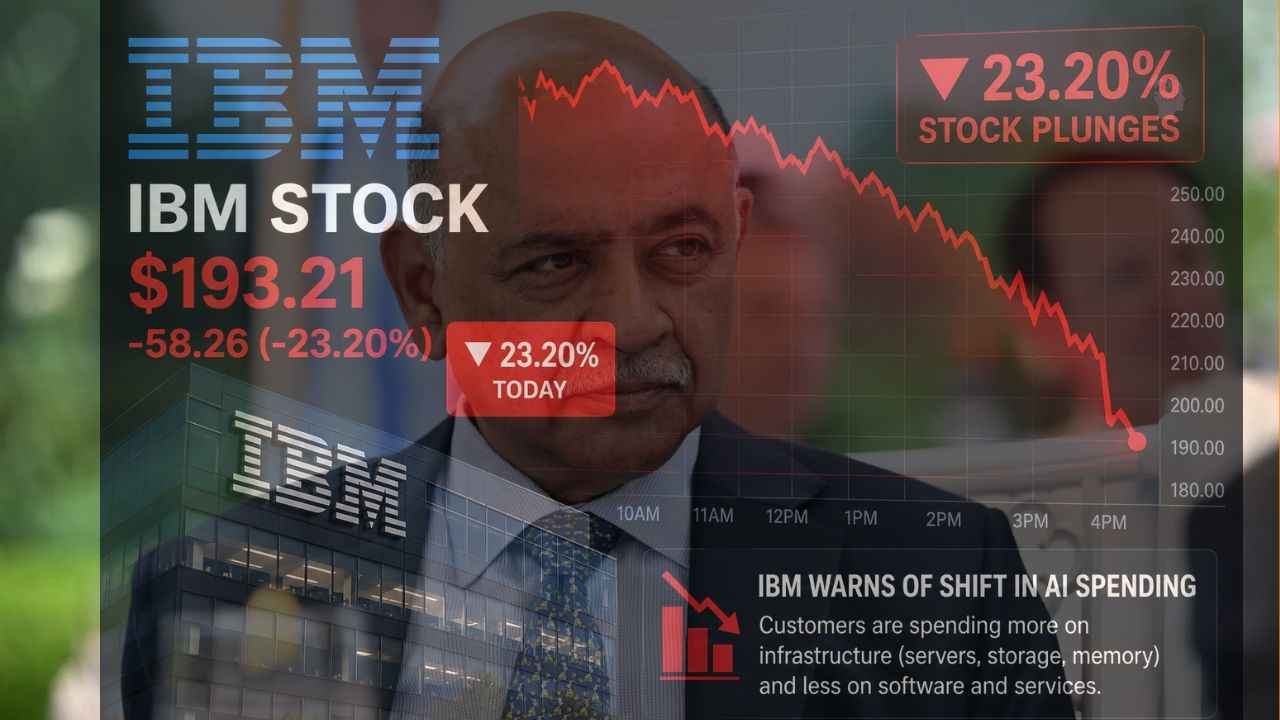
After the company revealed that enterprise customers are redirecting spending toward AI infrastructure instead of software, IBM shares suffered one of their sharpest declines in years. While the immediate focus was on weaker-than-expected revenue, the bigger story is what this says about the next phase of the AI race.
The question is no longer whether companies will invest in AI.
Instead, investors are asking:
Where is that money actually going?
Table of Contents
Why Did IBM Stock Fall?
IBM reported preliminary quarterly revenue below Wall Street expectations while warning that several enterprise deals failed to close before the quarter ended.
The reason surprised many investors.
Instead of increasing spending on enterprise software and consulting, many customers accelerated purchases of AI infrastructure—including servers, storage systems, networking equipment, and memory—to prepare for larger AI deployments.
In simple terms:
Businesses aren’t reducing AI spending.
They’re changing how they spend it.
That difference matters.
AI Budgets Are Being Rewritten
Think of AI investment like building a city.
Before companies can buy advanced AI software, they first need roads, electricity, buildings, and utilities.
In the AI world, that foundation includes:
- GPU servers
- Data centers
- High-speed networking
- Enterprise storage
- Memory chips
- Cooling systems
- Power infrastructure
Without those pieces, AI software cannot operate at scale.
This explains why many organizations are prioritizing infrastructure before expanding software subscriptions.
Why Infrastructure Companies May Benefit More
The AI boom is entering a capital-intensive stage.
Companies building AI systems often face enormous upfront costs before realizing productivity gains.
That trend naturally favors businesses supplying:
- AI chips
- Cloud infrastructure
- Enterprise servers
- Networking hardware
- Data-center equipment
Meanwhile, software companies may have to wait until customers finish building their AI foundations.
This doesn’t mean software demand disappears.
It simply arrives later.
IBM’s Challenge
IBM has invested heavily in enterprise AI, hybrid cloud, and automation.
Its AI platform has gained enterprise customers, particularly in regulated industries.
However, enterprise technology purchasing cycles are changing.
Many CIOs now face difficult decisions:
Should they buy another AI software platform?
Or should they first secure the hardware needed to run increasingly complex AI workloads?
IBM’s latest quarter suggests many organizations are choosing the second option.
Is This a Problem Only for IBM?
Probably not.
IBM may simply be the first large enterprise software company to publicly acknowledge this shift.
If AI budgets continue moving toward infrastructure, other software vendors could experience similar delays in customer spending.
That doesn’t necessarily mean weaker long-term demand.
It may simply reflect a different sequence of investment.
Companies often build infrastructure first and expand software later.
What This Means for the AI Industry
The AI market appears to be entering a new phase.
Phase 1: Experimentation
Businesses tested generative AI using existing cloud resources.
Phase 2: Infrastructure Expansion
Organizations begin purchasing dedicated AI hardware and expanding data-center capacity.
Phase 3: Enterprise Deployment
Once infrastructure is in place, companies increase spending on AI software, automation, analytics, and productivity tools.
IBM’s warning suggests many enterprises are currently transitioning between Phase 2 and Phase 3.
Why Investors Reacted So Strongly
Stock markets dislike uncertainty.
IBM’s warning introduced a new concern:
AI spending isn’t disappearing—but it isn’t flowing evenly across the technology sector either.
Companies benefiting from infrastructure investment may outperform in the short term, while software providers could experience slower revenue growth until enterprise deployments mature.
For investors, this changes how AI companies are evaluated.
Instead of asking:
“Does this company have AI?”
Markets may increasingly ask:
“Which part of the AI ecosystem does this company actually profit from?”
Is the AI Boom Slowing Down?
The evidence suggests otherwise.
Global AI investment continues to grow rapidly across cloud computing, enterprise software, semiconductor manufacturing, and hyperscale data centers.
What appears to be changing is the allocation of spending, not the overall level of investment.
Businesses remain committed to AI.
They’re simply investing in the infrastructure needed to support long-term adoption before expanding software budgets.
What Should Investors Watch Next?
Several indicators will reveal whether IBM’s warning reflects a broader industry trend:
- Enterprise software earnings from major technology companies
- Data-center spending by cloud providers
- AI server demand
- GPU supply trends
- Corporate AI capital expenditure
- Large enterprise software deal activity
If multiple companies report similar spending shifts, IBM’s warning could become one of the defining stories of this earnings season.
The Bigger Picture
IBM’s disappointing quarter may ultimately be remembered for something larger than its own financial results.
It highlights a fundamental reality of the AI revolution:
Every dollar invested in artificial intelligence doesn’t flow to software companies.
Before AI transforms workplaces, businesses first need the computing infrastructure capable of powering that transformation.
For now, the biggest winners may be the companies building AI’s foundation rather than those selling applications on top of it.
Whether this marks a temporary transition or the beginning of a longer realignment will become clearer as more technology companies report earnings in the coming weeks.
Frequently Asked Questions
Why did IBM stock fall?
IBM warned that customers are prioritizing spending on AI infrastructure such as servers, storage, and memory instead of software, leading to weaker-than-expected revenue and a sharp share price decline.
Is AI spending slowing?
No. Current evidence suggests companies are still investing heavily in AI, but more of that spending is going toward infrastructure rather than enterprise software.
Which companies could benefit from this trend?
Businesses focused on AI chips, cloud infrastructure, networking equipment, and data-center technologies could benefit if infrastructure spending remains strong.
Recommended for you: