
Table of Contents
The real divide isn’t between AI optimists and pessimists. It’s between those who control the infrastructure and those who don’t—and that gap is widening faster than any algorithm.
The Wrong Debate
Every few months, the internet erupts into the same argument. One side posts ChatGPT writing poetry and curing diseases. The other side posts deepfakes, job losses, and autonomous weapons. Both sides feel vindicated. Both sides are missing the point.
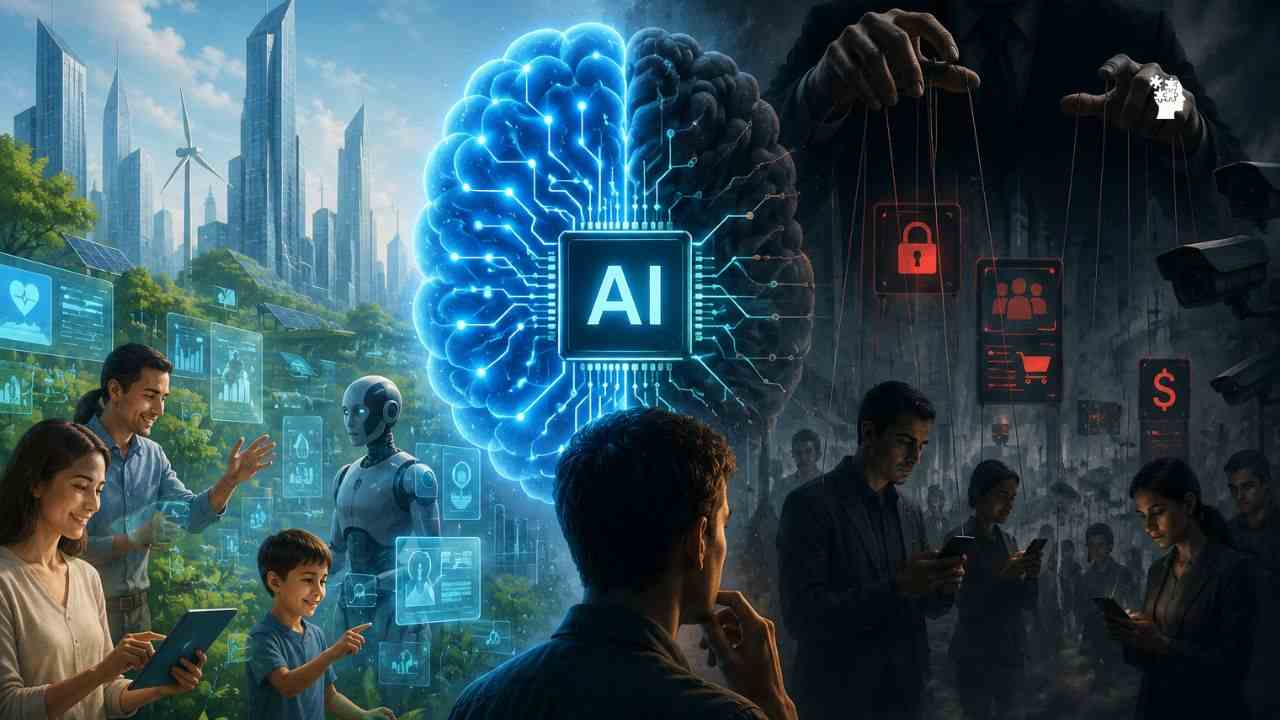
The question “Is AI a boon or a threat?” assumes AI is a single thing with a single trajectory. It isn’t. AI is a power distribution system disguised as a technology. And whether it helps or harms you depends almost entirely on where you sit in that distribution.
Here’s the uncomfortable truth: The same AI that saves a rural doctor’s patient can bankrupt a city’s taxi drivers. The same model that democratizes coding can centralize economic power in three companies. Boon and threat aren’t opposites. They’re simultaneous outcomes for different groups.
To understand AI’s future, stop asking whether it’s good or bad. Start asking: Who controls it, who profits from it, and who bears the costs?
The Infrastructure Trap: Why Ownership Matters More Than Intelligence
In 2026, there are roughly 10 companies that matter in AI. Not because they’re the smartest, but because they own the compute, data, and distribution layers that everyone else rents.
Table
| Layer | Who Controls It | What It Means |
|---|---|---|
| Compute | NVIDIA, Microsoft, Google, Amazon | If you can’t afford $100M+ GPU clusters, you don’t train frontier models |
| Data | Meta, Google, Microsoft, Apple | Decades of user behavior create moats no startup can replicate |
| Distribution | OpenAI, Google, Meta, Apple | The models people use are the models people know; switching costs are psychological |
| Regulatory Access | US, China, EU (selectively) | Policy is written by those with lobbyists, not those affected by policy |
This concentration isn’t accidental. It’s the natural endgame of capital-intensive technology. Railroads consolidated. Oil consolidated. Telecommunications consolidated. AI is consolidating faster because the upfront costs are higher and the network effects are stronger.
The boon isn’t going to “humanity.” It’s going to shareholders. And the threat isn’t coming from “AI.” It’s coming from the power asymmetry that AI accelerates.
The Three Futures of AI: A Framework
Rather than binary optimism or pessimism, consider three plausible futures based on current trajectories. None is predetermined. All are being fought over right now.
Future 1: The Subscription Society
Probability: 40% | Timeline: 2027–2032
In this future, AI becomes like electricity or water—a utility you can’t function without, controlled by 3–4 global providers. Every profession has an AI layer: doctors use Med-GPT, lawyers use Legal-GPT, teachers use Edu-GPT. The AI works well. Productivity soars. GDP rises.
But the subscription fees eat 15–20% of household income. Small businesses can’t afford enterprise tiers and fall behind. Individual practitioners become dependent on platforms that can raise prices, change terms, or de-prioritize their niche at any moment. The AI is competent, but the humans using it are technologically indentured.
Who it’s a boon for: Platform owners, large enterprises, AI-native startups with venture backing.
Who it’s a threat to: Independent professionals, small businesses, anyone without digital literacy or capital access.
Current signals: OpenAI’s $200/month Pro tier, Google’s Workspace AI add-ons, Adobe’s generative credits system, the gradual paywalling of previously free AI features.
Future 2: The Regulatory Moat
Probability: 35% | Timeline: 2028–2035
Governments worldwide, alarmed by deepfakes, autonomous weapons, and labor displacement, impose strict licensing regimes for AI development. The stated goal is safety. The practical effect is barrier creation.
Only companies with compliance departments, legal teams, and government relationships can afford to operate. Open-source models are restricted or liability-shifted to downstream users. Startups die under regulatory burden. The incumbents, who helped write the rules, cement their dominance.
AI becomes safer, slower, and more expensive. Innovation moves from garages to boardrooms. The technology still advances, but the distribution of benefits narrows dramatically.
Who it’s a boon for: Incumbent tech giants, defense contractors, government agencies, well-funded consultancies.
Who it’s a threat to: Open-source communities, academic researchers without industry partnerships, developing nations without regulatory capacity, small AI startups.
Current signals: The EU AI Act’s risk-based classification, US executive orders requiring safety testing for large models, China’s licensing requirements for generative AI services, the ongoing debate over open-weight model restrictions.
Future 3: The Fragmentation
Probability: 25% | Timeline: 2027–2035
In this future, no single AI architecture dominates. Instead, we see a proliferation of specialized models: medical AI trained on hospital data, agricultural AI trained on local crop patterns, legal AI trained on jurisdiction-specific case law. Open-source models improve to near-frontier quality. On-device AI becomes powerful enough for most tasks.
Compute becomes more distributed through edge computing, federated learning, and alternative chip architectures. Data sovereignty movements lead to regional AI ecosystems (European AI, African AI, Southeast Asian AI) rather than a single global standard.
This is the most optimistic future for equity, but it comes with costs: interoperability nightmares, security vulnerabilities from fragmented systems, and a slower overall pace of capability advancement.
Who it’s a boon for: Developing nations, local communities, privacy advocates, open-source ecosystems, specialized professionals.
Who it’s a threat to: Global platform businesses, anyone needing seamless cross-border AI integration, intelligence agencies accustomed to centralized data access.
Current signals: Mistral’s regional language models, India’s sovereign AI initiatives, China’s push for domestic chip ecosystems, the rise of on-device LLMs from Apple and Qualcomm, growing data localization laws.
The Labor Question: Where the Boon/Threat Divide Is Sharpest
No area of AI impact is more contested than work. And no area reveals the “boon or threat” framing as more inadequate.
The optimistic case: AI automates drudgery, augments human capability, and creates new categories of work we can’t yet imagine. History shows every technological revolution ultimately creates more jobs than it destroys.
The pessimistic case: This time is different. AI doesn’t just automate tasks—it automates judgment, creativity, and reasoning. The jobs being displaced are cognitive and professional, not just manual. And the pace of change outstrips any retraining program.
The realistic case: Both are true, for different people, at different speeds, in different places.
Table
| Worker Category | Near-Term Impact (2026–2028) | Long-Term Trajectory |
|---|---|---|
| Entry-level knowledge workers | Severe displacement risk | High threat; AI performs routine analysis, drafting, and research faster and cheaper |
| Senior specialists with judgment | Augmentation, not replacement | Boon; AI handles data, human handles strategy, ethics, and client relationships |
| Manual/technical trades (mechanics, technicians) | Strong augmentation via multimodal AI | Boon; AI as real-time diagnostic tool, not replacement |
| Creative professionals | Disruption and democratization | Mixed; top-tier creatives amplified, mid-tier commoditized |
| Care workers (healthcare, education, eldercare) | Limited direct impact | Boon; AI handles documentation, human focuses on presence and empathy |
The pattern isn’t “AI replaces humans.” It’s “AI stratifies humans.” The gap between AI-amplified workers and AI-displaced workers becomes a chasm. And social mobility—the ability to cross from one category to the other—depends on access to education, capital, and infrastructure that is itself increasingly AI-dependent.
The Hidden Cost: What We’re Not Measuring
GDP, productivity, and stock prices are easy to measure. The costs of AI are harder to quantify but no less real:
Table
| Measurable Benefit | Hidden Cost |
|---|---|
| Faster content generation | Information pollution; trust erosion; the death of shared factual baselines |
| 24/7 customer service chatbots | The elimination of human patience; the frustration of circular automation |
| Personalized recommendation engines | Filter bubbles; political polarization; the collapse of serendipity |
| AI medical diagnostics | Liability gaps when AI and doctor disagree; the deskilling of physicians over time |
| Autonomous surveillance | The end of practical anonymity; behavioral prediction as social control |
These aren’t bugs. They’re structural features of systems optimized for efficiency and engagement rather than human flourishing. And they accumulate slowly—one algorithmic decision at a time—until the social fabric has changed without anyone voting on it.
The Real Choice: Not Whether, But How
AI is not a weather system we observe from the shore. It’s a set of decisions made by specific people in specific rooms. The future isn’t being predicted—it’s being negotiated.
Here are the levers that actually matter:
1. Compute Access Should frontier AI training be restricted to entities that can afford billion-dollar clusters? Or should public compute resources (national AI clouds, academic supercomputers) democratize access? This single decision determines whether AI innovation is centralized or distributed.
2. Data Rights Do individuals own their data? Can they withdraw it from training sets? Can they be compensated for its use? The current default—”we trained on everything, deal with it”—is a choice, not a law of nature.
3. Open vs. Closed Should the most capable models be open-weight and auditable, or API-only and proprietary? Open models enable innovation and scrutiny. Closed models enable safety controls and revenue. There is no neutral answer—only a power allocation.
4. Labor Transition If AI displaces 20% of current tasks in a decade, what is the social contract for those affected? Universal basic income? Massive retraining? Nothing? The answer determines whether technological advancement is experienced as progress or precarity.
5. Global Governance AI doesn’t respect borders, but its impacts are distributed unevenly. Should there be international agreements on autonomous weapons, facial recognition, or model proliferation? Or should it be every nation for itself? The current trajectory is toward fragmentation, which benefits no one in the long run.
The Bottom Line: AI Is a Mirror
AI doesn’t have values. It reflects the values of the data it’s trained on, the incentives of the companies that deploy it, and the power structures of the societies that regulate it.
When we ask “Is AI a boon or a threat?” we’re really asking: Are our current institutions capable of directing powerful technology toward broad welfare rather than narrow profit?
The answer, so far, is mixed at best. The technology is advancing faster than the governance. The benefits are concentrating faster than they’re distributing. And the people most affected by AI’s disruptions are the least represented in the rooms where its future is decided.
AI will be a boon for some. It will be a threat to others. The ratio between those groups isn’t determined by the technology itself. It’s determined by who controls the infrastructure, who writes the rules, and who has a seat at the table.
The question isn’t whether AI is good or bad. The question is whether we have the collective will to make it good for more people than it’s bad for.
And on that question, the jury is very much still out.
What’s your take? Can AI be steered toward broad benefit, or is the concentration of power inevitable? Drop your perspective below.
Recommended for you:
1 thought on “The AI Boon or Bait and Switch: Why the Question Itself Is Misleading”