
Table of Contents
The world’s richest man is recruiting electricians and pipefitters with a one-line job post. The real story isn’t about AI—it’s about a labor market earthquake nobody saw coming.
A Job Ad That Broke the Internet (And Revealed Something Bigger)
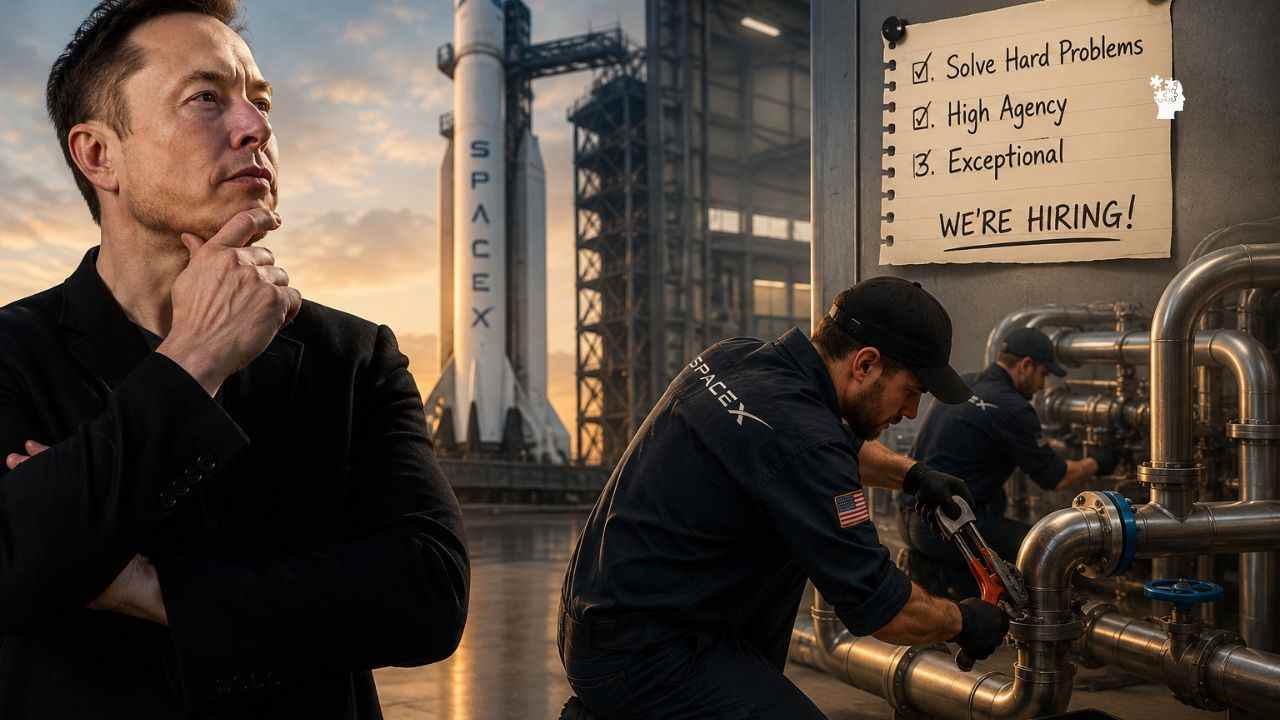
Last week, Elon Musk posted a job ad on X that would make any HR department weep:
“Email resume + 3 bullet points demonstrating evidence of exceptional ability.”
No cover letter. No LinkedIn Easy Apply. No “culture fit” interview. Just a Gmail address and a dare.
The roles? Electricians. Plumbers. Pipefitters. The kind of workers who fix your toilet, not your Python script.
The mission? Building “the most powerful AI supercomputer clusters on & off Earth.”
The internet did what it always does—laughed at Musk’s eccentricity, shared memes about “3 bullet points,” and moved on.
They missed the real story.
This isn’t about Musk being quirky. This isn’t even about SpaceX building AI data centers. This is about a fundamental inversion of the labor market that will reshape who gets rich in the next decade—and who gets left behind.
The Jensen Huang Prophecy: Why the AI Boom Needs Wrenches, Not PhDs
Nvidia CEO Jensen Huang said it plainly: the AI buildout will create jobs where “you don’t need to have a PhD in computer science.”
At the time, it sounded like CEO optimism. Now it looks like a warning.
Consider the numbers:
Table
| What SpaceX Is Building | What It Actually Needs |
|---|---|
| Colossus supercomputer (Memphis) | Electricians to wire 100,000 GPUs |
| Texas chip fab (ATCF) | Plumbers for liquid cooling systems |
| $119B Terafab megaproject | Pipefitters for industrial gas lines |
| Mars data centers | Technicians who can work in extreme environments |
Every single one of these projects fails without skilled tradespeople. You can’t code a cooling system into existence. You can’t prompt-engineer a 480-volt electrical panel.
The “3 bullet points” hiring style isn’t minimalism. It’s desperation disguised as confidence. Musk knows that the bottleneck in the AI race isn’t compute—it’s the people who can physically build it.
The $119 Billion Question: Why SpaceX Needs a Chip Factory and a Megaproject
Here’s where the story gets strange.
SpaceX is building two massive facilities in Texas:
- ATCF (Advanced Technology Chip Fab) — A joint Tesla/SpaceX facility combining logic, memory, and advanced packaging. Drone footage from July shows foundation work accelerating. New permits for contractor offices filed.
- Terafab (Grimes County) — A facility with potential costs reaching $119 billion. For context, that’s larger than the GDP of most countries.
Why two? Why now? And why the sudden urgency to hire tradespeople at both?
The answer lies in Musk’s S-1 filing from June—specifically, the 1 billion Class B shares that vest only if he achieves two goals:
Table
| Vesting Trigger | What It Actually Means |
|---|---|
| Permanent Mars colony (1M+ inhabitants) | A city that needs power, water, cooling, and data infrastructure |
| “Non-Earth-based data centers” delivering 100 terawatts/year | Data centers that can’t rely on Earth’s supply chain |
The “off Earth” language isn’t marketing. It’s a contractual obligation.
Musk isn’t just building AI infrastructure for Earth. He’s building the supply chain to build AI infrastructure anywhere—including a planet where you can’t call a plumber if the toilet breaks.
Today’s hires aren’t just building data centers. They’re building the template for data centers that can be replicated on Mars.
That’s why he needs tradespeople, not just engineers. Engineers design. Tradespeople build. And on Mars, there won’t be anyone else to call.
The Louisiana Spaceport: The Missing Piece Nobody’s Connecting
Buried in the coverage is a detail that changes everything: SpaceX is reportedly closing in on a deal to build a new spaceport in Louisiana.
Why Louisiana? Three reasons that reveal the real strategy:
- Deepwater access — Mars-bound rockets are massive. They need to be built near water.
- Gulf Coast industrial base — Decades of oil rig construction created a workforce that knows how to build in harsh environments.
- Proximity to the Terafab site — Texas and Louisiana share a border. The spaceport, the chip fab, and the megaproject form a geographic triangle of AI infrastructure.
This isn’t scattered expansion. It’s vertical integration at planetary scale.
Musk isn’t just hiring plumbers for Memphis. He’s building an industrial ecosystem where every piece feeds every other piece—and where the people who can physically construct things become more valuable than the people who can theoretically design them.
The Real Labor Market Inversion: Why Tradespeople Are the New Tech Workers
Here’s the contrarian thesis no one is writing:
The AI boom is creating a skilled trades shortage that will make the 2020s developer shortage look quaint.
Consider:
- The U.S. already hosts 3,000+ operational data centers with 1,500+ in development
- Each data center requires thousands of hours of electrical, plumbing, and HVAC work
- The average data center electrician earns $85,000–$120,000—with overtime, often more
- Apprenticeship programs can’t scale fast enough to meet demand
Meanwhile:
- Computer science graduates face a saturated job market with 300+ applicants per role
- Entry-level coding jobs are increasingly automated by AI itself
- “Prompt engineering” turned out to be a temporary fad, not a career
The market is speaking. We’re just not listening.
Musk’s “3 bullet points” ad is the canary in the coal mine. When the world’s most valuable private company can’t find enough electricians to build its data centers, something has fundamentally shifted.
The Mars Clause: What “Off Earth” Really Means for Workers
Let’s talk about the most audacious part of Musk’s S-1 filing: non-Earth-based data centers capable of delivering 100 terawatts per year.
For perspective:
- Total global electricity generation in 2024: ~30 terawatts
- Musk wants 3x global output from data centers… not on Earth
This sounds insane. But look at it from a hiring perspective:
If you’re a 25-year-old electrician today, Musk is offering you a career path that includes Mars.
Not as an astronaut. As a tradesperson. The person who wires the first AI supercomputer on another planet. The person who fixes the cooling system when a dust storm shorts the grid. The person who keeps the machines running so the colony survives.
This isn’t science fiction. It’s a recruiting pitch disguised as a vesting clause.
And it’s working. The “3 bullet points” ad went viral precisely because it speaks to a generation of workers who are tired of credentialism, tired of LinkedIn performance, and tired of being told they need a degree to matter.
Musk is saying: Show me what you can do. I don’t care where you went to school.
Three Takeaways for the Rest of Us
1. If you’re in a skilled trade, your market value just tripled.
Data center construction is the new oil boom. Electricians, plumbers, pipefitters, and HVAC technicians who specialize in industrial/commercial work are becoming the most in-demand workers in America. The “3 bullet points” ad isn’t an anomaly—it’s the beginning of a trend.
2. If you’re in tech, learn something physical.
The AI revolution isn’t just code. It’s cooling systems, power distribution, and physical infrastructure. The engineers who understand both software and hardware—who can read a circuit diagram and a Python script—are the ones who will lead the next decade.
3. If you’re an investor, watch the trades shortage.
SpaceX’s $119B Terafab project, the Louisiana spaceport, and the Mars data center clause all depend on one thing: enough skilled workers to build them. If the trades shortage worsens, these timelines slip. If it resolves, Musk’s empire accelerates. The labor market is now the critical variable in the AI race.
The Bottom Line
Elon Musk’s “3 bullet points” job ad isn’t quirky HR. It’s a strategic signal about where value is flowing in the AI economy.
The story isn’t that SpaceX is hiring for AI data centers. The story is that the most important AI infrastructure company in the world can’t find enough plumbers.
That should terrify every CS graduate with a $200K student loan. And it should excite every electrician who’s been told their career has a ceiling.
The AI revolution was supposed to belong to coders. Turns out, it belongs to the people who can keep the lights on.
And on Mars, the lights better stay on.
What’s your take? Are skilled trades the real winners of the AI boom? Or is this just Musk being Musk? Let me know in the comments.
Recommended for you: