
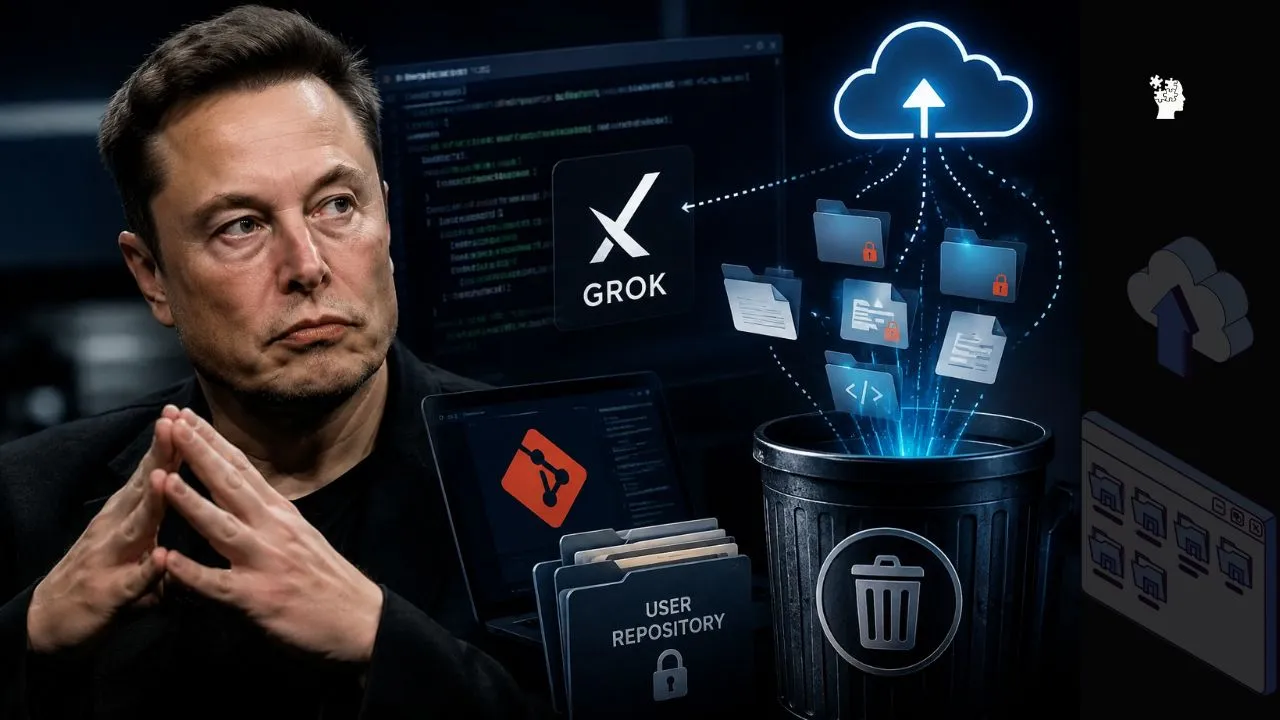
AI coding assistants are becoming an everyday tool for developers, helping write code, fix bugs, and automate repetitive work. But they also require access to local projects, making privacy one of the biggest concerns surrounding AI development tools.
That concern took center stage this week after independent security researchers claimed that xAI’s Grok Build coding assistant uploaded entire Git repositories—including sensitive files and commit histories—to cloud storage without users fully realizing it.
The discovery quickly sparked criticism across the developer community and prompted Elon Musk to publicly promise that all previously uploaded user data would be permanently deleted.
But the bigger question isn’t just what happened.
It’s what this incident reveals about the future of AI coding assistants and how developers should think about privacy when using these tools.
Table of Contents
What Happened?
According to independent security researchers, Grok Build CLI version 0.2.93 appeared to upload an entire Git repository instead of sending only the files required for an AI request.
Researchers claimed these uploads included:
- Complete Git history
- Hidden files
- Repository metadata
- Configuration files
- Files excluded from AI prompts
- Environment (.env) files containing API keys
- Database credentials
In one experiment, researchers reported that more than 5 GB of repository data was transferred even though only a tiny amount of context was needed for the AI conversation.
That immediately raised concerns because developers often keep highly sensitive information inside private repositories.
Why This Alarmed Developers
Unlike a chatbot answering general questions, coding assistants often work directly inside your development environment.
That means they may have access to:
- proprietary source code
- startup intellectual property
- client software
- authentication tokens
- cloud credentials
- production database passwords
- private API keys
If an assistant uploads more data than necessary, developers lose confidence in where their information is going.
The issue isn’t simply that data leaves a computer.
It’s whether users clearly understand:
- what is uploaded,
- when it is uploaded,
- why it is uploaded,
- and how long it is stored.
Transparency is becoming just as important as AI capability.
Elon Musk Responds
Following public discussion of the findings, Elon Musk said all previously uploaded user data would be completely deleted as a precaution.
According to xAI, enterprise customers using Zero Data Retention were not affected.
The company also said users can control retention settings through privacy commands within the CLI.
Soon afterward, researchers observed that the application stopped performing repository uploads after a server-side configuration change.
The Bigger Issue Isn’t Just Grok
The Grok incident highlights a much broader challenge facing every AI coding assistant.
Modern coding tools often need context from an entire codebase to provide useful answers.
Without that context, they may:
- misunderstand project architecture
- generate incorrect code
- miss dependencies
- fail to detect bugs
But giving an AI assistant broad access also increases privacy risks.
Every major AI coding platform now faces the same balancing act:
How much code is necessary—and how much is too much?
Why Entire Repository Uploads Matter
Uploading an entire Git repository is very different from sending a few source files.
A repository may contain years of development history, including:
Previous API Keys
Old credentials may still exist inside Git history even after removal.
Deleted Secrets
Sensitive information deleted months ago often remains inside commits.
Internal Documentation
Architecture diagrams, deployment notes, and confidential business information can all exist inside repositories.
Customer Data
Some projects accidentally include exported databases or customer information.
Even if the AI provider never misuses this information, collecting more data than necessary increases potential security exposure.
What Developers Should Do Right Now
Regardless of which AI coding assistant you use, several best practices can reduce risk.
Never store secrets inside Git repositories
Use secure secret-management tools instead of keeping passwords in source code.
Review privacy settings
Check whether data retention is enabled before using AI coding tools.
Use .gitignore properly
Although it isn’t perfect protection, keeping sensitive files outside repositories helps.
Rotate exposed credentials
If API keys may have been uploaded, generate new ones immediately.
Separate production secrets
Store production credentials outside development repositories whenever possible.
What This Means for the AI Industry
This incident may become another turning point in AI transparency.
Developers are increasingly asking difficult questions:
- Does the AI process code locally?
- What data leaves the machine?
- How long is it stored?
- Can uploads be disabled?
- Are enterprise protections available for everyone?
Companies that provide clear answers will likely earn greater trust.
Those that don’t risk losing developers to competitors with stronger privacy guarantees.
Trust Is Becoming the New Competitive Advantage
AI models continue improving at remarkable speed.
Writing code is becoming easier.
Debugging is becoming faster.
Automation is becoming smarter.
But privacy may ultimately determine which coding assistants developers choose.
For many teams, the smartest AI isn’t necessarily the best one.
The best assistant is the one developers trust with their source code.
As AI becomes deeply integrated into software development, transparency around data collection could become just as important as coding accuracy.
Frequently Asked Questions
Did Grok upload every user’s Git repository?
The reported behavior affected the Grok Build CLI version examined by researchers. xAI has since implemented a server-side change that appears to stop those uploads and says enterprise Zero Data Retention users were not affected.
Were API keys included?
Researchers reported recovering repository files that contained environment variables and other sensitive information, demonstrating why developers should avoid storing secrets inside repositories.
Has xAI fixed the issue?
Researchers observed that repository uploads stopped after a server-side configuration update. Elon Musk also pledged that previously uploaded user data would be deleted.
Should developers stop using AI coding assistants?
Not necessarily. AI coding assistants remain valuable productivity tools, but developers should understand each provider’s privacy policy, review data retention settings, and avoid exposing sensitive credentials.
Final Thoughts
The Grok Build controversy is more than a one-day headline. It reflects a growing challenge facing every AI coding platform: delivering powerful code assistance while protecting developer privacy.
Elon Musk‘s promise to purge uploaded data may help restore confidence, but the incident also serves as a reminder that developers should never assume AI tools access only the files they explicitly choose.
As AI becomes a standard part of software development, transparency, user control, and clear privacy safeguards will be just as important as the intelligence of the models themselves.
Recommended for you: