
Apple has finally put a date on what could become one of its most strategically important product launches in years.
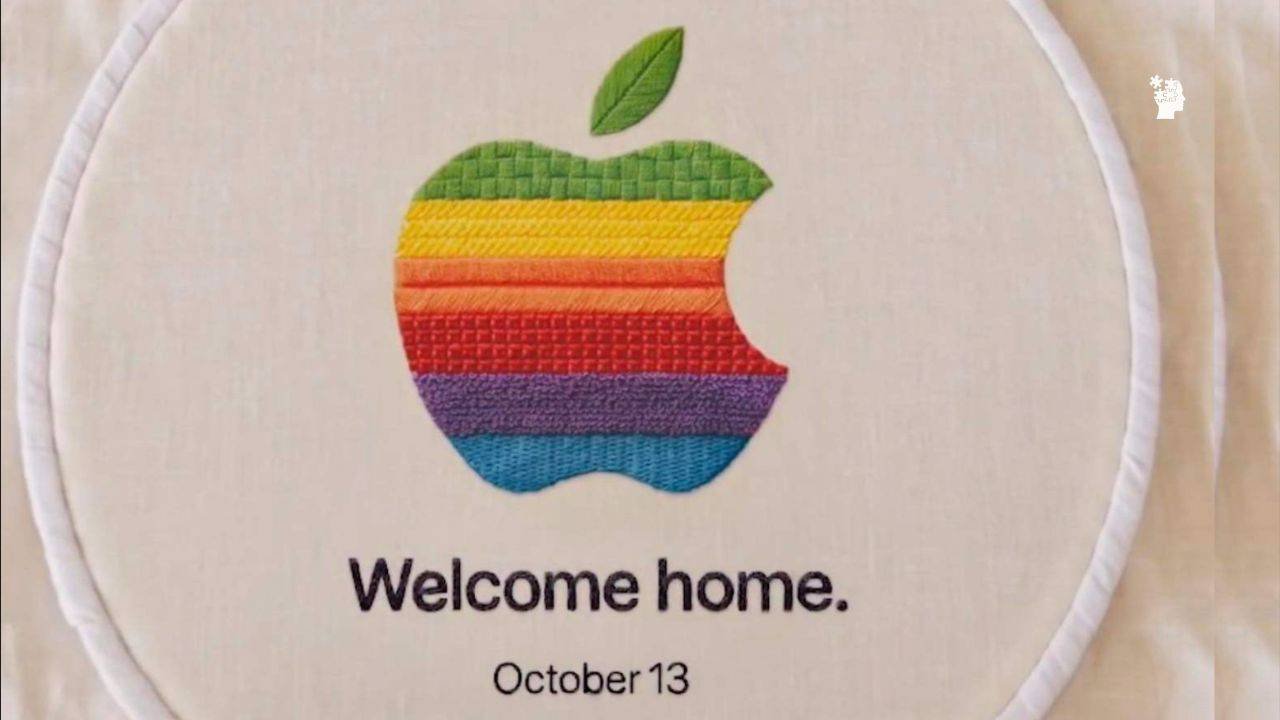
The company will hold a product launch experience in New York on October 13, 2026, using the unusually simple tagline: “Welcome home.”
Apple marketing chief Greg Joswiak revealed the date on October 8 with a 17-second teaser showing hands stitching the company’s retro six-colour logo into an embroidery hoop. The message appears at the end: “Welcome home. October 13.”
Press invitations describe an “Apple Experience” in Tribeca at 9 a.m. ET, rather than explicitly calling it a keynote. That distinction matters. Apple has not yet confirmed whether consumers will see a traditional livestreamed presentation or whether the company will reveal the products through press materials and videos while giving invited media hands-on access.
But the products expected on October 13 tell a much bigger story.
Apple is reportedly preparing a new smart-home hub with a screen, an updated HomePod mini and a new Apple TV 4K. The products are expected to be closely tied to the company’s new AI-powered Siri.
And that is why this launch could be more important than it initially looks.
Table of Contents
Apple is finally trying to solve its smart-home problem
Apple has never completely ignored the smart home.
HomePod, HomePod mini, Apple TV and the Home app have already given Apple a presence inside millions of homes. Siri can control compatible lights, thermostats and other accessories, while Apple TV and HomePod can act as home hubs.
The problem is that Apple has never built a dedicated centre of gravity for the home.
Amazon has Echo.
Google has Nest.
Samsung has SmartThings.
Apple has had a collection of devices and software, but no obvious product that says: this is the computer for your home.
The rumored October 13 hub could change that.
And Apple isn’t simply putting a screen on a speaker.
The reported concept is much closer to a stationary AI computer for the household.
The mysterious HomePad could be Apple’s most important new category
The device, reportedly code-named J490, is expected to have a roughly six-inch square display.
Reports indicate that Apple is considering both a countertop version and a wall-mounted model. The countertop version could use a speaker base, while the wall-mounted version would provide a thinner installation.
The interesting part, however, isn’t the hardware.
It’s the way Apple reportedly wants the device to understand who is standing in front of it.
A camera and presence sensing could allow the hub to recognize household members and display personalized information such as calendars, messages, contacts, notes and widgets. The device could therefore present a different experience depending on the person using it.
That sounds like a small feature.
It isn’t.
The home could become a multi-user AI environment
Today’s AI assistants generally assume that one person is talking to them.
A family home is different.
The same device might be used by a parent in the morning, a child after school and another family member in the evening.
If Apple’s system can reliably determine who is interacting with it, Siri doesn’t have to behave like a generic assistant anymore.
It could potentially become a personal assistant that happens to live in a shared environment.
Imagine walking into the kitchen and asking:
“What’s on my calendar today?”
The system could theoretically know which family member is speaking and respond accordingly.
That is a much more ambitious idea than simply asking Siri to turn the lights off.
Siri is the real product behind the hardware
This is perhaps the most important point about Apple’s October launch.
The home hub itself isn’t necessarily the revolutionary part.
Siri is.
Apple’s new Siri AI now promises capabilities including personal context, broader world knowledge, onscreen awareness and systemwide actions. Apple says the assistant can work with information across messages, emails and photos while taking actions across apps.
Those capabilities become considerably more interesting when Siri is placed in the home.
A smart speaker can answer questions.
A smart display can show information.
But an AI-powered home system could potentially understand the household and coordinate actions across it.
That is the direction Apple appears to be moving toward.
And it explains why the home hub reportedly took so long to arrive.
Apple reportedly delayed the hardware because Siri wasn’t ready
The irony is that Apple appears to have had the hardware concept for some time.
Reports indicate that the smart-home devices were originally expected much earlier, but Apple’s delayed next-generation Siri pushed the timetable back.
That delay may have been frustrating for Apple.
But strategically, it could turn out to be the correct decision.
Launching an expensive smart-home display with an ordinary voice assistant would have put Apple in a difficult position.
Amazon and Google already had years of experience in the category.
Apple needed a reason for consumers to buy another screen and speaker.
AI may be that reason.
HomePod mini gets a second chance
The HomePod mini is also expected to receive its first major refresh since its original launch in 2020.
The reported upgrade is less about a dramatic redesign and more about giving the small speaker enough processing and connectivity capability to support Apple’s newer AI ambitions.
Reports point to a faster processor, Apple’s N1 networking chip and new colour options including pink and green.
At first glance, that sounds like a routine refresh.
But there is a bigger possibility.
Apple may be turning HomePod mini from a standalone smart speaker into a distributed part of its home-AI network.
The important question is therefore not whether the new HomePod mini sounds better.
It’s whether multiple Apple devices can work together intelligently throughout a house.
The Apple TV could quietly become the other key piece
The Apple TV is reportedly due for its first major update since 2022.
Reports point to a newer A19-class chip, more memory, Apple’s N1 networking technology and an updated Siri Remote.
That may look like a performance upgrade.
But the Apple TV’s strategic importance is larger.
It already sits at the centre of many living rooms.
If Apple wants to build a home-wide AI platform, Apple TV can become one of the computing and connectivity anchors while the new hub becomes the interactive interface.
In other words, Apple doesn’t necessarily need one device to do everything.
It can make the entire Apple ecosystem inside a home behave like one computer.
That is potentially far more powerful.
And then there is LG
The most interesting part of Apple’s strategy may actually arrive after October 13.
Reports say Apple has worked with LG Electronics on a range of smart-home accessories, including a video doorbell, thermostat, smart lock and security cameras. These products are expected to carry the LG brand rather than Apple’s.
That could be a very deliberate decision.
Apple doesn’t need to manufacture every thermostat, camera and lock itself.
Instead, it can attempt to control the software, intelligence and ecosystem layer while hardware partners expand the range of compatible devices.
That resembles Apple’s broader approach to platforms: make the experience feel integrated even when different pieces of hardware come from different companies.
The reported use of standards such as Matter and Thread could also help Apple avoid creating a completely closed smart-home universe.
The privacy question could become Apple’s biggest advantage
There is another reason Apple’s home strategy could be different.
A home AI system potentially knows an enormous amount about its users.
It could know:
- when people are home;
- who is home;
- where they spend time;
- their schedules;
- what devices they use;
- when doors are opened;
- what rooms they occupy;
- and potentially what they ask their assistant.
That makes privacy far more important than it is with a conventional smart speaker.
Apple has spent years building its brand around privacy.
The company therefore has an opportunity to make privacy part of the product’s identity rather than treating it as a technical footnote.
But this also creates a difficult test.
The more useful Apple’s home AI becomes, the more information it potentially needs to understand.
Apple will have to convince consumers that personalization doesn’t mean surrendering control over their private lives.
Apple is entering a market where Amazon and Google already have the head start
This won’t be an easy market to conquer.
Amazon has spent years developing Alexa and Echo.
Google has Nest hardware and a huge AI infrastructure behind its ecosystem.
Apple is arriving later.
But Apple has one major advantage: the installed base of iPhones, Apple Watches, AirPods, Macs and Apple TVs already gives it a massive ecosystem to connect.
The new hub doesn’t need to convince consumers that Apple belongs in their digital lives.
Apple already won that battle.
The question is whether it can convince them that Apple belongs inside their physical homes too.
The $350 question
One of the biggest challenges could be price.
The new hub is reportedly expected to cost around $350.
That is a very different proposition from inexpensive smart speakers.
Apple’s argument will therefore need to be much stronger than:
“It’s an Apple smart display.”
Consumers would need to see a genuine difference.
The device would have to justify its price through a combination of AI, personalization, privacy, ecosystem integration and home control.
If Siri is merely a prettier version of today’s voice assistant, $350 could look excessive.
If it becomes a genuinely useful household AI interface, the calculation changes.
Why “Welcome home” is a clever tagline
Apple’s choice of words may be more revealing than it appears.
The company didn’t call this an “AI event.”
It didn’t say “Meet the future.”
It said:
“Welcome home.”
That makes the launch feel less like another technology announcement and more like the beginning of a new Apple category.
The iPhone changed how people carried computers.
The Apple Watch changed how computing interacted with the body.
Apple now appears to be asking whether computing can become part of the home itself.
The screen may be the visible product.
Siri may be the technology underneath it.
But the real ambition could be much larger: turning the home into an intelligent extension of the Apple ecosystem.
October 13 could be a bigger test of Apple than it looks
Apple’s October launch arrives at an important moment for the company.
The company has just entered another major iPhone cycle, and its first foldable iPhone is expected to go on sale on October 23.
Against that backdrop, a smart-home launch could easily look like a secondary event.
It may not be.
The iPhone is already Apple’s biggest business.
The smart home represents something different: a new territory where Apple has yet to establish dominance.
And under CEO John Ternus, the company is also entering a new phase in which product launches are expected to become less concentrated around one giant September event. Recent reporting has described October as an early test of that approach.
That makes October 13 worth watching for another reason.
Apple isn’t simply launching a device.
It may be testing a new philosophy for how often—and how broadly—it can create new categories.
The real question isn’t whether Apple can make a smart home hub
Apple can almost certainly make one.
The harder question is whether it can make people want one.
If the answer depends on Siri finally becoming genuinely personal, useful and reliable, then the October 13 launch is effectively a public examination of Apple’s AI progress.
The hardware will get the headlines.
Siri will determine whether the strategy works.
And if Apple gets it right, “Welcome home” could eventually mean something much bigger than a new gadget on a kitchen counter.
It could be Apple’s invitation to make the entire home part of its AI ecosystem.
Also Read :