
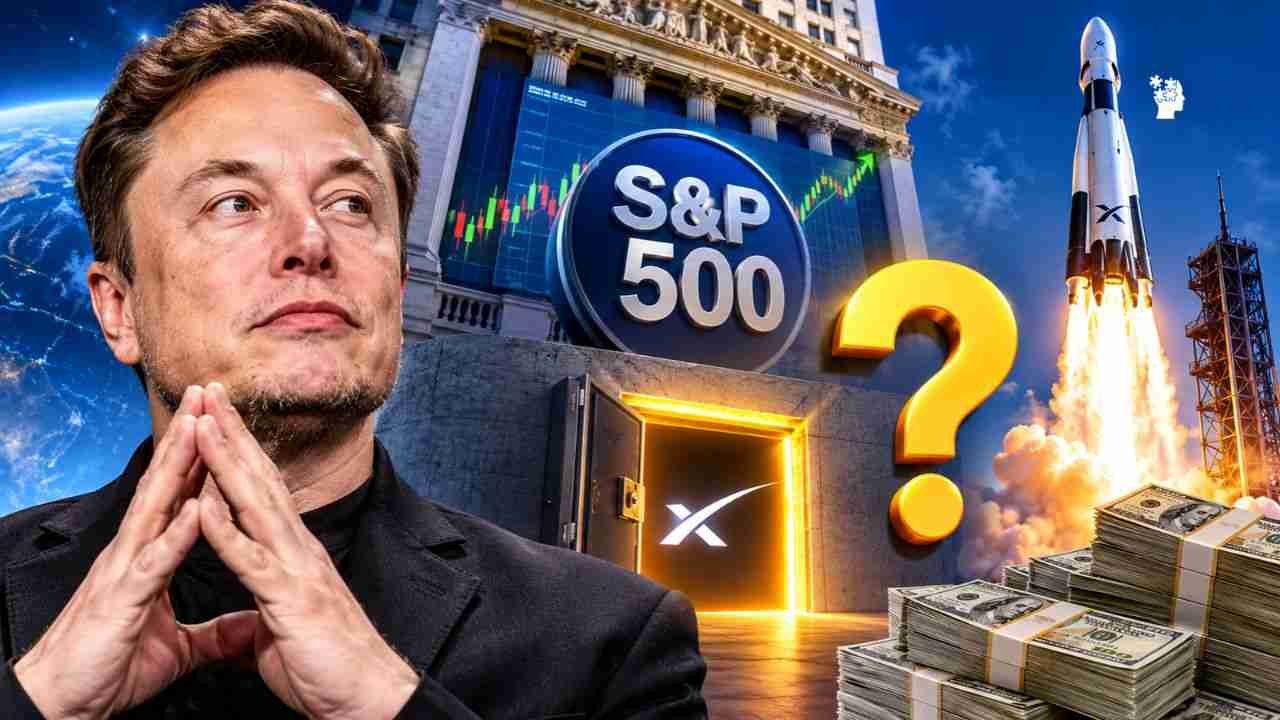
Elon Musk’s proposed Tesla-SpaceX merger could do something far more consequential than bring electric vehicles, rockets and artificial intelligence under one corporate roof. It could give SpaceX a potential route into the S&P 500, opening the door to billions of dollars in institutional investment.
The timing is particularly interesting. SpaceX has already demonstrated that becoming one of the world’s most valuable companies does not automatically guarantee a place in America’s most closely watched stock-market benchmark. Its earlier attempt to secure accelerated entry was rejected by S&P Dow Jones Indices.
Now, a possible combination with Tesla could change the calculation.
Table of Contents
Wisdom Imbibe Insight
What you need to know in 30 seconds
- Musk’s strategy: Combining Tesla and SpaceX could give the merged company a potential route into the S&P 500 through Tesla’s existing membership.
- The $100 billion opportunity: TD Securities analyst Reid Noch estimates that index inclusion could generate approximately $100 billion in demand from passive investment funds.
- Why it matters: S&P 500 funds generally need to hold companies according to their index weight, potentially creating enormous demand for the combined company’s shares.
- The big catch: S&P Dow Jones Indices has not guaranteed that the merged company would retain Tesla’s place in the index.
- The shareholder risk: Tesla and SpaceX investors must consider the merger valuation, ownership structure and Musk’s growing voting control.
- The bigger concern: A nearly $3.5 trillion company could further increase concentration risk in an already top-heavy US stock market.
The bottom line: The merger could unlock a significant institutional-investment opportunity, but the $100 billion figure is potential share-buying demand, not money guaranteed to flow into the company.
According to a November 14 Bloomberg report, discussions between the companies have progressed, with a potential merger creating a business valued at approximately $3.5 trillion based on the companies’ reported market valuations. That would make the combined company one of the largest constituents of the S&P 500 if it retained Tesla’s index position.
But the real story goes beyond index inclusion. The proposed transaction raises questions about passive investing, corporate governance, valuation, market concentration and whether a company’s existing membership in a major stock index could become a valuable strategic asset.
For investors, there is an important distinction: a merger could create a pathway into the S&P 500, but it would not guarantee admission, nor would it automatically create $100 billion in new money for the company.
Here’s what is really at stake.
What Makes The Tesla-SpaceX merger So Important?
At first glance, combining Tesla and SpaceX might look like another ambitious Musk project. However, the businesses have increasingly overlapping interests in artificial intelligence, computing infrastructure, energy storage, robotics and advanced manufacturing.
The proposed merger could bring several major operations together:
| Business | What it brings to the combined company |
|---|---|
| Tesla | Electric vehicles, energy storage, autonomous driving and robotics |
| SpaceX | Rockets, satellite launches, Starlink and space infrastructure |
| xAI | AI models and computing ambitions |
| X | Social media, communications and distribution |
| Terafab | Proposed joint semiconductor manufacturing infrastructure |
The strategic argument is that these businesses could support one another rather than operate as separate companies.
Tesla needs computing power, AI capabilities and energy infrastructure to advance autonomous driving and humanoid robots. SpaceX needs enormous computing capacity for its expanding ambitions, including proposed orbital data centres. Starlink provides satellite connectivity that could eventually support more connected devices and services.
The semiconductor connection is particularly interesting. Tesla and SpaceX already have a joint chip-manufacturing venture called Terafab. Musk has indicated that its first test chip could arrive around May or June 2027, with volume production targeted for the third quarter of 2028.
A merger could make it easier to coordinate investment, manufacturing priorities and computing infrastructure across these businesses. However, that does not mean combining their ownership automatically eliminates operational or financial challenges.
The bigger question is whether the benefits of operating together would justify the complexity of putting such different businesses under one corporate structure.
The $100 Billion Opportunity: Why the S&P 500 matters more than it appears
To understand the potential financial attraction, investors need to understand how the S&P 500 works.
The S&P 500 is a market-capitalisation-weighted index tracking 500 leading publicly traded American companies. Its constituents are selected by an index committee, rather than simply being the 500 largest companies.
The index is followed by an enormous investment ecosystem, including index funds, exchange-traded funds (ETFs), pension funds and institutional portfolios.
Funds that aim to replicate the index generally need to hold its constituent stocks in proportions that reflect their index weights.
This creates an important financial advantage for companies that become constituents.
When a company enters the S&P 500, index-tracking funds generally need to purchase its shares. The demand can be significant, particularly when the company has a large market capitalisation.
According to Bloomberg’s November 14 report, analyst Reid Noch of TD Securities estimated that the addition of the combined Tesla-SpaceX company could generate approximately $100 billion in demand from index funds.
That figure deserves attention, but it needs context.
It does not mean that the company would receive $100 billion in cash. Nor does it mean $100 billion would automatically flow into its stock immediately after a merger.
It is an estimate of potential stock-market buying demand associated with index inclusion.
The distinction matters because buying existing shares in the secondary market does not directly finance the company’s operations. It can, however, improve liquidity, expand the shareholder base and potentially support the share price.
There is another important figure in the Bloomberg report: approximately $16 trillion in passive investment money associated with the benchmark.
That is the broader pool of capital whose portfolios are influenced by the index, not a cheque waiting for Musk’s company.
Why this could matter to Musk: SpaceX could gain exposure to a much larger institutional investment ecosystem without having to establish an entirely independent path into the index.
How Tesla Could Provide SpaceX With An S&P 500 Shortcut
This is arguably the most intriguing part of the proposed transaction.
SpaceX is already a publicly traded company, but its IPO and market value alone did not guarantee immediate S&P 500 membership.
S&P Dow Jones Indices applies several eligibility requirements. These include:
- A qualifying US company structure and eligible stock exchange listing.
- A minimum market-capitalisation threshold.
- Adequate trading liquidity and public float.
- Positive GAAP earnings over the most recent four consecutive quarters combined.
- Positive earnings in the most recent quarter.
- At least 12 months of trading history for an IPO candidate.
Even satisfying these requirements does not guarantee inclusion. The S&P 500 committee retains discretion over constituent selection and sector representation.
SpaceX’s June 2026 IPO means its 12-month trading-history requirement would not ordinarily be satisfied until June 2027.
Bloomberg reported that analyst estimates suggest SpaceX could also meet the profitability requirement by around the middle of 2027.
Tesla, meanwhile, already has a place in the index.
A merger therefore creates an interesting question: does the resulting company need to be treated as an entirely new S&P 500 candidate, or could it retain Tesla’s existing constituent position?
The answer depends partly on the transaction’s legal and corporate structure and ultimately on the index committee’s decision.
If Tesla acquired SpaceX, the argument for retaining the existing constituent position could be more straightforward. But that is not the structure many observers expect.
If SpaceX acquired Tesla, or a new parent company absorbed both businesses, the committee would have to consider how the transaction affects the existing constituent and the index’s eligibility rules.
Some analysts believe retaining the position could be justified because removing a major constituent and subsequently adding the combined business could create unnecessary index turnover.
That is an argument for continuity, not a guarantee.
The crucial distinction is that a merger cannot simply transfer an S&P 500 membership like a corporate asset. The index provider controls its own inclusion decisions.
The Overlooked Risk: What Happens If The Combined Company is Rejected?
Much of the discussion has focused on the potential benefits of index inclusion. But there is an equally important downside scenario.
Imagine that the companies complete their merger, Tesla’s existing shares are exchanged for shares in a new combined entity, and the S&P 500 committee decides not to retain that company in the benchmark.
What happens next?
Index-tracking funds that receive shares in the transaction may need to sell them if the new company is not an eligible constituent and is not retained in the index.
That could create significant selling pressure.
This is why the legal structure of the transaction matters so much. It is not simply a question of which company acquires the other. It is also about what happens to the existing publicly traded security, its shareholders and its index status.
There are consequently two very different outcomes:
- Favourable outcome: The combined company retains Tesla’s index position, potentially creating substantial demand from index-tracking investors.
- Unfavourable outcome: The company loses that position and passive funds have to adjust their portfolios, potentially creating selling pressure.
Investors should not price in the first scenario as though it were already approved.
SpaceX’s Financial Performance Adds Another Layer To The Story
One detail that deserves more attention is that SpaceX is no longer simply a rocket-launch company.
Its business increasingly combines satellite connectivity, launch services, space infrastructure and AI-related computing ambitions.
Its September 2026 quarterly filing with the US Securities and Exchange Commission provides a useful snapshot.
SpaceX financial snapshot
The figures reveal an important nuance.
SpaceX reported a $4.4 billion profit in the third quarter, but its cumulative net loss for the first nine months of 2026 was $413 million.
That means its ability to satisfy S&P’s four-quarter profitability requirement cannot be established simply by pointing to one profitable quarter.
The distinction is important because index eligibility is based on reported GAAP earnings, not optimistic forecasts or management’s long-term revenue ambitions.
There is also a significant investment story behind the revenue growth.
SpaceX reported $14.58 billion in third-quarter revenue, compared with $5.58 billion in the corresponding quarter of 2025. However, its infrastructure spending is substantial.
Its SEC filing showed approximately $48.1 billion in purchases of property, plant and equipment during the first nine months of 2026.
That level of investment demonstrates both the scale of its ambitions and the capital required to pursue them.
For shareholders, the question is not simply how quickly SpaceX can grow. It is whether the business can turn its expanding infrastructure and revenue into durable, recurring profits.
Why Tesla Shareholders May Not Celebrate The Merger Immediately
A merger that could help SpaceX enter the S&P 500 might sound positive for Tesla investors. But the financial consequences are not necessarily straightforward.
Tesla is already a publicly traded company with its own shareholders, valuation and business risks. SpaceX has a different ownership structure, different financial requirements and a different group of investors.
The merger would require both sides to agree on how much their businesses are worth and how ownership should be divided in the combined company.
That is where the transaction could become contentious.
Reuters reported that analysts have discussed different premiums Tesla shareholders might demand. Some estimates suggested a premium of approximately 20% to 35%, while other market participants questioned whether a premium would be necessary.
Even a relatively modest premium could represent an enormous amount of money given Tesla’s reported market valuation.
The central issue is the exchange ratio.
How many shares in the combined company would Tesla investors receive for each existing Tesla share? How much value would be assigned to SpaceX? And would those valuations fairly reflect the prospects of both businesses?
A merger can create a larger company without necessarily creating additional value for every shareholder.
If Tesla investors receive an unfavourable exchange ratio, they could effectively transfer a disproportionate amount of economic value to SpaceX shareholders.
There is also a question of voting power.
Musk already has substantial influence over both businesses. The combined company’s ownership and voting structure could increase his control considerably.
Reuters reported that Musk’s voting control of SpaceX is significantly greater than his voting control of Tesla. Analysts have estimated that a merger could increase his voting power in the combined company to approximately 57% to 58%, depending on the final structure.
That would make governance particularly important.
Investors may support Musk’s long-term ambitions, but they still need confidence that the transaction is being negotiated fairly and that minority shareholders are being protected.
The Corporate Governance Question: Who Is Protecting Shareholders?
Perhaps the most sensitive issue in the proposed merger is the potential conflict of interest.
Musk is the central figure at both companies. When two businesses controlled by the same executive consider combining, the question of independent decision-making becomes especially important.
Who determines the fair value of Tesla?
Who determines the fair value of SpaceX?
Who ensures that neither company’s minority shareholders are disadvantaged?
Both companies have reportedly established special committees of independent directors to examine the proposed transaction.
Musk has said that the committees have not agreed on terms and that a deal might never happen. He has also indicated that he is not participating in the committees’ discussions because of the conflict.
The committees are an important safeguard, but their existence does not automatically establish that a proposed deal is fair.
The quality of their independent advice, valuation work, negotiations and disclosures will matter.
Shareholder approval could become another significant hurdle.
Reuters has reported that Musk indicated Tesla would require approval from a majority of all outstanding shares, rather than simply a majority of votes cast.
That distinction could make the voting process more complicated.
The transaction therefore needs to be evaluated on its own economic merits, not simply on the assumption that combining Musk’s companies will automatically benefit everyone involved.
Tesla and SpaceX Already Have a Financial Relationship
There is another detail that deserves attention: Tesla and SpaceX are not starting from completely separate financial relationships.
Tesla’s September 2026 quarterly filing disclosed that SpaceX purchased Megapack energy-storage products from Tesla.
For the first nine months of 2026, Tesla reported:
- $626 million in revenue from SpaceX’s Megapack purchases.
- $478 million in associated cost of revenue.
- $729 million in accounts receivable from SpaceX at September 30, including milestone billings and capacity reservations.
- $648 million in deferred revenue related to outstanding Megapack performance obligations.
Tesla also disclosed that it invested $2 billion in SpaceX common stock in March 2026, representing an ownership interest of less than 1%.
The investment was valued at approximately $2.865 billion in Tesla’s September 30 financial statements.
These disclosures matter for two reasons.
First, they demonstrate that the companies already have meaningful commercial and financial connections.
Second, they show why a merger would require particularly careful disclosure and independent oversight.
When companies connected to the same executive conduct business with one another, investors need confidence that transactions are conducted on commercially reasonable terms.
A full combination could simplify some relationships, but it would also bring both companies’ financial risks, capital requirements and strategic decisions under one corporate structure.
The Bigger Strategic Bet: AI, Robotics and Computing Beyond Earth
The proposed merger is not only about stock-market mechanics.
Musk has increasingly positioned his businesses around a common technological ambition: building an integrated ecosystem that combines computing, energy, communications, robotics and physical infrastructure.
Tesla’s autonomous-driving and robotics ambitions require advanced AI systems and enormous computing resources.
SpaceX’s launch capabilities and Starlink network provide infrastructure that could support future communication and space-based services.
xAI adds another layer through AI model development and computing ambitions.
Terafab could eventually provide a way to manufacture specialised semiconductor hardware for these operations.
One particularly ambitious idea is orbital data centres.
The argument is that space-based computing infrastructure could eventually take advantage of solar energy and potentially operate in environments with different cooling and power characteristics from conventional terrestrial data centres.
But this concept is far from a proven replacement for Earth-based data centres.
Launching equipment, maintaining hardware, managing radiation exposure, transmitting data and repairing infrastructure in orbit all introduce enormous costs and engineering challenges.
Even if the concept becomes technically viable, its commercial economics would need to be demonstrated.
A combined company could coordinate the necessary investment more easily, but it could also concentrate capital in projects with long development timelines and uncertain returns.
This is where investors need to distinguish between a compelling technological vision and a profitable business model.
Why a $3.5 Trillion Company Could Become a Concentration Problem for the S&P 500
There is another potential consequence that receives less attention: the effect on the index itself.
The S&P 500 is designed to represent a broad cross-section of the US equity market. But its largest constituents already account for a significant share of its total market value.
A combined Tesla-SpaceX company valued at nearly $3.5 trillion could become one of the benchmark’s most influential holdings.
This creates an unusual situation.
The combined business would not fit neatly into one traditional industry category.
Its performance could depend on:
- Electric vehicle sales and automotive competition.
- Satellite broadband growth and telecommunications regulation.
- Rocket launches and government contracts.
- AI investment and computing infrastructure.
- Robotics development and commercial adoption.
- Energy-storage demand and industrial supply chains.
These industries have different economics, risks and investment cycles.
That diversity could make the company strategically powerful, but it would also create a complicated risk profile.
If the combined company performed exceptionally well, its large index weighting could benefit passive investors.
But if it encountered a major setback, the impact on the S&P 500 could be substantial.
This raises an important question about passive investing.
Investors often choose index funds because they want broad market exposure without having to select individual stocks. However, an index weighted by market capitalisation can become increasingly dependent on a relatively small number of very large companies.
The number of companies in the benchmark does not necessarily tell investors how diversified their money really is.
A $3.5 trillion Musk-led company could make that issue even more visible.
The Valuation Problem: How Much of Musk’s Future Is Already Priced In?
The merger also raises a difficult valuation question.
Bloomberg reported that Tesla was trading at more than 180 times expected earnings, compared with approximately 18 times for the S&P 500 as a whole.
That gap illustrates how much future growth investors may already be pricing into Tesla.
Tesla’s valuation is not based exclusively on conventional automotive earnings. Investors are also assigning value to expectations surrounding autonomous vehicles, robotics, AI and future technology platforms.
SpaceX has its own ambitious growth expectations, including Starlink expansion, reusable launch systems, next-generation spacecraft and potential orbital infrastructure.
Combining the companies could create a powerful long-term technology platform.
But it could also make the valuation harder to understand.
Investors would be evaluating a company with businesses at very different stages of commercial development.
Established vehicle and energy operations would sit alongside capital-intensive aerospace projects and technologies that may take years to become commercially viable.
A higher combined market valuation would not necessarily mean shareholders have received a better deal.
The important question is whether the merger creates additional earnings and cash flow that would not otherwise exist.
If the combination mainly changes the ownership structure and index eligibility without improving underlying business performance, the long-term benefits could be considerably smaller than the headline valuation suggests.
The Regulatory Challenge That Could Complicate the Merger
Even if both companies agree on the financial terms, regulatory approval could become a major obstacle.
SpaceX has deep relationships with the US government, including national-security and defence-related activities. Its launch operations and government contracts operate under specialised regulatory frameworks.
Tesla, meanwhile, has major manufacturing and commercial interests across several countries, including China.
Bringing these businesses together could raise questions about:
- National-security oversight.
- Access to sensitive information.
- Government contracts and procurement.
- Foreign ownership and supply-chain exposure.
- Corporate compliance and operational independence.
- Competition and market concentration.
The companies operate in different regulatory environments. A merger would not eliminate those obligations. It could make the combined organisation more complicated to manage.
Government customers and regulators may also want assurances that sensitive programmes remain protected.
The scale of the transaction would make regulatory scrutiny unavoidable.
What If S&P 500 Inclusion Never Happens?
This may be the most important question for investors considering the deal.
Much of the financial excitement surrounding the merger depends on the possibility that the combined company retains Tesla’s position in the S&P 500.
But what if S&P decides otherwise?
The index committee has considerable discretion over constituent selection and corporate-action treatment.
If the new company is not retained, passive funds could be required to adjust their holdings. Depending on the structure, that could mean selling shares received through the merger.
This could create an entirely different market reaction from the one investors currently anticipate.
The merger might still make strategic sense, but one of its most attractive financial arguments would be weakened.
There is also a broader lesson here: index membership is not something companies can simply purchase, negotiate or transfer as part of a merger agreement.
The index provider must independently determine how its rules apply.
For Musk, this means the potential $100 billion demand is an opportunity, not a guaranteed outcome.
What the Merger Could Mean for Ordinary Investors
The consequences would extend beyond Tesla and SpaceX shareholders.
For Tesla investors: The exchange ratio, valuation premium and voting arrangements will determine whether existing shareholders receive a fair deal.
For SpaceX investors: A merger could provide access to a major public-market investment ecosystem, but it would also expose them to Tesla’s automotive, energy and technology risks.
For S&P 500 investors: The combined company could become a significant index holding. That could create opportunities while increasing exposure to one corporate group.
For new investors: The excitement surrounding a potential historic merger could attract buyers, but investors should distinguish market enthusiasm from improvements in earnings, cash flow and business fundamentals.
For investors outside the United States, including those holding S&P 500 ETFs through international platforms, the development is also relevant.
The transaction could change the composition of funds that provide exposure to the American market, even if those investors never purchase Tesla shares directly.
Five Things Investors Should Watch Next
The coming weeks could be important, particularly if reports of a December announcement prove accurate.
Rather than focusing only on whether a deal is announced, investors should watch five developments.
1. The merger structure
Will Tesla acquire SpaceX, will SpaceX acquire Tesla, or will both combine under a new parent company? The legal structure could influence how S&P treats the resulting business.
2. The exchange ratio
How many shares of the combined company will existing Tesla and SpaceX shareholders receive? This will be central to determining whether the deal is economically fair.
3. Independent committee recommendations
The recommendations of the companies’ special committees will provide important insight into how the boards address potential conflicts of interest.
4. S&P Dow Jones Indices’ decision
This may be the most important development for passive investors. The index provider’s treatment of the merger will determine whether the anticipated inclusion benefit materialises.
5. Regulatory and shareholder approval
Even a signed agreement would not mean the merger is complete. Shareholder votes, regulatory reviews and other closing conditions could delay or prevent the transaction.
The Bigger Question: Can Companies Engineer Their Way Into the S&P 500?
There is a broader issue behind this potential merger.
Index inclusion was traditionally viewed as a consequence of a company’s size, financial performance and eligibility.
But the growing importance of passive investing has made index membership a potentially valuable financial event in its own right.
When billions of dollars can be directed towards a company because of a benchmark decision, the rules governing that benchmark become increasingly consequential.
This creates a difficult question for index providers.
Should a company receive favourable treatment because it is already part of an index through a merger, even when the resulting business looks substantially different from the original constituent?
The argument for continuity is understandable. Index providers generally seek to avoid unnecessary turnover and preserve the benchmark’s representativeness.
But there is another side.
If investors believe a corporate transaction can effectively provide an alternative route into a major index, questions about consistency and fairness may arise.
S&P’s decision to maintain its existing rules for megacap IPOs was intended to preserve a consistent eligibility framework.
The Tesla-SpaceX situation could test how those principles work when an existing constituent becomes part of a much larger corporate combination.
This is bigger than one billionaire’s ambitions. It touches the credibility of the index-selection process itself.
Final Verdict: A Potential $100 Billion Opportunity, but Not a Guaranteed Win
A Tesla-SpaceX combination could become one of the most consequential corporate transactions in modern history.
It could unite electric vehicles, energy storage, satellite communications, aerospace, AI and robotics under one enormous corporate structure.
It could also potentially unlock substantial demand from passive investment funds by giving SpaceX a route into the S&P 500 through Tesla’s existing membership.
But three things must not be confused: a large market valuation, a successful corporate merger and guaranteed index inclusion.
They are three separate outcomes.
The $100 billion demand estimate is significant, but it is not a cheque that will arrive at the company’s headquarters. The potential index advantage is substantial, but S&P has not promised to approve it. And the strategic case for combining the businesses does not automatically mean Tesla shareholders will receive a fair deal.
Ultimately, the most important question may not be whether Musk can build a $3.5 trillion company.
It may be whether the resulting company can justify that valuation through real business performance, while managing the risks of concentrated corporate control, capital-intensive expansion and growing influence over the stock market.
Musk may have found a possible backdoor into the S&P 500 for SpaceX. But whether Wall Street turns that opportunity into a $100 billion buying event is a question that neither Musk nor the companies can answer alone.