
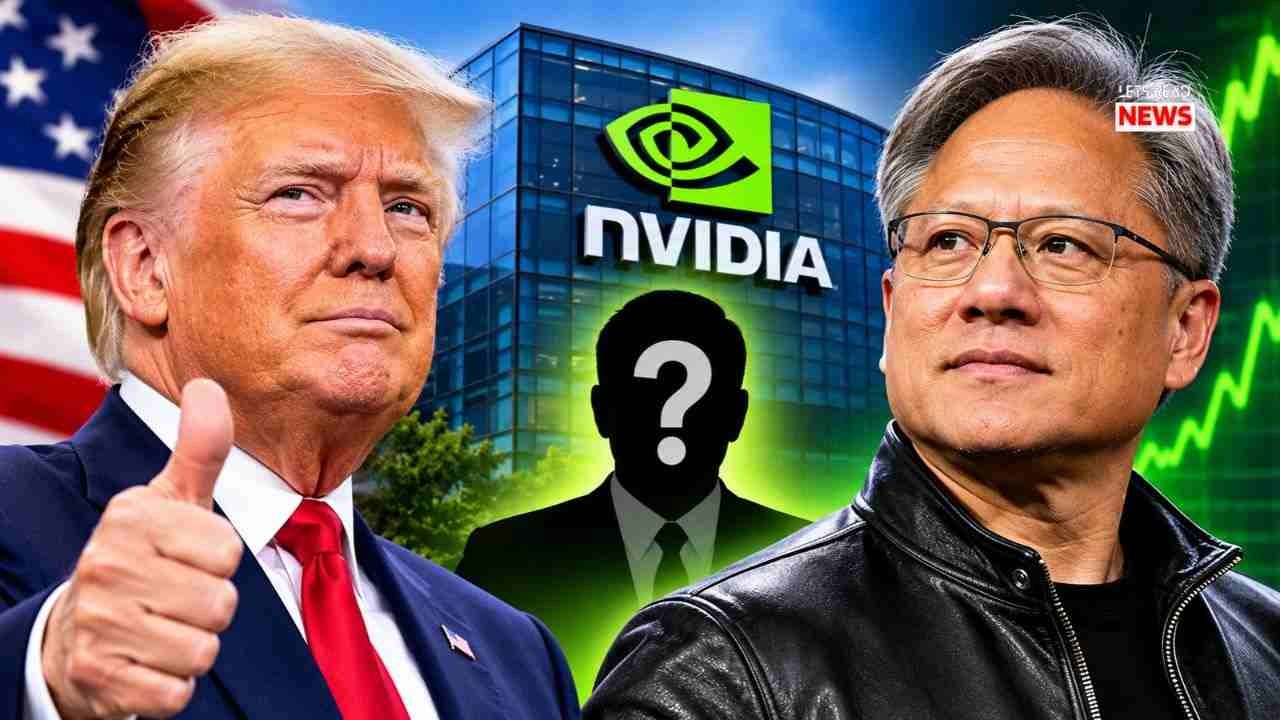
Donald Trump has publicly backed Jensen Huang’s possible return as Nvidia CEO, joining a growing campaign led by influential technology executives. But with national security questions, internal corporate tensions and a leadership succession battle unfolding, Nvidia faces a decision that could have consequences far beyond Silicon Valley.
The world’s most influential artificial intelligence chipmaker is facing an extraordinary leadership crisis. Just days after Jensen Huang stepped down as chief executive of Nvidia, US President Donald Trump has indicated that he would welcome the company’s co-founder returning to the position.
Trump’s comments have added a new dimension to an already complicated situation. What initially appeared to be a corporate leadership crisis has evolved into a wider debate involving Washington, Silicon Valley, international security and the future direction of the AI industry.
Speaking to reporters at the White House on Monday, November 16, before departing for Asia, Trump said he “wouldn’t mind” seeing Huang reinstated. He also suggested that the former CEO had learned an important lesson, while questioning whether the woman at the centre of the controversy was actually a Chinese spy.
The president’s support comes as prominent technology executives, investors and Nvidia supporters campaign for Huang’s return. Elon Musk, Epic Games CEO Tim Sweeney and other influential figures have backed the effort.
However, not everyone in Washington agrees. Treasury Secretary Scott Bessent has argued that Nvidia needs a dramatic leadership shake-up and should consider an outside candidate.
That disagreement raises a bigger question: Is Nvidia better served by bringing back the man who built it, or by using this crisis to establish a different kind of leadership?
Table of Contents
Why Did Jensen Huang Leave Nvidia?
On November 12, Nvidia announced that Jensen Huang had resigned as president, CEO and a member of its board of directors, ending a 33-year period at the company he co-founded in 1993.
The announcement followed growing scrutiny surrounding his personal relationships and reports involving Alice Huang, a former executive at Singapore-based Megaspeed International.
US authorities reportedly suspected Alice Huang of having connections to Chinese intelligence. The allegations raised concerns about whether a relationship involving the head of one of America’s most strategically important technology companies could create national security vulnerabilities.
Huang also acknowledged being unfaithful to his wife in an internal message to Nvidia employees.
Separate reporting raised questions about another alleged relationship involving a Nvidia employee who reportedly worked under him.
It is important to distinguish allegations from established facts. The public reporting has not established that Alice Huang was a Chinese intelligence operative, nor has it demonstrated that Jensen Huang deliberately transferred confidential information to Beijing.
The allegations have nevertheless created serious questions about executive judgment, corporate oversight and the security risks surrounding a company whose technology is central to America’s AI ambitions.
Nvidia’s board accepted Huang’s resignation and appointed longtime CFO Colette Kress as interim CEO while beginning a search for a permanent successor.
Trump Supports His Return, but Washington Is Divided
Trump’s intervention is particularly significant because Nvidia is not simply another American technology company.
Its advanced processors are essential to the development of artificial intelligence systems, military-related computing capabilities, scientific research and large-scale data centres.
The United States has therefore treated advanced semiconductor exports as a national security issue, particularly when it comes to China.
Speaking Monday, Trump said Huang had not put national security at risk and questioned whether Alice Huang was actually a spy.
He also criticised Huang’s personal conduct, suggesting that the former CEO should not have behaved as he allegedly did.
Trump’s position contrasts with the harder line taken by Treasury Secretary Scott Bessent.
On Sunday, Bessent argued that Nvidia needed a dramatic shake-up and should look outside the company for its next chief executive.
He also questioned whether Nvidia had adequately addressed warning signs involving intermediary companies in Singapore and the possible movement of advanced chips towards China.
This disagreement reveals two competing priorities inside the American political establishment.
One approach prioritises Nvidia’s technological leadership, its economic importance and the experience of the executive who built the company.
The other prioritises national security, export-control compliance and stronger corporate oversight.
These positions are not necessarily mutually exclusive. However, the leadership decision will reveal which concerns Nvidia’s board considers most important.
The Comeback Campaign: Why Silicon Valley Wants Jensen Back
The campaign to reinstate Huang is gaining momentum.
An online petition hosted by Stand With Jensen had attracted more than 177,000 signatures by Monday, according to its website.
Among the prominent supporters listed were Elon Musk, Epic Games CEO Tim Sweeney and Replit CEO Amjad Masad.
Investors Brad Gerstner of Altimeter Capital and Gavin Baker of Atreides Management have also urged Nvidia’s board not to rush into permanently replacing Huang before the independent investigation establishes the facts.
The argument behind the campaign is straightforward: Nvidia’s transformation into an AI powerhouse was closely connected to Huang’s leadership, and removing him before all relevant questions have been resolved could damage the company.
Supporters also argue that the board should establish whether the circumstances surrounding his departure justified such an extraordinary decision.
However, an online petition is not a corporate vote.
Even if hundreds of thousands of people support Huang’s return, the decision belongs to Nvidia’s board, which must consider its legal responsibilities, shareholders’ interests, corporate governance and the findings of its investigation.
There is also an important distinction between supporting Huang’s achievements and believing that he should automatically return to the same position.
A successful founder can create extraordinary value while still being subject to the same standards of accountability expected of other executives.
The Bigger Story: Colette Kress Could Change Nvidia From Within
One of the most overlooked dimensions of this crisis is the person currently running Nvidia.
Colette Kress is not simply a temporary replacement waiting for Huang to return. Her leadership could influence the company’s financial strategy, relationships with Washington and approach to the rapidly expanding AI infrastructure market.
Kress joined Nvidia in 2013 and has served as its chief financial officer for more than a decade.
According to Reuters reporting, she previously challenged some of Huang’s more aggressive investment and financing plans.
These disagreements reportedly involved major financial commitments to AI infrastructure companies and customers, including OpenAI-related projects and Lambda.
One proposed $250 billion support plan for an OpenAI data-centre project in Ohio was reportedly reduced to $120 billion.
This matters because Nvidia’s business model is changing.
The company is no longer simply selling powerful graphics processors to customers. It is increasingly involved in financing, partnerships and investments across the broader AI ecosystem.
Nvidia’s chips power the infrastructure used by many of the companies that are also part of its investment and partnership network.
That creates enormous opportunities, but it also raises questions about financial exposure, customer dependence and whether the AI infrastructure market is becoming too interconnected.
A CEO who is more cautious about financing arrangements could introduce stronger financial discipline.
But there is a potential downside.
Huang’s willingness to make aggressive strategic bets helped Nvidia move beyond gaming graphics into accelerated computing and AI infrastructure. Replacing that approach with a more conservative financial philosophy could affect the company’s appetite for risk.
The real challenge for Nvidia is finding a leader who can preserve its technological ambition without allowing its financial commitments to become excessive.
Kress may be able to stabilise the company, but whether she is the right person to lead its next decade is a separate question.
Why Nvidia’s CEO Decision Is Also an AI Industry Decision
Nvidia’s influence extends far beyond its own financial performance.
Its graphics processing units, networking systems and CUDA software ecosystem have become fundamental components of modern AI infrastructure.
From major cloud providers to AI research laboratories, thousands of organisations depend on Nvidia’s technology.
This creates a leadership problem that few other companies face.
A change at Nvidia could influence not only its employees and shareholders but also the strategic decisions of companies building AI models and data centres.
Consider three possible consequences.
1. A return could restore strategic continuity
Huang understands Nvidia’s technology, customers, partners and long-term ambitions better than almost anyone else.
His return could reassure investors and customers concerned about the company’s sudden leadership change.
It could also restore the executive leadership style that helped Nvidia establish its position in the AI computing market.
2. A new CEO could introduce stronger financial discipline
An outside leader might bring a different approach to corporate governance, financial risk and relationships with regulators.
This could be particularly important as AI infrastructure investments become increasingly expensive and interconnected.
However, an external appointment also carries the risk of losing institutional knowledge and disrupting established strategic relationships.
3. The leadership change could affect America’s AI competitiveness
Nvidia is a central player in the global competition to develop increasingly powerful AI systems.
The company must balance its commercial interests with US restrictions on advanced semiconductor exports.
A leadership team that takes a different approach to Washington could change the tone of those discussions.
That does not mean a new CEO can independently change American export policy. Those decisions belong to the government.
But the relationship between Nvidia’s leadership and policymakers will remain strategically important.
The China Question: The Issue That Could Outlast the Leadership Crisis
The allegations involving Alice Huang have brought renewed attention to Nvidia’s business relationships in Asia.
Megaspeed International, the Singapore-based company connected to Alice Huang, has become a focus of scrutiny over allegations involving the possible movement of advanced Nvidia chips towards Chinese customers.
The controversy is larger than one alleged personal relationship.
The US government has spent years trying to prevent China from obtaining access to the most advanced American AI processors.
These restrictions are intended to limit Beijing’s ability to develop advanced computing capabilities that could have military and strategic applications.
However, controlling the international semiconductor supply chain is complicated.
Chips can move through distributors, cloud providers, server manufacturers and companies operating across multiple countries.
This creates opportunities for intermediaries to obscure the ultimate destination of advanced computing equipment.
Singapore has also become an important location in the international technology and data-centre industry.
According to reporting by The Washington Post, US and Singaporean authorities had been monitoring Megaspeed as early as June 2025 over suspicions involving the possible diversion of high-end Nvidia chips to China.
The Associated Press has reported that Singapore began investigating Megaspeed in February 2025 over possible false declarations involving server purchases. Singaporean authorities later said there was insufficient evidence of a crime.
Megaspeed has denied evidence of illicit chip transfers and said it complies with export-control laws.
The company also announced an internal investigation led by outside lawyers and said Alice Huang had left on August 30, 2025.
The US and Singapore have agreed to continue discussions about the matter.
These details are important because they show that the controversy is not limited to questions about Huang’s private life.
It has developed into a broader examination of how advanced AI hardware is distributed internationally and whether existing safeguards are sufficient.
Even if Huang never returns as CEO, those questions are unlikely to disappear.
Could Trump’s Support Influence Nvidia’s Board?
Trump’s comments have created political pressure, but they do not give him the authority to appoint Nvidia’s chief executive.
Nvidia is a publicly traded corporation, and the appointment of its CEO is a responsibility of its board of directors.
The board must consider the company’s interests rather than simply follow the preferences of the president, investors or an online campaign.
Nevertheless, Trump’s position carries considerable weight.
His administration influences semiconductor export policy, trade negotiations and the regulatory environment in which Nvidia operates.
Huang has also been an important figure in discussions about American AI competitiveness and access to international markets.
Trump’s public support could therefore make Huang’s reinstatement more politically acceptable to some stakeholders.
It could also complicate matters for board members who believe a leadership change is necessary.
There is another important consideration: the appearance of political influence over corporate governance.
If a president publicly endorses a particular executive’s return, the board must be especially careful to demonstrate that its eventual decision follows a proper independent process.
The credibility of that process could matter almost as much as the identity of the next CEO.
Tim Cook, Rene Haas and the Search for Nvidia’s Next Leader
Trump has also previously floated Apple co-founder Steve Jobs’ successor, Tim Cook, as a potential replacement for Huang, describing the idea as a legendary figure replacing another legend.
However, Nvidia’s board has not announced Cook as its chosen successor.
Another name attracting attention is Rene Haas, CEO of Arm Holdings.
Reports have indicated that Nvidia’s board approached Haas about the position, although the company has cautioned that speculation about individual candidates is premature.
Internal candidates may also be considered.
Nvidia executive Ian Buck, a veteran of the company’s GPU computing and CUDA development efforts, has been mentioned as a potential contender.
The choice presents a difficult challenge.
Nvidia needs someone who understands the semiconductor industry, AI infrastructure, software ecosystems, major customers and global technology policy.
A traditional corporate executive may offer experience in management and governance but lack Huang’s technical vision.
A technology-focused candidate may understand the products but face difficulties managing the company’s increasingly complex financial and geopolitical relationships.
The board must find a balance between these competing requirements.
Nvidia’s November 17 Earnings: A Critical Test Beyond the CEO Drama
There is an important reason why the timing of this crisis matters.
Nvidia is scheduled to announce its third-quarter fiscal 2027 financial results on Tuesday, November 17.
The results will provide investors with an opportunity to examine whether the leadership turmoil is affecting the company’s business.
Before the leadership crisis, Nvidia had guided for approximately $108 billion in third-quarter revenue, plus or minus 2%, according to its second-quarter financial outlook.
The company had also indicated that its forecast did not assume data-centre compute revenue from China.
This is particularly important.
Nvidia’s long-term prospects depend on continued demand for AI computing infrastructure, but its ability to serve different international markets is influenced by export restrictions and geopolitical developments.
Investors will be watching several issues:
- Data-centre demand: Is spending on AI infrastructure continuing at a pace that supports Nvidia’s growth?
- Blackwell demand: Are customers continuing to adopt Nvidia’s advanced AI computing platforms?
- China exposure: How will export restrictions affect future sales opportunities?
- Margins: Can Nvidia maintain its profitability while expanding production and infrastructure commitments?
- Leadership confidence: Can Colette Kress reassure customers, investors and employees during the transition?
The earnings announcement will not resolve the questions surrounding Huang’s departure.
However, it could demonstrate how resilient Nvidia’s business is when its most recognisable leader is no longer in charge.
That distinction matters. A company can remain financially strong even while undergoing a serious governance crisis.
Three Possible Futures for Nvidia
The outcome of this leadership battle remains uncertain, but three broad scenarios are emerging.
Scenario 1: Jensen Huang returns
The board could conclude that Huang’s strategic value to Nvidia outweighs the risks associated with his departure.
A return could restore continuity and reassure investors, particularly if the independent investigation establishes that the company’s interests were not compromised.
However, reinstatement without meaningful governance safeguards could create questions about accountability.
Scenario 2: Colette Kress becomes permanent CEO
The board could decide that stability, financial discipline and a different leadership approach are more important than restoring the founder.
Kress would have the advantage of knowing Nvidia’s internal operations, financial structure and customers.
Her challenge would be demonstrating that she can sustain the technological ambition that made Nvidia an AI industry leader.
Scenario 3: Nvidia appoints an outside technology leader
The board could choose an external executive with semiconductor or AI industry experience.
This might offer a fresh start and help separate Nvidia’s future from the controversy surrounding Huang.
But changing leadership at such a strategically important moment could introduce uncertainty across the company and its ecosystem.
None of these scenarios is guaranteed. The independent investigation and the board’s assessment will be crucial.
What This Means for AI Investors and Consumers
For investors, the central issue is whether Nvidia’s competitive advantages are strong enough to survive a change in leadership.
The company’s position is built on more than its CEO.
Its hardware, software ecosystem, engineering teams, customer relationships and manufacturing partnerships are major sources of competitive strength.
However, Huang’s influence has been unusually significant. His departure creates uncertainty about how Nvidia will make its next generation of strategic decisions.
For consumers, the consequences are less immediate but potentially important.
AI services, cloud computing, software development and even everyday digital products depend on the infrastructure built by companies such as Nvidia.
If a leadership transition affects Nvidia’s investment strategy, product development or relationships with major technology companies, those changes could eventually influence the cost and availability of AI computing.
There is also a broader geopolitical question.
The competition between the United States and China over advanced AI chips is likely to continue regardless of who leads Nvidia.
The next CEO will inherit a company that must remain commercially competitive while navigating increasingly complicated national security restrictions.
That may be a more difficult job than simply replacing a famous founder.
The Real Question Is Bigger Than Jensen Huang
Donald Trump’s support has given Jensen Huang’s potential comeback campaign a powerful political boost.
Silicon Valley executives are rallying behind him, investors are asking the board to reconsider his departure, and a growing public campaign is questioning whether the company acted too quickly.
But the most important decision is not whether Huang deserves another opportunity.
It is what kind of company Nvidia wants to become.
For 33 years, Huang’s leadership helped transform Nvidia from a graphics-chip manufacturer into one of the central forces behind the global AI revolution.
His achievements are difficult to separate from the company’s identity.
Yet Nvidia has reached a point where its influence extends beyond ordinary commercial competition. Its technology has become part of the economic and national security infrastructure of the United States.
That brings greater expectations for governance, transparency and accountability.
If Huang returns, Nvidia will need to demonstrate that its leadership can address those expectations. If he does not, the board must prove that a new executive can preserve the company’s technological advantage.
Trump can express his preference. Silicon Valley can organise a campaign. Investors can make their demands.
But the final decision belongs to Nvidia’s board.
And whatever it decides, the consequences will reach far beyond one executive’s office.