
Table of Contents
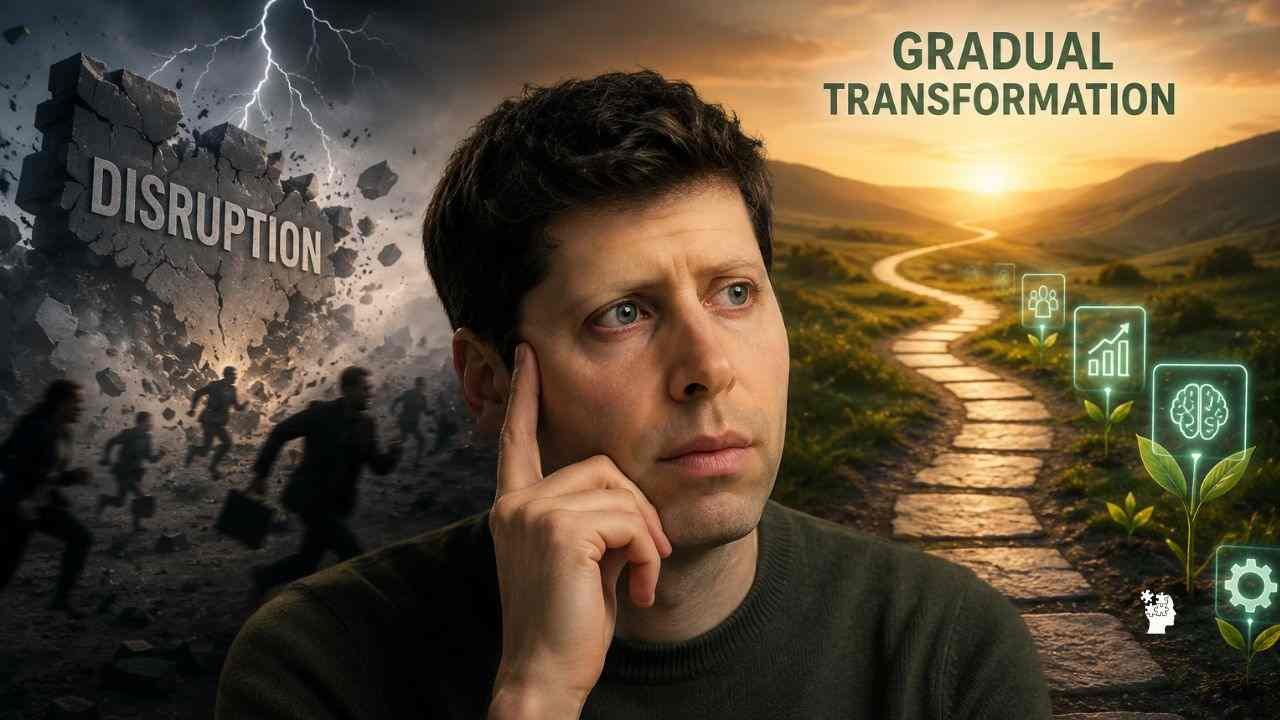
Why Sam Altman’s “mistake” about adoption speed reveals a hidden truth: gradual transformation beats disruption every time
The Confession That Wasn’t a Confession
Sam Altman said he was wrong. That’s the headline everywhere.
“OpenAI CEO admits he misjudged AI adoption speed.” “Altman expected faster disruption.” “The AI revolution is slower than promised.”
But here’s what nobody’s asking: What if being “wrong” was actually being right?
Altman told the world in 2023 that GPT-4 would upend software businesses “right away.” It didn’t. Now, in August 2026, he’s acknowledging the gap between his prediction and reality.
But look closer at what he actually said. He called it “an application problem, not a training problem.” He suggested OpenAI may need to “pace the rate of AI development so the world can catch up.”
That’s not an admission of failure. That’s a strategic recalibration—and it might be the most important decision in AI’s history.
The Disruption Myth: Why Fast Change Destroys More Than It Builds
Silicon Valley worships speed. “Move fast and break things” isn’t just a motto—it’s a religion. The assumption is that the faster technology spreads, the more value it creates.
History says otherwise.
Table
| Technology | Time to Mass Adoption | Outcome |
|---|---|---|
| Electricity | ~40 years (1880s–1920s) | Transformed every industry, created the modern economy |
| Automobiles | ~30 years (1900s–1930s) | Reshaped cities, work, and daily life |
| Personal computers | ~20 years (1980s–2000s) | Enabled the internet economy |
| Smartphones | ~10 years (2007–2017) | Changed communication, commerce, and culture |
| AI (so far) | ~3 years (2023–2026) | Still figuring out what it’s actually for |
Notice the pattern? The slower the adoption, the deeper the transformation.
Electricity didn’t “disrupt” factories overnight. It took decades of rewiring, retraining, and reimagining work. But when it was done, the change was irreversible and universal.
AI’s “slow” adoption isn’t a bug. It’s the necessary precondition for lasting change.
What Altman Really Meant: The Application Problem
When Altman says AI adoption is “an application problem, not a training problem,” he’s pointing to something the hype cycle ignores:
Building a powerful model is easy. Building a world that can use it is hard.
Consider the evidence from Google’s recent ATLAS study (15 million AI interactions analyzed):
- 68% of occupations show AI use, but only 20% of tasks within each role
- Fewer than 10% of workplace interactions fully automate a task
- 86% of AI usage happens outside formal work—in taxes, shopping, home administration
This isn’t failure. This is integration in progress. People aren’t rejecting AI. They’re absorbing it—gradually, carefully, one task at a time.
The mechanic who uploads a photo of a broken part to diagnose it. The parent who uses AI to navigate school paperwork. The small business owner who automates invoicing. These aren’t “disruptions.” They’re adaptations.
And adaptations build stronger foundations than disruptions ever could.
The NVIDIA Signal: Why $7 Billion Says “Slow and Steady”
Altman’s recalibration isn’t happening in a vacuum. NVIDIA—the company that literally powers the AI revolution—just made a move that confirms the slow-burn thesis.
NVIDIA earmarked $7 billion for Poolside, an AI startup focused on open-weight models. The breakdown is telling:
- $6 billion in technology licensing (spreading the tech wide)
- $1 billion in equity (betting on gradual, distributed adoption)
This isn’t the move of a company expecting explosive, winner-take-all growth. This is hedging. NVIDIA is preparing for a world where AI doesn’t consolidate into a few mega-models but spreads across thousands of specialized applications.
If the fastest-growing company in history is diversifying for a slower timeline, maybe “slow” isn’t the problem. Maybe it’s the plan.
The Anthropic Subtext: When Safety Becomes Strategy
Altman’s interview contained another layer that most coverage missed. He laid out AI’s “two failure modes”:
- The technology becomes uncontrollably powerful
- Power concentrates in too few hands
He called both “very anti-human” and took a thinly veiled shot at Anthropic’s safety-first, centralized oversight philosophy.
But here’s the irony: Altman’s “slower” timeline is actually the best safety mechanism imaginable.
If AI adoption had exploded as fast as he predicted in 2023, we’d be in uncharted territory right now—billions of people dependent on systems nobody fully understands, with no time to build guardrails, regulations, or social norms.
By slowing down, the industry is buying time for:
- Governments to draft meaningful AI legislation
- Workers to retrain and adapt
- Society to develop norms around AI use
- Companies to build safer, more reliable systems
Anthropic wants centralized control as the safety solution. Altman is discovering that decentralized, gradual adoption might be the better safeguard.
The 70% Problem: Why Americans Rejecting Data Centers Is a Feature, Not a Bug
Altman’s interview also touched on something most tech coverage ignores: public resistance.
A Gallup poll found 70% of Americans oppose data center construction in their communities. Altman’s response? Build them “off in the desert, around no one.”
That sounds dismissive. But it reveals a deeper truth: AI infrastructure is hitting social limits faster than technical limits.
Communities don’t want data centers because they consume water, strain power grids, and offer few local jobs. This isn’t NIMBYism—it’s rational self-interest.
And here’s the thing: Those limits are forcing the industry to innovate.
- More efficient chips (less power per computation)
- Edge computing (processing closer to users)
- Distributed models (smaller, specialized AI running locally)
- Renewable energy integration
If AI adoption had been instant, we’d have built a centralized, energy-hungry infrastructure by now. Because it’s slow, we’re building a distributed, efficient one.
That’s not a delay. That’s progress.
What This Means for You: Three Takeaways
1. If you’re a worker, stop panicking about “AI disruption.”
The slow timeline is your friend. Use it. Learn one AI tool deeply. Apply it to one task. Then another. The people who win won’t be the ones who “adapted instantly”—they’ll be the ones who adapted deliberately.
2. If you’re building a business, ignore the “AI or die” urgency.
The companies that survive won’t be the ones that slapped AI on everything in 2024. They’ll be the ones that integrated AI where it actually solved problems in 2026 and beyond. Focus on applications, not announcements.
3. If you’re an investor, bet on the tortoises, not the hares.
The startups building specialized, reliable AI tools for specific industries will outlast the ones promising general intelligence “next year.” The Poolside deal is a signal: open, distributed, gradual is the winning strategy.
The Bottom Line
Sam Altman said he was wrong about AI’s adoption speed. But maybe the real mistake was ever thinking speed was the right metric.
Electricity didn’t disrupt the world in three years. Neither did the automobile, the computer, or the internet. Each took decades to reshape society—and the reshaping was deeper because it was slower.
AI isn’t behind schedule. It’s on the only schedule that ever works: the one that lets people catch up.
Altman’s “admission” isn’t a failure of prediction. It’s a recognition of reality. And in a tech industry addicted to hype, recognizing reality might be the most disruptive thing of all.
Is AI’s slow adoption a blessing or a missed opportunity? Share your take in the comments.
Recommended for you:
3 thoughts on “The Slow AI Revolution Is the Smartest Thing That Ever Happened to Tech”