
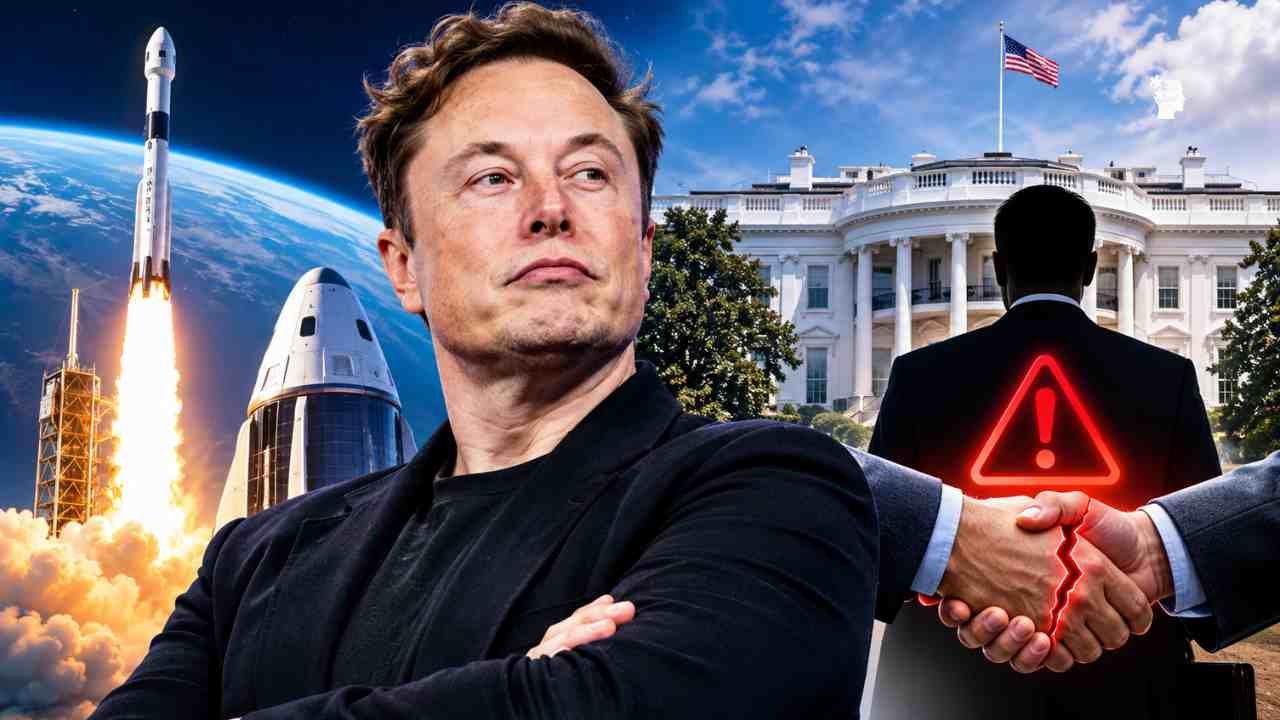
SpaceX is forecasting that U.S. government revenue will fall below 10% this quarter and below 5% within a year. But as its AI business expands, a surprising new dependency is emerging—and it could reshape the company’s future.
Elon Musk appears increasingly confident that SpaceX can grow without relying heavily on American government contracts.
On November 6, Musk made an unusually direct statement on X: payments from U.S. government agencies would account for less than 10% of SpaceX’s revenue in the current quarter, falling below 5% within a year.
He also appeared willing to walk away from federal business.
“Happy to cancel any that the government doesn’t want. Just say the word!” Musk wrote.
The comment came after Democrats won control of both chambers of Congress in the 2026 midterm elections, potentially creating a more challenging political environment for Musk and his businesses.
But there is a much bigger story behind the announcement.
SpaceX is no longer just a rocket company earning money from satellite launches, NASA missions and Starlink subscriptions. Its artificial intelligence infrastructure business has expanded dramatically, becoming a major source of revenue.
And that transformation has created an unexpected situation: one AI customer now accounts for more than a third of SpaceX’s quarterly revenue, according to the company’s latest financial filing.
In other words, SpaceX may be reducing its dependence on Washington while developing a new concentration of commercial risk.
Table of Contents
What Exactly Did Elon Musk Announce?
Musk’s statement followed a suggestion from X user Warren Redlich, who proposed that he offer congressional Democrats the opportunity to cancel federal contracts they opposed.
Musk responded by defending SpaceX’s government work, describing its contracts as both the best product and the lowest-priced option.
He then made two important predictions:
- Government revenue will represent less than 10% of SpaceX’s total revenue in the fourth quarter of 2026.
- That percentage will decline to less than 5% within approximately one year.
The figures represent a significant change from the reported 16.6% government-related revenue share in the previous quarter and approximately 20% in 2025.
However, there is an important distinction between a forecast and a confirmed financial result.
SpaceX has not yet published fourth-quarter results confirming Musk’s prediction. Nor has it announced that any federal contract has actually been cancelled.
His comments should therefore be understood as a statement about the company’s expected revenue mix, not an announcement that SpaceX is ending its relationship with Washington.
The Financial Numbers Reveal a Much Bigger Transformation
SpaceX’s third-quarter 2026 financial results help explain why Musk believes government revenue will become less important.
According to its SEC filing for the quarter ended September 30, 2026, SpaceX reported:
| Financial metric | Q3 2026 |
|---|---|
| Total revenue | $14.58 billion |
| Space segment revenue | $1.77 billion |
| Connectivity revenue | $5.25 billion |
| Super Intelligence revenue | $7.56 billion |
| Net income | $4.4 billion |
| Year-over-year revenue growth | 161% |
The company’s revenue increased from approximately $5.58 billion in the same quarter of 2025 to $14.58 billion in 2026.
But the most interesting number is not total revenue.
It is the $7.56 billion generated by SpaceX’s Super Intelligence (SI) segment.
That figure was greater than the revenue generated by Starlink’s entire Connectivity segment, which brought in approximately $5.25 billion.
The company’s business is changing faster than its traditional identity suggests.
SpaceX is increasingly becoming a combination of a space transportation business, a global connectivity provider and a large-scale AI computing infrastructure company.
The growth of the third business is particularly important because it changes the economics of the company.
Government contracts once represented a major source of revenue. Now, commercial demand for computing infrastructure is helping change the balance.
The Unexpected Twist: One AI Customer Accounts for 34.5% of Revenue
Here is the detail that deserves considerably more attention.
SpaceX’s third-quarter SEC filing disclosed that one customer, identified only as Customer B, accounted for 34.5% of consolidated revenue.
That customer contributed revenue exclusively through the Super Intelligence segment.
Bloomberg subsequently identified Customer B as Anthropic, citing a person familiar with the matter.
This would make Anthropic SpaceX’s largest individual customer.
The financial implications are enormous.
Based on SpaceX’s reported quarterly revenue of $14.58 billion, a 34.5% share represents approximately $5.03 billion in revenue during the quarter.
That is an illustrative calculation based on the disclosed percentage, not a separately reported customer revenue figure.
The relationship is also substantial in scale.
SpaceX’s securities filings describe agreements under which Anthropic purchases computing capacity from its Colossus infrastructure in Memphis, Tennessee.
Anthropic’s October 2026 SEC prospectus disclosed agreements with SpaceX involving approximately 325,000 Nvidia GPUs and potential aggregate spending of up to $120.5 billion through 2029, subject to the agreements’ terms and capacity delivery.
The prospectus describes a monthly payment rate of approximately $3.1 billion once the full contracted computing capacity is delivered.
This is not an ordinary customer relationship.
It is a major infrastructure partnership between two of the most influential companies in the AI industry.
And it creates a financial question that could become more important than Musk’s government revenue forecast.
What happens if Anthropic no longer needs that computing capacity?
SpaceX May Have Replaced Government Dependence With AI Customer Concentration
There is a critical difference between having fewer government customers and having a more diversified business.
SpaceX’s latest filing reveals that its customer concentration remains significant.
Consider the company’s disclosed customer figures:
| Customer disclosure | Q3 2025 | Q3 2026 |
|---|---|---|
| Customer A | 23.9% | 16.6% |
| Customer B | Below 10% | 34.5% |
The filing does not publicly identify either customer by name.
Bloomberg identified Customer B as Anthropic. The government-related interpretation of Customer A has been reported separately, but the SEC filing itself does not identify it as the U.S. government.
This distinction matters.
SpaceX may be reducing the proportion of revenue coming from government agencies, but the company is also becoming more exposed to a small number of very large customers.
Customer B alone represented more than one-third of quarterly revenue.
That creates a different kind of vulnerability.
Government contracts can be politically sensitive, but they are often supported by long-term programs, formal procurement processes and substantial operational requirements.
Commercial AI contracts, meanwhile, depend on demand, computing prices, infrastructure requirements and the customer’s ability to secure alternatives.
SpaceX is moving from one type of customer risk toward another.
The Anthropic Contract Contains a Potential Weak Point
The biggest concern is not necessarily that Anthropic will leave.
It is that the contract gives the customer an eventual exit option.
Anthropic’s SEC prospectus describes termination rights allowing either party to end the relevant computing agreements with 90 days’ notice after their initial contractual periods.
Those initial periods extend into early 2027.
This means the large revenue relationship is not necessarily guaranteed to continue unchanged through 2029.
There is another important detail.
The approximately $3.1 billion monthly payment rate is associated with the delivery of the full contracted computing capacity, rather than being a guaranteed amount SpaceX was already receiving throughout the third quarter.
That distinction is essential when evaluating the headline numbers.
SpaceX is investing heavily in servers, GPUs, networking equipment and data center infrastructure. Such investments require customers who are willing to purchase computing capacity at scale.
If Anthropic expands its AI operations, the partnership could become extremely valuable.
If Anthropic reduces its requirements or finds more attractive computing alternatives, SpaceX could face pressure to find replacement customers for expensive infrastructure.
This is why customer concentration deserves as much attention as government revenue.
Why SpaceX Is Betting So Heavily on AI Infrastructure
The expansion of artificial intelligence has created enormous demand for computing resources.
Training advanced AI models and running them for millions of users requires powerful processors, high-speed networking, enormous amounts of electricity and specialized cooling systems.
SpaceX has been building infrastructure to serve that demand.
Its Colossus facilities in the Memphis area have become central to its AI ambitions.
The company can use this computing capacity for its own AI development while renting available resources to outside customers.
That creates two potential revenue opportunities.
First, SpaceX can develop its own AI products and models.
Second, it can generate revenue by selling access to its computing infrastructure to other AI companies.
This strategy is particularly interesting because it gives SpaceX another business that does not depend directly on launching rockets or selling satellite internet subscriptions.
But it also introduces new challenges.
Data centers are expensive to build and operate. Their economics depend on electricity availability, cooling capacity, hardware utilization and the ability to secure long-term customers.
A large AI infrastructure business is not automatically a highly profitable one simply because demand for computing is increasing.
SpaceX’s third-quarter filing showed $7.56 billion in Super Intelligence revenue, but the segment also reported $7.13 billion in total costs and expenses.
Its operating income was approximately $431 million.
That means the segment’s revenue growth should not be confused with unlimited profitability.
The difference between revenue and operating income is particularly important when evaluating a business that requires enormous infrastructure investment.
The Political Timing Is Difficult to Ignore
Musk’s comments arrived just days after Democrats won control of both the House and Senate in the November 2026 midterm elections.
The change will create a different political environment when the new Congress takes office in January 2027.
Musk spent more than $445 million backing Republican political candidates, according to reporting cited in the political coverage surrounding the election.
Many of those candidates lost.
That could complicate relationships between Musk’s businesses and lawmakers who may now have greater influence over congressional oversight, government spending and investigations.
However, it would be a mistake to assume that a change in congressional control automatically means SpaceX will lose federal contracts.
Government procurement decisions are not controlled by political statements alone.
Contracts are administered through agencies, procurement officials and established legal procedures.
Congress can influence funding, conduct investigations and scrutinize agency decisions, but individual contract terminations require the appropriate legal and administrative process.
Under the Federal Acquisition Regulation, government contracting officers can terminate contracts for convenience when it is in the government’s interest, subject to the applicable contractual terms and settlement procedures.
The political shift may increase scrutiny, but it does not automatically invalidate existing agreements.
Why Washington Still Needs SpaceX
Here is the irony at the center of this story.
Even if government payments eventually account for less than 5% of SpaceX’s revenue, the company could remain strategically important to the United States.
SpaceX performs services that are difficult to replace quickly.
Its Falcon 9 rockets launch commercial satellites, government payloads and astronauts.
Its Dragon spacecraft provides NASA with a transportation system for carrying astronauts to and from the International Space Station.
The company also participates in national security space launch programs, placing sensitive government satellites into orbit.
And there is a much bigger commitment ahead.
NASA has selected SpaceX to develop its Starship Human Landing System for the Artemis program, which is intended to return astronauts to the lunar surface.
The agency is working with SpaceX and Blue Origin on lunar lander development. NASA’s inspector general has also warned that development challenges could delay planned Artemis missions.
Separately, NASA awarded SpaceX an additional $946 million in September 2026 for three crew transportation missions. The modification brought the company’s total Commercial Crew Transportation Capability contract value to $5.92 billion.
These commitments illustrate why government revenue percentages do not tell the whole story.
A company can become financially less dependent on the government while remaining operationally important to national security and America’s space ambitions.
SpaceX’s importance to Washington is not measured only by how much money it receives.
It is also measured by the capabilities the government relies on it to provide.
Could SpaceX Actually Walk Away From Government Contracts?
Musk’s statement that he would be happy to cancel contracts raises another interesting question.
Would SpaceX really be willing to abandon government business?
Financially, the company may have more flexibility than it did several years ago.
Starlink has created a recurring commercial revenue stream, while the AI infrastructure business is rapidly expanding.
However, the economics of individual contracts matter more than the overall revenue percentage.
Some government contracts may offer predictable payments, long-term relationships and opportunities to support strategic infrastructure.
Others may be less attractive depending on their costs, obligations and operational requirements.
There is also a distinction between cancelling a contract voluntarily and the government terminating one.
A government agency cannot simply erase every contractual obligation without considering the applicable termination clauses, completed work, payments and settlement costs.
The Federal Acquisition Regulation establishes procedures for these situations.
Therefore, Musk’s offer is better understood as a political and commercial statement than as an immediate operational decision.
No specific contract cancellations were announced in his post.
What This Means for NASA, the Pentagon and American Space Competition
SpaceX’s changing revenue mix could have consequences beyond the company’s financial statements.
For NASA, maintaining reliable access to space remains essential.
The agency needs commercial partners capable of transporting astronauts, launching scientific missions and supporting its longer-term lunar ambitions.
For the Department of Defense, reliable access to orbit is equally important.
National security satellites support communications, navigation, surveillance and other critical capabilities.
The U.S. government does have alternatives, including United Launch Alliance, Blue Origin and other emerging launch providers.
But replacing an established provider is not as simple as switching suppliers.
Launch vehicles require extensive testing, certification, operational experience and infrastructure.
Developing additional providers takes time.
This creates an unusual relationship: SpaceX may need Washington less financially, but Washington cannot necessarily replace SpaceX quickly.
That imbalance gives the company considerable strategic importance, regardless of the percentage of revenue it receives from government customers.
The Bigger Question: Is SpaceX Becoming an AI Company That Also Owns Rockets?
Perhaps the most important takeaway is how dramatically SpaceX’s identity is changing.
For years, the company was primarily associated with reusable rockets, ambitious Mars plans and the expansion of Starlink.
Today, its financial results reveal a much broader business.
Its three major revenue engines are:
- Space: Rocket launches, spacecraft development and related services.
- Connectivity: Starlink satellite internet and enterprise connectivity services.
- Super Intelligence: AI computing infrastructure, cloud services and related technology.
In the third quarter of 2026, Super Intelligence generated more revenue than the other two segments combined.
That is a remarkable change for a company originally built around reducing the cost of accessing space.
But there is a strategic connection between these businesses.
SpaceX has experience building complex infrastructure at enormous scale. Its satellite network, launch operations, engineering capabilities and computing facilities all require substantial capital and technical expertise.
The company is applying that infrastructure-building approach to artificial intelligence.
If the strategy succeeds, SpaceX could become a major player in the global AI computing market.
If it struggles, the company could find itself carrying expensive infrastructure with fewer customers willing to pay for it.
That is the risk hidden behind the impressive revenue growth.
What Investors and the Public Should Watch Next
Musk’s prediction will be tested by SpaceX’s fourth-quarter financial results and subsequent disclosures.
But the government revenue percentage is only one part of the story.
There are five developments worth watching:
1. Whether government revenue actually falls below 10%
The fourth-quarter results should provide the first meaningful test of Musk’s forecast. Investors should distinguish between a lower percentage and an actual decline in government revenue dollars.
2. Whether Anthropic remains SpaceX’s biggest customer
The concentration of revenue in one AI customer creates an important risk. Any change in Anthropic’s computing requirements could affect SpaceX’s financial outlook.
3. Whether SpaceX can attract more AI customers
Diversifying its computing business would reduce dependence on a single customer and make the infrastructure investment more sustainable.
4. Whether AI infrastructure becomes more profitable
Revenue growth alone is not enough. Operating income, capital expenditure, data center utilization and electricity costs will reveal whether the business is generating attractive returns.
5. Whether Washington changes its relationship with SpaceX
The new Congress could increase scrutiny of federal contracts, while NASA and the Pentagon will continue to need dependable access to space.
The outcome could shape the company’s relationship with the U.S. government for years.
The Bottom Line: Less Government Dependence Does Not Mean Less Risk
Elon Musk’s prediction that government revenue will fall below 5% of SpaceX’s total revenue is a significant statement about the company’s changing business model.
It suggests that Starlink, AI computing and other commercial operations could eventually become much more important than federal contracts.
But the bigger development may be the emergence of a new financial dependency.
SpaceX’s latest filing shows that one customer accounted for 34.5% of quarterly revenue. Bloomberg identified that customer as Anthropic, whose computing agreements also contain future termination rights.
This creates a fascinating contradiction.
SpaceX may be gaining independence from Washington at the same time it becomes more exposed to the decisions of a single private AI company.
For Musk, the next challenge may not be proving that SpaceX can survive without government contracts.
It may be proving that the company can build a diversified, profitable AI infrastructure business without depending too heavily on any one customer.
And that could ultimately be a much harder test.
Frequently Asked Questions
1. What percentage of SpaceX revenue comes from the U.S. government?
Elon Musk said government revenue would account for less than 10% of SpaceX’s revenue in the fourth quarter of 2026, down from a reported 16.6% in the previous quarter. He expects it to fall below 5% within a year. The latest forecast has not yet been independently confirmed by fourth-quarter results.
2. Who is SpaceX’s biggest customer in 2026?
Bloomberg identified Anthropic as SpaceX’s largest individual customer, accounting for approximately 34.5% of its third-quarter 2026 revenue. SpaceX’s SEC filing identifies this customer only as Customer B.
3. How much revenue did SpaceX generate in Q3 2026?
SpaceX reported approximately $14.58 billion in third-quarter revenue, representing 161% growth compared with the same quarter in 2025.
4. How much revenue did SpaceX’s AI business generate?
Its Super Intelligence segment generated approximately $7.56 billion in the third quarter of 2026, exceeding the revenue generated by its Connectivity segment.
5. Could SpaceX lose its Anthropic contract?
The agreements disclosed in Anthropic’s SEC prospectus include termination rights allowing either party to end the relevant arrangements with 90 days’ notice after their initial contractual periods. Those periods extend into early 2027.
6. Does NASA still depend on SpaceX?
Yes. SpaceX remains an important provider of astronaut transportation, cargo services, rocket launches and lunar lander development for NASA.
7. Can the U.S. government cancel SpaceX contracts?
Government agencies can terminate contracts under applicable contractual provisions and federal procurement regulations. Such decisions involve formal procedures and potential financial settlements. A change in congressional control does not automatically cancel existing agreements.