
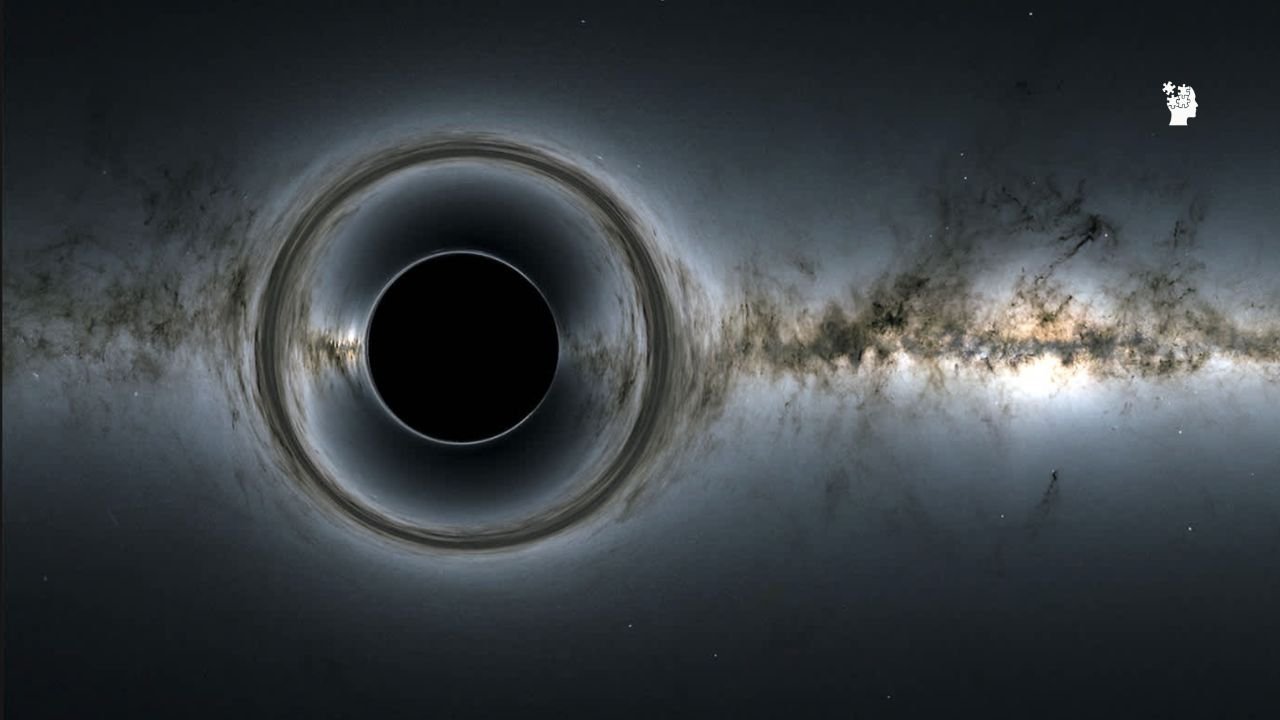
A 50-year-old prediction from general relativity has finally been observed: a supermassive black hole blasted from its galaxy at nearly 1,000 km/s, leaving a 200,000-light-year trail of newborn stars in its wake. Here’s the full story — and why it changes everything we know about cosmic mergers.
In September 2022, astronomers spotted something that shouldn’t exist: a razor-thin streak of young, blue stars stretching more than 200,000 light-years across the cosmos — longer than twice the diameter of our Milky Way. At one end sat a compact, star-forming galaxy. At the other? Nothing visible at all. Just a violent bow shock punching through intergalactic gas, and a luminous trail of stellar newborns forming in its turbulent wake.
Three years later, the James Webb Space Telescope (JWST) has confirmed what theorists have predicted for half a century: humanity has found its first confirmed runaway supermassive black hole.
Designated RBH-1, this object is traveling at 954 km/s — more than 3.4 million kilometres per hour — and it was launched by nothing less than the asymmetric fury of gravitational waves themselves.
This isn’t just a spectacular cosmic accident. It’s a Rosetta Stone connecting what telescopes can see with what gravitational-wave observatories will soon hear — and it validates one of the most dramatic predictions ever made by Einstein’s theory of general relativity.
Table of Contents
The Discovery: A Stellar Contrail 7.5 Billion Years in the Making
The story begins with a routine observation. In 2022, astronomers led by Pieter van Dokkum noticed an anomalous linear feature near a galaxy roughly 7.5 billion light-years from Earth. Follow-up observations with JWST in 2025 revealed something extraordinary: the structure wasn’t a background galaxy or an instrumental artifact. It was a bow shock — the compressed, shock-heated gas piled up in front of a massive object plowing through the circumgalactic medium at extreme velocity.
Behind this shock front, JWST detected young, blue stars actively forming in the turbulent wake — a cosmic contrail left by an invisible engine. The velocity measurements were staggering: material behind the shock was moving 600 km/s faster than the gas in front of it, with only a thin boundary between them. The only object capable of producing such a signature is a supermassive black hole with a mass comparable to the one anchoring our own galaxy — hurtling through space at nearly a thousand kilometres per second.
“We dub the object RBH-1, recognizing that it is the first confirmed runaway supermassive black hole,” the discovery team wrote. “RBH-1 is empirical validation of the 50-year-old prediction that SMBHs can escape from their host galaxies.”
The Physics: How Gravitational Waves Become a Cosmic Cannon
To understand how a black hole gets kicked across intergalactic space, you need to understand gravitational wave recoil — one of the most counterintuitive consequences of general relativity.
When two black holes orbit each other, they emit gravitational waves: ripples in spacetime that carry away energy and angular momentum. This emission is what drives the inspiral, tightening the orbit until the black holes collide and merge. But gravitational waves don’t just carry energy — they carry linear momentum too.
If the gravitational waves are emitted perfectly symmetrically, the momentum cancels out and the merged black hole stays put. But in reality, the emission is almost always asymmetric. The smaller black hole moves faster than its larger companion, “beaming” gravitational radiation preferentially in one direction — like a rocket engine firing in a single direction. By conservation of momentum, the merged remnant recoils in the opposite direction.
This isn’t a gentle nudge. For rapidly spinning black holes with misaligned spin axes, the recoil velocity can reach up to ~5,000 km/s — fast enough to eject even a billion-solar-mass monster completely from its host galaxy.
For RBH-1, the numbers tell a precise story. A team led by Tousif Islam (UCSB Kavli Institute) and Tejaswi Venumadhav (UCSB Physics) ran hundreds of thousands of simulations to reconstruct the merger. A simple collision between two non-spinning black holes would produce a recoil of only about 200 km/s — far too weak to explain RBH-1’s escape.
Instead, the simulations reveal a far more dramatic scenario:
- Two supermassive black holes of similar mass (mass ratio less than 6:1)
- The heavier black hole spinning at 70–75% of the maximum rate allowed by general relativity
- Its spin axis tilted and precessing like a wobbling top
- A major, gas-rich (“wet”) galaxy merger where the larger galaxy was no more than 4 times as massive as the smaller
The resulting combined galaxy, designated GX, had already reorganized for roughly 70 million years before the black holes finally overcame the “final parsec problem” and merged — releasing a gravitational-wave kick that sent the newborn black hole screaming into intergalactic space.
“I was initially surprised by how extreme this sounds,” Venumadhav admitted, “but then I realised it probably had to be the case in order to have produced the dramatic feature visible in telescopes.”
The Final Parsec Problem: How Did They Even Merge?
Here’s where RBH-1 gets even more interesting. The existence of this runaway black hole implies that its progenitor binary successfully merged — and that’s not as easy as it sounds.
When two galaxies collide, their central supermassive black holes sink toward the center through dynamical friction, losing energy to surrounding stars and gas. But once they get within about one parsec (3.26 light-years) of each other, they carve out a gap in their surroundings. The density of stars and gas drops dramatically, dynamical friction becomes ineffective, and the black holes should orbit each other almost indefinitely. This is the infamous “final parsec problem” — a puzzle that has vexed astrophysicists for decades.
Yet supermassive black holes do merge. The recent detection of a nanohertz gravitational-wave background by pulsar timing arrays (NANOGrav, EPTA, CPTA, and PPTA) provided the first evidence that black hole binaries routinely overcome this barrier.
RBH-1 now adds a crucial piece to this puzzle. The fact that it exists at all — with a merger that occurred just ~70 million years ago in cosmic terms — tells us that the mechanisms solving the final parsec problem can operate on timescales far shorter than the age of the universe. Whether the solution involves gas-rich environments, three-body interactions with a third black hole, or even exotic dark matter physics, RBH-1 proves that these mergers happen, and they happen with enough violence to launch the remnant into intergalactic exile.
Why RBH-1 Is Different From Every “Candidate” Before It
Astronomers have suspected runaway black holes existed for years. Previous observations turned up galaxies with offset central black holes, quasars showing anomalous Doppler shifts (like SDSS J092712.65+294344.0), and even galaxies apparently missing their supermassive black holes entirely.
But these were always candidates — ambiguous cases where alternative explanations couldn’t be fully ruled out. What makes RBH-1 unique is the combination of evidence:
Table
| Feature | What It Tells Us |
|---|---|
| 200,000-light-year star trail | Direct evidence of sustained high-velocity motion through intergalactic gas |
| Bow shock structure | Confirms supersonic motion; velocity measured via blueshifted shock-heated gas |
| Young stellar population in the wake | Star formation triggered by the black hole’s passage — a smoking gun |
| Host galaxy GX identified | The “crime scene” is found; the black hole’s origin is traceable |
| Velocity matches GW recoil models | The kick magnitude and direction are consistent with numerical relativity predictions |
No previous candidate offered this level of multi-wavelength, multi-technique confirmation. RBH-1 isn’t just the best case — it’s the first confirmed case.
The LISA Connection: Bridging What We See and What We’ll Hear
Perhaps the most profound implication of RBH-1 concerns the future of gravitational-wave astronomy — specifically, the Laser Interferometer Space Antenna (LISA), ESA’s planned space-based observatory set to launch in the mid-2030s.
LISA will detect the low-frequency gravitational waves produced by supermassive black hole mergers — frequencies far below the reach of ground-based detectors like LIGO, Virgo, and KAGRA. While LIGO hears stellar-mass black holes (tens to hundreds of solar masses) in the final seconds of their merger, LISA will track supermassive binaries years to decades before they collide, listening to their slow inspiral across the cosmos.
RBH-1 is a perfect preview of what LISA will observe. The progenitor binary that created RBH-1 would have emitted gravitational waves with signal-to-noise ratios exceeding 1,000 in the LISA band — an incredibly loud cosmic whistle.
“This connects what telescopes see to what LISA will hear,” Venumadhav explained. And the connection runs deeper than mere detection.
Recent research shows that multiband observations — combining LISA’s long-duration inspiral data with ground-based detectors’ merger-and-ringdown measurements — can constrain the recoil kick velocity to within tens of km/s accuracy. LISA’s years-long observation of spin precession cycles provides information that ground detectors, which observe only the final second, simply cannot capture.
When LISA flies, it won’t just detect merging supermassive black holes. It will predict their kicks — telling us, before the merger even happens, whether the remnant will stay bound to its galaxy or go rogue. RBH-1 is the proof of concept that makes this science possible.
What This Means for Galaxy Evolution
General relativity predicts that 5–10% of all supermassive black hole mergers should produce large recoil kicks capable of ejecting the remnant from its host galaxy. Before RBH-1, this was a theoretical number. Now it’s an observed fact.
The implications cascade across astrophysics:
1. Missing Black Holes Explained Some of the universe’s largest galaxies — particularly brightest cluster galaxies — appear to be “missing” their expected supermassive black holes. Gravitational recoil offers a natural explanation: the black hole was kicked out after a merger and is now wandering intergalactic space, invisible except when it triggers star formation in its wake (as RBH-1 does) or briefly accretes intergalactic gas.
2. Galaxy Core Scouring Even when a kick isn’t strong enough to fully eject the black hole, it can displace it from the galactic center for millions of years. During this time, the black hole’s gravitational influence no longer regulates star formation in the nucleus, potentially altering the galaxy’s structure and creating the “cores” observed in massive elliptical galaxies.
3. Hyper-Compact Stellar Systems A kicked black hole doesn’t travel alone. It can drag its accretion disk, a cluster of bound stars, and even gas along for the ride. These “hyper-compact stellar systems” could be detectable as unusual compact objects in intergalactic space — and RBH-1’s star trail may be the first example of this phenomenon at supermassive scales.
4. The Cosmic Web’s Hidden Population Simulations suggest that thousands of rogue supermassive black holes may be wandering the cosmic web right now, invisible to conventional surveys because they lack the bright accretion disks of active galactic nuclei. RBH-1 provides the observational template for finding them: look for linear star-forming trails, bow shocks in the circumgalactic medium, and anomalous velocity structures.
What’s Next: The Hunt for More Rogues
“Now that we have JWST, this is hopefully the first of many such observations,” said lead author Tousif Islam. And the hunt is already expanding.
The techniques used to identify RBH-1 — combining Hubble and JWST imaging with velocity mapping of bow shocks — can be applied systematically across deep survey fields. JWST’s infrared sensitivity is uniquely suited to detecting the young, hot stars formed in black hole wakes, which glow brightly at infrared wavelengths.
Meanwhile, pulsar timing arrays are already hearing the gravitational-wave background from unresolved supermassive black hole binaries across the universe. As these arrays improve their sensitivity, they may identify individual “loud” binaries that are on the verge of merging — systems that could, like RBH-1’s progenitor, be destined to produce runaway remnants.
And when LISA launches in the 2030s, the synergy will be extraordinary: LISA will provide the gravitational-wave soundtrack of the inspiral, while JWST and the next generation of ground-based telescopes will search for the electromagnetic aftermath — the star trails, the bow shocks, and the displaced galactic nuclei that mark where a black hole once called home.
The Bottom Line
RBH-1 is more than a cosmic oddity. It is:
- ✅ The first empirical confirmation of a 50-year-old prediction from general relativity
- ✅ A solution to the puzzle of missing supermassive black holes in massive galaxies
- ✅ A bridge between electromagnetic and gravitational-wave astronomy
- ✅ A template for finding the hidden population of rogue black holes wandering intergalactic space
- ✅ A preview of the science that LISA will revolutionize in the 2030s
Einstein’s equations predicted that the fabric of spacetime itself could act as a cosmic cannon, firing black holes across the universe at millions of kilometres per hour. For decades, this remained a beautiful theoretical curiosity. With RBH-1, it has become an observed reality — and the universe just got a lot more interesting.
Recommended for you:
1 thought on “RBH-1: The First Confirmed Runaway Supermassive Black Hole — How Einstein’s Gravity Just Kicked a Monster Into Intergalactic Space”