
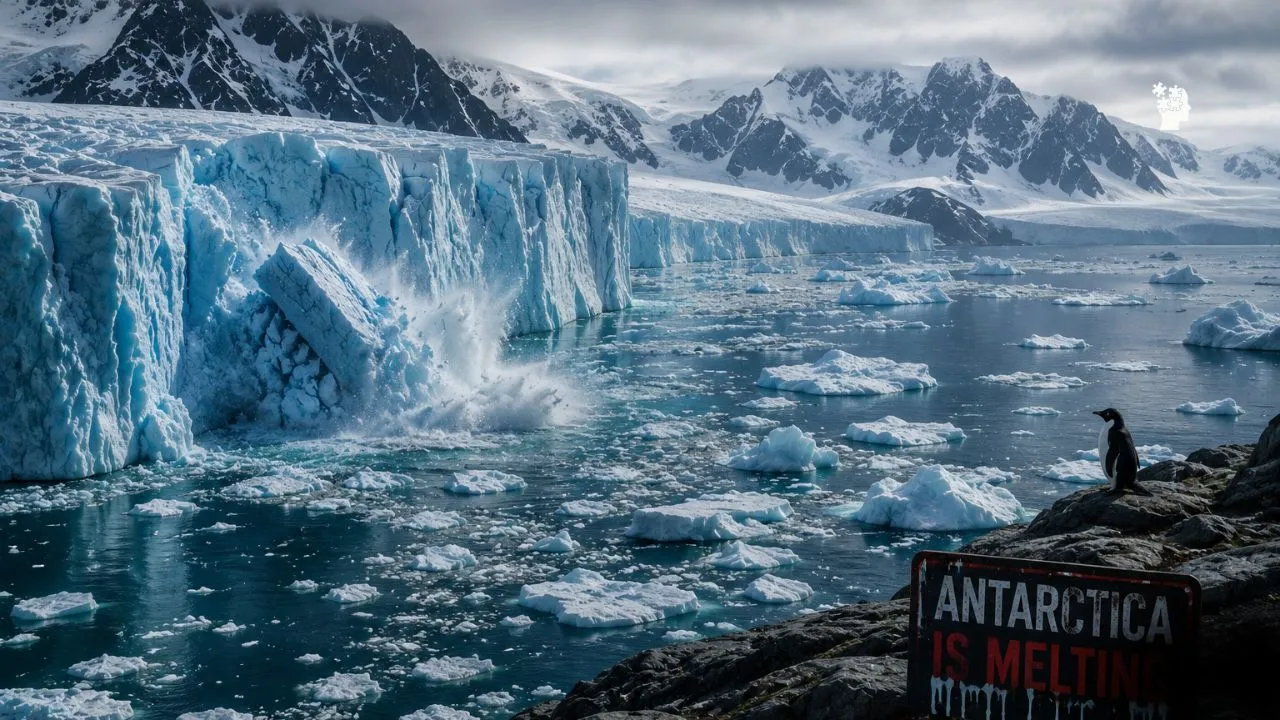
Here’s the uncomfortable truth buried inside two new research papers: our best tools for predicting sea level rise are already out of date. Not because scientists have been careless, but because the ice is doing things we didn’t know to look for.
The two studies, published this week in Nature Communications and Science Advances respectively, describe two separate — and compounding — mechanisms that are accelerating Antarctica’s melt. Neither is captured in existing climate models.
Table of Contents
The grooves nobody modelled
The first finding sounds almost mundane until you grasp the consequences. Researchers from Norway’s iC3 Polar Research Hub studied the underside of the Fimbulisen Ice Shelf in East Antarctica and found that long, channel-like grooves in the ice act as heat traps.
When warm ocean water flows in, it doesn’t just pass through. The grooves create small circular currents that hold the warmer water in place, concentrating melt rates up to ten times higher than in smoother sections of the shelf. The mechanism is entirely missing from current climate projections.
What makes this particularly alarming is the feedback loop it creates. Faster melting makes the grooves deeper and wider, which traps more heat, which melts faster, which makes them wider still. All the while, the uneven thinning weakens the shelf’s structural integrity — and the shelf is what holds back the glaciers behind it.
“The shape of the ice shelf underside is not just a passive feature,” lead author Tore Hattermann said. “It can actively trap ocean heat in exactly the places where extra melting matters most.”
The implication for supposedly stable, “cold” ice shelves is quietly devastating: they may be far more fragile than scientists assumed, because nobody was looking at the shape of their undersides.
The sea ice triple whammy
The second study, from the University of Southampton, zooms out to explain something that’s already visible in the data: the catastrophic decline in Antarctic sea ice since 2015, which wiped out ice coverage equivalent in area to the entire landmass of Greenland.
The researchers identified a three-stage cascade. Around 2013, strengthening winds began pulling warm Circumpolar Deep Water up toward the surface. By 2015, intense wind mixing melted surface ice rapidly across East Antarctica. And since 2018, the system has entered a self-reinforcing loop: with less ice to melt, the ocean surface stays warm and salty, which prevents new ice from forming, which keeps the surface warm.
The critical warning here is about timing. If this low-ice state persists past 2030, the Southern Ocean could flip from being one of Earth’s primary climate stabilizers — absorbing enormous amounts of heat and CO₂ — to actively driving warming instead. That’s not a distant hypothetical; 2030 is four years away.
And there’s a third thing
Both studies arrive against the backdrop of a third piece of research published in late April, confirming that a massive pool of deep-ocean heat has expanded and shifted toward the Antarctic continental shelf over the past two decades. Think of it as the pressure building behind a dam — the warm water is getting closer, and the dam is getting weaker from two new directions at once.
Why this matters beyond Antarctica
The immediate concern is sea level rise, and current models are almost certainly underestimating it. Coastal infrastructure planning — seawalls, drainage systems, property valuations, insurance risk — is based on projections that don’t account for groove-trapped melt or the sea ice feedback loop. Cities from Mumbai to Miami are making trillion-dollar decisions on data that is, by the researchers’ own admission, incomplete.
But the Southern Ocean reversal scenario carries a deeper danger. The ocean’s capacity to absorb carbon has been one of the few genuine buffers in humanity’s climate situation. If that buffer flips to an amplifier, the trajectory of warming becomes sharply steeper — and the window for intervention narrows accordingly.
What scientists are really saying
It’s worth sitting with what these papers are actually admitting. These aren’t fringe warnings from alarmists — they’re peer-reviewed findings telling us that the foundational tools we use to project climate futures are missing significant real-world mechanisms. That’s a scientific community saying, plainly: we need to revise upward.
The honest response isn’t panic, but it’s also not business as usual. It’s urgency with clarity — understanding that the gap between what our models predict and what Antarctica is actually doing is a gap we can’t afford to ignore.
Recommended for you:
2 thoughts on “Antarctica Is Melting Faster Than We Thought — And the Models Can’t Keep Up”