
For years, major social media companies have operated like black boxes. Users could see what happened on the platform, but almost nobody outside the company understood how the platform actually worked behind the scenes.
That may be about to change.
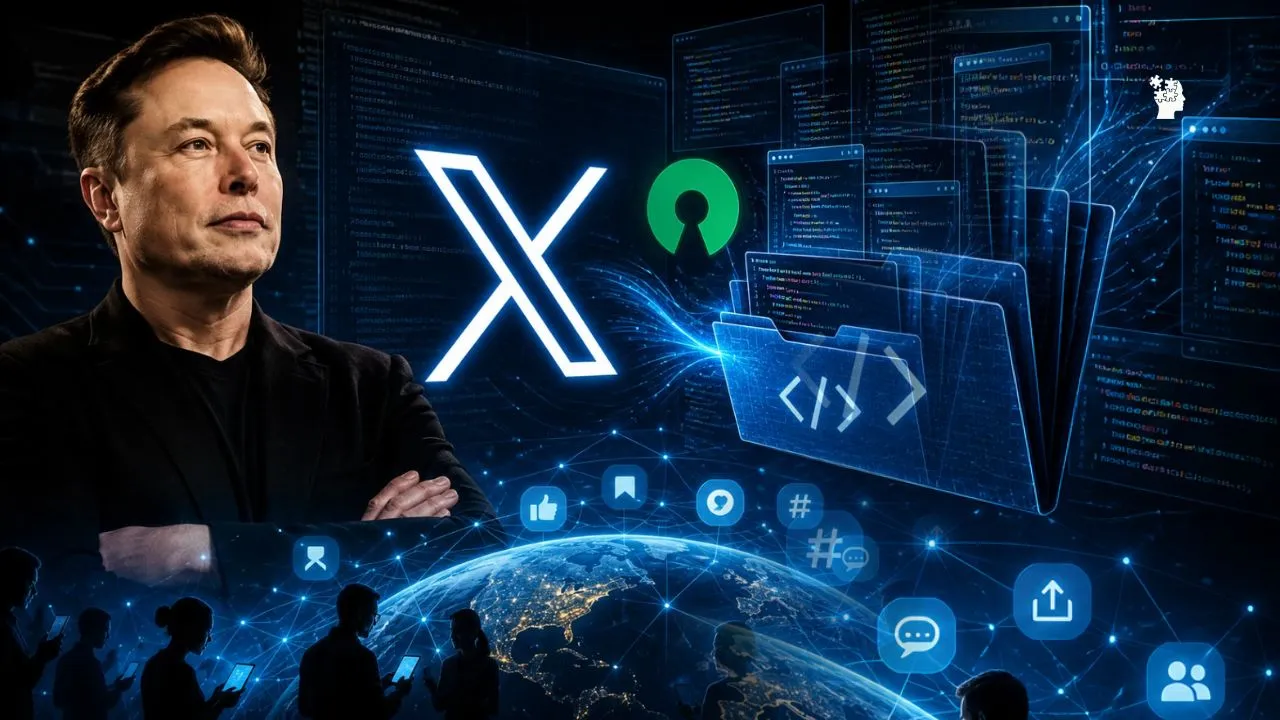
Elon Musk announced that X plans to release its entire codebase as open source once the company completes an internal security review. If the promise becomes reality, it would represent one of the boldest transparency moves ever attempted by a global social media platform.
But beyond the headline lies a much bigger question:
What would an open-source X actually mean for everyday users, developers, businesses, advertisers, and the future of social media?
Let’s break it down.
Table of Contents
What Exactly Did Elon Musk Announce?
Musk said X intends to publish its complete codebase without exceptions after reviewing the software for security vulnerabilities.
Earlier, X had already released parts of its recommendation algorithm, allowing developers and researchers to inspect how posts are ranked.
Now Musk says the goal is much bigger—not just the recommendation engine, but the entire platform.
If implemented exactly as described, this would include everything from backend services to infrastructure code, making X one of the most transparent major technology platforms ever created.
Why This Is a Bigger Deal Than Most Headlines Suggest
Many readers assume “open source” simply means sharing code online.
In reality, it changes much more.
A fully open-source platform allows developers to understand:
- how posts are processed
- how recommendation systems interact
- how moderation tools operate
- how infrastructure is designed
- how bugs are fixed
- how performance is optimized
Very few companies at X’s scale have offered this level of visibility.
Why Would Musk Do This?
There are several possible reasons.
1. Building Trust
One of the biggest criticisms of social media companies is that users rarely understand why certain posts become viral while others disappear from feeds.
Publishing the code allows outsiders to inspect how many systems actually work.
Even if only experienced developers read the code, transparency itself can increase trust.
2. Community Development
Open-source software often improves because thousands of developers contribute ideas, identify bugs, and suggest improvements.
Instead of relying solely on internal engineers, X could potentially benefit from a worldwide developer community.
This approach helped projects like Linux, Python, Kubernetes, and many developer tools become industry standards.
3. Attracting AI Developers
X is increasingly positioning itself as an AI platform alongside Grok.
Making infrastructure public could encourage developers to build applications, research tools, automation systems, and integrations around X.
That could strengthen its ecosystem beyond social networking.
Could This Actually Improve Security?
It sounds counterintuitive.
Wouldn’t publishing the code make hacking easier?
Not necessarily.
Open-source software follows a principle often summarized as:
“Many eyes make bugs shallow.”
When thousands of developers inspect code, vulnerabilities are often discovered faster than in closed systems.
This is why many of the world’s most secure technologies—including Linux, OpenSSL, PostgreSQL, and Kubernetes—are open source.
However, transparency only works if security reviews happen continuously.
Simply publishing code without strong maintenance could expose weaknesses.
The Biggest Risks
The announcement also raises legitimate concerns.
Attackers Can Study the Platform
Cybersecurity researchers—and malicious actors—would gain access to the same code.
If vulnerabilities remain undiscovered before publication, attackers could attempt to exploit them.
That explains why Musk emphasized completing a security review first.
Competitors Can Learn Faster
Publishing the code also allows competitors to study architectural decisions, optimization techniques, and engineering practices.
While this may accelerate innovation across the industry, it also reduces the secrecy many companies rely on.
Maintaining an Open-Source Community Isn’t Easy
Open-source projects require:
- documentation
- contribution guidelines
- code reviews
- governance
- regular maintenance
Managing thousands of external contributions can become a major engineering challenge.
What Changes for Everyday Users?
For most users, nothing changes immediately.
The X app will still look familiar.
However, over time users could benefit from:
- faster bug fixes
- greater transparency
- better accountability
- more independent research
- improved developer tools
- stronger third-party applications
The biggest change may not be visible inside the app—it may happen in the broader ecosystem built around it.
Could Other Social Platforms Follow?
If X successfully publishes its production code while maintaining security, pressure could increase on competitors.
Platforms such as Meta, TikTok, Reddit, and others have frequently faced criticism over algorithm transparency.
Although it is unlikely that every company will fully open-source its systems, users and regulators may increasingly demand greater visibility into how algorithms shape online conversations.
The Bigger Picture: Transparency Is Becoming a Competitive Advantage
For years, technology companies competed by building better algorithms.
The next phase may be competing on trust.
Artificial intelligence, recommendation systems, and content moderation are becoming increasingly important in daily life.
As these systems influence elections, businesses, creators, and public opinion, transparency itself becomes a valuable feature.
Whether X’s move ultimately succeeds or not, it pushes the conversation beyond “Who has the best algorithm?” toward a more important question:
Should users be able to understand the software that shapes what they see online every day?
Will X Really Release Everything?
That’s still the biggest unknown.
Musk has stated that the release will happen only after a comprehensive security review.
No timeline has been announced, and publishing a production-scale codebase is far more complex than releasing a recommendation algorithm.
Until that review is complete, the announcement remains a commitment rather than a finished product.
The coming months will reveal whether X becomes the first major global social network to fully embrace open-source transparency—or whether practical challenges limit how much code can actually be released.
Final Thoughts
If X follows through on its promise, the impact could extend far beyond one social media platform.
Developers would gain unprecedented insight into how a global social network operates. Researchers could study recommendation systems with greater accuracy. Security experts would have new opportunities to audit critical infrastructure. At the same time, X would face new challenges in protecting sensitive systems while managing an open-source ecosystem.
Whether this becomes a landmark moment in internet history or an ambitious promise that evolves over time, one thing is clear: the debate around transparency in social media has entered a new phase.
Recommended for you: