
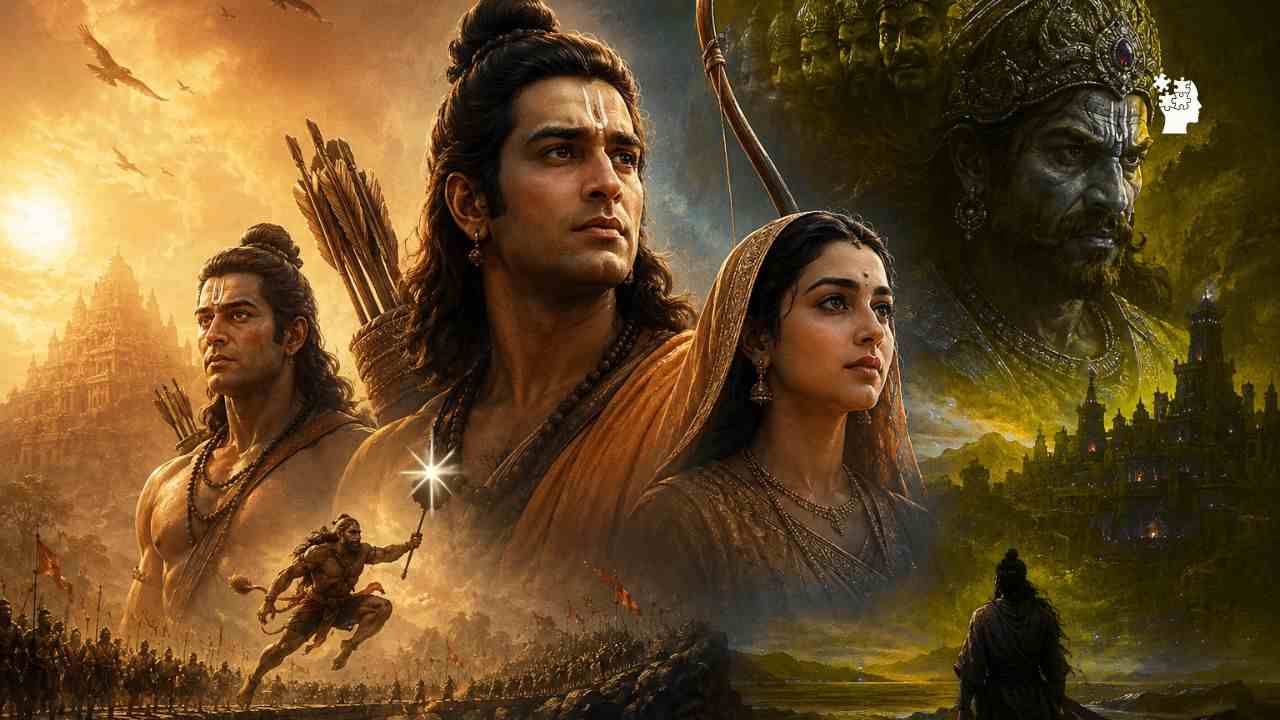
A timeless epic that has shaped billions of lives, inspired civilizations across Asia, and continues to offer profound wisdom for the modern world.
Table of Contents
Introduction
Imagine a story written thousands of years ago that still inspires billions of people, shapes cultures across Asia, teaches leadership, devotion, courage, and righteousness—and is now being adapted into one of India’s most ambitious films. That story is the Ramayana.
More than just an ancient text, the Ramayana is a living tradition. It is recited in temples, performed in village squares, referenced in political discourse, and studied in universities worldwide. From the snow-capped Himalayas to the tropical islands of Indonesia, from the royal courts of Thailand to the scholarly halls of Harvard, the Ramayana transcends boundaries of geography, language, and time.
But why does this epic endure? Why do parents still narrate Rama’s journey to their children? Why do filmmakers, writers, and artists continuously return to its wellspring of stories?
The answer lies in its universal appeal. The Ramayana is not merely a tale of gods and demons—it is a profound exploration of dharma (righteous duty), bhakti (devotion), sacrifice, and the human condition. It asks timeless questions: What does it mean to be a just ruler? How does one remain virtuous when surrounded by adversity? What is the true measure of love and loyalty?
Whether you are a student seeking to understand India’s greatest epic, a devotee looking for authentic knowledge, a foreign reader discovering Hinduism, or a film enthusiast excited about the upcoming Ramayana movie—this guide is designed to answer nearly every question you may have.
Let us embark on this journey together.
What is the Ramayana?
Meaning of Ramayana
The word “Ramayana” (रामायण) is derived from two Sanskrit words: Rama (the name of the epic’s central hero) and Ayana (journey or going). Thus, Ramayana literally translates to “The Journey of Rama” or “Rama’s Progress.”
In Sanskrit literary tradition, the suffix -ayana also carries connotations of a sacred pilgrimage or a transformative passage. The title therefore encapsulates not just a physical journey from Ayodhya to Lanka and back, but a spiritual odyssey that transforms everyone it touches.
One of India’s Two Great Epics
The Ramayana stands alongside the Mahabharata as one of India’s two great epics (Itihasas). While the Mahabharata is a sprawling, complex narrative of a catastrophic family war, the Ramayana is often described as more focused, poetic, and idealistic. Where the Mahabharata presents moral ambiguity and difficult choices, the Ramayana presents a clearer—though no less profound—vision of righteous living.
Importance in Hinduism
For Hindus, the Ramayana is far more than literature. It is:
- Sacred Scripture: Considered Smriti (that which is remembered), it conveys eternal truths through narrative.
- Moral Compass: Rama is revered as Maryada Purushottama—the supreme upholder of moral limits and righteous conduct.
- Cultural Foundation: It has shaped Indian art, music, dance, architecture, and social values for millennia.
- Devotional Text: The story of Rama and Sita inspires deep bhakti (devotion), while Hanuman’s unwavering service represents the ideal of selfless dedication.
The epic teaches that dharma is not always easy, but it is always worth upholding. This message resonates across religious boundaries—Buddhists, Jains, and Sikhs have all drawn inspiration from Rama’s story.
Who Wrote the Ramayana?
Maharishi Valmiki: From Bandit to Sage
The Ramayana is traditionally attributed to Maharishi Valmiki (महर्षि वाल्मीकि), revered as Adi Kavi—the First Poet of Sanskrit literature. His life story is as extraordinary as the epic he composed.
The Early Life of Ratnakara
Before he became Valmiki, he was known as Ratnakara—a hunter and, by some accounts, a highway robber living in the forests near the banks of the Tamasa River. He robbed travelers to support his family, believing his actions were justified by his responsibilities.
Narada’s Guidance
One day, the divine sage Narada passed through the forest. Ratnakara attacked him, but Narada—unafraid and compassionate—asked a simple yet profound question: “Will your family share the sin of your actions?”
Ratnakara, confident they would, returned to his family and asked. To his shock, his parents, wife, and children refused. They said: “Your duty is to provide for us, but the sin belongs to you alone.”
Devastated and awakened, Ratnakara returned to Narada and begged for liberation. Narada initiated him into the Rama mantra—but since Ratnakara was unlettered and could not pronounce it properly, he chanted “Mara” (मर), which means “death.” He repeated it with such intensity and devotion that the syllables inverted into “Rama” (राम).
Meditation and Transformation
Narada instructed him to sit in meditation, chanting this mantra until further notice. Ratnakara sat so still and focused that an anthill (Valmika in Sanskrit) gradually formed around him. Years passed. When the anthill completely covered him, the sages of the forest broke it open and found a transformed being—radiant with spiritual power.
He was named Valmiki—”one born from an anthill.”
Becoming Adi Kavi
After his enlightenment, Valmiki established an ashram on the banks of the Tamasa River. One day, while bathing, he witnessed a hunter kill one of a pair of mating krauncha birds. Overcome with compassion, a verse spontaneously emerged from his lips—the first ever composed in Sanskrit meter. This marked the birth of Sanskrit poetry and earned him the title Adi Kavi (First Poet).
How Was the Ramayana Written?
The Divine Inspiration
The composition of the Ramayana is described in the epic itself, in the Bala Kanda. According to tradition:
- Narada’s Narration: Sage Narada once visited Valmiki’s ashram and narrated the condensed story of Rama—a prince of extraordinary virtues who descended to earth to destroy the demon king Ravana and establish righteousness.
- Brahma’s Blessing: After hearing Narada’s account, Valmiki went to the Tamasa River for his morning ablutions. Immersed in contemplation, he witnessed the krauncha bird incident and uttered the first shloka. Immediately, Lord Brahma (the creator) appeared and blessed him, granting him divine vision to see Rama’s entire life as it unfolded.
- Divine Vision: With Brahma’s blessing, Valmiki could perceive all events—past, present, and future—related to Rama’s incarnation. He saw Rama’s birth, his childhood, his marriage, his exile, Sita’s abduction, the war, and the eventual return to Ayodhya.
Composition in Sanskrit
Valmiki composed the Ramayana in Sanskrit, using the Anushtubh meter—a verse form consisting of 32 syllables arranged in four lines of eight syllables each. This meter became the standard for later Sanskrit epics and Puranas.
The First Shloka
The very first verse of the Ramayana is:
मां निषाद प्रतिष्ठां त्वमगमः शाश्वतीः समाः।यत्क्रौञ्चमिथुनादेकमवधीः काममोहितम्॥
(Maa nishaada pratishthaam tvamagamah shaashvateeh samaah |Yat krauncha mithunaadekam avadheeh kaamamohitam ||)
Translation: “O hunter! You will find no rest or fame for endless years, for you have killed one of a pair of krauncha birds in the act of love.”
This verse is remarkable because it emerged from pure compassion (karuna rasa)—an emotion that would permeate the entire epic. Even in describing a warrior’s tale, Valmiki’s poetry is suffused with empathy for all living beings.
Historical Background
When Did the Ramayana Happen?
According to traditional Hindu chronology, the Ramayana is set in the Treta Yuga—the second of the four cosmic ages (Yugas). The traditional timeline places the events approximately:
- Traditional dating: Between 1.7 million to 7,000 years before the present era, depending on the specific chronology followed.
- Yuga calculations: The Treta Yuga is said to have lasted 1,296,000 years, and Rama’s birth is traditionally placed in the 24th Treta Yuga of the current Manvantara.
Historical and Archaeological Perspectives
From an academic and archaeological standpoint, dating the Ramayana is complex and contested:
- Literary analysis suggests the Valmiki Ramayana as we know it was composed between 500 BCE and 100 BCE, though it likely drew upon much older oral traditions.
- Archaeological evidence from sites like Ayodhya, Chitrakoot, Panchavati (near Nashik), Hampi (identified with Kishkindha), and Sri Lanka shows continuous habitation and cultural significance, but no definitive proof linking these sites to specific Ramayana events.
- Astronomical references in the text (positions of stars and planets mentioned during Rama’s birth and other events) have been used by some researchers to propose dates ranging from 7000 BCE to 5000 BCE, though these interpretations are debated among scholars.
It is important to approach this topic with respect for both devotional beliefs and scholarly inquiry. For millions of Hindus, Rama is a historical divine incarnation whose life occurred in the Treta Yuga. For historians and archaeologists, the Ramayana represents a layered text that evolved over centuries, reflecting the cultural, social, and political realities of ancient India.
Is Ramayana History or Mythology?
This is perhaps the most searched question about the Ramayana—and the answer depends entirely on one’s perspective.
The Religious Perspective
For devout Hindus, the Ramayana is nor history not mythology in the Western sense—it is Itihasa, a Sanskrit term meaning “thus it happened.” Rama is Bhagavan (the Supreme Lord) who incarnated as a human being. His life is a factual divine descent (Avatara) meant to establish dharma and demonstrate ideal behavior.
Key points from this view:
- The Ramayana is a sacred account of real events witnessed by sages.
- Archaeological evidence is secondary to scriptural testimony.
- The epic’s spiritual truths are more important than historical verification.
The Historical Perspective
Historians and archaeologists approach the Ramayana as a textual tradition that evolved over centuries:
- The narrative likely crystallized around historical kernels—ancient kingdoms, tribal conflicts, and cultural memories—that were elaborated over time.
- The text shows layers of composition, with later additions (particularly the Uttara Kanda) differing in style and content from the earlier books.
- Sites associated with the Ramayana demonstrate continuous sacred geography rather than definitive proof of specific events.
The Academic Literary Perspective
Scholars of comparative mythology and literature view the Ramayana as:
- One of the world’s greatest epic poems, comparable to the Iliad, Odyssey, and Shahnameh.
- A text that encodes social values, political ideals, and philosophical concepts of ancient India.
- A narrative that functions as cultural memory, shaping identity regardless of historicity.
The Archaeological Perspective
Archaeological findings present a mixed picture:
- Ayodhya has revealed structures dating to the Kushan period (1st century CE) and earlier, with ongoing excavations.
- Sri Lanka has sites like Sita Eliya and Ashoka Vatika that align with Ramayana descriptions.
- Ram Setu (Adam’s Bridge) is a natural chain of shoals and sandbanks, but its age and formation are subjects of scientific study.
A Balanced View
Rather than forcing a binary choice between “true” and “false,” it is more productive to recognize that the Ramayana operates on multiple levels simultaneously:
- As Scripture: It conveys eternal spiritual truths.
- As History: It may preserve memories of ancient events, kingdoms, and conflicts.
- As Literature: It is a masterpiece of poetic composition.
- As Culture: It has shaped civilizations across Asia for millennia.
The Ramayana’s power lies precisely in its ability to be all of these things at once.
Structure of Valmiki Ramayana
The Valmiki Ramayana is divided into seven Kandas (books or cantos), each covering a major phase of Rama’s life. Together, they contain approximately 24,000 verses (though some versions include more).
1. Bala Kanda (Book of Childhood)
Verses: ~1,900
This opening book establishes the cosmic context of Rama’s birth. It describes:
- The divine purpose of Vishnu’s incarnation as Rama.
- King Dasharatha’s Putrakameshti Yagna (fire sacrifice for sons).
- The birth of Rama, Bharata, Lakshmana, and Shatrughna.
- Rama’s childhood exploits, including his encounter with the sage Vishwamitra.
- The destruction of demons Tataka, Subahu, and Maricha.
- Rama’s journey to Mithila and his breaking of Shiva’s bow at Sita’s swayamvara.
- The confrontation with Parashurama.
- Rama and Sita’s wedding.
The Bala Kanda sets the stage by establishing Rama’s divine nature while emphasizing his human experiences.
2. Ayodhya Kanda (Book of Ayodhya)
Verses: ~3,000
Often considered the most emotionally powerful book, the Ayodhya Kanda narrates:
- The preparations for Rama’s coronation as crown prince.
- Kaikeyi’s manipulation of Dasharatha using the two boons he had promised her.
- The demand that Rama be exiled for 14 years and Bharata be crowned instead.
- Dasharatha’s heartbreak and eventual death from grief.
- Rama’s serene acceptance of exile, Sita and Lakshmana’s insistence on accompanying him.
- The journey to the forest and the grief of Ayodhya’s citizens.
- Bharata’s refusal to accept the throne and his pilgrimage to Chitrakoot to beg Rama to return.
- Rama’s firm adherence to his father’s word, forcing Bharata to rule as a regent from Nandigram.
This Kanda is a profound meditation on duty, sacrifice, and the pain of righteous choices.
3. Aranya Kanda (Book of the Forest)
Verses: ~2,000
The Aranya Kanda covers the forest exile:
- The journey through Dandakaranya forest.
- Life at Panchavati on the banks of the Godavari River.
- The encounter with Shurpanakha (Ravana’s sister), her disfigurement by Lakshmana, and her complaint to her brothers Khara and Dushana.
- The destruction of Khara and Dushana’s demon army.
- The golden deer (Maricha in disguise) and Sita’s longing for it.
- Rama’s pursuit of the deer, Lakshmana leaving Sita despite his misgivings, and Ravana’s abduction of Sita.
- Jatayu’s heroic but fatal attempt to stop Ravana.
- Rama and Lakshmana’s grief and their meeting with Kabandha and Shabari.
- The journey toward Kishkindha in search of Sita.
This book marks the transition from peaceful exile to active conflict.
4. Kishkindha Kanda (Book of Kishkindha)
Verses: ~1,900
This book focuses on the monkey kingdom:
- Rama and Lakshmana’s arrival at Kishkindha and their meeting with Sugriva.
- The story of Vali’s betrayal of Sugriva and the usurpation of Sugriva’s wife Ruma.
- Rama’s alliance with Sugriva and his killing of Vali (a morally complex act that generates much philosophical discussion).
- Sugriva’s coronation and his initial failure to mobilize search parties for Sita.
- Lakshmana’s angry intervention to remind Sugriva of his duty.
- The dispatch of search parties in all four directions, with Hanuman, Angada, and Jambavan leading the southern expedition.
The Kishkindha Kanda introduces the theme of kingly duty and alliance.
5. Sundara Kanda (Book of Beauty/Hanuman)
Verses: ~2,800
The Sundara Kanda is the most beloved and frequently recited book of the Ramayana. It focuses entirely on Hanuman’s journey to Lanka:
- Hanuman’s leap across the ocean (a feat of devotion and divine power).
- His exploration of Lanka and discovery of Sita in the Ashoka Grove.
- Hanuman’s meeting with Sita, delivering Rama’s ring and message of hope.
- His destruction of the Ashoka Grove and capture by Indrajit’s Brahmastra.
- The burning of Lanka with his fiery tail (after Ravana orders it set ablaze).
- Hanuman’s return with news of Sita’s location and well-being.
- The council of war and the march toward the southern ocean.
The Sundara Kanda represents the power of devotion (bhakti) overcoming impossible obstacles.
6. Yuddha Kanda (Book of War)
Verses: ~4,500
The longest and most action-packed book:
- The construction of Rama Setu (the bridge to Lanka) with the help of Nala and the monkey army.
- The siege of Lanka and the diplomatic mission of Angada.
- The great battles: Kumbhakarna’s awakening and death, Indrajit’s invisible attacks and eventual defeat by Lakshmana, and the duel between Rama and Ravana.
- Ravana’s death and Vibhishana’s coronation as king of Lanka.
- Sita’s agni-pariksha (fire test) and Rama’s initial hesitation to accept her.
- The return to Ayodhya in the Pushpaka Vimana and Rama’s coronation as king.
This Kanda explores the nature of evil, the cost of war, and the complexities of righteousness.
7. Uttara Kanda (Book of Aftermath)
Verses: ~3,000
The most controversial book, believed by many scholars to be a later addition:
- The doubts of Ayodhya’s citizens regarding Sita’s purity.
- Rama’s agonizing decision to exile Sita (now pregnant) to the forest.
- Sita’s refuge in Valmiki’s ashram and the birth of Lava and Kusha.
- The Ashwamedha Yagna and the twins’ recitation of the Ramayana.
- Sita’s final return and her descent into the earth (her mother Bhumi Devi receiving her).
- Rama’s reign of thousands of years and his eventual return to Vaikuntha (the divine abode).
The Uttara Kanda raises profound questions about the price of public duty and the vulnerability of the ideal.
Complete Story of Ramayana
The Divine Descent
In the age of Treta Yuga, the world was plagued by the demon king Ravana and his allies. Ravana had acquired immense power through severe austerities and had secured a boon that made him nearly invincible. Drunk with power, he terrorized the three worlds—heaven, earth, and the netherworld. The gods, unable to defeat him, approached Lord Vishnu, the preserver of the universe.
Vishnu agreed to incarnate as a human being to circumvent Ravana’s boon (which did not protect him from humans and monkeys). He would be born as Rama, the son of King Dasharatha of Ayodhya, in the Ikshvaku dynasty—the solar race of kings descended from the sun god.
Birth and Childhood
Dasharatha, the virtuous king of Ayodhya, had three wives—Kaushalya, Kaikeyi, and Sumitra—but no children. On the advice of his ministers and sages, he performed the Putrakameshti Yagna, a grand fire sacrifice. From the sacred fire emerged a divine being carrying a vessel of payasam (sweet pudding).
Dasharatha distributed the payasam among his wives:
- Kaushalya gave birth to Rama, the incarnation of Vishnu.
- Kaikeyi gave birth to Bharata, blessed by the presence of Vishnu’s divine discus.
- Sumitra consumed two portions and gave birth to Lakshmana and Shatrughna, manifestations of the divine serpent Shesha and the conch shell.
The four brothers grew up in Ayodhya, inseparable from birth. Rama and Lakshmana, and Bharata and Shatrughna, shared bonds deeper than ordinary sibling affection.
Education and Early Exploits
Rama was trained in all the arts of kingship—archery, horsemanship, statecraft, and scripture. His guru was Vashishtha, the royal preceptor, and later the great sage Vishwamitra took a special interest in his development.
Vishwamitra, once a king who became a sage through immense effort, arrived at Dasharatha’s court with an unusual request. Demons were disturbing his sacrificial fires in the forest, and he wanted Rama (then barely sixteen) to protect the rituals. Despite Dasharatha’s reluctance to send his young son, Rama and Lakshmana accompanied Vishwamitra.
In the forest, Rama demonstrated his divine prowess by killing the demoness Tataka and her sons Subahu and Maricha. Vishwamitra, pleased, bestowed upon Rama divine weapons (astras) that would serve him in his future battles.
The Journey to Mithila and Sita Swayamvara
Vishwamitra then led the brothers to Mithila, the kingdom of King Janaka. Janaka had found a baby girl while plowing a field and had adopted her as his daughter, naming her Sita (from the Sanskrit word for “furrow”). Sita was no ordinary princess—she was an incarnation of Lakshmi, Vishnu’s divine consort, who had descended to earth to be Rama’s wife.
Janaka had possessed a massive bow of Lord Shiva, so heavy that it could not be lifted by ordinary mortals. He declared that whoever could string this bow would win Sita’s hand in marriage. Princes and warriors from across the world had tried and failed.
When Rama entered the assembly, he not only lifted the bow but broke it while attempting to string it. The earth shook, and the heavens rejoiced. Sita placed the victory garland around Rama’s neck, and their eyes met—divine recognition of their eternal bond.
But the breaking of Shiva’s bow angered Parashurama, the sixth incarnation of Vishnu and an immortal warrior who had already rid the earth of corrupt kshatriyas twenty-one times. He confronted Rama, but upon recognizing Rama’s true divine nature, he withdrew and blessed the union.
Marriage and Blissful Years
Rama and Sita were married in Mithila with extraordinary festivities. Lakshmana married Sita’s sister Urmila, and Bharata and Shatrughna married her cousins Mandavi and Shrutakirti. The four couples returned to Ayodhya, and for twelve years, Rama and Sita lived in perfect happiness, beloved by all.
The Conspiracy and Exile
As Dasharatha grew older, he decided to crown Rama as Yuvaraja (crown prince). The city prepared for a grand coronation. But fate—intertwined with past karma—intervened.
Kaikeyi, Rama’s stepmother, had once saved Dasharatha’s life in battle. He had promised her two boons, which she had saved for a future time. Now, manipulated by her hunchback maid Manthara, Kaikeyi demanded:
- That Bharata be crowned king instead of Rama.
- That Rama be exiled to the forest for fourteen years.
Dasharatha was devastated. The shock was so great that he collapsed and eventually died of grief. But Rama, when he learned of the demand, accepted it without hesitation. For him, a father’s word was dharma itself.
Sita refused to be left behind. “The forest where you dwell is Ayodhya to me,” she declared. “The palace without you is a forest.” Lakshmana also insisted on accompanying his brother. The three left the city in simple bark garments, while the citizens wept.
Bharata’s Refusal and Nandigram
Bharata, who had been away at his maternal grandfather’s kingdom, returned to find his father dead and his brother exiled. He was furious with his mother and refused the throne. He pursued Rama to the forest and begged him to return.
At Chitrakoot, Bharata fell at Rama’s feet, weeping. But Rama was resolute: “I cannot break our father’s promise. Rule as his representative, and when I return, I shall take my place.”
Bharata, unable to change Rama’s mind, took Rama’s wooden sandals (padukas) and placed them on the throne. He ruled from Nandigram, a village outside Ayodhya, living as an ascetic and governing in Rama’s name. This act of self-denial made Bharata one of the most revered figures in Indian tradition.
Forest Life and the Golden Deer
The trio traveled deeper into the forest, visiting sages’ hermitages and destroying demons who harassed the ascetics. They settled at Panchavati, near the Godavari River, in a simple hut built by Lakshmana.
One day, Shurpanakha, Ravana’s sister, saw Rama and desired him. When he refused her (citing his fidelity to Sita), she attacked Sita. Lakshmana intervened and cut off her nose and ears. Humiliated, Shurpanakha complained to her brothers Khara and Dushana, who attacked Panchavati with a demon army. Rama and Lakshmana destroyed them all.
Shurpanakha then went to Lanka and described Sita’s beauty to Ravana. The demon king, overcome with lust and arrogance, decided to abduct Sita.
Ravana enlisted the help of the shape-shifting demon Maricha. Maricha, still bearing the wounds from Rama’s earlier attack, reluctantly agreed. He transformed into a golden deer and wandered near Panchavati. Sita, enchanted by its beauty, asked Rama to capture it for her.
Rama, sensing danger but unwilling to deny Sita, pursued the deer deep into the forest. As he shot it, Maricha cried out in Rama’s voice: “O Sita! O Lakshmana!” Sita, hearing the cry, insisted that Lakshmana go to Rama’s aid. Lakshmana was deeply reluctant—he knew no force in the three worlds could harm Rama, and this was clearly a demonic trick. But Sita, overcome with anxiety, accused him of having ulterior motives, suggesting he wished Rama dead so he could claim her for himself. Stung by this unjust accusation, Lakshmana left her alone in the hut and went to find his brother.
📌 Note on the Lakshmana Rekha: The popular image of Lakshmana drawing a protective line around the hut—crossing which led to Sita’s abduction—does not appear in Valmiki’s Sanskrit Ramayana. It was introduced centuries later in Tulsidas’s Ramcharitmanas (16th century) and reinforced by folk traditions and television adaptations. In Valmiki’s original account, Lakshmana leaves simply because Sita’s distress and harsh words leave him no choice, making the moment even more tragic and psychologically complex.ut), Sita’s anxiety compelled him to leave.
The Abduction
Ravana, disguised as a mendicant sage, approached the now-empty hut. Sita, bound by the code of hospitality to never refuse a Brahmin seeker, stepped outside to offer him alms. The moment she crossed the threshold, Ravana shed his disguise, seized her by the wrist, and dragged her toward his aerial chariot. Sita cried out for Rama and Lakshmana, struggling against his grip. The vulture king Jatayu, though old and weakened with age, rose to intercept Ravana. He fought with the fury of a father, tearing at Ravana’s arms and chariot, but the demon king drew his sword and severed Jatayu’s wings. As the noble bird fell bleeding to the earth, Ravana climbed into his Pushpaka Vimana and flew south toward Lanka, Sita weeping and calling Rama’s name as the forests and rivers of her homeland vanished below.
As they flew over mountains and forests, Sita dropped her jewelry as markers for Rama to find. Eventually, they reached Lanka, where Ravana imprisoned Sita in the Ashoka Grove (Ashoka Vatika), surrounded by demonesses who tried to break her spirit. But Sita remained unyielding, her faith in Rama absolute.
The Search and Hanuman’s Leap
When Rama and Lakshmana returned and found Sita gone, they were devastated. They discovered the dying Jatayu, who told them of Ravana’s direction before breathing his last. After performing Jatayu’s last rites, they met the demon Kabandha (who was freed from a curse by Rama) and the ascetic woman Shabari, who fed them berries she had tasted first to ensure they were sweet—an act of pure devotion that Rama accepted with grace.
Kabandha directed them to Kishkindha, the monkey kingdom. There, they formed an alliance with Sugriva, the exiled monkey king, and killed his tyrannical brother Vali. Sugriva, now king, sent search parties in all four directions.
The southern party, led by Hanuman, Angada, and Jambavan (also known as Jambavantha, an immortal king of the bears), reached the southern ocean but found themselves stuck—no one seemed capable of crossing the vast sea. Then Jambavan reminded Hanuman of his divine origins: he was the son of the wind god Vayu and possessed limitless powers that he had forgotten due to a childhood curse.
Realizing his true nature, Hanuman grew to a gigantic size and leaped across the ocean—a distance of approximately 100 miles—in a single bound. He landed on the mountain Trikuta in Lanka and began his search.
Hanuman in Lanka
Hanuman explored Lanka at night, eventually finding Sita in the Ashoka Grove. He watched as Ravana tried to persuade Sita to marry him, offering her queenship and riches. Sita refused, declaring that she would rather die than betray Rama.
Hanuman revealed himself to Sita, presenting Rama’s ring as proof of his identity. He offered to carry her back immediately, but Sita refused—she would only return with Rama, and her honor required that Ravana be defeated in battle.
Hanuman, not content with mere reconnaissance, decided to deliver a message. He destroyed the Ashoka Grove, killed several demon warriors, and allowed himself to be captured. Ravana ordered Hanuman’s tail to be set on fire, but Hanuman used this to burn the city of Lanka (except the Ashoka Grove where Sita sat). He then leaped back across the ocean with his tail still blazing, extinguishing it in the sea.
The Bridge and the War
With Sita’s location confirmed, Rama’s army marched to the southern tip of India. The ocean god refused to part, and Rama threatened to dry up the waters with his arrows. The ocean god relented and suggested that Nala (a monkey architect) build a bridge with the help of the army.
The construction of Rama Setu is one of the epic’s most iconic episodes. Stones inscribed with Rama’s name floated on the water, and the bridge was completed in five days. The army crossed over and camped outside Lanka.
Rama sent Angada as a final envoy to Ravana, offering peace if Sita was returned. Ravana refused. The war began.
The Great Battles
The war between Rama’s army and Ravana’s forces lasted several days and featured some of the most dramatic confrontations in epic literature:
Kumbhakarna: Ravana’s giant brother, who slept for six months at a time, was awakened with great difficulty. Despite his monstrous appetite (he devoured hundreds of monkeys), he was a formidable warrior. He fought bravely but was eventually killed by Rama.
Indrajit (Meghanada): Ravana’s son, who had defeated Indra himself (earning his name “Conqueror of Indra”), was nearly invincible. He used the Patala Astra to become invisible and struck down both Rama and Lakshmana with the Nagastra (serpent weapon). They were revived only when Garuda (the eagle lord and Vishnu’s mount) appeared and dispelled the serpents.
Indrajit then performed a dark ritual at the Nikumbhila shrine to gain invincibility. Lakshmana, guided by Vibhishana, interrupted the ritual and engaged Indrajit in a fierce duel. After a prolonged battle, Lakshmana killed Indrajit with the Aindrastra (Indra’s weapon).
Ravana: With his brother and son dead, Ravana himself entered the battlefield. He was a master of illusion and wielded the Brahmastra and other divine weapons. The battle between Rama and Ravana lasted seven days. Each time Rama severed Ravana’s heads, they grew back. Finally, Vibhishana revealed that Ravana’s nectar of immortality was stored in his navel. Rama aimed the Brahmastra at Ravana’s navel, and the demon king fell.
As Ravana lay dying, Rama instructed Lakshmana to learn statecraft from him—Ravana was a great scholar and ruler despite his flaws. This act of compassion even toward his enemy exemplifies Rama’s character.
Sita’s Return and the Fire Test
With Ravana dead, Vibhishana was crowned king of Lanka. Rama sent Hanuman to inform Sita of her liberation. But when Sita was brought before him, Rama spoke words that have been debated for millennia:
“I have killed Ravana to avenge the insult to my lineage and to fulfill my duty. But I cannot accept you, for you lived in another man’s house. You are free to go wherever you wish—to Lakshmana, Bharata, Sugriva, or Vibhishana.”
Sita, heartbroken but dignified, asked for a fire pyre to be built. She declared that if she had been faithful to Rama in thought, word, and deed, the fire would not harm her. She entered the flames, and Agni (the fire god) himself emerged, holding her unscathed and testifying to her absolute purity.
Rama then explained that his words were necessary to prove Sita’s innocence to the world, though he had never doubted her. This episode, known as Agni Pariksha (fire test), remains one of the most discussed and debated events in the epic.
Return and Coronation
The fourteen years of exile were complete. Rama, Sita, and Lakshmana returned to Ayodhya in the Pushpaka Vimana, accompanied by Hanuman and others. The city, which had waited in darkness, erupted in celebration. Deepavali (the festival of lights) commemorates this return.
Rama was crowned king in a ceremony of unparalleled splendor. His reign, known as Rama Rajya, became the gold standard for governance in Indian thought—an era of justice, prosperity, and peace where:
- Cows gave abundant milk.
- Crops grew without failure.
- People lived long and healthy lives.
- Truth and righteousness prevailed.
- Even the weakest could find justice at the king’s door.
The Final Trials
Despite the perfection of Rama Rajya, shadows lingered. A washerman in Ayodhya was heard saying: “I am not Rama to accept a wife who lived in another man’s house.” Though this was the complaint of a common man, it spread through the city.
Rama, as king, faced an impossible choice—his love for Sita versus his duty to maintain public trust. In one of the epic’s most heartbreaking moments, he ordered Lakshmana to take Sita (now pregnant) to the forest and leave her there.
Lakshmana, weeping, obeyed his brother’s command. Sita was abandoned near Valmiki’s ashram. The sage, recognizing her divinity, took her in. She gave birth to twin sons, Lava and Kusha.
13 Years later, Rama performed the Ashwamedha Yagna (horse sacrifice). The sacrificial horse wandered into the forest and was captured by Lava and Kusha—unaware that they were Rama’s sons. When Rama came to reclaim the horse, he heard the boys singing the Ramayana, composed by Valmiki.
Years after Sita’s exile, Rama performed the Ashvamedha Yagna (Horse Sacrifice) to proclaim his sovereignty. The sacred horse wandered into the forest and was captured by two young warriors—Lava and Kusha—who had been raised in Valmiki’s ashram and knew nothing of their true lineage.
Rama sent his brothers and Hanuman to retrieve the horse, but the twins defeated them all. Even Lakshmana and Hanuman were overpowered by the boys’ skill and the divine weapons they had learned from Valmiki. As Rama himself prepared to ride out and face these mysterious warriors, Valmiki intervenes.
The sage arrived at the sacrificial ground with Sita, Lava, and Kusha. He revealed the twins’ identity to Rama and the assembled court. Sita, standing before the husband who had exiled her, did not weep or accuse. She simply declared her innocence one final time. Then she called upon her mother, Bhumi Devi (the Earth goddess), to receive her if she had remained faithful in thought, word, and deed.
The earth trembled and split open. A divine throne emerged, carried by serpents and radiant with celestial light. Without looking back, Sita sat upon it and descended into the earth, leaving Rama forever. The goddess had answered. The queen was gone.ing Rama forever.
Rama ruled for many more years. When his time came, he walked into the Sarayu River, and the gods appeared to welcome him back to Vaikuntha, his divine abode. The incarnation was complete.
📌 The Curse of Vrinda (Tulsi): Why Even God Suffered Separation
Hindu tradition offers a profound theological explanation for why Rama—an incarnation of the Supreme Lord—was forced to endure the agony of separation from Sita. The answer lies in a curse received long before the Ramayana.
Jalandhar, a powerful demon king born from the ocean, had become nearly invincible through severe austerities. His strength, however, drew its true power from his wife Vrinda (also revered as Tulsi), whose unwavering chastity (pativrata dharma) created a protective shield around him. Unable to defeat Jalandhar in battle, the gods appealed to Lord Vishnu.
To break Jalandhar’s power, Vishnu took the form of Jalandhar himself and approached Vrinda. Mistaking him for her husband, Vrinda’s chastity was momentarily broken. With that shield gone, Lord Shiva was able to slay Jalandhar in battle.
When Vrinda discovered the deception, her grief turned to righteous fury. She cursed Vishnu with the very pain she now endured: “Just as you have separated me from my beloved husband, in your future incarnation, you too shall suffer the agony of separation from your wife.”
Thus, when Vishnu descended as Rama, the curse manifested. He was separated from Sita during her abduction by Ravana, and ultimately lost her forever when she returned to the earth. The tradition emphasizes that even the Supreme Lord does not override the word of a devoted soul. He voluntarily accepts the consequences of karma to uphold the moral order of the universe and to demonstrate that no one—not even God—is above the laws of dharma and the heartfelt cries of the faithful.
Major Characters
Rama
The seventh incarnation of Lord Vishnu and the hero of the epic. He is Maryada Purushottama—the ideal man who upholds the limits of righteous conduct. As a son, he obeys his father unconditionally. As a husband, he is devoted but bound by duty. As a king, he sacrifices personal happiness for public good. As a warrior, he is invincible yet compassionate. His life demonstrates that dharma is not always comfortable, but it is always supreme.
Sita
The incarnation of Goddess Lakshmi and the ideal of feminine virtue, strength, and devotion. She chooses exile with Rama over palace comfort. She rejects Ravana’s advances with unyielding dignity. She undergoes the fire test to prove her innocence. Her final descent into the earth is a powerful statement about the limits of human judgment and the sanctity of feminine honor.
Lakshmana
Rama’s younger brother and inseparable companion. He represents selfless service and fraternal devotion. He leaves his wife Urmila to serve Rama and Sita in the forest. He sleeps little (another sacrifice) to guard them. He defeats Indrajit and remains Rama’s right hand throughout. His character embodies the ideal that true love is expressed through service.
Hanuman
The monkey god and the greatest devotee in Hindu tradition. Son of the wind god Vayu, he possesses immense strength, wisdom, and humility. His leap to Lanka, his meeting with Sita, and his burning of the city are legendary. But his greatest quality is his devotion (bhakti)—he asks for nothing in return for his service. He is worshipped today as a symbol of strength, courage, and unwavering faith.
Bharata
Rama’s brother by Kaikeyi. Though he was the beneficiary of the conspiracy that exiled Rama, he is perhaps the most selfless character after Hanuman. He refuses the throne, lives as an ascetic in Nandigram, and places Rama’s sandals on the throne. His fourteen-year wait exemplifies patience, loyalty, and the rejection of unearned power.
Shatrughna
The youngest brother, devoted to Bharata. He serves as Bharata’s companion and assistant, representing the quiet strength of those who support without seeking the spotlight.
Dasharatha
The king of Ayodhya and Rama’s father. His name means “one with ten chariots” (symbolizing his power), but he is ultimately a tragic figure undone by his love for Kaikeyi and his inability to break his word. His death from grief is one of the epic’s most moving episodes.
Kaushalya
Rama’s mother and Dasharatha’s chief queen. She embodies maternal love and quiet strength, accepting her son’s exile with dignity while inwardly grieving.
Kaikeyi
Rama’s stepmother and the catalyst for the exile. Though often portrayed as a villain, a deeper reading reveals her as a tragic figure manipulated by Manthara and bound by her own past boons. Her later remorse is profound.
Sumitra
Mother of Lakshmana and Shatrughna. She is notable for blessing her sons to serve their elder brothers rather than seeking power for them—a lesson in selflessness.
Ravana
The ten-headed demon king of Lanka and the epic’s primary antagonist. He is a complex villain—a great scholar, a master of the Vedas, a skilled musician, and a powerful ruler. His flaw is ahankara (ego) and kama (uncontrolled desire). His abduction of Sita is the act of a man who believes himself above moral law. His death is both a defeat and a liberation.
Mandodari
Ravana’s chief wife and the queen of Lanka. She is wise, virtuous, and devoted, constantly urging Ravana to return Sita and avoid destruction. She represents the tragedy of those who see disaster coming but cannot prevent it.
Vibhishana
Ravana’s younger brother who defects to Rama’s side. He is guided by dharma rather than blood loyalty. Though some criticize him as a traitor, the epic presents him as a righteous man who chose truth over tyranny. He is crowned king of Lanka after Ravana’s death.
Kumbhakarna
Ravana’s gigantic brother, known for sleeping six months at a time. He is good-natured but bound by fraternal loyalty. He advises Ravana to return Sita, but when ignored, he fights fiercely for his brother. His death is both comic and tragic.
Meghanada (Indrajit)
Ravana’s son, a warrior of extraordinary skill who defeated Indra. His use of dark rituals and invisible weapons makes him nearly invincible. He represents the danger of power without righteousness.
Jatayu
The elderly vulture king who dies trying to save Sita. His selfless sacrifice earns him Rama’s deepest respect, and Rama performs his last rites as he would for a father.
Sugriva
The monkey king who befriends Rama. He represents the grateful ally—saved by Rama from Vali, he mobilizes his entire kingdom to serve Rama’s cause.
Vali
Sugriva’s elder brother, a powerful monkey king who usurped Sugriva’s wife and kingdom. His death at Rama’s hands (while fighting Sugriva) is one of the epic’s most morally complex episodes, as Rama shoots him from concealment.
Angada
Vali’s son and Sugriva’s nephew. He becomes a brave warrior and diplomat, leading the search party south and later serving as Rama’s envoy to Ravana.
Shabari
An ascetic woman of low birth who waited her entire life to meet Rama. Her offering of tasted berries—given with pure love—demonstrates that devotion transcends social status and ritual purity.
Ahalya
The wife of sage Gautama, turned to stone by her husband’s curse after being deceived by Indra. She is restored to life by Rama’s touch—a symbol of redemption.
Parashurama
The sixth incarnation of Vishnu, an immortal warrior who confronted Rama at Sita’s swayamvara. His submission to Rama confirms Rama’s divine status.
Narada
The divine sage who narrates Rama’s story to Valmiki and moves through the epic as a messenger of the gods.
Valmiki
The composer of the epic, whose transformation from bandit to sage embodies the power of repentance and divine grace.
Lava and Kusha
Rama and Sita’s twin sons, raised in Valmiki’s ashram. They sing the Ramayana and eventually reunite with their father, though they lose their mother in the process.
Family Tree
The Solar Dynasty (Ikshvaku Vamsha)
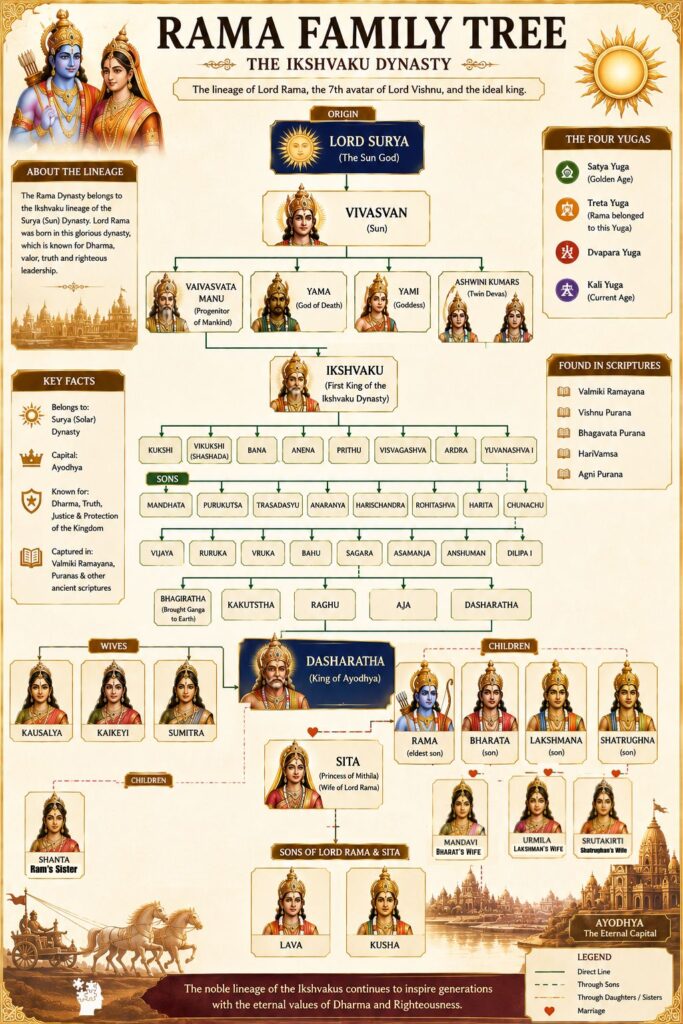
Lord Rama’s Family Lineage
From Brahma and the ancient Solar Dynasty to Lord Rama, Sita, Lava and Kusha
Ancient Ancestry of the Solar Dynasty
The traditional lineage leading toward the Ikshvaku dynasty
Many generations of kings are traditionally placed between Ikshvaku and the later Ayodhya kings. The important lineage shown here continues to Raghu, Aja and Dasharatha.
Dasharatha, His Three Queens & Four Sons
Dasharatha’s marriages and the maternal lineage of his four sons are shown separately.
Shanta is traditionally described in later accounts as a daughter of Dasharatha. Her maternal association varies among traditions, so she is shown separately here.
The Four Brothers and Their Wives
Marriage relationships are shown separately from parent-child relationships.
Rama and Sita’s Children
The next generation of Rama’s family
Rama’s Immediate Family
Lineage & Direct Ancestors (Suryavansha / Ikshvaku Dynasty)
Certainly. This is an important lineage in Hindu tradition, because it connects Brahma → Marichi → Kashyapa → Vivasvan (Surya) and ultimately to the Solar Dynasty (Suryavansha), in which Lord Rama is traditionally placed.
The Lineage
Brahma → Marichi → Kashyapa → Vivasvan (Surya) → Vaivasvata Manu → Ikshvaku → Suryavansha → Rama
Here’s what each figure means:
1. Brahma — The Creator
Brahma is traditionally described as the creator deity in the Hindu Trimurti, alongside Vishnu and Shiva.
According to the genealogical traditions found in texts such as the Puranas, Brahma produced several Prajapatis, primordial progenitors responsible for populating the world.
One of these was Marichi.
2. Marichi — Son of Brahma
Marichi is one of Brahma’s mind-born sons (Manasaputras) and is counted among the Prajapatis.
His name is commonly associated with “ray of light” or “beam of light.”
Marichi married Kala in many traditional accounts.
Their son was:
Marichi → Kashyapa
3. Kashyapa — Great Prajapati
Kashyapa is one of the most important sages in Hindu genealogical traditions.
He is described as a Prajapati, a progenitor of numerous classes of beings.
Different traditions describe Kashyapa as having several wives, including Aditi, Diti, Danu, Kadru and Vinata.
Through these different lineages, Kashyapa becomes an ancestor of many important beings.
Most relevant here is Aditi.
Kashyapa + Aditi → Vivasvan (Surya)
4. Vivasvan — Surya, the Sun
Surya is the solar deity, and Vivasvan is one of his important names.
In the Bhagavad Gita, Krishna says:
“I taught this imperishable yoga to Vivasvan, the Sun…”
Vivasvan is therefore both a name of the Sun deity and a crucial ancestor in the Solar Dynasty genealogy.
His son was:
Vivasvan (Surya) → Vaivasvata Manu
5. Vaivasvata Manu
Vaivasvata Manu is traditionally regarded as the seventh Manu, the Manu of the present Manvantara.
He is also called Shraddhadeva Manu in some traditions.
The name Vaivasvata literally connects him to Vivasvan:
Vivasvan → Vaivasvata Manu
He is especially important because Ikshvaku, the founder of the Solar Dynasty of kings, is traditionally described as his son.
6. Ikshvaku — Founder of the Solar Royal Dynasty
Manu → Ikshvaku
Ikshvaku is regarded as the founder of the Ikshvaku dynasty, which became known as the Suryavansha (Solar Dynasty).
This is the royal lineage in which Lord Rama is traditionally placed.
1.🌞 The Lineage
- Brahma (Creator) Marichi, Kashyapa, Vivasvan (Surya, Sun God)
- Vaivasvata Manu (First human / king)
- Ikshvaku (Founder of the Ikshvaku dynasty / Suryavansha)
- Key Notable Ancestors:Harishchandra, Bhagiratha (brought Ganga to Earth), Dilipa, Raghu (hence Raghuvansha), Aja (Father of Dasharatha)
2. Parents & Step-Mothers
- Father: King Dasharatha of Ayodhya
- Mother: Queen Kausalya (Primary Queen)
- Step-Mothers:
- Queen Kaikeyi
- Queen Sumitra
3. Siblings, Spouses & Children
- Sister:
- Shanta (Eldest daughter of Dasharatha & Kausalya; adopted by King Romapada; married to Sage Rishyasringa)
- Rama & His Brothers:
| Prince | Mother | Wife | Children |
| Rama | Kausalya | Sita (Daughter of Janaka) | Lava & Kusha |
| Bharata | Kaikeyi | Mandavi (Niece of Janaka) | Taksha & Pushkala |
| Lakshmana | Sumitra | Urmila (Sister of Sita) | Angada & Chitraketu |
| Shatrughna | Sumitra | Shrutakirti (Sister of Mandavi) | Subahu & Shrutasena |
4. Next Generation Kingdom Divisions
- Lava: Ruled Sravasti (or Lavapuri / Lahore).
- Kusha: Ruled Kushavati (capital near the Vindhyas) and succeeded Rama in Ayodhya.
- Taksha: Founded Takshashila (Taxila).
- Pushkala: Founded Pushkalavati (Peshawar).
- Angada & Chitraketu: Ruled regions in the Karupada / Angadiya territories.
- Subahu & Shrutasena: Ruled Mathura (after Shatrughna defeated Lavanasura) and Muru.
Ravana’s Family (Rakshasa Lineage)
Ravana’s family lineage is known easily through the given picture:
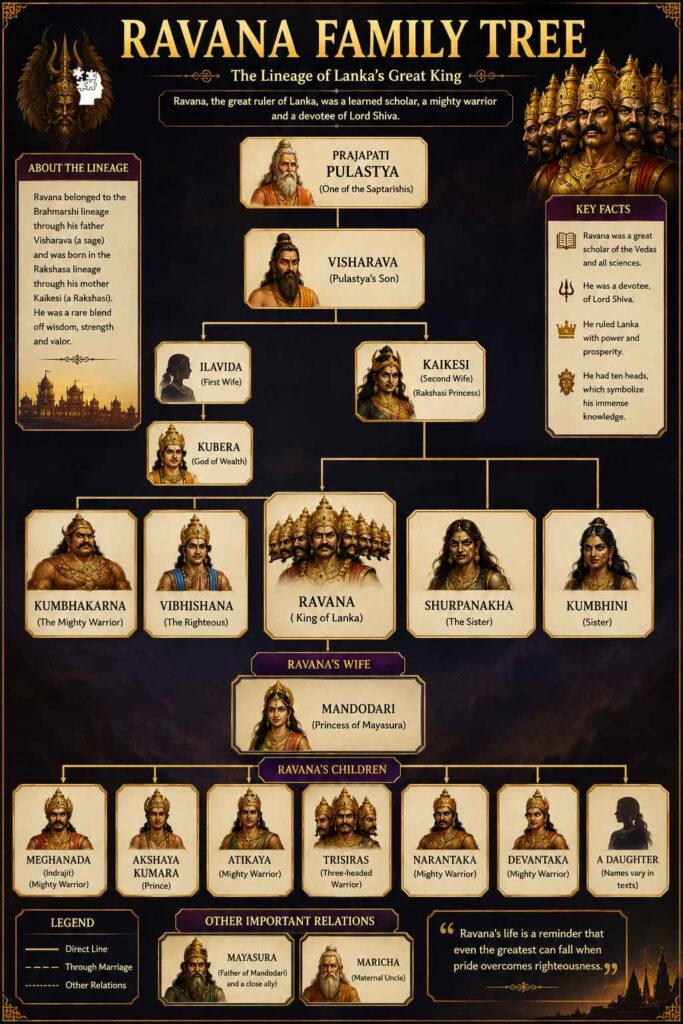
🔱 Ravana’s Ancestry
Ravana’s Ancestry Family lineage simplified below:
Ravana Family Tree
Genealogy from Brahma to Ravana and his family
Kubera and Ravana share the same father, Vishrava, but have different mothers. Kubera is the son of Ilavida, while Ravana is the son of Kaikesi.
1. 🪷 Brahma
Brahma is traditionally described as the creator deity.
Among his mind-born sons was Pulastya, one of the great sages.
Brahma → Pulastya
2. 🧘 Pulastya
Pulastya is one of the Prajapatis and one of the seven great sages in several traditions.
Pulastya had a son named Vishrava.
Pulastya → Vishrava
This is extremely important because it means Ravana is ultimately descended from Brahma through his paternal line.
3. 🧘 Vishrava
Vishrava was a powerful sage and the son of Pulastya.
Vishrava had children through different wives, most importantly:
Vishrava + Ilavida → Kubera
and
Vishrava + Kaikesi → Ravana, Kumbhakarna, Vibhishana and Shurpanakha
This creates a fascinating relationship between Kubera and Ravana.
They were half-brothers, sharing the same father, Vishrava.
👑 Ravana’s Parents
Father: Vishrava
Lineage: Brahma → Pulastya → Vishrava
Mother: Kaikesi
Kaikesi belonged to the Rakshasa lineage.
She was the daughter of Sumali, a powerful Rakshasa.
So Ravana’s ancestry combines:
Brahminical sage lineage + Rakshasa lineage
This is one reason Ravana is portrayed as an extraordinarily complex character.
Ravana’s Maternal Line
The maternal genealogy is:
Sumali → Kaikesi → Ravana
But Sumali himself belongs to an older Rakshasa family.
A simplified version is:
But Kaikesi’s own ancestry goes through the Rakshasa king Sumali.
Ravana’s Siblings
Ravana had three important full siblings:
Kumbhakarna
Ravana’s younger brother, famous for his enormous size and extraordinary sleep.
Vibhishana
Ravana’s younger brother who chose dharma over loyalty to Ravana and eventually joined Rama.
Shurpanakha
Ravana’s sister whose encounter with Rama and Lakshmana in the forest becomes one of the events leading toward Sita’s abduction.
And then there is:
Kubera — Half-brother
Kubera was the son of Vishrava and Ilavida, making him Ravana’s paternal half-brother.
Kubera was associated with wealth and became the lord of Lanka in the earlier part of the traditional story.
Ravana eventually defeated Kubera and took Lanka and the famous aerial chariot Pushpaka Vimana.
Ravana’s Own Family
Ravana’s principal wife is traditionally known as Mandodari.
Mandodari was the daughter of Mayasura and Hema in many traditional accounts.
Ravana and Mandodari had several children.
The most famous was:
Indrajit / Meghanada
Indrajit
He was Ravana’s most powerful son and earned the name Indrajit after defeating Indra.
Other sons attributed to Ravana in different traditions include Akshayakumara and Atikaya.
The fascinating connection
The most interesting part is that Ravana and Kubera were half-brothers, while Ravana himself descended from the same Brahma lineage as many important figures in Hindu cosmological genealogy.
So Ravana wasn’t simply an unrelated “demon king.”
His lineage can be understood as:
Brahma → Pulastya → Vishrava → Ravana
combined with:
Rakshasa lineage → Sumali → Kaikesi → Ravana
This makes Ravana’s genealogy a fusion of two major lineages: the sage lineage of Pulastya and the Rakshasa lineage of his mother Kaikesi.
Rama’s ancestry traces through the Solar Dynasty (Suryavansha), while Ravana’s paternal ancestry traces back to Brahma through Pulastya.
Timeline of Ramayana
Table
| Event | Traditional Age | Description |
|---|---|---|
| Divine Decision | Before Treta Yuga | Gods approach Vishnu to incarnate as Rama |
| Dasharatha’s Yagna | Early Treta Yuga | Putrakameshti sacrifice for sons |
| Birth of Rama | ~1 million+ years ago (traditional) | Rama born in Ayodhya |
| Childhood & Education | 0–16 years | Training under Vashishtha and Vishwamitra |
| Tataka’s Defeat | Age 16 | First major demon slaying |
| Sita Swayamvara | Age 16 | Marriage to Sita in Mithila |
| Married Life | 16–28 years | Twelve years of bliss in Ayodhya |
| Coronation Conspiracy | Age 28 | Kaikeyi’s demands; exile begins |
| Forest Entry | Year 1 of exile | Arrival at Chitrakoot; Bharata’s visit |
| Panchavati | Years 10–13 | Settlement and Shurpanakha incident |
| Sita’s Abduction | Year 13 | Ravana takes Sita to Lanka |
| Search Begins | Year 13 | Alliance with Sugriva; Hanuman’s mission |
| Hanuman in Lanka | Year 13 | Discovery of Sita; burning of Lanka |
| Bridge Construction | Year 14 | Rama Setu built; army crosses |
| War and Ravana’s Death | Year 14 | Great battles; fall of Ravana |
| Return to Ayodhya | Year 14 | End of exile; coronation as king |
| Rama Rajya | 14+ years | Ideal reign |
| Sita’s Exile | ~15–16 years after return | Separation due to public doubt |
| Birth of Twins | During exile | Lava and Kusha born in Valmiki’s ashram |
| Ashwamedha Yagna | Many years later | Reunion with sons |
| Sita’s Return to Earth | After Yagna | Descent into Bhumi |
| End of Rama’s Life | Thousands of years later | Return to Vaikuntha |
Geography of Ramayana
The Ramayana spans a vast geographical area, from the Himalayan foothills to the island of Sri Lanka. Many sites mentioned in the epic are identifiable today:
Ayodhya (Uttar Pradesh, India)
The capital of Kosala and Rama’s birthplace. Located on the banks of the Sarayu River, it remains one of Hinduism’s seven sacred cities. The Ram Janmabhoomi temple marks the traditional birthplace.
Mithila (Janakpur, Nepal / Bihar, India)
The kingdom of King Janaka and Sita’s birthplace. Janakpur in Nepal is a major pilgrimage site, while the ancient city is associated with regions in modern Bihar.
Chitrakoot (Madhya Pradesh/Uttar Pradesh, India)
The forest retreat where Rama, Sita, and Lakshmana spent their early exile. It is here that Bharata met them and where the sage Atri and his wife Anasuya blessed them.
Dandakaranya (Central India)
The vast forest region where the trio wandered for years. It covers parts of modern Chhattisgarh, Maharashtra, Odisha, and Andhra Pradesh.
Panchavati (Near Nashik, Maharashtra, India)
The site of their hut on the Godavari River, where Sita was abducted. Modern Nashik and nearby areas are associated with this location.
Kishkindha (Hampi, Karnataka, India)
The monkey kingdom, identified with the region around Hampi in Karnataka. The Rishyamukha mountain and Malyavanta hill are associated with Sugriva’s refuge.
Rameswaram (Tamil Nadu, India)
The southern tip of India where Rama prayed to Lord Shiva before building the bridge to Lanka. The Ramanathaswamy Temple is one of India’s holiest shrines.
Lanka (Sri Lanka)
Ravana’s kingdom. Many sites in Sri Lanka are associated with the epic:
- Sita Eliya (Sita’s prison in the Ashoka Grove)
- Divurumpola (where Sita underwent the fire test)
- Ravana Ella (Ravana’s cave)
- Kataragama (associated with Skanda/Kartikeya and the war)
Ram Setu (Adam’s Bridge)
The chain of shoals and sandbanks connecting India and Sri Lanka. Traditional belief holds that this was the bridge built by Rama’s army, while science describes it as a natural formation.
Important Weapons
The Ramayana features an arsenal of divine weapons (astras), each with specific powers and significance:
Brahmastra
The most powerful weapon in the epic, derived from Lord Brahma. It is said to be capable of destroying the entire universe. Rama uses it to kill Ravana, and Indrajit uses it against Lakshmana. Its use is restricted by strict moral codes—it cannot be used against unarmed opponents or in unjust causes.
Agneyastra
The fire weapon of Agni, the fire god. It creates flames that cannot be extinguished by normal means. Used to destroy demonic forces and structures.
Pashupatastra
The weapon of Lord Shiva, the most destructive astra in existence. It is said to be capable of destroying all creation. Rama possesses this weapon but does not use it in the war, demonstrating restraint.
Aindrastra (Indra Astra)
The weapon of Indra, king of the gods. Lakshmana uses this to kill Indrajit. It represents the power of divine authority.
Nagastra
The serpent weapon that binds the target with supernatural serpents. Indrajit uses this to incapacitate Rama and Lakshmana, who are freed only by Garuda’s intervention.
Varunastra
The water weapon of Varuna, the ocean god. Used to create floods and water-based attacks.
Vayavyastra
The wind weapon of Vayu, the wind god. Creates devastating storms and tornadoes.
Gandharvastra
A weapon that creates illusions and confusion, derived from the Gandharvas (celestial musicians).
Significance
These weapons are not merely tools of war—they represent cosmic forces harnessed by those with the spiritual authority to wield them. Their use is always tied to dharma, and misuse brings severe consequences.
Lessons from Ramayana
The Ramayana is not just a story to be read—it is a manual for living. Its lessons span every aspect of human life:
Leadership
Rama’s leadership is defined by service rather than domination. He eats only after his subjects have eaten. He walks through his kingdom to hear their grievances. A true leader, the Ramayana teaches, sacrifices personal comfort for public welfare.
Duty (Dharma)
The central theme of the epic. Rama chooses exile because it is his father’s word. Bharata refuses the throne because it is not rightfully his. Lakshmana serves without expectation. Dharma is not about what is easy—it is about what is right.
Sacrifice
Every major character makes profound sacrifices: Dasharatha gives his life, Sita gives up palace comfort, Lakshmana leaves his wife, Bharata rejects power, Hanuman risks his life. The epic teaches that greatness is born from sacrifice.
Respect
Rama treats everyone with respect—sages, demons, animals, and outcasts. He performs the last rites for the demon Jatayu. He accepts Shabari’s tasted berries. Respect is not based on status but on the inherent dignity of all beings.
Loyalty
The bonds between the brothers are the emotional core of the epic. Lakshmana never leaves Rama’s side. Bharata waits fourteen years. Hanuman serves without question. True loyalty is not blind obedience but committed support.
Brotherhood
The four brothers represent the ideal of fraternal unity. Even when separated by conspiracy, their love remains unbroken. The Ramayana teaches that family bonds are sacred but must be grounded in righteousness.
Marriage
Rama and Sita’s relationship is the model for Hindu marriage: monogamous, devoted, and respectful. Even in separation, their bond remains unbreakable. Sita’s choice to follow Rama into exile and Rama’s grief at her loss demonstrate that true marriage is a partnership of souls.
Governance
Rama Rajya is the ideal state: where justice is swift, the vulnerable are protected, and the ruler is accountable. The epic teaches that governance is a sacred trust, not a privilege.
Truth
Rama is called Satyavadi—the speaker of truth. His commitment to truth is absolute, even when it causes personal pain. The Ramayana teaches that truth is the foundation of all virtue.
Patience
Bharata waits fourteen years. Sita endures captivity without despair. Hanuman searches tirelessly. The epic demonstrates that patience is not passivity but persistent faith.
Humility
Despite being the Supreme Lord, Rama never claims divinity. He weeps, doubts, and struggles like any human. His humility makes him accessible and relatable. True greatness, the epic shows, does not need to announce itself.
Scientific and Engineering Discussions
The Ramayana has inspired numerous scientific and engineering debates, particularly in India:
Ram Setu (Adam’s Bridge)
The most discussed topic is the bridge connecting India and Sri Lanka. Satellite imagery shows a 48-kilometer chain of shoals and sandbanks. The debate centers on:
- Traditional view: The bridge was built by Rama’s monkey army under the architect Nala, using stones that floated because Rama’s name was inscribed on them.
- Scientific view: Geological studies suggest it is a natural formation of limestone shoals, approximately 5,000–7,000 years old.
- Middle ground: Some researchers propose that natural formations may have been enhanced or utilized by ancient builders.
The Government of India declared Ram Setu a protected national monument in 2021, acknowledging its cultural significance.
Floating Stones
In various temples (particularly at Rameswaram), stones are displayed that are said to be from the original bridge. These pumice stones can indeed float due to their porous structure, though whether they came from the specific bridge is a matter of faith.
Astronomy References
The Ramayana contains detailed astronomical descriptions—positions of planets, stars, and constellations during Rama’s birth and other events. Researchers like Pushkar Bhatnagar have used planetarium software to propose dates around 5114 BCE for Rama’s birth, based on these descriptions. However, these calculations depend on interpretations of specific verses and are debated among scholars.
Ancient Cities
Archaeological excavations at Ayodhya have revealed continuous habitation dating back to at least the first millennium BCE, with some findings suggesting earlier settlement. The Saryu River course and ancient structures align with textual descriptions.
Distinguishing Tradition from Evidence
It is crucial to distinguish between:
- Traditional beliefs held by millions of devotees
- Textual descriptions from the Valmiki Ramayana
- Scientific and archaeological findings
Each has its own validity and context. The Ramayana’s spiritual and cultural significance does not depend on archaeological verification, just as scientific findings do not diminish its philosophical value.
Ramayana Around the World
The Ramayana is not merely an Indian epic—it is an Asian epic. Its influence extends across cultures and nations:
Thailand: Ramakien
The Thai version, Ramakien, is the national epic of Thailand. It is performed in the Khon masked dance tradition and depicted in murals at the Grand Palace in Bangkok. While the core story remains, Thai adaptations incorporate local deities and cultural elements. Hanuman is particularly popular and is depicted as a playful, romantic figure rather than purely ascetic.
Indonesia: Kakawin Ramayana
In Indonesia (both Java and Bali), the Kakawin Ramayana (written in Old Javanese) is a masterpiece of classical literature. The Prambanan temple in Java features extensive Ramayana reliefs. In Bali, the Kecak dance (performed by chanting men) dramatizes Hanuman’s burning of Lanka. The Indonesian version emphasizes Ravana’s nobility and presents a more balanced view of the conflict.
Cambodia: Reamker
The Cambodian version, Reamker, is depicted in the bas-reliefs of Angkor Wat—the world’s largest religious monument. The Cambodian adaptation blends Hindu and Buddhist elements and places greater emphasis on Hanuman’s romantic adventures and the monkey army’s exploits.
Nepal: Siddhi Ramayana
Nepal, as the birthplace of Sita (Janakpur), holds the Ramayana in special reverence. The Siddhi Ramayana in Nepali and various Newari versions exist. The Janakpur temple complex is a major pilgrimage site.
Sri Lanka: Ramayana Trail
In Sri Lanka, the Ramayana is part of the cultural memory, particularly among Tamil and Sinhala communities. The Ramayana Trail connects sites associated with the epic:
- Sita Eliya (Sita’s prison)
- Divurumpola (fire ordeal site)
- Ravana Ella (cave and waterfall)
- Munneswaram and Manavari (where Rama prayed to Shiva)
Malaysia: Hikayat Seri Rama
The Malay version, Hikayat Seri Rama, shows strong Islamic and local influences. It was likely composed between the 13th and 17th centuries and reflects the Sufi tradition’s emphasis on spiritual love.
Laos: Phra Lak Phra Ram
The Lao national epic, Phra Lak Phra Ram (Lakshmana and Rama), is performed during festivals. It incorporates Buddhist themes and local folklore, with Hanuman again playing a central and often comic role.
Myanmar: Yama Zatdaw
The Burmese version, Yama Zatdaw, is performed in puppet theater and classical drama. It emphasizes Rama’s royal dignity and incorporates Burmese court traditions.
Global Influence
Beyond Asia, the Ramayana has inspired:
- Western literature (translations by Ralph Griffith, R.K. Narayan, and others)
- Academic study in universities worldwide
- Modern adaptations in film, television, and graphic novels
- Comparative mythology studies linking Rama to other hero figures
Different Versions of Ramayana
The story of Rama has been told and retold in hundreds of languages and forms. The major versions include:
Valmiki Ramayana
The oldest and most authoritative version, composed in Sanskrit around 500 BCE–100 BCE. It consists of seven Kandas and approximately 24,000 verses. It is considered the source text for all subsequent versions. Its tone is more human and less explicitly devotional than later adaptations.
Ramcharitmanas (Tulsidas)
Composed in Awadhi Hindi by the 16th-century saint Goswami Tulsidas, the Ramcharitmanas is the most beloved version in North India. Written during a period of Islamic rule, it made Rama’s story accessible to the common people. Its language is simple, its devotion intense, and its philosophy deeply influenced by Ramanandi Vaishnavism. The famous verse “Sri Ramachandra Kripalu Bhajamana” comes from this text.
Kamba Ramayanam (Tamil)
Composed by the poet Kamban in the 12th century CE, this Tamil version is considered a masterpiece of Dravidian literature. Kamban took significant creative liberties, expanding scenes and adding psychological depth. His description of the monsoon (as Hanuman leaps across the ocean) is legendary. The Kamba Ramayanam is longer than Valmiki’s version and is central to Tamil culture.
Adhyatma Ramayana
Attributed to Vyasa (though likely composed later), this Sanskrit text presents the Ramayana as an explicitly spiritual allegory. Rama is clearly identified as Brahman (the Absolute), Sita as the individual soul (jiva), and Ravana as ego (ahankara). It influenced the Ramcharitmanas and other devotional texts.
Anand Ramayan
A later Sanskrit text that expands on the Uttara Kanda, adding many stories not found in Valmiki’s version.
Adbhuta Ramayana
A Sanskrit text focusing on Sita’s warrior aspect. In this version, Sita transforms into Kali and destroys a thousand-headed Ravana (Mahiravana), demonstrating that the divine feminine is the ultimate power.
Jain Ramayanas
In Jain tradition, Rama is a liberated soul (siddha) rather than an incarnation of God. Lakshmana kills Ravana (not Rama), and the story emphasizes non-violence and karmic consequences.
Buddhist Ramayanas
In some Buddhist traditions (particularly in Laos and Thailand), Rama is a Bodhisattva (enlightened being), and the story is adapted to Buddhist ethics.
Southeast Asian Versions
As discussed above, the Thai, Indonesian, Cambodian, Malay, and Lao versions all represent unique cultural adaptations while maintaining the core narrative.
Fascinating Facts
- Longest Epic Tradition: While the Valmiki Ramayana has ~24,000 verses, the tradition of Rama stories across languages comprises millions of verses. If all versions were compiled, it would be the largest epic tradition in human history.
- Hanuman’s Powers: According to tradition, Hanuman possesses Ashta Siddhi (eight perfections) and Nava Nidhi (nine treasures), including the ability to become as small as an atom or as large as a mountain.
- Ravana’s Scholarship: Despite being the villain, Ravana was a master of the Vedas, a skilled Veena player, and an astrologer. His ten heads symbolize his mastery over the four Vedas and six Shastras.
- Valmiki’s Poetry: The Ramayana introduced the Anushtubh meter to Sanskrit, which became the standard for all later epics and Puranas.
- Ram Setu Length: The bridge is approximately 48 kilometers (30 miles) long and separates the Palk Strait from the Gulf of Mannar.
- Animals in the Ramayana: The epic features an extraordinary cast of animal allies—Hanuman (monkey), Jambavan (bear), Jatayu and Sampati (vultures), Garuda (eagle), and the squirrel who helped build the bridge (and received Rama’s blessing in the form of stripes).
- Ayodhya’s Size: Traditional texts describe Ayodhya as 12 yojanas long and 3 yojanas wide (approximately 150 km × 38 km), with magnificent palaces and gardens.
- Rama’s Name: The name Rama is considered a Taraka Mantra—a name powerful enough to grant liberation. In the Ramcharitmanas, Shiva tells Parvati that Rama’s name is greater than Rama himself.
- Lakshmana’s Sleep: According to tradition, Lakshmana did not sleep for the entire 14 years of exile to guard Rama and Sita. His wife Urmila slept in his place, which is why she is not mentioned during the forest years.
- Sita’s Age: Sita is said to have been around 6 years old at her marriage (according to some traditional calculations), though this is interpreted differently across traditions.
- Ravana’s Boons: Ravana had secured boons from Brahma and Shiva that made him invulnerable to gods, demons, and celestial beings—but not to humans and monkeys, which is why Vishnu incarnated as Rama (human) with monkey allies.
- Pushpaka Vimana: Ravana’s aerial chariot is one of the earliest descriptions of a flying vehicle in world literature. It was originally owned by Kubera (god of wealth) and was stolen by Ravana.
Ramayana in Modern Pop Culture
The Ramayana has never ceased to inspire creative adaptation:
Television
- Ramayan (1987): Directed by Ramanand Sagar, this TV series became the most-watched television show in Indian history, drawing over 100 million viewers per episode. It defined how generations visualize Rama, Sita, and Hanuman.
- Ramayan (2008): A remake by NDTV Imagine.
- Siya Ke Ram (2015): Told from Sita’s perspective, offering a feminist reimagining.
- The Legend of Hanuman (2021): An animated series on Disney+ Hotstar that became hugely popular among younger audiences.
Animation
- Ramayana: The Legend of Prince Rama (1992): A Japanese-Indian co-production considered one of the finest animated adaptations. It was directed by Yugo Sako and featured stunning hand-drawn animation.
- Hanuman (2005): An Indian animated film focusing on Hanuman’s childhood.
Comics
- Amar Chitra Katha, India’s iconic comic book series, has published numerous Ramayana titles that introduced the epic to millions of children.
Film
- Lanka Dahan (1917): One of India’s earliest films, directed by Dadasaheb Phalke, depicted Hanuman burning Lanka.
- Sampoorna Ramayanam (1958): A Tamil classic.
- Lava Kusha (1963): A Telugu/Tamil film about Rama’s sons.
- Raavan (2010): Mani Ratnam’s modern retelling with moral ambiguity.
- Adipurush (2023): A high-budget adaptation that generated significant debate over its visual effects and dialogue.
Global Influence
- The Forest Book and other Western works draw indirect inspiration from the Ramayana’s narrative structure.
- Graphic novels in the West have adapted the epic for new audiences.
- Video games featuring Rama and Hanuman have been developed for mobile platforms.
Upcoming Ramayana Movie
One of the most anticipated film projects in Indian cinema is the upcoming Ramayana adaptation by director Nitesh Tiwari, known for Dangal and Chhichhore. While details continue to evolve, here is what has been officially confirmed or widely reported:
Why the Anticipation?
The Ramayana has been adapted numerous times, but modern audiences are eager for a technologically advanced, visually spectacular retelling that matches the scale of international epics like Lord of the Rings or Baahubali. Given India’s growing VFX capabilities and the global interest in Indian mythology, expectations are sky-high.
Cast (Officially Announced/Reported)
- Ranbir Kapoor is reportedly playing Lord Rama
- Sai Pallavi is reportedly playing Sita
- Yash (of KGF fame) is reportedly playing Ravana
- Sunny Deol is reportedly playing Hanuman
Note: Casting details should be verified against the latest official announcements as they may change.
Director and Production
- Director: Nitesh Tiwari
- Producers: The film is being produced on a massive budget reportedly exceeding ₹500 crore (approximately $60 million USD), making it one of the most expensive Indian films ever made.
- Visual Effects: The production is reportedly collaborating with international VFX studios to create never-before-seen depictions of Lanka, the monkey army, the bridge, and the celestial weapons.
Trailer in Hindi Language
English Language trailer
Planned Release
The film is expected to be released in two parts, similar to Baahubali and KGF, to do justice to the epic’s scope. The first part relasing on 6 November 2026.
How It Differs from Previous Adaptations
- Scale: Modern VFX allows for realistic depictions of the Pushpaka Vimana, the ocean leap, and the war scenes.
- Realism: Reports suggest a more grounded, humanized approach to the characters rather than purely divine portrayals.
- Global Appeal: The film is expected to be released in multiple languages and potentially international markets, introducing the Ramayana to new audiences.
Frequently Asked Questions
Who wrote the Ramayana?
The Ramayana was composed by Maharishi Valmiki, revered as the first poet (Adi Kavi) of Sanskrit literature.
How old is the Ramayana?
Traditional Hindu belief places the events in the Treta Yuga, millions of years ago. Scholars generally date the written text between 500 BCE and 100 BCE, though it draws on much older oral traditions.
How many chapters (verses) are in the Ramayana?
The Valmiki Ramayana contains approximately 24,000 verses across seven Kandas. Some versions include additional verses, particularly in the Uttara Kanda.
Who killed Ravana?
Lord Rama killed Ravana on the seventh day of their final battle, using the Brahmastra to strike at Ravana’s navel where his nectar of immortality was stored.
Why did Rama go into exile?
Rama went into exile to honor his father Dasharatha’s promise to his stepmother Kaikeyi. Dasharatha had granted Kaikeyi two boons, and she demanded that Rama be exiled for 14 years and her son Bharata be crowned.
Who was Hanuman?
Hanuman is the monkey god, son of the wind god Vayu, and the greatest devotee of Lord Rama. He is known for his strength, wisdom, humility, and his leap across the ocean to find Sita in Lanka.
Is the Ramayana older than the Mahabharata?
Traditionally, yes. The Ramayana is set in the Treta Yuga, while the Mahabharata occurs in the subsequent Dwapara Yuga. Hindu chronology places the Treta Yuga before the Dwapara Yuga, making Rama’s incarnation anterior to Krishna’s. The Ramayana is often called Adi Kavya (the first epic), and the Mahabharata itself refers to Rama’s story as an earlier, established tradition.
Recommended for you: