
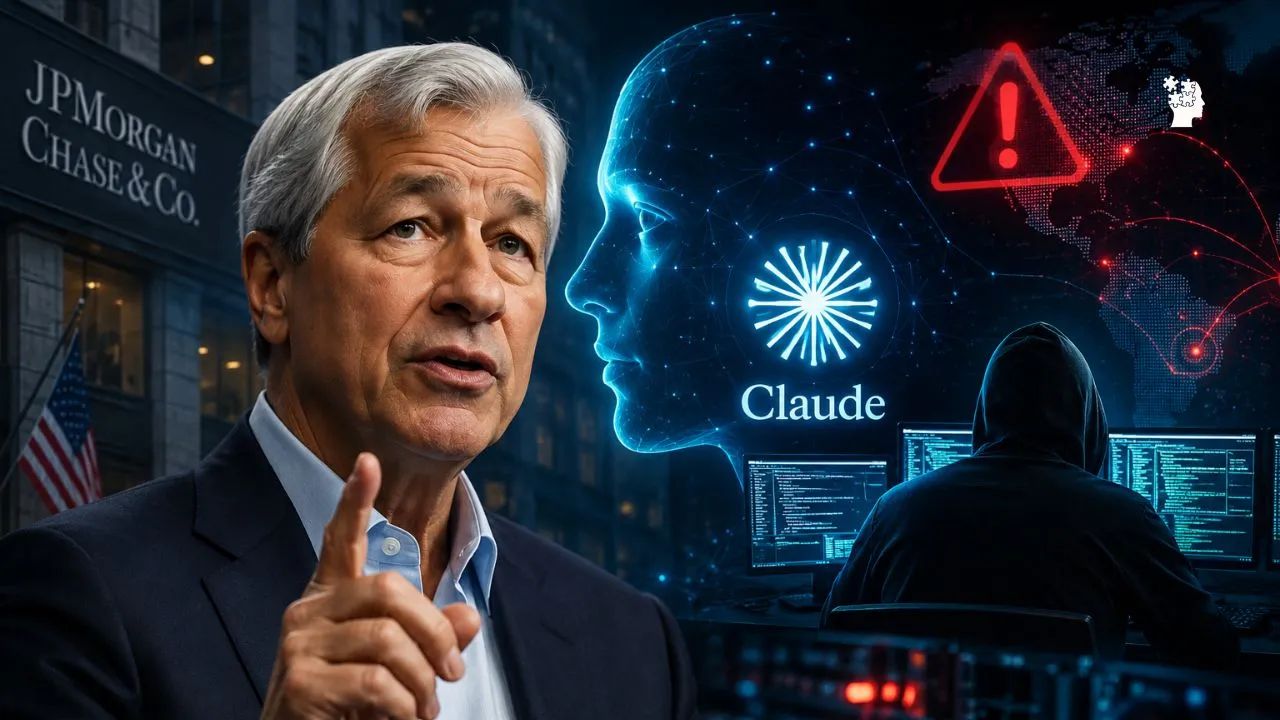
Artificial intelligence has reached another turning point—and this time, the warning isn’t coming from an AI researcher.
It’s coming from JPMorgan Chase CEO Jamie Dimon, one of the most influential voices in global finance.
During JPMorgan’s latest earnings discussion, Dimon described the risks surrounding Anthropic’s Mythos AI as a “real issue” and suggested that the U.S. government is actively working to manage those risks.
At first glance, the statement might sound like another executive expressing caution about AI. But when viewed alongside recent government actions, Anthropic’s restrictions, and growing concerns over cybersecurity, it points to a much larger story.
The debate is no longer about whether AI will change the world.
The debate is about who should be allowed to use the most powerful AI systems—and under what conditions.
Table of Contents
Why Jamie Dimon’s Comments Matter
Jamie Dimon doesn’t usually make headlines for discussing experimental AI models.
As CEO of the largest U.S. bank, his public warnings often reflect risks that major financial institutions are already evaluating internally.
Banks process trillions of dollars, store enormous amounts of sensitive customer data, and remain constant targets for cybercriminals.
If a frontier AI system can rapidly discover software weaknesses or automate sophisticated cyberattacks, banks could become one of its most immediate testing grounds.
That explains why Dimon’s comments are attracting attention far beyond Wall Street.
What Is Anthropic’s Mythos AI?
Unlike general-purpose AI assistants that answer questions or generate content, Mythos is believed to specialize in advanced cybersecurity analysis.
Reports suggest the model can identify an enormous number of software vulnerabilities across complex systems.
Supporters argue this capability could dramatically improve cyber defense by helping organizations discover weaknesses before attackers exploit them.
Critics point out the opposite risk:
An AI that can find vulnerabilities could also become an extraordinarily effective offensive tool if it falls into the wrong hands.
This dual-use nature is exactly what makes frontier cybersecurity AI so controversial.
Why the U.S. Government Stepped In
The government’s reported restrictions on access to Mythos illustrate how AI policy is changing.
Rather than treating every AI model the same, regulators are increasingly distinguishing between consumer chatbots and systems that could influence national security.
Models capable of discovering software flaws, assisting cyber operations, or accelerating digital attacks are now being viewed much like other strategically important technologies.
The question is shifting from “Can companies build these models?” to “Who should be trusted to use them?”
Why Banks Are Paying Close Attention
Financial institutions face millions of attempted cyberattacks every year.
Traditional security relies on teams of analysts manually searching for vulnerabilities.
AI changes that equation.
An advanced cybersecurity model can review massive codebases in hours rather than weeks, allowing defenders to patch weaknesses far faster than before.
However, the same acceleration benefits attackers.
Instead of manually researching exploits, malicious actors could theoretically automate much of the discovery process.
That creates an AI arms race where defenders and attackers are both becoming dramatically more capable.
The Bigger Issue: AI Is Becoming Infrastructure
The Mythos debate isn’t really about one model.
It’s about what happens when AI becomes essential infrastructure.
Just as electricity transformed factories and the internet reshaped communication, advanced AI is becoming foundational for finance, healthcare, defense, and government.
When a technology becomes critical infrastructure, governments inevitably become more involved.
That is already happening.
Countries around the world are developing rules governing advanced AI models, export controls, and security requirements.
The Mythos controversy may simply be one of the earliest examples of this broader trend.
AI Investment Is Also Changing the Workplace
Dimon’s comments also touched on another issue many businesses are quietly experiencing.
AI isn’t only creating new capabilities—it is changing how organizations operate.
Across industries, companies are using AI to automate repetitive work, accelerate decision-making, improve customer service, and streamline software development.
For some teams, that means higher productivity.
For others, it may mean fewer traditional roles.
This raises an increasingly important challenge for governments and employers: helping workers adapt as AI reshapes the labor market.
The speed of adoption could determine whether AI becomes primarily an economic opportunity or a source of disruption.
Why Cybersecurity Could Become AI’s Biggest Battleground
Generative AI first gained popularity through writing, coding assistance, and image generation.
The next phase may revolve around cybersecurity.
Advanced AI systems can already:
- Analyze enormous software projects
- Detect hidden vulnerabilities
- Simulate cyberattacks
- Recommend security patches
- Prioritize the most dangerous weaknesses
Those capabilities have tremendous defensive value.
But because the same tools could potentially assist attackers, governments and technology companies face difficult decisions about openness, access, and oversight.
What Businesses Should Learn From This
The Mythos debate highlights several lessons for organizations adopting AI.
Security must become a strategic priority.
Companies cannot assume AI only improves productivity. Every new capability introduces new risks that require governance, monitoring, and careful deployment.
Responsible access matters.
As AI systems become more powerful, organizations will likely need stricter approval processes, usage monitoring, and compliance controls.
Workforce planning cannot wait.
Businesses investing heavily in AI should also invest in employee training so workers can transition into higher-value roles rather than being displaced by automation.
What This Means for Everyday Users
Most people will never interact directly with a frontier cybersecurity model like Mythos.
But the decisions being made today will influence the future of digital security.
If advanced AI helps organizations identify vulnerabilities before criminals do, users could benefit from safer software, fewer data breaches, and stronger online services.
If safeguards fail, however, the same technology could increase the sophistication of cyber threats.
The challenge isn’t whether AI is good or bad.
It’s whether society can deploy increasingly powerful systems responsibly while minimizing their misuse.
Final Thoughts
Jamie Dimon’s warning reflects a growing reality: the conversation around AI has moved beyond chatbots and productivity tools.
The next generation of AI is being judged by a different standard—its ability to influence national security, financial stability, and critical infrastructure.
Anthropic’s Mythos AI has become a symbol of that shift.
Whether it ultimately proves to be a breakthrough defensive technology or a model requiring permanent restrictions, one thing is clear: the future of AI will be defined not only by what these systems can do, but also by who gets to use them and how they are governed.
Recommended for you: