
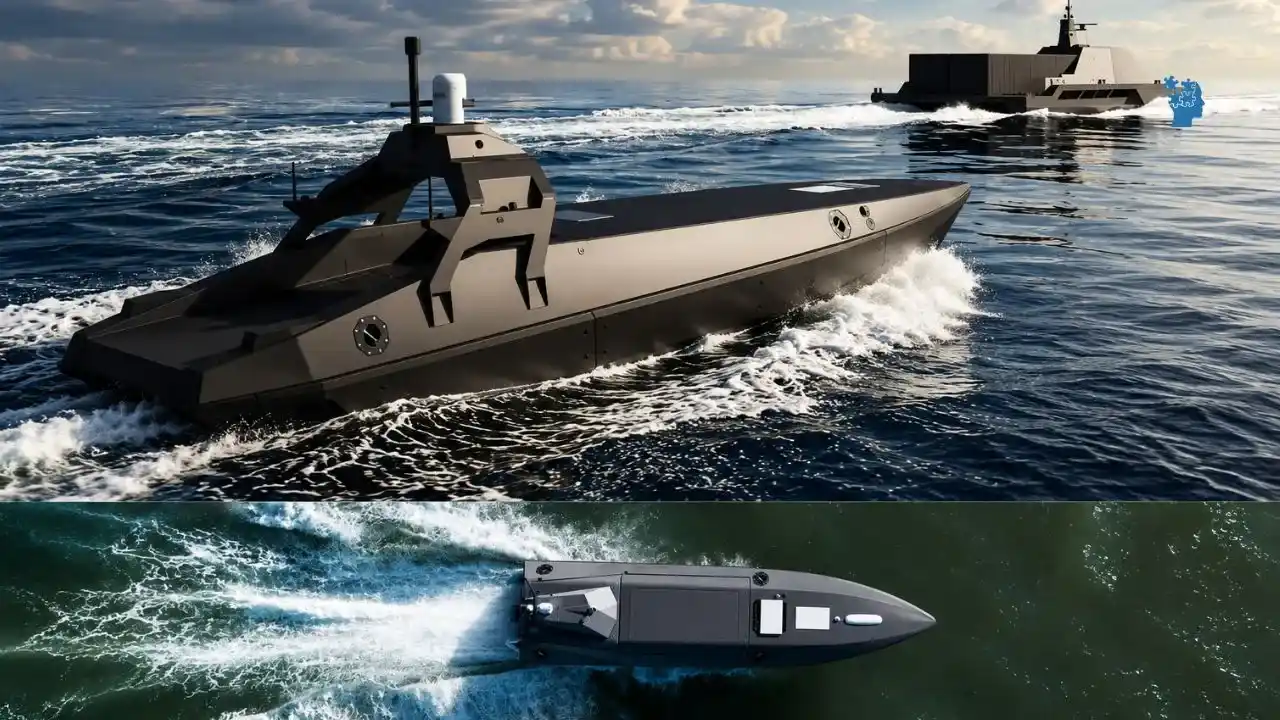
Five years ago, few people outside the defence industry had heard of Kraken Technology Group.
Today, the British startup has joined Europe’s growing list of billion-dollar defence companies after raising $175 million in Series B funding, reaching a valuation of $1 billion.
But the funding itself isn’t the biggest story.
The real story is what investors are betting on.
Instead of traditional warships costing hundreds of millions of dollars, militaries around the world are increasingly looking toward autonomous, high-speed drone boats that can perform dangerous missions without putting sailors at risk.
Kraken’s latest funding round suggests that this shift is accelerating faster than many expected.
Table of Contents
The Bigger Picture: Why Investors Suddenly Love Defence Startups
Only a few years ago, many venture capital firms avoided defence technology.
Today the opposite is happening.
Conflicts in Europe, the Middle East and the Indo-Pacific have fundamentally changed how governments think about military technology.
Investors now see defence startups as one of the fastest-growing sectors because governments are increasing defence budgets while demanding faster innovation than traditional defence contractors can provide.
Kraken is one of the clearest examples of that trend.
What Does Kraken Actually Build?
Unlike traditional shipbuilders, Kraken focuses on uncrewed surface vessels (USVs).
These vessels operate with little or no onboard crew and can perform missions such as:
- Intelligence gathering
- Coastal surveillance
- Logistics support
- Mine detection
- Force protection
- Maritime reconnaissance
Because they don’t carry large crews, they can enter dangerous waters where sending sailors would be risky.
They also cost significantly less than conventional naval ships.
Why Drone Boats Are Becoming the Navy’s Next Big Weapon
Modern naval warfare is changing rapidly.
Recent conflicts have demonstrated that relatively inexpensive autonomous systems can threaten much larger and more expensive military assets.
Instead of relying solely on destroyers, frigates and patrol ships, navies increasingly want fleets of smaller autonomous vessels that can work together.
Advantages include:
Lower costs
One autonomous vessel can cost only a fraction of a traditional warship.
Reduced risk
Human lives are not placed directly in harm’s way.
Faster deployment
Smaller platforms can often be produced much more quickly.
Better surveillance
Autonomous vessels can patrol large areas continuously without exhausting crews.
This is one of the reasons governments are rapidly increasing investment in maritime robotics.
Why NATO and Major Investors Backed Kraken
Kraken’s funding round attracted an unusually diverse group of investors.
Support came not only from venture capital firms but also from organisations connected to national security and defence.
That matters because defence technology companies often depend on long-term government contracts.
Backing from defence-focused investors can provide both financial support and credibility as companies expand internationally.
It also signals confidence that autonomous maritime systems will remain a strategic priority for years to come.
The Race Against Anduril and Other Defence Tech Giants
Kraken isn’t entering an empty market.
Companies like Anduril Industries have already demonstrated how AI-powered autonomous defence systems can disrupt traditional military procurement.
Kraken’s strategy appears focused specifically on maritime operations rather than a broader defence portfolio.
That specialization could become a competitive advantage if naval autonomy continues growing faster than expected.
Why This Funding Matters Beyond the United Kingdom
Although Kraken is headquartered in Britain, its ambitions are global.
The company already collaborates with manufacturing partners in Germany, North America and other regions.
This reflects a broader trend.
Rather than relying on a single manufacturing base, defence companies increasingly establish regional production to meet local security requirements and government procurement rules.
That approach could allow Kraken to scale much faster than previous generations of defence startups.
Risks Investors Should Watch
Despite the excitement, several challenges remain.
Government contracts take time
Military procurement processes are often lengthy and unpredictable.
Competition is increasing
Large defence contractors are investing heavily in autonomous maritime systems.
Geopolitical uncertainty
Demand depends partly on global security conditions and defence spending priorities.
Technology must prove itself
Autonomous systems must demonstrate reliability in real-world operations before large-scale adoption.
What This Means for the Future of Naval Warfare
The most important takeaway from Kraken’s funding isn’t simply that another startup became a unicorn.
It’s that autonomous maritime systems are moving from experimental projects to mainstream military planning.
Just as drones transformed aerial surveillance and combat over the past decade, autonomous vessels could reshape naval operations during the next one.
Governments appear increasingly willing to invest in technologies that are faster to build, cheaper to deploy and capable of operating in contested environments with minimal human risk.
Kraken’s latest funding suggests investors believe that future has already begun.
Final Thoughts
Kraken’s $175 million funding round is more than another venture capital headline.
It highlights a broader transformation taking place across the defence industry, where autonomous systems, artificial intelligence and lower-cost military platforms are becoming central to future strategy.
Whether Kraken ultimately becomes a dominant defence contractor remains to be seen.
But one thing is already clear: investors, governments and military planners are placing increasingly large bets on autonomous maritime technology—and Kraken has positioned itself at the center of that shift.
Recommended for you: