
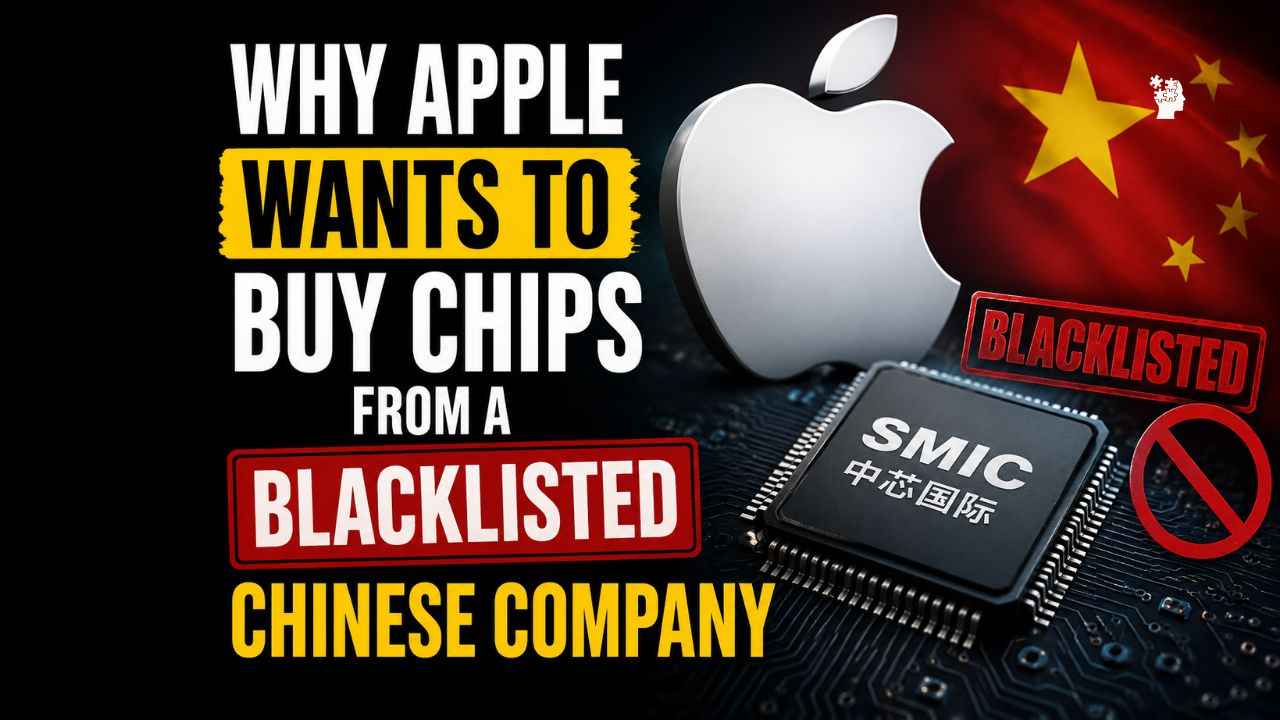
Just a few years ago, the idea of Apple asking Washington for permission to buy chips from a Pentagon-blacklisted Chinese company would have seemed impossible.
Today, it is becoming reality.
According to recent reports, Apple has approached the Trump administration seeking approval to purchase memory chips from Chinese manufacturer ChangXin Memory Technologies (CXMT), a company recently added to the Pentagon’s Chinese Military Company list.
At first glance, this looks like another chapter in the ongoing US-China technology conflict.
But the real story is much bigger.
It highlights a growing problem affecting nearly every major technology company: the AI boom is consuming enormous amounts of memory chips, driving prices higher and forcing even the world’s richest companies to rethink their supply chains.
The decision could influence not only Apple’s future products but also the price consumers pay for Macs, iPads, and potentially even future iPhones.
Table of Contents
What Is Actually Happening?
Reports indicate Apple is requesting government approval to source memory chips from CXMT.
Although the company is not under a complete trade ban, its inclusion on the Pentagon’s blacklist creates significant legal and political uncertainty for American firms.
Apple appears to be seeking clarity before expanding any business relationship.
The request comes just after Apple increased prices on several Mac and iPad models, citing soaring memory costs driven by unprecedented AI infrastructure demand.
Why Are Memory Chips Suddenly So Expensive?
This is the question most articles barely explain.
Artificial intelligence has dramatically changed the semiconductor market.
Modern AI systems require massive amounts of high-speed memory to process enormous datasets.
Companies investing heavily include:
- OpenAI
- Microsoft
- Amazon
- Meta
- Oracle
- Tesla
Every new AI data center needs thousands of advanced memory chips.
That explosive demand has tightened global supply.
Unlike processors, memory chips are manufactured by only a handful of companies capable of producing them at scale.
As demand rises faster than production capacity, prices inevitably increase.
Apple now faces substantially higher component costs across many of its devices.
Why Doesn’t Apple Simply Buy From American Companies?
This is where the story becomes particularly interesting.
The United States has relatively few major memory chip manufacturers compared with Asia.
Most global memory production comes from companies based in:
- South Korea
- Japan
- China
- Taiwan
Although Micron remains America’s largest memory producer, worldwide demand has increased so quickly that relying on a single supplier becomes expensive and risky.
Diversifying suppliers has long been part of Apple’s manufacturing strategy.
Adding another supplier could help stabilize pricing while reducing dependence on a limited number of manufacturers.
Why Is CXMT Controversial?
CXMT’s challenge is not purely technological.
It is geopolitical.
The Pentagon recently classified the company as having links to China’s military-industrial ecosystem.
That designation does not completely prohibit commercial sales, but it increases regulatory scrutiny and reputational risks.
Congressional lawmakers have already expressed concern that sourcing critical components from companies associated with China’s defense sector could weaken America’s long-term technology strategy.
Apple therefore faces a delicate balancing act between reducing costs and navigating political pressure.
The Bigger Story: AI Is Reshaping the Entire Semiconductor Industry
This isn’t just about Apple.
The AI revolution is transforming the economics of semiconductor manufacturing.
Until recently, graphics processors attracted most attention.
Now memory chips have become nearly as important.
Every AI server requires enormous quantities of DRAM and high-bandwidth memory.
As cloud providers race to build larger AI clusters, demand continues climbing.
This affects companies across the industry, including smartphone makers, laptop manufacturers, cloud providers, and enterprise hardware vendors.
What This Could Mean for Consumers
If memory prices continue rising, consumers may notice:
- Higher Mac prices
- More expensive iPads
- Potential iPhone price increases
- Slower hardware upgrade cycles
- Premium pricing for AI-enabled devices
Technology companies may also introduce fewer low-cost models if component costs remain elevated.
Could the Trump Administration Approve Apple’s Request?
Several outcomes remain possible.
Scenario 1: Approval
Apple gains another supplier.
Supply pressures ease.
Future product pricing becomes more stable.
Scenario 2: Rejection
Apple continues relying on existing suppliers.
Manufacturing costs remain elevated.
Price increases become more likely.
Scenario 3: Limited Approval
Washington could permit purchases under strict conditions while maintaining broader restrictions.
This would allow Apple some flexibility without fully relaxing national security policies.
Why Investors Are Watching Closely
The outcome extends beyond Apple’s hardware business.
It may signal how aggressively the U.S. government intends to enforce technology restrictions against Chinese semiconductor firms.
Other technology companies facing similar supply-chain pressures could view Apple’s case as a precedent.
A favorable decision might encourage broader industry engagement with Chinese suppliers, while a rejection could accelerate investment in alternative manufacturing capacity outside China.
Final Thoughts
Apple’s request is about far more than one supplier.
It reflects the growing tension between national security, global manufacturing, and the unprecedented demand created by artificial intelligence.
As AI infrastructure expands worldwide, the competition for advanced memory chips is becoming one of the defining economic battles of the decade.
Whether Washington approves or rejects Apple’s request, the outcome will likely influence technology pricing, semiconductor supply chains, and the future relationship between the world’s two largest economies.
For consumers, the impact may ultimately be felt in the price tag attached to the next generation of Apple devices.
Recommended for you: