
Table of Contents
It’s not about dilution. It’s not about AI demand. It’s about who Intel just invited to the table—and what happens when the U.S. government becomes your largest shareholder.
The Headline Everyone’s Reading
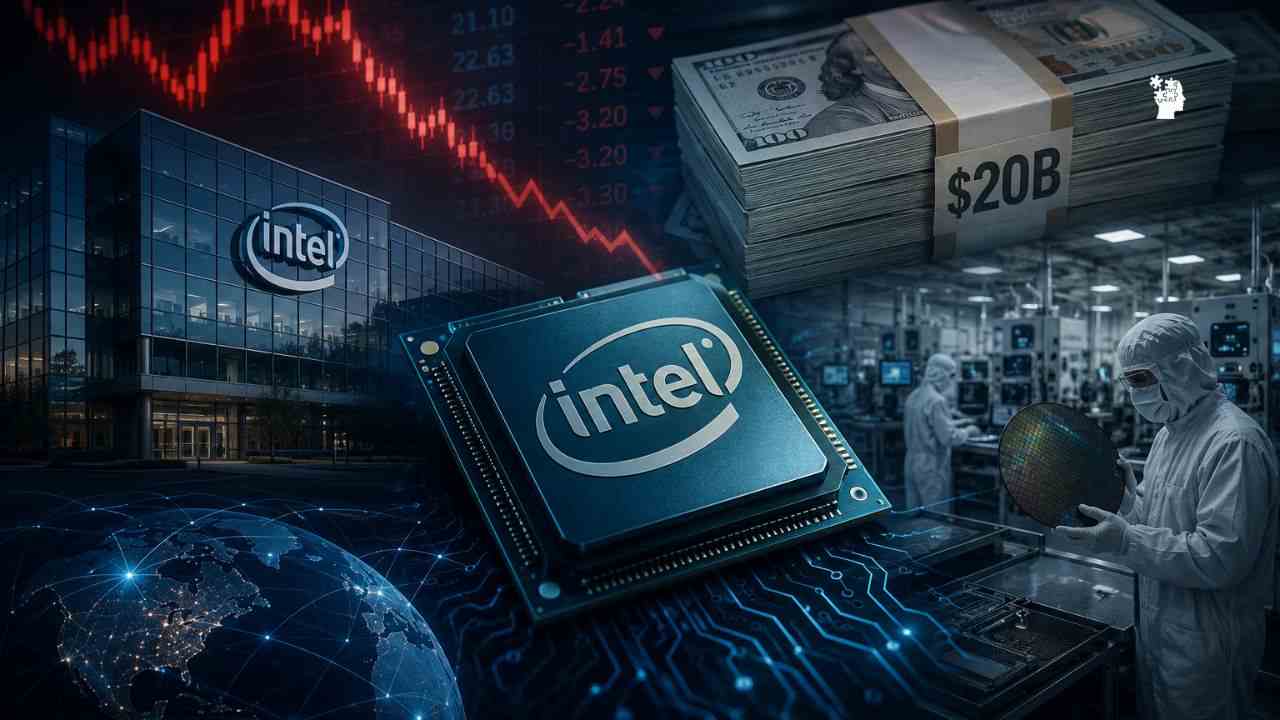
Intel is upsizing its stock offering to $20 billion, a third more than the $15 billion announced Monday. The stock surged in 2026. AI demand is booming. The U.S. government already owns 10% from August 2025. JPMorgan, Goldman Sachs, Morgan Stanley, and Citigroup are running the books.
The narrative writes itself: Intel cashes in on its turnaround to fund the AI chip race.
But that’s the surface story. Underneath lies a strategic shift that could reshape the entire semiconductor landscape—and not in the way most investors think.
The Government Stake Isn’t Just Money. It’s Leverage.
Let’s talk about that 10% U.S. government stake for a moment.
Most coverage treats it as a footnote. “The U.S. took a 10% stake in August 2025, and the stock has risen sharply since then.”
Here’s what nobody’s asking: What does the U.S. government want in return?
This isn’t a passive index fund investment. The CHIPS Act and related semiconductor subsidies come with strings. Strings about where you build. Strings about who you supply. Strings about which countries you can sell to.
Intel’s $20 billion raise isn’t just funding fabs. It’s cementing a relationship where the U.S. government is now Intel’s most powerful shareholder—and potentially its most demanding customer.
Table
| Traditional Intel | Post-$20B Intel |
|---|---|
| Sells to whoever pays | Prioritizes U.S. government and allied nations |
| Builds where costs are lowest | Builds where subsidies are highest |
| Competes purely on technology | Competes on technology + geopolitical alignment |
| Independent capital allocation | Government-influenced strategic decisions |
This isn’t conspiracy theory. It’s industrial policy in action. And Intel just made it permanent by diluting private shareholders to raise capital the government helped make possible.
The Apple Deal: A Trojan Horse?
Earlier this year, Intel secured a deal with Apple that “further boosted shares.”
But here’s the contrarian question: What if that Apple deal was the catalyst for the government to double down?
Apple is the world’s most valuable company. Its supply chain decisions ripple across the global economy. If Apple commits to Intel’s foundry services, it creates a proof point that U.S.-based advanced chip manufacturing is viable.
The government didn’t invest in Intel because Intel was cheap. It invested because Apple validated the business model. And now Intel is raising $20 billion to scale that model—with the government as a 10% partner and Apple as a marquee customer.
This isn’t a turnaround story. It’s a nationalization-by-investment story disguised as a market success.
The Dilution Nobody’s Calculating
At roughly $95 per share, the $20 billion offering translates to approximately 210 million new shares entering the market.
That’s substantial dilution. But the financial dilution isn’t the real risk.
The real dilution is strategic.
Intel’s existing shareholders—retail investors, mutual funds, pension plans—aren’t just getting diluted in ownership percentage. They’re getting diluted in decision-making power. Because when the U.S. government owns 10% and is underwriting your national security relevance, you don’t say no to Washington.
Consider this scenario: Intel’s new Ohio or Arizona fab is running at capacity. The U.S. military needs chips for a defense system. A Chinese company offers 20% more per wafer. In 2020, Intel takes the higher margin. In 2026? The government shareholder says otherwise.
That’s not a bug. That’s the feature.
Why This Deal Ranks Among the Largest in Semiconductor History
Reuters notes that if completed at $20 billion, this would be “among the largest equity raises in semiconductor history.”
But size isn’t the story. Timing is.
Intel isn’t raising $20 billion because it has to. It’s raising $20 billion because the window is open—and it may not stay open.
Table
| Factor | Why It Matters |
|---|---|
| Stock surged in 2026 | Valuation is favorable for issuance |
| AI demand narrative | Investors are willing to pay premium multiples |
| Government backing | Reduces perceived risk |
| Apple deal validation | Creates FOMO among institutional investors |
| Pre-election cycle | Policy support for domestic manufacturing is peak |
Intel is striking while the iron is hot. But hot irons cool. If AI demand softens, if geopolitical tensions ease, if the next administration shifts semiconductor policy—this $20 billion might look expensive in hindsight.
The Uncomfortable Truth: Intel Is Betting the Company on a Geopolitical Trend
Intel’s 2026 capex forecast is now more than $20 billion—meaning this stock offering essentially funds one year of capital spending.
One year.
For context, TSMC spends roughly $30 billion annually on capex. Samsung’s semiconductor capex is in a similar range. Intel isn’t just catching up. It’s sprinting to close a gap that took decades to open—and it’s doing so with money that comes with political obligations.
This is the core risk nobody’s discussing:
What if the geopolitical rationale for U.S. chip manufacturing weakens?
If U.S.-China relations thaw, if TSMC builds enough capacity in Arizona, if AI demand shifts toward software rather than hardware—Intel’s $20 billion bet becomes a $20 billion anchor.
The company isn’t just building fabs. It’s building fabs on a geopolitical thesis that may not hold for the 10-15 year lifespan of those facilities.
What This Means for Investors, Competitors, and the Industry
For Intel Investors: You’re not betting on a chip company anymore. You’re betting on U.S. industrial policy + AI demand + Intel’s execution. Two of those three are outside Intel’s control. The 6.5% discount to Friday’s close might be generous—or it might not be enough.
For Competitors (AMD, NVIDIA, Qualcomm): Intel’s government-backed manufacturing push creates a dual-track market. Private companies compete on merit. Intel competes on merit + subsidies + national security priority. That’s not a level playing field, and it won’t stay unchallenged.
For the Semiconductor Industry: We’re entering an era where capital allocation is political. The largest equity raises won’t be driven by market demand alone. They’ll be driven by national strategy. And the companies that learn to navigate both will thrive. The ones that don’t will be left behind.
The Bottom Line
Intel’s $20 billion stock offering is being sold as a triumph—a turnaround validated by surging shares, AI demand, and government confidence.
But look closer, and it’s something else entirely: the moment Intel stopped being a purely commercial enterprise and became a strategic national asset.
The $20 billion isn’t just money. It’s a down payment on a future where Intel’s success and U.S. policy are inseparable.
For some investors, that’s a feature. For others, it’s a warning.
The question isn’t whether Intel can build the fabs. It’s whether building them as a government-adjacent entity creates more value than it destroys.
And on that question, the market hasn’t priced in an answer yet.
Is Intel’s government partnership a competitive advantage or a strategic liability? Share your take below.
Recommended for you:
- Microsoft’s $678 Billion Trap: Why the Biggest Backlog in Tech History Could Be a Warning Sign
- The $119 Billion Secret Behind Musk’s “3 Bullet Points” Job Ad: Why SpaceX Is Really Hiring Plumbers
- The SpaceX Short Squeeze Playbook: Why the World’s Biggest Bet Against a Stock Could Backfire Spectacularly