
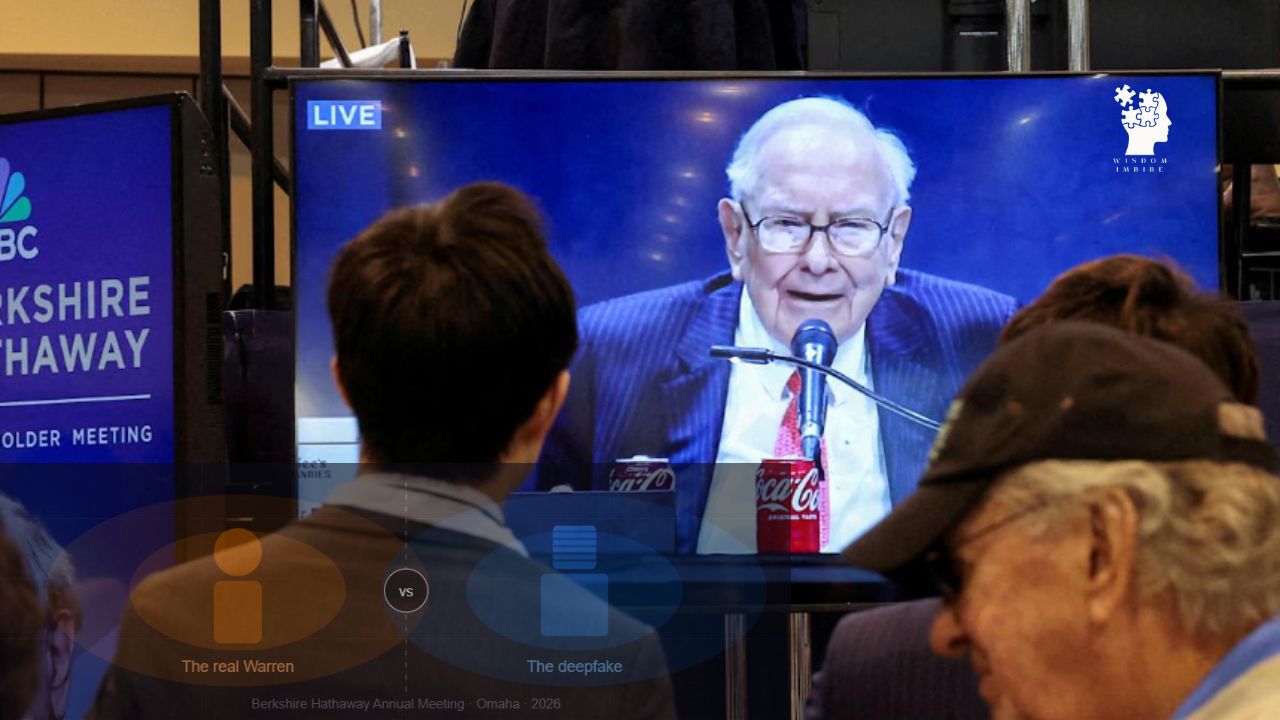
Imagine sitting down at the most famous investor gathering on the planet, expecting a new era — and the very first voice you hear is a dead ringer for the guy who just left. That’s exactly what happened in Omaha on Saturday, and it was deliberately unsettling.
Greg Abel, now running the show as Berkshire Hathaway’s CEO, opened the post-Buffett era not with a rousing speech or a polished slideshow, but with a deepfake of Warren Buffett himself. The AI-generated Buffett appeared on screen, cracked a joke about his new “role,” and lobbed Abel a softball question: why should shareholders keep holding Berkshire stock?
The crowd presumably chuckled. Then came the reveal.
Table of Contents
The lesson hiding inside the stunt
“That was done with zero input from Warren,” Abel told shareholders. “We managed to create it using publicly available information and replicate his speech patterns and voice.”
That’s the part that should stop you cold. No cooperation. No secret recordings. Just publicly available audio and video, fed into AI tools that most people with a laptop could access today. The result was convincing enough to open one of the most-watched corporate events of the year.
Abel’s point was sharp: this isn’t a hypothetical threat. It’s Tuesday. And Berkshire, with its sprawling empire of insurance companies, utilities, railroads, and retailers, faces this kind of exposure across hundreds of operating businesses every single day.
It was a remarkably candid admission — and a smart piece of communication, frankly. Rather than issuing a memo about cyber risk that nobody reads, Abel showed shareholders exactly what the threat looks like. In a room full of investors conditioned to trust their eyes and ears, making them briefly trust the wrong thing was the whole lesson.
What this means for investors and businesses
The implications ripple well beyond Berkshire’s boardroom.
Fraud risk is no longer theoretical. If you can clone Warren Buffett’s voice from YouTube clips and TV interviews, you can clone any executive, any financial advisor, any family member. The “grandparent scam” — where fraudsters impersonate relatives in distress — is already rampant. Deepfakes will industrialize it.
Verification is now a core business function. Companies need to think seriously about internal protocols: how do you confirm that the “CFO” authorizing a wire transfer is actually the CFO? How do you validate that the voice on the phone issuing instructions is real? The answer can’t just be “it sounds like them.”
The reputational stakes are enormous. A convincing deepfake of a CEO making a controversial statement — or worse, a false announcement about earnings or a merger — could move markets before anyone catches on. The legal and regulatory frameworks for this are still being written, which means companies are essentially on their own for now.
A new Berkshire for a new era
There’s something quietly poignant about all of this, too. Buffett — the real one — sat in the front row, watching his AI doppelgänger open a meeting he’d personally dominated for decades. He weighed in on the moment with characteristic restraint: “We don’t know what’s going to happen.”
That might be the most honest five-word summary of the AI moment we’re all living through.
Berkshire’s shares are down nearly 6% in 2026, its worst start since 2015. Abel is navigating a genuine transition — not just in leadership, but in the entire landscape of risk that Berkshire’s businesses face. His approach to AI, reportedly cautious and utility-focused (“only where it clearly enhances operations”), is very much in the Buffett tradition of not chasing shiny things. But the deepfake demonstration signals he’s not ignoring the threat either.
The first-quarter numbers, at least, were encouraging — profit more than doubled to $10.1 billion, helped by investment gains and solid operating performance. The cash pile sits near $397 billion. The fortress is intact.
The bigger picture
We’re entering a period where the most dangerous lies will be indistinguishable from the truth — not because they’re cleverly written, but because they look and sound exactly like people we trust. The tools to do this are cheap, accessible, and improving rapidly.
What Abel did on Saturday was essentially run a fire drill. He showed a room full of some of the world’s most sophisticated investors just how easy it is to be fooled. The message wasn’t “AI is scary.” It was: wake up, update your assumptions, and build systems that don’t rely on your senses alone.
That’s pretty good advice — whether you’re running a railroad, managing a portfolio, or just answering your phone.
Recommended for you: