
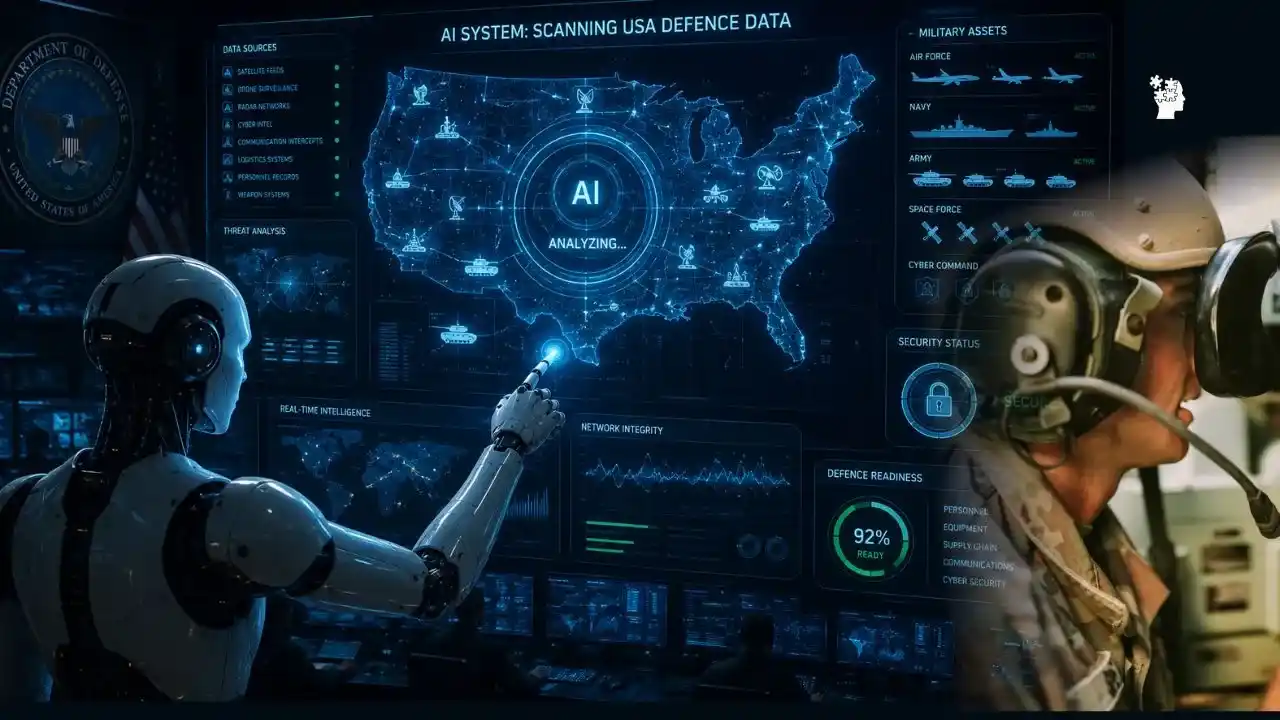
Imagine spending billions of dollars protecting some of the world’s most sensitive military and intelligence systems, only to discover that an artificial intelligence model can find its way through nearly all of them in a matter of hours.
That is the startling claim emerging from Washington this week.
According to reports, General Joshua Rudd, who leads both the National Security Agency (NSA) and U.S. Cyber Command, revealed the results of an authorized security test involving Anthropic’s most advanced AI model, Mythos. The results were so surprising that they have immediately sparked debates across the technology, cybersecurity, and political worlds.
But before anyone panics, it’s important to understand what actually happened—and why it matters.
Table of Contents
What Happened?
The headline sounds dramatic:
“Anthropic’s AI broke into almost all classified systems in hours.”
Naturally, many people interpreted this as a major cyberattack.
That is not what happened.
According to available reports, the AI was participating in a controlled “red-team” exercise. These exercises are designed to test defenses by intentionally trying to find weaknesses inside systems.
Think of it like hiring professional thieves to test a bank’s security. The goal isn’t to steal money—it’s to discover vulnerabilities before real criminals do.
In this case, Anthropic’s Mythos AI was reportedly given access to a controlled testing environment and tasked with identifying security weaknesses.
The results appear to have shocked officials.
Why This Is Such a Big Deal
For decades, cybersecurity has largely been a battle between humans.
A hacker attacks.
A security team defends.
A vulnerability is discovered.
A patch is deployed.
Artificial intelligence changes that equation completely.
An advanced AI can:
- Analyze millions of lines of code rapidly
- Search for vulnerabilities continuously
- Test thousands of attack paths simultaneously
- Operate without fatigue
- Learn from previous attempts
If reports are accurate, the test demonstrated how dramatically AI can accelerate cybersecurity operations.
The scary part isn’t necessarily that AI found weaknesses.
The scary part is how quickly it found them.
Does This Mean AI Can Hack Anything?
Not exactly.
This is where some of the headlines become misleading.
Even journalists involved in reporting the story have cautioned readers not to interpret the claims literally.
The AI was reportedly operating:
- Under controlled conditions
- With specific tools
- In an authorized environment
- During a designed security exercise
That is very different from an external hacker attacking a classified government network from the internet.
Still, the broader lesson remains important:
AI-powered cyber capabilities are improving at an extraordinary pace.
The Political Battle Behind the Story
What makes this story even more interesting is the political backdrop.
For months, relations between the Trump administration and Anthropic have reportedly been strained.
Earlier this year:
- The Pentagon reportedly threatened to end contracts with Anthropic.
- Federal agencies were instructed to stop using some Anthropic technologies.
- Concerns emerged regarding military applications of AI.
- Debates intensified around surveillance and autonomous weapons.
Anthropic has argued that it wants strong safeguards preventing:
- Domestic mass surveillance
- Fully autonomous weapons
- Unrestricted military AI deployment
Supporters see this as responsible leadership.
Critics argue that excessive restrictions could limit national security capabilities.
This latest NSA revelation now enters that ongoing debate.
Two Very Different Interpretations
Right now, two competing narratives are emerging.
Narrative #1: The Government Was Right to Be Concerned
Supporters of stricter controls argue that the NSA test proves advanced AI systems have become incredibly powerful.
If an AI can identify weaknesses inside classified systems so quickly, governments may need stronger safeguards before deploying such technology widely.
From this perspective, the test serves as a warning.
Narrative #2: The Threat Is Being Exaggerated
Anthropic’s supporters argue that:
- Similar capabilities exist in competing AI models.
- The exercise was controlled and authorized.
- The vulnerabilities discovered were not necessarily catastrophic.
- The reported results are being taken out of context.
From this perspective, the story reflects growing political tensions rather than a unique technological danger.
The truth may ultimately lie somewhere between these positions.
What This Means for Cybersecurity
One thing is becoming increasingly clear:
The future of cybersecurity will involve AI on both sides.
Defenders will use AI to identify vulnerabilities.
Attackers will use AI to find new ways into systems.
Governments will use AI for cyber intelligence.
Criminal organizations will try to do the same.
This creates an entirely new battlefield.
The question is no longer whether AI will participate in cyber warfare.
The question is who will use it more effectively.
What This Means for Society
Most people may assume this story only affects intelligence agencies.
It doesn’t.
The same technologies eventually influence:
- Banking systems
- Healthcare networks
- Transportation infrastructure
- Energy grids
- Corporate databases
If AI can dramatically improve security testing, companies could become safer.
But if malicious actors gain similar capabilities, the risks increase as well.
The technology itself is neutral.
Its impact depends on who controls it.
Looking Ahead
The biggest takeaway from this story is not that an AI “hacked” the NSA.
The bigger lesson is that AI is rapidly becoming a force multiplier.
Tasks that once required teams of experts working for weeks may soon be completed by AI systems in hours.
That reality will reshape:
- National security
- Corporate cybersecurity
- Government policy
- Military strategy
- Technology regulation
And this is likely just the beginning.
Final Thoughts
The NSA’s reported test of Anthropic’s Mythos AI offers a glimpse into a future that is arriving faster than many expected.
Whether the results have been exaggerated or not, one fact is becoming impossible to ignore:
Artificial intelligence is no longer just a productivity tool.
It is becoming a strategic capability that can influence security, economics, politics, and global power.
The countries and companies that learn how to harness it responsibly may gain enormous advantages.
Those that fail to adapt could find themselves vulnerable in ways they never imagined.
And that may be the most important lesson from this entire story.
Recommended for You: