
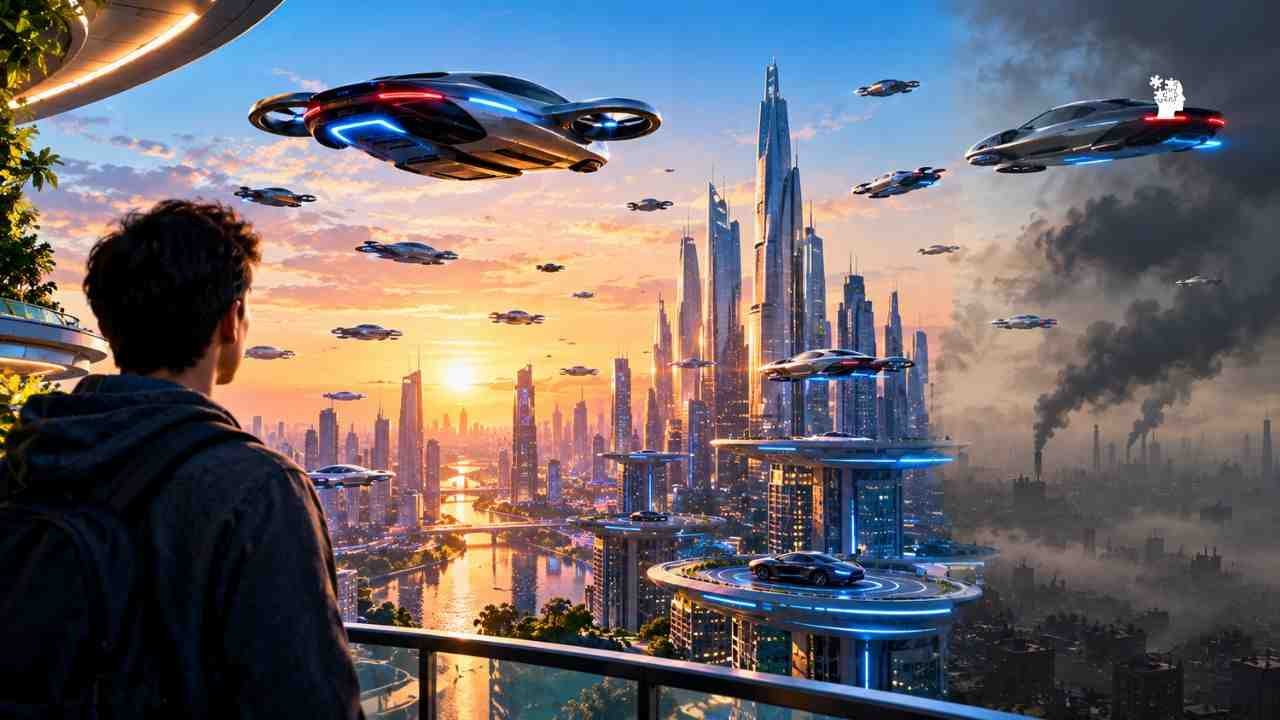
Imagine drinking a cup of tea in your living room while flying cars pass outside your window every few seconds. What if the sky we enjoy today becomes another crowded highway tomorrow?
For decades, flying cars have represented the future of transportation. Science-fiction movies have shown us cities filled with vehicles gliding between skyscrapers, allowing people to travel above traffic jams and reach their destinations in minutes.
Today, advances in electric propulsion, automation, and aerospace engineering are bringing some forms of air mobility closer to reality. Companies are developing electric aircraft that can take off and land vertically, while entrepreneurs continue to explore the idea of vehicles that combine road travel with flight.
At first glance, this future sounds exciting. Imagine avoiding a two-hour traffic jam by flying directly to your destination. Imagine reaching a remote village during a medical emergency without worrying about damaged roads.
But there is another side to this dream that deserves our attention.
What happens if the sky becomes so crowded that we lose the peace, privacy, and sense of safety we currently enjoy in our homes?
Table of Contents
1. From Traffic Jams on Roads to Traffic Jams in the Sky
Our cities are already struggling with traffic congestion. Roads that once provided convenient transportation have become crowded with cars, buses, motorcycles, and delivery vehicles.
Flying cars promise a possible solution: move some transportation away from the ground and into the air.
However, moving vehicles upward does not automatically eliminate congestion. It could simply create a new form of it.
Imagine a busy city where thousands of flying vehicles travel between residential buildings, offices, shopping centers, and airports. Each vehicle needs a route, sufficient separation from other aircraft, and a safe place to land.
The sky may look enormous when we gaze at it from the ground, but the airspace available for safe, frequent flights over a densely populated city is not unlimited in practical terms.
Buildings, weather, aircraft performance, landing locations, and safety requirements would all influence where vehicles could travel.
If flying cars became affordable and widely available, cities might need an entirely new system for managing aerial traffic.
We could eventually face a strange situation: people looking upward at a traffic jam instead of looking forward at one.
2. Imagine a Flying Car Crashing Into Your Home
Consider an ordinary evening.
You are sitting in your living room, enjoying a cup of tea or coffee. Perhaps you are reading a book, watching television, or talking with your family. Outside, the sky is peaceful, and your home feels like a place where you can relax without worrying about the world beyond your walls.
Now imagine that flying vehicles regularly pass close to your windows.
Most journeys might be completed without incident. But what if one vehicle experiences a technical failure? What if it loses control and crashes into a nearby building?
Even a very unlikely accident could have devastating consequences for the people involved.
This is not an argument that flying cars will inevitably crash into homes. Rather, it highlights the need to consider the consequences of failures before making aerial transportation a routine part of urban life.
Aircraft already operate under safety requirements, and future electric air taxis would need appropriate certification, operating rules, and emergency procedures. But a new generation of vehicles operating frequently near residential buildings would raise additional questions about acceptable risk.
How far should routine flight paths be kept from homes? What happens when a vehicle cannot reach its designated landing site? Who is responsible for damage? How would emergency services respond?
These questions should be addressed before large numbers of vehicles begin flying over populated neighborhoods.
After all, technological progress should not force people to feel less secure in their own homes.
3. Could We Lose the Peaceful Sky?
The sky is more than an empty space above our heads.
For many people, looking at the sky is a simple source of relaxation. We watch clouds change shape, observe birds flying, enjoy sunsets, or sit outside at night to admire the stars.
A quiet sky gives us a sense of openness. It offers a visual break from the buildings, screens, and busy streets that surround us.
Now imagine replacing that view with a constant stream of moving vehicles.
Their silhouettes might interrupt the view of the clouds. Their lights could become visible at night. Their movements might draw our attention even when we are trying to relax.
Of course, the impact would depend on the number of vehicles, their altitude, their design, and how frequently they passed overhead. A few aircraft travelling along distant routes would have a very different effect from hundreds of vehicles flying close to apartment windows.
Nevertheless, a future filled with low-flying traffic could change the visual character of our neighborhoods.
We already discuss light pollution, noise pollution, and air pollution. A world of widespread flying vehicles could make visual clutter and aircraft noise more important parts of urban planning.
The question is not whether every aircraft would disturb everyone. It is whether we should allow the skies above our homes to become crowded without considering what we might lose.
4. The Hidden Psychological Cost of Constant Noise and Movement
A home is supposed to provide a sense of security and control over our immediate surroundings.
If aircraft repeatedly pass close to residential buildings, their noise and movement could become sources of distraction or discomfort for some residents.
People might worry about privacy, particularly if vehicles carry cameras or other sensors. Others might find it difficult to relax if the sound of passing aircraft becomes a constant part of daily life.
Research on transportation noise has linked persistent environmental noise exposure with sleep disturbance, annoyance, and other health effects. However, the precise psychological consequences of widespread low-altitude flying cars would depend on their characteristics and operating patterns; we cannot assume that every person would experience the same effects.
This distinction matters because the future should be designed around evidence rather than fear.
Still, a fundamental principle remains: the success of a transportation system should not be measured only by how much time its passengers save. We should also consider its effects on people who never use it.
If one person saves 30 minutes by flying over a neighborhood while hundreds of residents experience additional noise, the overall benefit deserves careful evaluation.
Convenience for some should not automatically become a burden for everyone else.
5. What About Privacy?
Flying cars could introduce another concern: the feeling of being watched.
Many future aircraft may use cameras, navigation sensors, and automated systems to understand their surroundings. These technologies can serve legitimate safety purposes, but their presence near homes could raise questions about data collection and privacy.
Would residents know whether a vehicle was recording their property? How long would such recordings be stored? Who could access the information?
These questions would depend on the aircraft’s design and the laws governing its operation. Not every sensor records personal information, and not every flying vehicle would be capable of looking into homes.
Nevertheless, privacy protections should be part of the discussion from the beginning.
People should not have to choose between living in a technologically advanced city and enjoying reasonable privacy in their own homes.
6. Will Flying Cars Become a Luxury for the Rich?
There is also a question of fairness.
Advanced flying vehicles may initially be expensive to purchase and operate. If they remain accessible mainly to wealthy individuals, the benefits could be distributed unevenly.
A small group of people might enjoy faster journeys while the wider population deals with the noise, visual disruption, and safety concerns associated with aerial traffic.
This outcome is not inevitable. Air taxis could eventually provide useful services to more people, and some applications might benefit entire communities.
For example, aircraft could help emergency medical teams reach patients, support rescue operations, or connect places where ground transportation is difficult.
These uses could provide substantial public benefits.
But there is a meaningful difference between using aircraft to address important transportation needs and filling urban skies with private vehicles simply because their owners can afford them.
Before embracing widespread flying cars, society should ask who benefits, who bears the costs, and whether the overall improvement in people’s lives justifies the disruption.
7. Can We Enjoy Flying Cars Without Crowding the Sky?
The answer does not necessarily have to be a complete rejection of flying vehicles.
Instead, governments, engineers, urban planners, and communities could work together to establish sensible limits.
Designated flight corridors: Routine flights could follow carefully planned routes rather than passing freely over every residential street.
Restrictions around sensitive areas: Schools, hospitals, densely populated neighborhoods, and other sensitive locations could receive additional protection.
Noise limits: Aircraft could be required to meet strict noise standards, with special restrictions during nighttime hours.
Safe landing infrastructure: Dedicated landing locations could reduce the need for vehicles to maneuver close to homes.
Limits on traffic density: Airspace management systems could restrict the number of aircraft operating in particular areas at the same time.
Privacy protections: Rules could limit unnecessary recording, establish data-handling requirements, and protect residents from intrusive surveillance.
Public consultation: Communities should have a meaningful opportunity to influence decisions about flight routes and operating hours.
These measures would not eliminate every risk, but they could help ensure that future transportation systems respect the people living beneath them.
The aim should be to introduce new technology responsibly rather than treating every technological possibility as something that must be adopted everywhere.
8. Perhaps We Don’t Need Flying Cars Everywhere
One of the biggest mistakes we could make is assuming that if a technology becomes possible, it must become universal.
Cars are useful, but that does not mean every street should be filled with them. Aircraft are valuable, but that does not mean every journey should take place in the air.
Different transportation methods serve different purposes.
For many urban journeys, better public transportation, walkable neighborhoods, reliable rail networks, and safer cycling infrastructure may provide more practical benefits than private flying vehicles.
Flying cars or electric air taxis could be useful in particular situations, but their benefits should be compared with alternatives rather than assumed in advance.
A city with efficient public transportation and peaceful residential neighborhoods might offer a better quality of life than a city where people can fly everywhere but can never escape the noise of traffic.
Perhaps the real goal should not be to make every journey faster at any cost. It should be to make daily life better.
Conclusion: The Future Should Give Us Freedom, Not Take Away Our Peace
Flying cars may eventually become part of our transportation systems. They could create exciting opportunities, support emergency services, and provide new ways to travel.
But their success should not be determined solely by their speed, engineering, or ability to perform spectacular maneuvers.
We must also consider the experience of the people who live beneath them.
Will residential neighborhoods remain peaceful? Will people feel safe in their homes? Will privacy be protected? Will the benefits be worth the noise, risks, and disruption? And will ordinary citizens have a voice in deciding how the airspace above them is used?
These are not questions we should postpone until the sky is already crowded.
The most important lesson is that technological progress and human well-being should move forward together.
We should welcome innovations that genuinely improve our lives while being willing to restrict those that impose unnecessary costs on others.
Perhaps, decades from now, we will look up and see flying cars travelling through carefully managed aerial corridors. Perhaps they will become as ordinary as vehicles on today’s roads.
But even then, there should be places where the sky remains quiet, where birds can fly without constant disturbance, and where people can sit beside their windows with a cup of tea and enjoy the simple peace of looking outside.
The future should not be measured only by how much of the sky we can occupy, but by how wisely we choose to share it.
Also Read: