
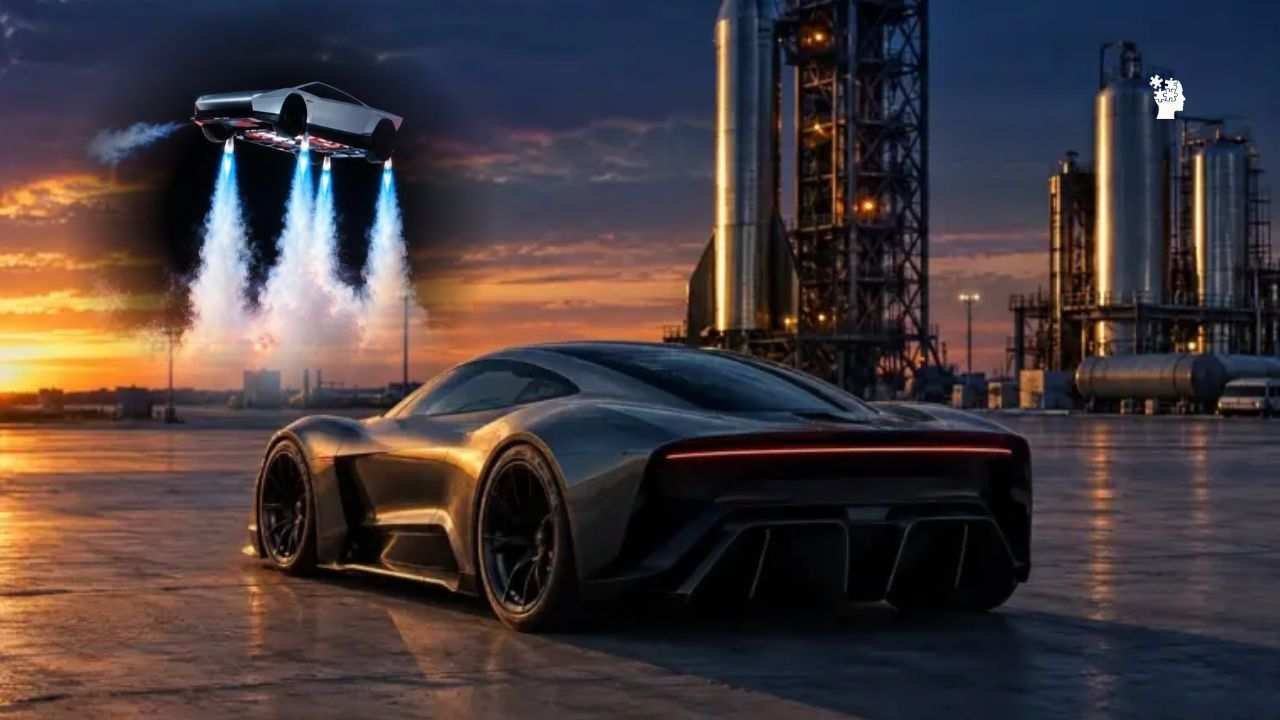
Tesla’s new Roadster can perform spectacular airborne maneuvers, but does that make it the future of transportation? Its biggest challenge may not be engineering the technology, but proving that people actually need it.
When Elon Musk unveiled Tesla’s redesigned Roadster on October 15, 2026, he gave the world something that looked as though it had escaped from a science-fiction movie. The electric sports car demonstrated airborne maneuvers using SpaceX-inspired thrusters, capturing attention far beyond the usual automotive audience. Tesla says production is planned for 2028.
It is an extraordinary concept. But one question deserves more attention than the spectacular demonstration itself: Will this technology make the Roadster a genuinely better car, or will it simply make the car more entertaining to watch?
My view is that the new Roadster could succeed as a luxury performance car and a symbol of technological ambition. However, its flying capability faces serious practical challenges, making it difficult to see it becoming a useful form of everyday transportation in the near future.
Table of Contents
1. A Flying Car Sounds Incredible—Until You Think About Everyday Driving
Imagine driving through a crowded city. The road ahead is blocked by traffic, motorcycles are moving between lanes, pedestrians are crossing, and vehicles are waiting at an intersection.
Would you be able to activate your car’s thrusters and fly over the traffic?
Technically demonstrating an airborne maneuver in a controlled environment is one thing. Performing it safely on a public road is an entirely different challenge.
A normal car is designed to remain on the road. Its brakes, tyres, suspension, airbags, and other safety systems are developed around that basic requirement. A vehicle that leaves the ground introduces additional questions about stability, landing, nearby vehicles, and the consequences of a malfunction.
Even if the Roadster can briefly jump or perform a flip, that does not mean it can fly over traffic whenever its driver wants.
There is also a fundamental distinction between briefly becoming airborne and achieving sustained, controlled flight. The demonstration established that the prototype could perform dramatic airborne maneuvers, not that it could replace an aircraft or provide a practical alternative to road travel.
For most drivers, the real value of a car lies in getting from one destination to another safely, comfortably, and reliably. A flying stunt does not automatically improve any of those things.
2. The Technology Could Be More Impressive Than Useful
Tesla’s Roadster combines electric-car engineering with technology inspired by SpaceX. That connection is fascinating because it brings together two very different engineering disciplines.
However, technological sophistication does not always translate into practical value.
Consider the everyday requirements of a vehicle:
- Range: How far can it travel on a single charge under real-world conditions?
- Reliability: Can its systems work consistently over years of use?
- Maintenance: How complicated and expensive will repairs be?
- Safety: What happens if the propulsion system malfunctions?
- Convenience: Can owners use the special features without extensive preparation or restrictions?
The more complicated a system becomes, the more questions engineers must answer about its reliability, cost, and maintenance.
The Roadster’s thrusters may be exciting, but their usefulness depends on how the production vehicle implements them. If the equipment adds cost and complexity without offering a meaningful benefit during ordinary driving, many buyers may consider it an unnecessary luxury.
That does not mean the technology is worthless. It means Tesla must demonstrate why it is worth paying for.
3. Safety and Regulations Could Be Major Obstacles
Perhaps the biggest challenge is not whether the Roadster can leave the ground, but whether it can do so safely and legally in real-world conditions.
A public-road vehicle that performs airborne maneuvers would need to address risks that conventional cars do not ordinarily face in the same way.
What happens if the system activates unexpectedly? How would the vehicle maintain a safe distance from pedestrians and other road users? Where could it land if something went wrong? What restrictions would authorities place on its operation?
These questions become even more complicated in densely populated cities.
In countries such as India, where roads often contain a mixture of cars, motorcycles, bicycles, pedestrians, and other vehicles, introducing a car capable of jumping or flying would raise particularly difficult safety and infrastructure questions.
Even if the vehicle can perform its advertised maneuvers, that alone does not establish that those maneuvers will be permitted on public roads. The relevant safety requirements and regulations would have to be addressed.
This is why the future of flying cars cannot depend on engineering demonstrations alone. It also requires a practical operating environment, robust safety systems, and an appropriate regulatory framework.
4. The Roadster Might Be Designed to Attract Attention
There is another way to understand Tesla’s new Roadster: perhaps it is not intended to transform everyday transportation at all.
Instead, it could serve as a halo product—a vehicle designed to capture attention and strengthen the image of the company behind it.
Luxury automakers have long used exceptional performance cars to demonstrate their engineering capabilities and attract interest in their brands. Such vehicles do not need to become common on the roads to have marketing value.
The Roadster could play a similar role for Tesla.
Its unusual technology generates headlines, encourages discussions about the future of mobility, and demonstrates the potential relationship between Tesla’s automotive engineering and SpaceX’s aerospace expertise.
Reuters reported that the vehicle was presented as a prestige-focused product with limited expected financial impact.
From that perspective, the Roadster may already be accomplishing something important: making people talk about Tesla.
However, generating attention and delivering a successful consumer product are two different achievements.
A spectacular launch can create enormous excitement, but the long-term reputation of a product depends on what customers receive after the excitement fades.
5. Tesla’s Long Road to Production Raises Another Question
The second-generation Roadster was originally revealed in 2017, with production initially anticipated much earlier than the latest target.
The redesigned version is now scheduled to enter production in 2028, meaning the project has experienced years of delays.
That history makes it reasonable to distinguish between what has been demonstrated and what has actually been delivered.
A prototype can showcase ambitious technology under carefully controlled conditions. A production vehicle must meet engineering, manufacturing, quality, reliability, and regulatory requirements.
Tesla still needs to demonstrate that the promised features can be incorporated into a vehicle that customers can purchase and use as intended.
There are several questions prospective buyers should watch closely:
- Will the production vehicle retain the demonstrated airborne capabilities?
- What will the final price be for versions equipped with the special technology?
- How will the thrusters affect the vehicle’s weight, range, and maintenance?
- What safety restrictions will apply to airborne maneuvers?
- When will customers receive production vehicles?
Until those questions are answered, it is too early to judge the Roadster solely by its launch demonstration.
6. A Better Sports Car May Matter More Than a Flying One
There is a simpler way Tesla could make the Roadster successful: build an exceptional electric sports car first.
Imagine a vehicle that offers extraordinary acceleration, precise handling, an engaging driving experience, dependable engineering, useful range, and high-quality construction.
Those characteristics would give customers reasons to buy it even if they never used the flying feature.
Now imagine two versions of the same car. One delivers outstanding performance and reliability at a compelling price for its market. The other adds spectacular airborne capabilities but introduces substantial extra costs and restrictions.
Which would make more sense to a buyer who wants to enjoy driving rather than perform stunts?
The answer depends on the buyer. Some wealthy enthusiasts may happily pay a premium for a unique experience. Others may prefer conventional performance and proven reliability.
That is why the Roadster does not necessarily need to fail as a car for its flying technology to disappoint. Its future as a sports car and its future as a flying vehicle should be evaluated separately.
7. Could Flying Cars Become Practical in the Future?
Dismissing the entire idea of flying cars would also be a mistake.
Aerospace technology, batteries, electric propulsion, automation, and materials science continue to develop. Different companies are exploring electric aircraft and other forms of advanced transportation.
But a practical flying vehicle must solve more than the problem of lifting itself into the air.
It needs adequate range, controlled flight, safe takeoff and landing, reliable systems, manageable operating costs, and infrastructure that supports its use. Depending on its design, it may also require aircraft-specific certification and operating permissions.
A short airborne maneuver does not solve these problems.
The Roadster’s thrusters could still demonstrate useful engineering ideas or inspire future innovations. Yet there is a considerable gap between a car that performs a spectacular jump and a vehicle that can transport people through the air safely and economically.
The technology should be judged by what it can reliably accomplish, not just by how futuristic it looks.
Final Verdict: A Remarkable Showpiece, but an Unproven Transportation Revolution
Tesla’s new Roadster is an ambitious experiment in combining electric performance with aerospace-inspired technology. Its demonstration is exciting, and its engineering ambition deserves serious attention.
Nevertheless, the central question remains: Does the ability to fly briefly make a car more useful?
For most people, the answer is not yet clear.
The Roadster could attract wealthy buyers who value exclusivity, extreme performance, and unusual technology. It could also strengthen Tesla’s image as a company willing to attempt things that traditional automakers might avoid.
But its airborne capabilities face practical challenges involving safety, regulation, complexity, and everyday usability. Until Tesla demonstrates how those challenges will be addressed in production, describing the Roadster as a revolution in transportation would be premature.
Perhaps the most sensible way to view the new Roadster is as an extraordinary sports car with an ambitious experimental feature—not yet as the flying car that will solve the world’s transportation problems.
The real test will not be whether the Roadster can fly for a few moments. It will be whether its technology makes the car meaningfully better to own and drive.
Because in the end, people do not buy a car simply because it can perform an incredible stunt. They buy it because it gives them a reason to drive it.
And if the flying feature is mostly for spectacle, Tesla may have created a remarkable showpiece rather than the future of everyday transportation.
Also Read