
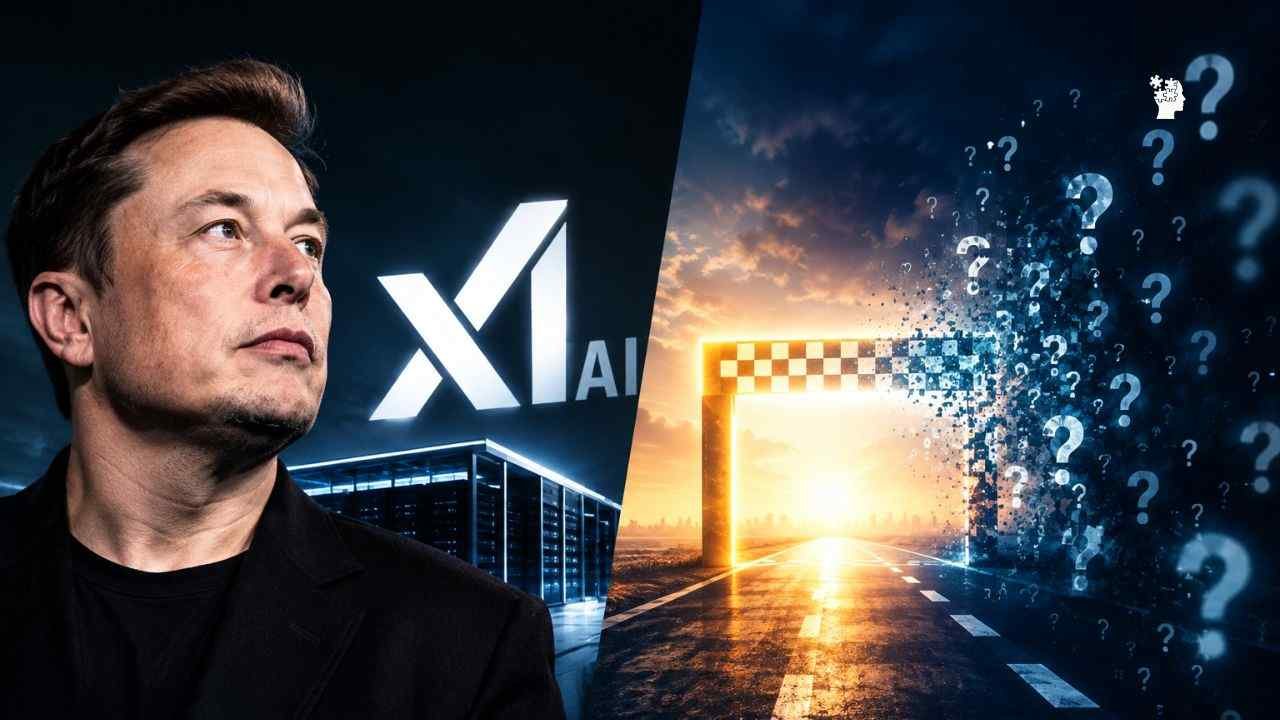
Elon Musk has made one of the biggest promises in the AI race: Grok 5 will achieve artificial general intelligence.
But there’s an awkward detail sitting underneath that prediction.
Grok 4.7 hasn’t even arrived yet.
In a series of posts on X on September 14, Musk described a rapid progression from Grok 4.8 to Grok 4.9 and eventually Grok 5 — with Grok 5 being the model he says will reach AGI. The claim is extraordinary. The evidence behind it is much less clear.
Musk provided no benchmark that would establish AGI, no precise timetable for Grok 5, and no definition of what he actually means by “AGI.”
And that creates a more interesting question than whether Musk is right: how do you know when an AI has actually achieved AGI?
Table of Contents
What Did Elon Musk Actually Say?
Musk’s comments describe an unusually aggressive roadmap. He said Grok 4.8 — reportedly a 2.5-trillion-parameter model built on xAI’s new C++ software stack — should finish training within the week before moving into reinforcement learning.
Asked how close that model would come to AGI, Musk’s answer was blunt: “That will be Grok 5.”
He characterized the still-unreleased Grok 4.7 as “roughly on par with Opus 5.0, not 5.1,” Anthropic’s earlier flagship — “better in some ways, worse in others,” with multimodal performance still needing work. He projected Grok 4.9 would reach “Astra/Fable class,” a reference to OpenAI’s GPT-6 Astra and Anthropic’s Fable line. Then came the biggest claim: Grok 5 could be “better than anything.”
Followed immediately by the hedge: “we shall see.”
That qualification matters, because we’re dealing with a forecast, not a demonstrated capability.
The Problem With the AGI Claim
This is where the analysis needs to go deeper than the headline.
There is currently no universally accepted benchmark that says: “this AI is now AGI.” That’s because AGI isn’t simply another model score. A system could outperform humans on one collection of tests and still struggle with:
- Long-horizon planning
- Reliability
- Adapting to unfamiliar situations
- Understanding ambiguous instructions
- Autonomous decision-making
- Real-world interaction
- Knowing when it is wrong
So when Musk says “Grok 5 will achieve AGI,” the immediate question isn’t only when? It’s: what exactly would count as AGI?
💡 Wisdom Imbibe Insight
The most interesting part of Musk’s Grok 5 prediction isn’t whether he will be right. It’s that the AI industry still hasn’t agreed on what “right” would actually look like.
AI companies can compete on benchmarks — coding scores, reasoning tests, multimodal evaluations, increasingly difficult tasks. But AGI is a much bigger claim.
If Grok 5 performs exceptionally well across today’s benchmarks, does that mean AGI has arrived?
What if it can solve problems humans struggle with but still makes bizarre mistakes on tasks a child can handle? What if it can autonomously write and debug software for hours but cannot reliably distinguish a real-world consequence from a simulated one?
The closer AI companies get to human-level general capability, the more important the definition becomes.
Otherwise, AGI risks becoming less of a scientific milestone and more of a label companies compete to claim first.
Grok 4.7 Hasn’t Even Shipped
Musk’s AGI prediction arrives while Grok 4.7 is still being tuned. Originally expected around September 12, the model missed its window. On September 11, Musk said it needed “a few more days to cook” because the team may have penalized response length too heavily during reinforcement learning — leaving the model prone to giving up on hard tasks early and failing to check its own work.
That’s actually a revealing technical detail, because it illustrates the difference between raw capability and reliable capability. A model can be extremely powerful and still fail because its training incentives push it toward the wrong behavior.
That distinction becomes especially important if we’re talking about AGI.
The delay also stands out because rival labs have been shipping steadily. Anthropic released Claude Fable 5.1 on September 1, Google DeepMind published its Gemini 3.8 Flash model card on September 2, and OpenAI published a safety overview for GPT-6 Astra on September 3. Three frontier releases landed in three days while xAI was still tuning its next model.
The Race Is Moving Faster Than the Labels
Every frontier lab is trying to establish itself as the leader: Anthropic with Claude, Google with Gemini, OpenAI with GPT, xAI with Grok. But the terminology is becoming increasingly competitive too: frontier model → reasoning model → agent → superintelligence → AGI.
The danger is that these labels start becoming marketing milestones rather than scientific ones.
Which brings us back to Musk. If Grok 5 arrives and xAI declares “this is AGI,” the rest of the industry may disagree. And then the question becomes: who gets to define the finish line?
The Strange Timing of Musk’s Prediction
Musk’s AGI prediction landed the same day he endorsed calls from Anthropic CEO Dario Amodei and OpenAI’s Sam Altman to slow the pace of capability development over safety concerns. On one side: build toward AGI. On the other: slow the frontier down.
That apparent contradiction drew immediate scrutiny — and contributed to a rough day for AI stocks, with Nvidia falling 3.46% and AMD dropping 6.24% as investors reassessed demand projections amid the broader slowdown rhetoric.
But perhaps the two positions aren’t completely contradictory. The real distinction may be: build powerful AI versus deploy increasingly powerful AI before society understands how to control it. That interpretation connects directly to the debate Musk just signed onto — and to the question at the center of our companion analysis.
Related: [Dario Amodei Wants to Slow AI. China May Be the Reason It Can’t Happen] ← internal link to the Amodei article
Why Grok 5 Could Matter
None of this means the prediction should be dismissed. If Grok 5 genuinely approaches general-purpose capability, the implications are enormous:
- AI competition: xAI would suddenly become a much more central player in the frontier race
- Computing demand: more capable models require enormous training and inference infrastructure
- Autonomous agents: a more general model could perform longer, more complex sequences of tasks
- Software development: AI capable of sustained autonomous coding could change the economics of software creation
- AI safety: the consequences of mistakes grow as systems gain more autonomy
- Geopolitics: a genuine capability breakthrough before competitors would extend far beyond consumer chatbots
Compute Can Win the Race. It Can’t Prove You’ve Won It.
xAI commands formidable resources — its Memphis-based Colossus cluster runs 200,000 H100 GPUs. But compute is an input, not a guarantee. It isn’t a guarantee of better training data, better algorithms, better reasoning, better reinforcement learning, reliability, safety, or generalization.
And most importantly: compute doesn’t define AGI. As one industry analysis put it, “compute can get you into the race. It doesn’t publish a release date for you.”
The Bottom Line
Elon Musk has never been shy about making aggressive predictions about the future of AI. Grok 5 achieving AGI would be an extraordinary milestone — if it happened.
But right now, the claim is a forecast rather than a demonstrated achievement. The more interesting race may therefore not be which company reaches AGI first. It may be which company gets to define what AGI means when it claims to have reached it.
Because once the finish line becomes a matter of interpretation, winning the AI race may depend as much on defining the milestone as achieving it.
Read Next : Dario Amodei Wants to Slow AI. China May Be the Reason It Can’t Happen
2 thoughts on “Elon Musk Says Grok 5 Will Achieve AGI. There’s Just One Problem”