

While millions across Europe struggled through record-breaking temperatures, another crisis was quietly unfolding behind the scenes.
The same extreme heat that overwhelmed hospitals, strained power grids, and contributed to more than a thousand deaths is also exposing a growing vulnerability in the infrastructure powering today’s artificial intelligence.
AI may seem like software living in the cloud, but every chatbot, image generator, and AI assistant depends on massive data centers that generate enormous amounts of heat. When the weather itself becomes hotter, keeping those facilities running efficiently becomes far more difficult—and much more expensive.
Europe’s latest heatwave is more than a weather story. It may be an early warning for the future of AI.
Table of Contents
Why Heat Is a Bigger Problem for AI Than Most People Realize
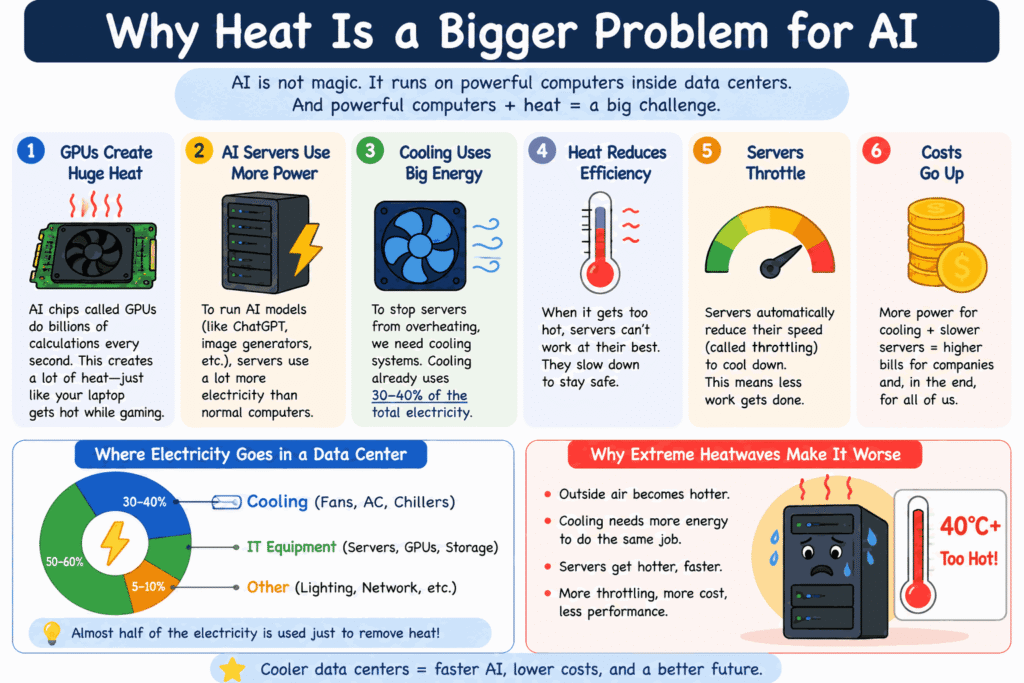
Imagine you’re playing your favorite video game on a laptop. After a while, the laptop gets hot. If it becomes too hot, the fan starts spinning faster. If the heat keeps rising, the laptop may slow down to protect itself. AI data centers work in a very similar way—just on a much, much larger scale.
AI doesn’t live in the “cloud” like magic. Every time you ask an AI chatbot a question, generate an image, or translate a language, your request is processed by thousands of powerful computers inside giant buildings called data centers.
These computers use special chips called Graphics Processing Units (GPUs). Unlike the chips in a regular home computer, GPUs are built to solve millions of calculations every second. They are incredibly powerful, but they also produce a huge amount of heat—just like a car engine gets hot after running for a long time.
Because so many GPUs work together at the same time, the temperature inside a data center can rise very quickly. To keep everything safe, large cooling systems run day and night, much like giant air conditioners. In fact, cooling can use 30% to 40% of a data center’s total electricity, making it one of the biggest operating costs.
Now imagine it’s the middle of summer, and the outside temperature climbs above 40°C (104°F). Cooling those computers becomes even harder. The cooling systems have to work longer and use more electricity to keep the servers at a safe temperature.
If the servers still become too hot, they automatically slow themselves down to prevent damage. This safety feature, called throttling, is similar to how your phone may become slower after being left in the sun. While throttling protects the hardware, it also means AI systems can process fewer tasks in the same amount of time.
As temperatures continue to rise, companies face higher electricity bills, spend more money on advanced cooling technology, and may even need to redesign or relocate their data centers to cooler regions. That’s why extreme heat isn’t just a weather problem—it has become a growing challenge for the future of artificial intelligence.
Why Europe’s Heatwave Matters Beyond Europe
When people think about artificial intelligence, they usually picture chatbots, image generators, or self-driving cars. Very few think about the physical buildings that make all of those technologies possible.
Behind every AI model are thousands of high-performance servers running inside massive data centers. These facilities consume enormous amounts of electricity and generate an extraordinary amount of heat, making cooling systems just as essential as the processors themselves.
Europe’s recent heatwave has revealed a challenge that extends far beyond the continent. It has exposed a vulnerability that every country investing in AI infrastructure will eventually have to confront.
Over the past few years, Europe has become an increasingly attractive destination for AI infrastructure. Global technology companies are expanding cloud regions and data centers across countries such as France, Germany, the United Kingdom, Spain, and the Netherlands to support growing demand for AI services, cloud computing, and enterprise applications.
However, the climate conditions that once made many of these locations reliable are changing.
Heatwaves are becoming more frequent, lasting longer, and reaching temperatures that were once considered rare. As average temperatures continue to rise, keeping AI servers within safe operating limits becomes significantly more expensive. Every additional degree increases the energy required for cooling, raises electricity costs, and puts greater pressure on already stressed power grids.
This is why Europe’s heatwave is not just a regional weather event—it is a preview of a global infrastructure challenge.
The same questions now facing Europe will soon confront AI developers across North America, Asia, the Middle East, and other rapidly growing technology markets.
- Can future AI data centers operate efficiently during weeks of extreme heat?
- Will electricity grids be able to support both rising cooling demand and growing AI workloads?
- Which regions will remain attractive for building the next generation of AI infrastructure?
- How will companies balance performance, sustainability, and operating costs in a warmer world?
These questions are becoming increasingly important because AI demand is growing much faster than climate conditions are improving.
In the past, companies often chose data center locations based on internet connectivity, land availability, and access to reliable electricity. In the coming decade, climate resilience may become just as important. Regions with cooler temperatures, abundant renewable energy, and stable water supplies could gain a significant competitive advantage over areas that experience prolonged periods of extreme heat.
Europe’s record-breaking temperatures may therefore represent more than a single summer’s crisis. They could mark a turning point in how the global technology industry decides where to build the AI infrastructure of the future.
The real story isn’t that Europe became dangerously hot. The real story is that the climate assumptions behind today’s AI infrastructure are beginning to change. As extreme heat becomes more common, the global race for artificial intelligence may increasingly become a race for cooler climates, cleaner energy, and more resilient infrastructure.
The AI Boom Meets Climate Reality
For the past few years, the conversation around artificial intelligence has focused on one question: Who will build the most powerful AI? Tech giants are investing hundreds of billions of dollars in faster chips, larger data centers, and more advanced AI models. But Europe’s record-breaking heatwave highlights another question that could become just as important: Can the infrastructure behind AI withstand a warming planet?
Every AI query—from generating an image to analyzing complex data—runs inside data centers packed with thousands of high-performance processors. These chips consume enormous amounts of electricity and generate significant heat. Under normal conditions, cooling systems already account for a substantial share of a data center’s energy consumption. During prolonged heatwaves, however, those systems must work even harder, increasing both electricity demand and operating costs.
Now imagine this challenge repeating every summer while AI adoption continues to accelerate. More businesses are integrating AI into their daily operations, governments are investing in national AI infrastructure, and billions of people are beginning to rely on AI-powered services. As demand grows, companies will need to build more data centers—just as climate change makes operating them more difficult.
The economic impact extends far beyond higher electricity bills. In many regions, prolonged heatwaves strain national power grids, increasing the risk of energy shortages during periods of peak demand. Drought conditions can limit water availability for facilities that rely on water-based cooling systems. At the same time, insurers are reassessing the risks associated with extreme weather, leading to higher premiums for facilities located in climate-vulnerable regions. Construction costs may also rise as developers invest in stronger cooling systems, backup power infrastructure, and climate-resilient designs.
Individually, each of these challenges appears manageable. Together, they create a compounding effect that could significantly increase the cost of building and operating AI infrastructure. A data center that was profitable under today’s climate conditions may become far more expensive to run if extreme heat becomes a recurring seasonal event.
This represents a shift in how the AI industry must think about growth. Success will no longer depend solely on developing faster processors or more capable language models. It will increasingly depend on access to reliable electricity, resilient power grids, sustainable water resources, advanced cooling technologies, and locations that remain relatively stable as global temperatures rise.
In other words, the next phase of the AI race may not be determined only by computing power—it may be shaped by climate resilience. Companies that can operate efficiently in a hotter world could gain a lasting competitive advantage, while those that fail to adapt may face rising costs, slower expansion, and greater operational risks.
Europe’s recent heatwave may therefore be remembered as more than an extreme weather event. It could become one of the first major warnings that the future of artificial intelligence is tied not only to technological innovation, but also to the realities of a changing climate.
Why Water Could Become as Strategic as Electricity in the AI Race
For years, the conversation around artificial intelligence has focused on one resource above all others: electricity. Training large AI models and running millions of daily AI queries require enormous amounts of power, making access to affordable electricity a key factor in where companies build data centers.
But another critical resource is moving into the spotlight—water.
Modern AI servers generate tremendous amounts of heat. While traditional air conditioning can cool smaller facilities, today’s AI data centers increasingly rely on advanced cooling systems that use water, chilled liquid, or closed-loop liquid cooling to remove heat efficiently from high-performance processors.
This growing demand means that water availability is no longer just an environmental issue; it’s becoming an infrastructure consideration. In regions facing prolonged droughts or increasingly frequent heatwaves, operators may find it more difficult—or more expensive—to keep data centers running at peak efficiency.
The challenge extends beyond the cost of cooling. Higher temperatures force cooling systems to work harder, increasing electricity consumption while placing additional pressure on local water resources. In some regions, governments have already begun scrutinizing the water use of large industrial facilities, including data centers, as climate conditions become more extreme.
That is why companies are investing heavily in new cooling technologies. Some facilities are adopting closed-loop liquid cooling systems that continuously recirculate coolant instead of consuming fresh water. Others are designing data centers that minimize or eliminate water evaporation during cooling, reducing overall water demand while maintaining high performance.
As AI infrastructure expands worldwide, companies may begin choosing locations based on more than just available land or tax incentives. Access to renewable energy, naturally cooler climates, reliable water supplies, and resilient power grids could become equally important factors.
In other words, the next phase of the global AI race may not simply be about who owns the fastest GPUs. It could increasingly be about who can build and operate AI infrastructure in places where electricity, cooling, and water can be supplied sustainably for decades to come.
For governments, investors, and technology companies alike, climate resilience is becoming part of AI strategy. The countries best positioned for the next generation of AI may be those that combine clean energy, abundant natural resources, and infrastructure capable of withstanding a warming world.
Microsoft and Nvidia Are Already Preparing for a Hotter Future
The AI industry has seen this challenge coming for years. While Europe’s record-breaking heatwave has brought the issue into the spotlight, major technology companies have already begun redesigning the way data centers are cooled—not because it’s a marketing trend, but because traditional cooling systems may struggle to keep pace with the next generation of AI infrastructure.
Microsoft’s Push Toward Zero-Water Cooling
For decades, many large data centers relied on evaporative cooling, a system that uses significant amounts of water to remove heat from servers. It works well under normal conditions, but as droughts become more frequent and freshwater resources come under increasing pressure, this approach becomes harder to justify.
Microsoft is moving toward zero-water evaporation cooling, where water is continuously recirculated inside a sealed system instead of being lost through evaporation. The goal isn’t simply to reduce water bills—it’s to make future AI facilities more resilient in regions where water scarcity is becoming a serious concern.
This shift also gives Microsoft greater flexibility when choosing locations for future AI campuses. Facilities no longer need to be built only where abundant water supplies are available, opening the door to more sustainable long-term expansion.
Nvidia’s Warm-Water Cooling Could Change Data Centers
AI servers powered by advanced GPUs generate far more heat than traditional enterprise servers. Simply adding more air conditioning is becoming both expensive and energy intensive.
Nvidia believes the future lies in warm-water liquid cooling.
Instead of cooling servers with chilled air, liquid is circulated directly around high-performance components. Because water transfers heat far more efficiently than air, servers can operate at higher performance while consuming less energy for cooling.
Even more significant is Nvidia’s focus on closed-loop cooling systems. Rather than constantly consuming fresh water, coolant circulates repeatedly through sealed pipes, dramatically reducing water consumption and improving efficiency.
Another advantage is heat recovery. Instead of wasting the heat generated by AI servers, future facilities could redirect it to nearby buildings, industrial processes, or district heating networks. What was once considered waste energy could become a valuable resource.
The message from both Microsoft and Nvidia is clear: the future of AI won’t depend only on faster chips. It will depend on smarter infrastructure capable of operating efficiently even as the climate becomes more unpredictable.
Where Will Future AI Data Centers Be Built?
For years, companies selected data center locations primarily based on land prices, internet connectivity, and access to electricity. Climate is quickly becoming just as important.
If extreme heat continues to become more common, some of today’s most attractive locations may become significantly more expensive to operate. Higher temperatures mean greater cooling demands, increased electricity consumption, and rising insurance costs.
That could shift investment toward naturally cooler regions.
Countries such as Norway, Finland, Iceland, Sweden, Canada, and parts of Scotland already offer several advantages:
- Naturally cold climates reduce cooling requirements for much of the year.
- Abundant renewable energy helps lower long-term electricity costs.
- Stable political environments encourage multi-billion-dollar infrastructure investments.
- Lower environmental impact supports corporate sustainability goals.
Rather than spending enormous amounts of electricity cooling hot air, operators can use naturally cooler outdoor temperatures to assist the cooling process, improving efficiency while reducing operating expenses.
This doesn’t mean AI data centers will disappear from warmer regions. Large markets still require local infrastructure to reduce internet latency. However, many of the world’s largest future AI campuses could increasingly be built where nature itself provides part of the cooling.
Climate may soon become as valuable a resource as electricity.
Could AI Become More Expensive?
Consumers often think of AI as software running somewhere in the cloud. Behind every chatbot, image generator, and coding assistant, however, are enormous facilities filled with thousands of high-performance processors that consume vast amounts of electricity.
As temperatures rise, several costs increase simultaneously:
- Cooling systems require more electricity.
- Power demand grows during heatwaves.
- Construction costs increase as facilities require more advanced cooling technologies.
- Insurance premiums rise because climate risks become more severe.
- Water management systems become more complex in drought-prone regions.
Individually, these increases may seem manageable. Together, they create a much more expensive operating environment.
Large technology companies may absorb these costs today, but over time they could influence how AI services are priced, how quickly new data centers are built, and where companies choose to expand.
Rather than slowing AI innovation, higher infrastructure costs are likely to accelerate the search for more efficient chips, better cooling systems, and lower-energy AI models.
The next breakthrough in AI may not only come from smarter algorithms—it may come from making those algorithms dramatically cheaper to run.
The New AI Race Isn’t Just About Chips Anymore
For the past several years, the global AI competition has largely revolved around one question:
Who has the most powerful GPUs?
Companies raced to secure advanced processors, build larger models, and train increasingly capable AI systems.
That race is now evolving.
Tomorrow’s AI leaders will also compete for resources that rarely make headlines:
- Reliable electricity.
- Efficient cooling technologies.
- Sustainable water supplies.
- Climate-resilient locations.
- Renewable energy.
- Land suitable for massive AI campuses.
In other words, the future of AI will be shaped not only by semiconductor innovation but also by energy infrastructure and environmental resilience.
The countries best positioned to support next-generation AI may be those that can provide abundant clean power, cooler climates, and long-term climate stability—not simply the largest number of GPUs.
The AI revolution is becoming an infrastructure race as much as a technology race.
What This Means for Everyday AI Users
Most people won’t notice these changes immediately.
Your favorite AI chatbot, coding assistant, or image generator will continue to work much as it does today.
But behind the scenes, the industry is entering a period of rapid transformation.
Over the coming years, users could experience:
- AI systems becoming more energy efficient.
- Data centers relocating to cooler regions.
- Increased investment in renewable-powered AI infrastructure.
- New cooling technologies replacing traditional air conditioning.
- More efficient AI chips delivering greater performance while consuming less electricity.
If infrastructure costs continue to rise, AI companies may also place greater emphasis on efficiency rather than simply building ever-larger models.
The future of artificial intelligence won’t only be measured by intelligence—it will also be measured by sustainability.
Conclusion
Europe’s deadly heatwave will be remembered first and foremost for its devastating human impact. But it may also become one of the defining moments that exposed a hidden weakness in the AI revolution.
Artificial intelligence is often described as digital technology, yet it ultimately depends on physical infrastructure—servers, power grids, cooling systems, water resources, and data centers that must operate reliably regardless of the weather outside.
As climate change makes extreme heat more frequent, building smarter AI models alone will no longer be enough. Companies will need to design infrastructure capable of thriving in a warmer world.
The next generation of AI won’t be defined solely by faster chips or larger models. It will also depend on where those systems are built, how efficiently they are cooled, how sustainably they consume energy, and how resilient they remain under increasingly extreme climate conditions.
The race to build the future of artificial intelligence has quietly become something much bigger.
It is no longer just a race for computing power.
It is a race to build AI that can withstand the realities of a changing planet.
Recommended for you: