
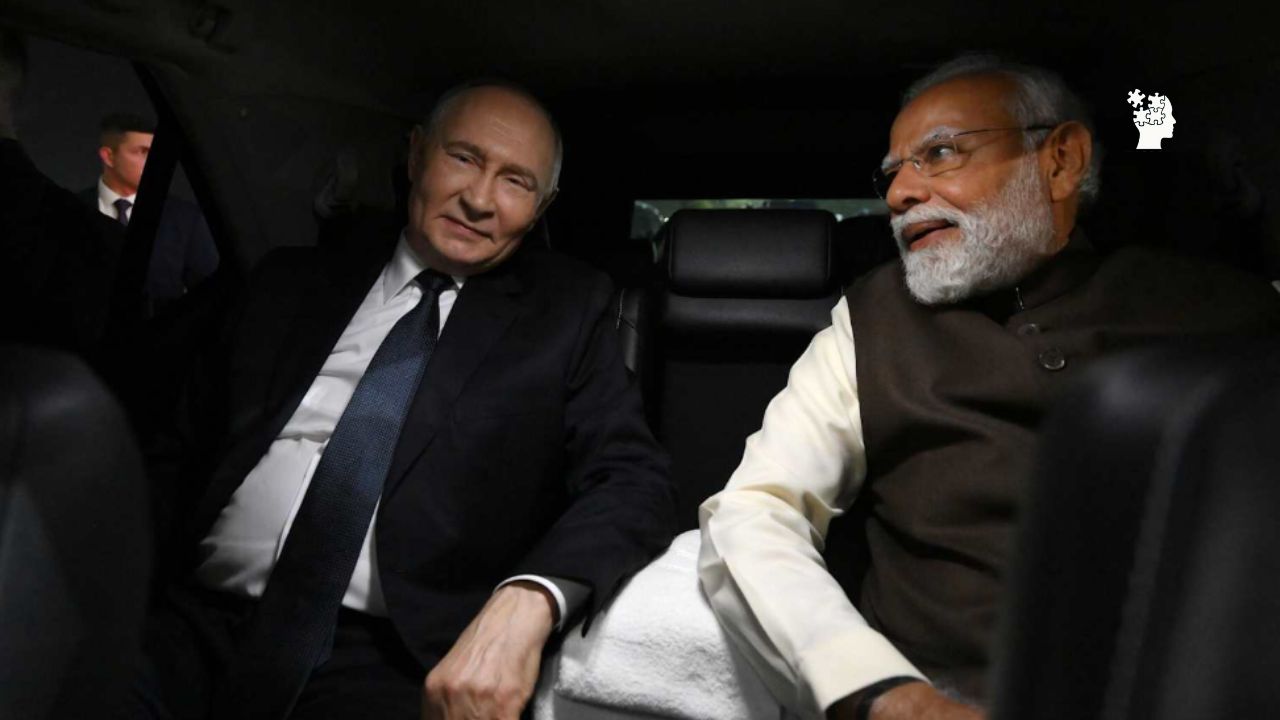
NEW DELHI – In the gilded halls of Hyderabad House, where Indian Prime Minister Narendra Modi extended a lavish welcome to Russian President Vladimir Putin on December 4 and 5, the ghosts of U.S. foreign policy loomed large. What was billed as a routine state visit—complete with hugs, joint press briefings, and a slew of economic pacts—has instead become a stark indictment of President Donald Trump’s approach to America’s oldest strategic partner in Asia. As Modi and Putin inked deals for “uninterrupted” Russian fuel supplies and a “Vision 2030” blueprint for trade, the optics screamed defiance: India, rebuffing Washington’s hectoring over Moscow’s war machine, is charting its own course.
The visit, Putin’s first to India since his 2022 invasion of Ukraine, unfolded against a backdrop of escalating U.S.-India tensions. Just four months earlier, in August 2025, Trump slapped a punishing 50% tariff on Indian imports—one of the highest rates imposed on any trading partner—explicitly tying it to New Delhi’s purchases of discounted Russian crude. Half of that levy (25%) was a “reciprocal” tariff, the other half a direct penalty for what the White House called “funding Russia’s aggression.” Putin, ever the opportunist, wasted no time in his pre-visit interview with Indian media, questioning U.S. hypocrisy: “If the U.S. has the right to buy our nuclear fuel, why shouldn’t India have the same privilege?” By the summit’s end, Russia had pledged steady oil flows to power India’s booming economy, a lifeline amid global energy jitters.
Enter Michael Rubin, the sharp-tongued former Pentagon official turned senior fellow at the American Enterprise Institute. In a blistering interview with ANI on December 6, Rubin didn’t mince words: Putin’s triumphant arrival in Delhi was “the result of Donald Trump’s gross incompetence.” Citing polls showing 65% of Americans disapprove of Trump, he argued that the president’s missteps have alienated a key ally, handing Putin a diplomatic coup. “Trump deserves a Nobel Prize for bringing India and Russia together the way he did,” Rubin quipped sarcastically, noting the irony of a U.S. leader whose “flattery of the Pakistanis” or possible “bribery” from Turkish and Qatari backers has upended decades of Washington-New Delhi courtship.
Rubin reserved special ire for the tariffs, calling them a “disastrous bribe” that ignores India’s realities. “What Americans don’t understand is that Indians elected Prime Minister Modi to represent Indian interests,” he said. Lecturing New Delhi on Russian oil while the U.S. itself imports Russian uranium for its nuclear plants? “Hypocritical,” Rubin thundered. “If we don’t want India to purchase Russian fuel, what are we going to do to provide fuel to India at a cheaper price and in the quantities India needs? If we don’t have an answer for that, our best approach is simply to shut up.” It’s a sentiment echoed across Indian media and X (formerly Twitter), where users lampooned Trump’s policies as a self-inflicted wound, with one viral post declaring: “Trump’s tariffs just arranged a Putin-Modi bromance—Nobel for diplomacy fail?”
Table of Contents
The Tariff Trigger: A Policy Powder Keg
The flashpoint dates back to August 6, when Trump signed an executive order declaring India’s Russian oil buys a “national emergency” threat, stacking a 25% penalty atop existing duties. India, the world’s third-largest oil importer, had ramped up Russian crude purchases post-Ukraine invasion, snapping up discounted barrels that saved refiners an estimated $12.20 per barrel while stabilizing global prices—a move tacitly endorsed by the Biden administration. By October 2025, Russia supplied 32% of India’s imports, though volumes dipped 38% year-over-year amid U.S. sanctions on giants like Rosneft and Lukoil.
The tariffs hit hard: textiles, gems, pharmaceuticals, and auto parts—$50 billion in annual U.S. exports—now face duties up to 50%, among the steepest globally. Indian exporters warn of 20-30% profit erosion, with small firms in Gujarat’s jewelry hubs and Tamil Nadu’s garment clusters already slashing jobs. Yet, as Putin jetted into Delhi, Modi signaled no retreat, announcing diversified trade deals worth $10-15 billion in non-oil sectors like defense and agriculture. “Our friendship is resilient to external pressure,” Modi declared, a not-so-subtle nod to Washington.
On X, the backlash was swift. “Trump’s obsession with tariffs brought Russia-Pak closer—India won’t tolerate terrorism or trade wars,” one user fumed, linking the policy to broader Indo-Pacific realignments. Another quipped: “Putin in India negotiating trades after dumb tariffs. Stagflation incoming.”
How This Affects America: A Cascade of Strategic and Economic Blowback
Trump’s gambit, intended to starve Russia’s war chest, has instead boomeranged, inflicting self-harm on U.S. interests in a multipolar world. Here’s a breakdown of the fallout:
1. Strategic Erosion in the Indo-Pacific
America’s pivot to Asia hinges on India as a counterweight to China—think Quad summits, joint military drills, and tech-sharing pacts. But the tariffs have soured that bet. Polls show favorable U.S. views in India plummeting from 77% in 2023 to 51% post-tariffs, while Russia enjoys 60% approval. Putin’s visit, with its S-400 missile nods and BRICS expansions, underscores India’s “multi-alignment”: cozying up to Moscow without ditching the West entirely. Result? A weakened QUAD, emboldened China (which hosted Modi-Putin sidelines in August), and a Russia-India axis that dilutes U.S. leverage against Beijing. As Rubin put it, this “saddles America with a strategic deficit for decades.”
2. Economic Boomerang: Higher Costs and Lost Markets
U.S. consumers are already paying the price. Indian imports—affordable apparel, jewelry, and generics—face markups, fueling inflation in a post-tariff economy where ADP payrolls signal stagflation. American firms like Walmart and Home Depot, reliant on Indian supply chains, report 10-15% cost hikes, with some like Home Depot teetering on bankruptcy edges. Ironically, the U.S. imports refined products from Russian crude processed in India—gasoline and diesel that end up in American pumps—making sanctions a circular farce.
India’s retaliation looms: It could halt $6.6 billion in U.S. energy imports (up 70% YoY) or pivot to Brazilian/Chinese markets, costing American exporters $20-30 billion annually. Global oil prices spiked 8% post-sanctions, adding $6-7 billion to U.S. import bills.
| Impact Area | Short-Term Hit to U.S. | Long-Term Risk |
|---|---|---|
| Consumer Prices | +5-10% on apparel/pharma; inflation up 0.5% | Supply chain disruptions, higher CPI |
| Exports | $10-15B loss in ag/energy sales to India | Diversion to China/Russia markets |
| Geopolitics | Weakened alliances (e.g., Quad) | Russia-India bloc strengthens vs. China |
| Energy Security | Circular sanctions raise global crude | India boosts non-U.S. LNG/coal imports |
3. Diplomatic Isolation and Hypocrisy Exposed
Trump’s “America First” bravado has isolated the U.S., with allies like the EU quietly criticizing the India tariffs while pursuing their own Russia deals. Putin’s unchallenged red-carpet treatment—amid Trump’s Ukraine peace push—paints Washington as the erratic actor. Domestically, it’s fodder for critics: 65% of Americans, per Rubin, see this as incompetence, eroding Trump’s base in a midterms buildup.
In essence, the tariffs haven’t curbed Russian oil (volumes stabilized post-visit) but have accelerated India’s diversification—more Middle East LNG, U.S. coal alternatives, and Russian non-energy ties. As one X analyst noted: “India’s message: We answer to 1.4 billion people, not tariffs.”
A Reckoning for U.S. Diplomacy?
Rubin calls for a “vocal apology” to mend fences, but with Modi eyeing EU and U.S. trade talks warily, time is short. Trump’s team, including envoy Steve Witkoff, has floated Ukraine ceasefires, but India—burned by unilateralism—demands equity first. As Putin departs with bolstered markets, the real Nobel question isn’t Trump’s—it’s whether America can reclaim its seat at Asia’s table before Russia (and China) make it permanent.