
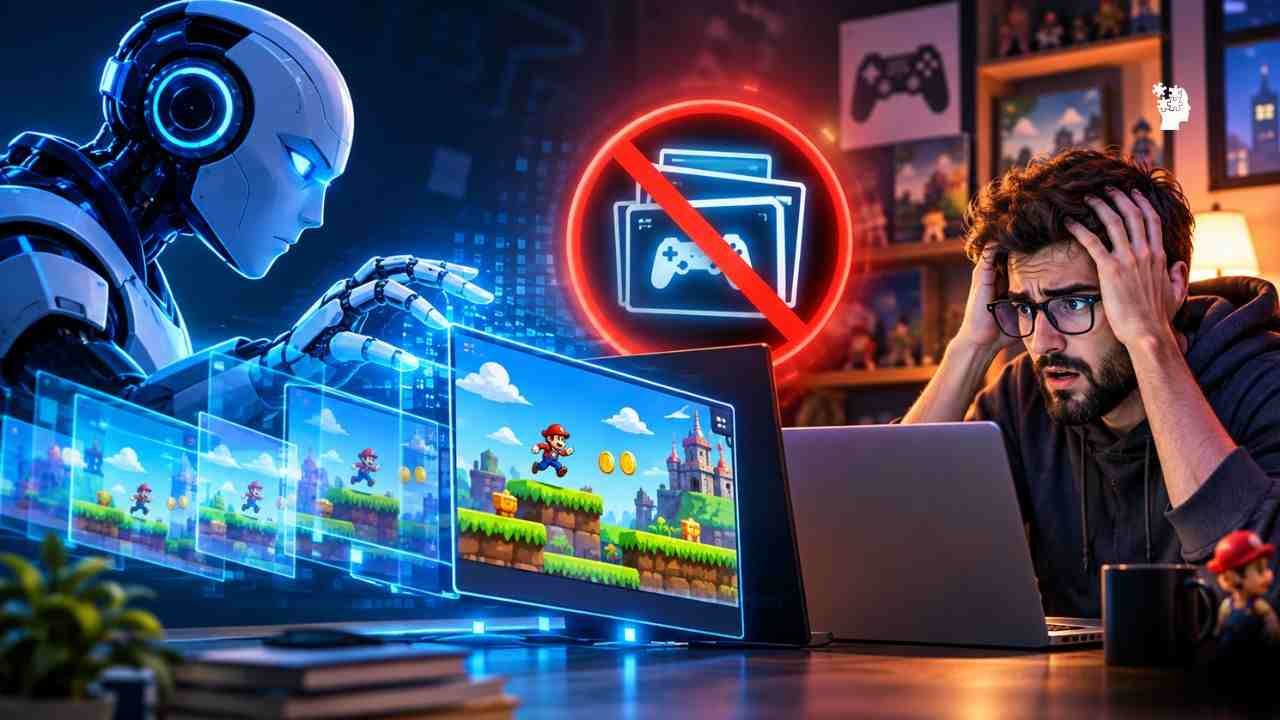
The video game industry has a new problem, and it is not simply that artificial intelligence can help people make games faster. It is that someone can potentially take an unfinished game’s mechanics, presentation and structure, use AI-assisted development tools to recreate a similar experience, and release a competing product before the original developer gets the opportunity to launch.
That possibility is already changing how independent studios approach game development.
Anthropic has now confirmed that it has added a restriction to Claude Code, its AI-powered coding tool, instructing it not to recreate specific existing video games, even when users attempt to rename them or describe the project as original. The company says the change is intended to prevent intellectual property infringement, not to stop people from developing games.
But the timing is significant. Independent developers have recently started cancelling or restricting public demos because they fear their unfinished projects could be reverse-engineered and copied using increasingly capable AI tools.
The controversy raises a much bigger question than whether an AI assistant should refuse to copy a game: If developers become afraid to show their games before launch, what happens to the open development culture that has helped independent games succeed?
Table of Contents
Anthropic confirms a new restriction in Claude Code
The change was first spotted around October 27, 2026, by an X user known as Chasm, who identified a new server-delivered instruction under an internal flag called tengu_heron_brook.
The instruction draws a distinction between creating something original and recreating an existing commercial product.
It tells Claude Code:
Do build original games, games in a genre, and games from the user’s own designs and assets. Do not build a recreation of a specific existing game, even if it is renamed or called original.
Unlike a normal user preference, the instruction reportedly cannot be disabled through a user-facing setting.
Anthropic subsequently confirmed the change through Addy Osmani, a member of its technical staff.
Osmani explained that the company had added two sentences to Claude Code’s prompt for Opus 5.5 to discourage recreating someone else’s specific game because using Claude to infringe intellectual property violates its usage policy.
He also clarified that original games, genre-based projects and games built using a user’s own designs and assets should continue to work.
Anthropic says it will continue adjusting the restriction to find an appropriate balance.
This distinction matters. The company is not announcing a ban on AI-assisted game development. It is attempting to prevent its coding assistant from becoming a convenient tool for reproducing somebody else’s specific creative work.
However, the policy also introduces a difficult question: how can an AI system reliably distinguish an infringing clone from legitimate development work that happens to involve an existing game?
The real warning came before Anthropic’s announcement
The most revealing part of this story is that some developers were already changing their behaviour before Anthropic confirmed its restriction.
One particularly important example is Digital Sun, the Spanish studio behind Moonlighter and Cataclismo.
The studio had planned a public Steam playtest for its upcoming game ReVamp, a project described as a tower-defensevania. Thousands of players had expressed interest in testing it.
But on October 19, Digital Sun announced that it would no longer proceed with the large public playtest as originally planned.
Instead, the studio moved the initial testing programme to a smaller, more controlled Discord community.
Its concern was straightforward: someone could obtain the public game build, reverse-engineer it, use AI tools to create a competing version and potentially publish that version before the original game reached its March 25, 2027 launch.
In an interview with PC Gamer, Digital Sun marketing manager Israel Mallén explained that the change had significant consequences.
The studio had tens of thousands of people signed up for the original Steam playtest. By moving to Discord and manually approving participants, it expected to reach only a few hundred testers.
The difference is not merely administrative.
A smaller test means fewer players providing feedback, less exposure among gaming communities and fewer opportunities for content creators to discover the game.
Digital Sun also explained why Discord offered greater control: it could manually approve participants, monitor activity and request non-disclosure agreements.
The studio had been making games for approximately a decade and said it had never previously felt this level of concern about sharing its work with players.
That is an important warning for the industry. The threat is no longer limited to losing a finished product. Developers are beginning to reconsider whether they should show unfinished products at all.
AI has changed the economics of game cloning
Game cloning is not new.
The mobile gaming industry has experienced copying disputes for years. Games with successful mechanics have frequently inspired competitors, while some developers have accused others of reproducing distinctive visual elements, interfaces and gameplay experiences.
The difference today is the cost and speed of producing a competing version.
Traditionally, recreating a commercial game required considerable programming knowledge, development time and technical resources.
AI coding assistants can reduce some of those barriers.
A developer can use AI to generate code, explain unfamiliar systems, reproduce basic mechanics, create interfaces and accelerate debugging. When combined with reverse-engineering tools, these capabilities can make certain forms of imitation significantly faster.
This does not mean an AI can automatically reproduce an entire commercial game from a screenshot or a short demonstration. Complex games involve substantial engineering, testing, performance optimisation, art production and balancing.
But a simpler game may have a much smaller technical barrier.
An incremental game, puzzle game, basic platformer or simple survival experience can sometimes be imitated far more easily than a large open-world production.
That creates a new economic imbalance.
The original developer may spend months refining a game, building an audience and preparing a launch. A copycat may have little interest in creating something genuinely new. Its objective is to exploit the attention already generated by somebody else’s work.
The competitive advantage is no longer necessarily better design or better execution. It can simply be getting a similar product onto a storefront first.
The ten-day copying problem
PC Gamer has reported an example involving the incremental punching game Escape the Walls.
After the creator shared footage of the game on X, multiple similar versions reportedly appeared on Roblox within approximately ten days, with at least one appearing on Steam.
This illustrates why the issue is particularly serious for small developers.
A successful independent game often depends on a relatively short period of concentrated attention. A competing product that appears during that window can potentially divert searches, player interest and social media traffic.
Even when the original creator ultimately wins recognition, the damage to early visibility can be difficult to reverse.
The problem is bigger than Claude: Steam is facing a discovery crisis
Anthropic’s decision addresses one part of the problem, but the distribution platforms face another challenge.
AI is making it easier to produce games, but it is not automatically making it easier for players to find good ones.
Steam has become a particularly important battleground.
At a Steam Indie Connect event in Busan, South Korea, Valve representatives Tom Giardino and Marc Wilkinson acknowledged concerns about AI-generated low-effort games and cloning.
According to PC Gamer’s October 28 report, developers have even reported extortion threats involving the promise to clone their games using AI if they refuse to pay.
Giardino said Valve does not want to become a gatekeeper deciding which development tools creators can use.
He also pointed out that game cloning existed before AI, although it happened much more slowly.
Valve’s challenge is therefore not simply deciding whether AI-generated games should be allowed. It must balance the freedom to create with the need to protect developers and maintain a useful discovery system.
The scale of the challenge is becoming increasingly visible.
According to the SteamDB figures cited by PC Gamer, nearly 23,000 games had already been released on Steam in 2026 by late October.
A growing catalogue does not automatically mean a healthier gaming ecosystem.
When thousands of additional products compete for attention, original developers face a second problem after finishing their games: getting noticed.
Why storefront algorithms matter more than ever
Valve explained that Steam Next Fest initially exposes players to games through a relatively broad discovery process. After the first two days, its recommendations become more personalised.
The company recognises that this approach can expose users to low-quality games, even as it tries to give developers an opportunity to be discovered.
This creates an uncomfortable situation.
A copycat does not necessarily need to produce a better game. It may only need to capture enough attention through search results, recommendations, similar artwork or trending mechanics to compete with the original.
For an established publisher, this may be manageable.
For a small studio relying on wishlists, community engagement and a successful launch, it can become a serious commercial threat.
The question is no longer only how many games a platform can host. It is how effectively it can distinguish original creative work from opportunistic imitations.
The hidden cost: developers may stop showing their games
This could become the most damaging consequence of AI-enabled cloning.
Public demos and playtests are not simply promotional activities. They are an important part of how independent games are developed.
They allow studios to discover bugs, understand player behaviour, test difficulty, improve controls and determine whether their central gameplay loop is enjoyable.
They also create a relationship between developers and players long before launch.
For smaller studios, this relationship can be essential to survival.
Digital Sun has warned that restricting access to ReVamp means losing months of large-scale feedback and opportunities for content creators to discuss the game.
The studio still intends to organise public testing closer to launch, but that changes the purpose of the exercise.
A demo released shortly before launch is more likely to function as a marketing event than as an extended opportunity to improve the game with community feedback.
Other studios are facing similar decisions.
Alliance Arts and Who’s You also cancelled a planned Steam Next Fest demo for Drunken Goddess Reflux over concerns that the material could be imitated and released before the original.
The consequences could extend well beyond these individual projects.
If more studios adopt restricted testing, players may see fewer early demos, fewer experimental prototypes and fewer opportunities to influence games during development.
In other words, the people who lose access to early builds may not just be developers. It could be the gaming community itself.
Why Anthropic’s restriction could create a new problem for legitimate developers
There is another side to the story that deserves attention.
A policy designed to prevent copyright infringement must also avoid blocking legitimate work.
One developer at Conflict Simulations LLC reported on GitHub that Claude Code had started refusing professional work involving digital adaptations of board wargames.
The developer said the company builds customised digital modules under paid commissions for clients who own the relevant games. According to the report, the code is written from scratch and uses materials supplied by clients.
The developer argued that this is legitimate commissioned work rather than an attempt to steal or distribute someone else’s intellectual property.
The reported refusal raises an important question: what happens when a broad safety instruction cannot recognise the difference between unauthorised copying and work performed with permission?
There are several legitimate situations in which developers may need to work with existing games:
- A publisher may commission a digital adaptation of its own board game.
- A developer may build an authorised remake or port.
- A studio may create accessibility tools for an existing title.
- A developer may build a mod using assets and permissions supplied by the rights holder.
- A game owner may commission a private companion application.
A blanket refusal could interfere with some of these activities if the model cannot establish the relevant context.
Anthropic has acknowledged that it intends to keep refining the balance and that developers whose legitimate work is refused can bring those cases to Osmani’s attention.
This is important because AI safety policies should not treat every project involving an existing intellectual property as automatically unlawful.
The real distinction is permission, ownership and the nature of the work being reproduced.
Is copying a game’s mechanics actually illegal?
This is where the discussion becomes more complicated.
There is a difference between copying a game’s underlying idea and reproducing its protected creative expression.
The World Intellectual Property Organization explains that copyright protection extends to original expression, not simply to ideas, procedures or methods of operation.
Video games are particularly complicated because they combine several creative elements, including software, graphics, animation, music, sound and interactive audiovisual experiences.
For example, the general idea of a puzzle game, platformer or tower-defence experience is not automatically owned by the first developer to create one.
Another studio can generally create its own game in the same broad genre.
However, copying protected code, artwork, music, characters or other distinctive creative elements can create intellectual property problems. Other legal protections, including trademarks and applicable design rights, may also become relevant depending on the circumstances and jurisdiction.
This distinction explains why Anthropic’s wording is significant.
It does not instruct Claude to stop making platformers because another platformer already exists. It specifically targets recreations of particular existing games.
But there is no universal technical test that can determine whether every similar game is a lawful inspiration, an independent creation or an infringing imitation.
That is why human review, licensing and the relevant legal context remain important.
This is a general explanation of intellectual property principles, not legal advice.
What should Steam and other gaming platforms do?
Valve has suggested that improving discovery and platform intelligence is a better starting point than restricting which tools developers can use.
That is understandable, but discovery algorithms alone may not solve the problem of stolen or reverse-engineered builds.
There are several practical protections that platforms could consider.
1. Better access controls for unreleased games
Developers should have more control over who can access private and public playtests.
Options could include account age, previous purchases, playtime, review history and participation records.
This would not eliminate copying, but it could make suspicious access patterns easier to identify.
2. Faster intellectual property complaints
When a developer reports a suspicious clone, platforms need a transparent process to review evidence and respond quickly.
The speed of review matters because a copycat may benefit most during the original game’s launch window.
3. Better protection for unreleased builds
Platforms could explore stronger build-access controls, monitoring for suspicious redistribution and better tools for identifying unauthorised copies.
These measures would not make reverse engineering impossible, but they could raise the cost of abusing early access.
4. Better discovery systems
Recommendation systems should reward meaningful player engagement and originality rather than allowing large volumes of nearly identical releases to overwhelm smaller creators.
5. A clear distinction between AI-assisted development and AI-enabled infringement
Using AI to write code or generate original assets should not automatically make a game suspicious.
Platforms need to focus on the actual content and whether it infringes somebody else’s rights.
Steam already asks developers to disclose certain uses of generative AI, particularly AI-generated content shipped with a game and content generated while the game is running. Its documentation also makes clear that disclosure does not excuse illegal or infringing content.
The next challenge is ensuring that its enforcement systems can address unauthorised copying without penalising legitimate AI-assisted development.
The open-weight AI loophole: one company cannot solve the problem alone
There is a major limitation to Anthropic’s approach.
Claude Code is only one tool in a much larger AI development ecosystem.
Developers who want to recreate existing games can potentially move to other coding assistants or open-weight models that do not enforce the same restrictions.
Even if one company successfully prevents its models from helping users reproduce specific games, that does not mean the underlying capability disappears.
This creates a difficult problem for AI companies.
If one provider adopts strict restrictions while competitors offer fewer safeguards, the responsible provider may reduce misuse through its own products without significantly reducing the overall availability of cloning tools.
That does not make Anthropic’s decision meaningless.
Its policy establishes an important principle: an AI company can draw a boundary between helping people create original work and helping them reproduce somebody else’s specific product.
But meaningful protection will require cooperation between AI developers, game studios, storefronts and rights holders.
No single coding assistant can protect an entire industry.
What this means for independent game developers
For indie studios, the immediate lesson is that the traditional approach to public testing may need to evolve.
Developers should not have to abandon demos altogether, but they may need to think more carefully about what they distribute and when.
Some practical steps include:
- Releasing smaller or time-limited test builds when appropriate.
- Keeping unreleased assets and sensitive development files outside public builds.
- Using controlled playtests for particularly vulnerable projects.
- Maintaining clear records of original development work and asset ownership.
- Monitoring storefronts for suspiciously similar releases.
- Building a recognisable community and brand that cannot be reproduced simply by copying a gameplay mechanic.
The last point is particularly important.
A game’s long-term value is not just its code. It also comes from its characters, personality, sound, world-building, development team and relationship with players.
A copycat may reproduce a basic mechanic, but building the same level of trust and community is much harder.
Still, this should not become an excuse for platforms to leave independent developers unprotected.
The responsibility for maintaining a healthy marketplace cannot rest entirely on the people whose work is being copied.
The bigger question: Will AI make game development more creative or more crowded?
AI has enormous potential in game development.
It can help small teams prototype ideas, automate repetitive tasks, explore new mechanics and build experiences that might previously have required much larger development budgets.
That is a genuine opportunity.
A solo developer should be able to use AI to create an original game without needing a large studio behind them.
But the same technology can also reduce the cost of imitation.
When creating something original and copying something successful become increasingly similar in cost and speed, the industry faces a difficult choice about what it wants to reward.
If the easiest path to commercial attention is reproducing another developer’s work, genuine innovation becomes harder to sustain.
And if developers respond by hiding their games until launch, players lose the open development culture that has helped many independent titles find their audiences.
Anthropic’s new Claude Code restriction is therefore more than a technical adjustment to an AI coding assistant. It is an early attempt to establish boundaries in an industry where the ability to create and the ability to copy are becoming increasingly accessible.
The real test will not be whether Claude refuses a particular prompt.
It will be whether AI companies and gaming platforms can protect original creators without making legitimate experimentation, modding, licensed adaptations and independent development more difficult.
Because the future of game development should be about making it easier for more people to create original games — not making it easier for someone else to profit from their work before they get the chance.
Frequently Asked Questions
1. Why is Anthropic stopping Claude Code from cloning existing games?
Anthropic added instructions to Claude Code to discourage recreating specific existing games because it considers using its AI tools to infringe intellectual property a violation of its usage policy.
2. Can Claude Code still create original video games?
Yes. Anthropic says users can continue creating original games, games belonging to established genres and projects based on their own designs and assets.
3. Can users disable Claude Code’s game-cloning restriction?
The reported instruction is delivered from Anthropic’s servers and does not have a user-facing setting to turn it off.
4. Why are indie game developers cancelling public demos?
Some developers fear that people could download unfinished game builds, reverse-engineer them and use AI tools to create competing versions before the original games launch.
5. What happened to Digital Sun’s ReVamp playtest?
Digital Sun replaced its planned large public Steam playtest with a smaller, controlled Discord test because of concerns about AI-assisted game cloning. The studio said it hoped to hold a public test around January 2027.
6. Does copyright protect a game’s gameplay mechanics?
Copyright generally protects original creative expression rather than abstract ideas, procedures or methods of operation. However, copying a game’s protected code, artwork, music or other expressive elements may raise intellectual property issues.
7. Can AI still be used to develop games?
Yes. Anthropic’s restriction is aimed at recreating specific existing games, not at AI-assisted game development as a whole.
The bottom line: AI is making game creation more accessible, but the industry must ensure that the technology does not turn the work of independent developers into an easy shortcut for competitors.
Also read: