
Table of Contents
Why the “acquisition” narrative might be backwards—and what it means for the future of AI consolidation
The Headline Everyone’s Running
“Morgan Stanley sees SpaceX shares doubling on Cursor deal.”
“SpaceX acquires AI coding platform Cursor for $60 billion.”
“Adam Jonas: SpaceX AI business worth $600/share in bull case.”
Every finance publication this week is telling the same story: SpaceX, the rocket company, is becoming an AI powerhouse. It bought Cursor. Its shares could double. The end.
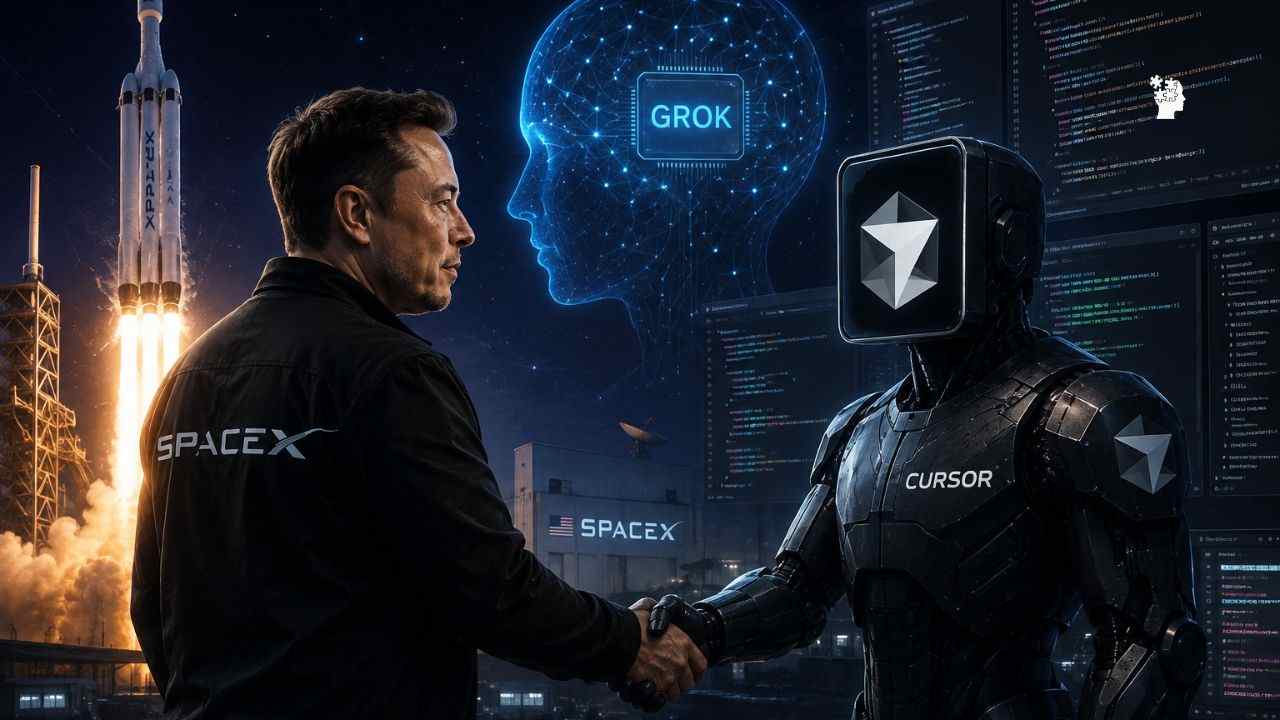
But here’s the angle nobody’s exploring: What if SpaceX didn’t acquire Cursor? What if Cursor acquired SpaceX?
Not in a legal sense. In a strategic sense. And that distinction matters more than any price target.
The Real Deal Structure: A Reverse Takeover in Disguise
Let’s look at what actually happened.
SpaceX is “acquiring” Anysphere (Cursor’s parent company) for $60 billion in Class A common stock. Not cash. Stock. Specifically, SpaceX stock.
That means Cursor’s founders and investors aren’t getting paid out—they’re becoming SpaceX’s largest shareholders. The four MIT classmates who started Cursor in 2022 are now among the biggest owners of a company that launches rockets and operates satellite internet.
Here’s why that matters:
Table
| Traditional Acquisition | What Actually Happened |
|---|---|
| Acquirer pays cash or stock, target exits | Target receives stock and becomes dominant owner |
| Acquirer’s business drives the deal | Target’s business (AI) drives the valuation |
| Acquirer’s brand stays primary | Target’s product becomes the growth engine |
SpaceX didn’t buy Cursor with profits from launching satellites. It issued new shares—diluting existing shareholders—to bring Cursor inside. The market is now valuing SpaceX based on Cursor’s projected revenue ($33 billion by 2030), not its legacy launch business.
In every way that matters to investors, Cursor is now the company. SpaceX is just the wrapper.
The Collaboration That Started Before the “Acquisition”
Here’s the detail buried in every report but never analyzed: SpaceX and Cursor have been collaborating since April 2026—jointly training Grok 4.5 on Cursor interaction data.
That means for four months before the “acquisition,” Cursor’s data was already feeding SpaceX’s AI models. And SpaceX’s infrastructure was already powering Cursor’s growth.
So what changed on June 16? Not the collaboration. The ownership structure.
This wasn’t a strategic acquisition. It was a consolidation of control over the most valuable asset in tech right now: real-world AI interaction data at scale.
Cursor has 64% of Fortune 500 companies using its platform. Every code suggestion, every error fix, every refactoring decision—that’s training data. And SpaceX has the compute infrastructure (Starlink + data centers) to process it.
The deal wasn’t “SpaceX buys Cursor.” It was “the AI data pipeline and the AI compute pipeline merge into one entity.”
Why Morgan Stanley’s $600 Target Might Be Conservative (Or Completely Wrong)
Adam Jonas’s bull case is built on a simple math: Cursor’s ARR hits $33 billion by 2030, apply a 20x multiple, add it to SpaceX’s existing business, and you get $600/share.
But this math assumes SpaceX remains the entity being valued. What if the market starts valuing it differently?
Consider three scenarios:
Scenario 1: SpaceX as an AI Company (The Bull Case)
- Cursor revenue dominates
- AI valuation multiples apply (20-40x revenue)
- $600/share is achievable
- This is what Jonas is betting on
Scenario 2: SpaceX as a Holding Company (The Realistic Case)
- Launch/Starlink = cash cow utility
- Cursor = high-growth AI platform
- Market applies different multiples to each segment
- Valuation becomes more complex, but potentially higher
Scenario 3: Cursor Spins Out (The Hidden Risk)
- Cursor’s founders, now major SpaceX shareholders, push to spin out the AI business
- SpaceX becomes a legacy infrastructure play again
- Cursor trades at pure AI multiples as a separate entity
- Current SpaceX shareholders get diluted twice
None of these scenarios are discussed in the bullish coverage. But Scenario 3 is particularly relevant because the deal was structured in stock, not cash. If Cursor’s founders believe their business is worth more as a standalone AI company than as a division of SpaceX, they have the leverage—and the shareholding—to make that happen.
The Bigger Picture: This Is How AI Consolidation Really Works
The SpaceX-Cursor deal isn’t an outlier. It’s a template.
In 2025-2026, we’re seeing a new pattern in AI M&A:
Table
| Old Model | New Model |
|---|---|
| Big tech buys startup for cash | Startup takes over big tech via stock swap |
| Acquirer absorbs target’s tech | Target’s tech becomes the acquirer’s growth engine |
| Founders exit with payout | Founders become largest shareholders and de facto leaders |
| Brand of acquirer dominates | Brand of target dominates investor narrative |
We’re not watching traditional acquisitions. We’re watching reverse takeovers disguised as acquisitions—where the “target” is actually the more valuable asset, and the “acquirer” is just the vehicle that brings it public or scales it.
SpaceX gave Cursor:
- A public valuation framework (even though SpaceX is private, it has a liquid secondary market)
- Compute infrastructure (Starlink, data centers)
- A $60 billion currency to attract more talent and make more acquisitions
Cursor gave SpaceX:
- The only growth story that matters in 2026
- A reason for investors to value it at tech multiples instead of aerospace multiples
- The data engine that could make Grok competitive with OpenAI and Anthropic
This isn’t an acquisition. It’s a merger of equals where one side had better PR.
What Investors Should Actually Watch
Forget the $600 price target for a moment. Here are the real signals to monitor:
1. Who Runs What? If Cursor’s CEO or founders start appearing at SpaceX earnings calls and investor days more than Elon Musk, that’s your signal that the power dynamic has shifted.
2. Revenue Mix Disclosure Morgan Stanley says Cursor will contribute $2.5 billion in 2026 and $13 billion in 2027. If SpaceX starts breaking out Cursor revenue separately—and if it grows faster than legacy business—that’s confirmation the AI segment is the real company.
3. The Spin-Out Risk Watch for any language about “strategic alternatives” or “unlocking shareholder value” related to the AI business. If Cursor’s founders start agitating for a separate listing, the $600 target becomes irrelevant for SpaceX shareholders.
4. Grok Model Releases Grok 4.6, 4.7, and potential Grok 5 are mentioned as catalysts. But the real question is: Are these models getting better because of Cursor data, or despite it? If Grok improves dramatically, Cursor’s data moat is real. If not, the $60 billion price tag looks speculative.
The Bottom Line
Morgan Stanley’s $600 bull case is headline-grabbing. But it’s built on a narrative that may be backwards.
SpaceX didn’t buy Cursor to become an AI company. Cursor used SpaceX as a vehicle to become a $60 billion AI company without an IPO. The four MIT founders who started with $100 million ARR in January 2025 are now sitting on one of the largest equity positions in private tech.
The question for investors isn’t “Will SpaceX shares double?” It’s “Who actually owns the value being created?”
And if the answer is “Cursor’s founders, not SpaceX’s legacy shareholders,” then this deal looks less like a catalyst and more like a transfer of wealth—from rocket investors to AI investors, wrapped in a press release about an acquisition.
What’s your take? Is SpaceX really an AI company now, or did Cursor just pull off the most valuable reverse takeover in tech history? Let me know in the comments.
Recommended for you: