
Table of Contents
As tech giants push always-on AI devices, the real battle isn’t privacy—it’s the slow death of human parity
The Question Nobody’s Asking
Every headline this week is screaming about privacy. CNN, ABC, every tech blog—you name it. “Always-on AI wearables spark privacy warnings.” “Consent is disintegrating.” “Regulation lags behind.”
They’re not wrong. But they’re missing the bigger story.
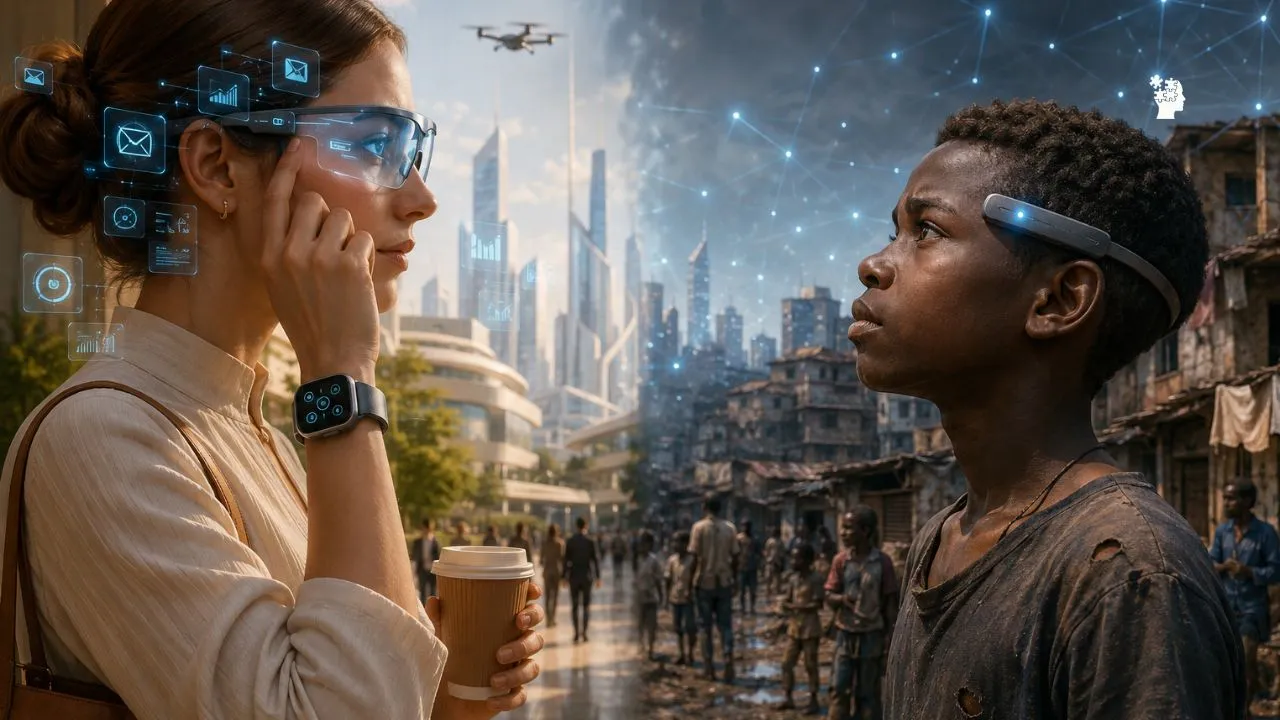
When Mark Zuckerberg says people without AI glasses will face a “cognitive disadvantage,” he’s not making a product pitch. He’s describing a future where human capability itself becomes tiered. And that future is arriving faster than anyone is prepared for.
This isn’t about privacy. Privacy is the symptom. The disease is something far more fundamental: the emergence of cognitive inequality.
The Three Tiers of Human Capability (2026 and Beyond)
Here’s what’s actually happening. Society is quietly splitting into three groups:
Table
| Tier | Who They Are | What They Have |
|---|---|---|
| Tier 1: The Augmented | Early adopters with AI glasses, pins, wristbands | Real-time transcription, instant recall, facial recognition, language translation, contextual search |
| Tier 2: The Smartphone-Dependent | Most people today | Intermittent access to AI, requires active use, breaks flow |
| Tier 3: The Unaugmented | Those who opt out or can’t afford access | Pure human memory, no external cognitive support |
Zuckerberg’s “cognitive disadvantage” comment sounds like hyperbole until you break down what these devices actually do:
- A lawyer with AI glasses walks into a deposition with instant access to every case precedent, every witness statement, every contradiction—without breaking eye contact.
- A doctor with a NotePin captures every patient interaction, cross-references symptoms with global databases, and never misses a detail.
- A student with a Bee Pioneer records lectures, auto-summarizes them, and queries the transcript in real-time during exams.
These aren’t conveniences. They’re competitive advantages that compound.
And here’s the uncomfortable truth: Tier 1 isn’t just slightly better than Tier 2. They’re operating in a different cognitive universe.
Why Privacy Is the Wrong Battle (At Least Right Now)
Don’t misunderstand—privacy matters. Irina Raicu is right that consent is “disintegrating.” Calli Schroeder is right that these devices can be misused in dressing rooms and private spaces. The class-action lawsuit against Meta is real. Women being covertly filmed is real.
But here’s the thing: We’ve had this exact privacy fight before.
Smartphones with cameras sparked identical fears in 2007. Google Glass was called a privacy nightmare in 2013. Every new recording technology triggers the same cycle—panic, then normalization, then ubiquity.
The difference this time? The stakes are higher because the utility is exponentially greater.
A smartphone camera lets you record a moment. AI wearables let you augment your memory, your knowledge, and your decision-making in real-time. The privacy debate is a distraction from the structural shift happening underneath.
When Qualcomm’s Cristiano Amon says “some of the largest companies in the world” are developing AI pendants and jewelry, he’s not talking about gadgets. He’s talking about the next platform war. And platforms reshape society.
The “Keyboard and Mouse Are Dead” Declaration
OpenAI president Greg Brockman declared last week that the era of keyboards and mice is ending. It sounded like typical Silicon Valley grandiosity. But look at what he’s actually describing:
Table
| Input Method | Cognitive Load | Speed | Context Awareness |
|---|---|---|---|
| Keyboard/Mouse | High (requires active focus) | Medium | None |
| Smartphone | Medium (requires pulling out device) | Medium | Limited |
| Voice/AI Wearable | Low (ambient, always-on) | Instant | Full environmental context |
The keyboard required you to stop what you were doing and interact with a machine. Smartphones made it portable but still attention-interrupting. AI wearables promise zero-friction cognition—information layered onto reality without breaking your focus.
That’s not an interface upgrade. That’s a cognitive paradigm shift.
And paradigm shifts don’t ask permission. They create winners and losers before society has time to debate the rules.
The Regulatory Fantasy
Let’s be honest about regulation. The article notes that “no comprehensive federal framework in the United States addresses always-on wearable recording devices.” This is technically true. It’s also irrelevant.
Why? Because technology always outpaces regulation by 5–10 years. By the time Congress drafts a bill, the devices will be mainstream. By the time it passes, they’ll be obsolete. By the time it’s enforced, we’ll be arguing about neural implants instead.
The EU’s AI Act? It classifies biometric identification as “high-risk” but leaves enormous loopholes for consumer devices. State-level recording consent laws? A patchwork that varies by jurisdiction and is nearly impossible to enforce against invisible wearables.
Regulation isn’t coming to save us. The only question is whether social norms and market dynamics will create a tolerable equilibrium—or whether we’ll sleepwalk into a world where cognitive augmentation is mandatory for professional survival.
What Amazon’s Panos Panay Actually Revealed
Amazon’s Panos Panay said: “The more they know, the better off they can complete tasks for you.”
Read that again. Not “the more you tell them.” “The more they know.”
This is the core tension. These devices don’t work well unless they’re always listening, always watching, always learning your patterns. The utility is directly proportional to the surveillance. You can’t have one without the other.
And once you’re in? The switching cost is your external brain. Your recorded memories, your conversation history, your learned preferences—they’re all locked into ecosystems designed to make leaving impossible.
This isn’t a bug. It’s the business model.
The Real Divide: Affordability and Access
Here’s where the cognitive inequality thesis gets uncomfortable.
Table
| Device | Price Point | Annual Subscription |
|---|---|---|
| Meta Ray-Ban Smart Glasses | $299–$379 | None (yet) |
| Amazon Bee Pioneer | Estimated $199–$299 | Likely bundled with Prime/Amazon services |
| Plaud NotePin S | $169 | Subscription for AI features |
| Samsung AI Smart Glasses (upcoming) | Unknown | Unknown |
These aren’t luxury items. But they’re not free either. And the real cost isn’t the hardware—it’s the data ecosystem, the cloud storage, the AI processing, the premium features.
What happens when the best doctors, lawyers, and executives are all Tier 1 augmented? What happens when job postings start listing “AI wearable proficiency” as a preferred qualification? What happens when schools begin allowing—or requiring—these devices during exams?
The unaugmented won’t just be at a “cognitive disadvantage.” They’ll be structurally excluded from opportunity.
Three Scenarios for 2030
Scenario A: The Tolerable Equilibrium Social norms evolve. LED indicators become standardized and culturally enforced. “No AI” zones become as common as “no smoking” zones. The unaugmented retain dignity and opportunity. Regulation catches up enough to prevent worst-case abuses.
Scenario B: The Professional Mandate Certain industries (law, medicine, finance) begin treating AI wearables as standard professional equipment. Not having them becomes malpractice or negligence. Cognitive inequality becomes institutionalized.
Scenario C: The Backlash High-profile abuses trigger a cultural rejection. “Unplugged” becomes a status symbol. Analog skills regain prestige. The augmented face social stigma. The market fragments between “always-on” and “intentionally off.”
My bet? We get a messy combination of all three, varying by geography, industry, and social class.
What You Should Actually Do
If you’re considering buying AI wearables:
Don’t just ask “Is this useful?” Ask: “Am I comfortable being dependent on this?” The utility is real. The lock-in is realer.
If you’re a professional in any field:
Start experimenting now. Not because you need the gadget, but because you need to understand the capability gap. You can’t advocate for fair norms if you don’t know what you’re advocating against.
If you’re a policymaker or regulator:
Forget trying to ban the technology. Focus on portability mandates (your data must move with you), transparency requirements (clear, unavoidable recording indicators), and anti-discrimination protections (cognitive augmentation status should be a protected category).
If you’re building these products:
Zuckerberg’s “cognitive disadvantage” framing is dangerously honest. The industry needs to stop pretending this is about convenience and start addressing the structural inequality it’s creating. Build opt-out modes. Design for the unaugmented. Don’t make surveillance the price of competence.
The Bottom Line
The privacy warnings are valid. The consent concerns are real. The regulatory gaps are alarming.
But the real story of AI wearables in 2026 isn’t that they’re invasive. It’s that they’re inevitable, unequal, and irreversible.
We’re not debating whether to let these devices into society. We’re already living in the transition. The only question left is whether we’ll build guardrails fast enough to prevent cognitive capability from becoming the new social currency.
Because once it is, there won’t be a reset button. Not even if you take the glasses off.
Where do you stand? Are AI wearables the next smartphone, or the next surveillance state? Share your take below.
Recommended for you