
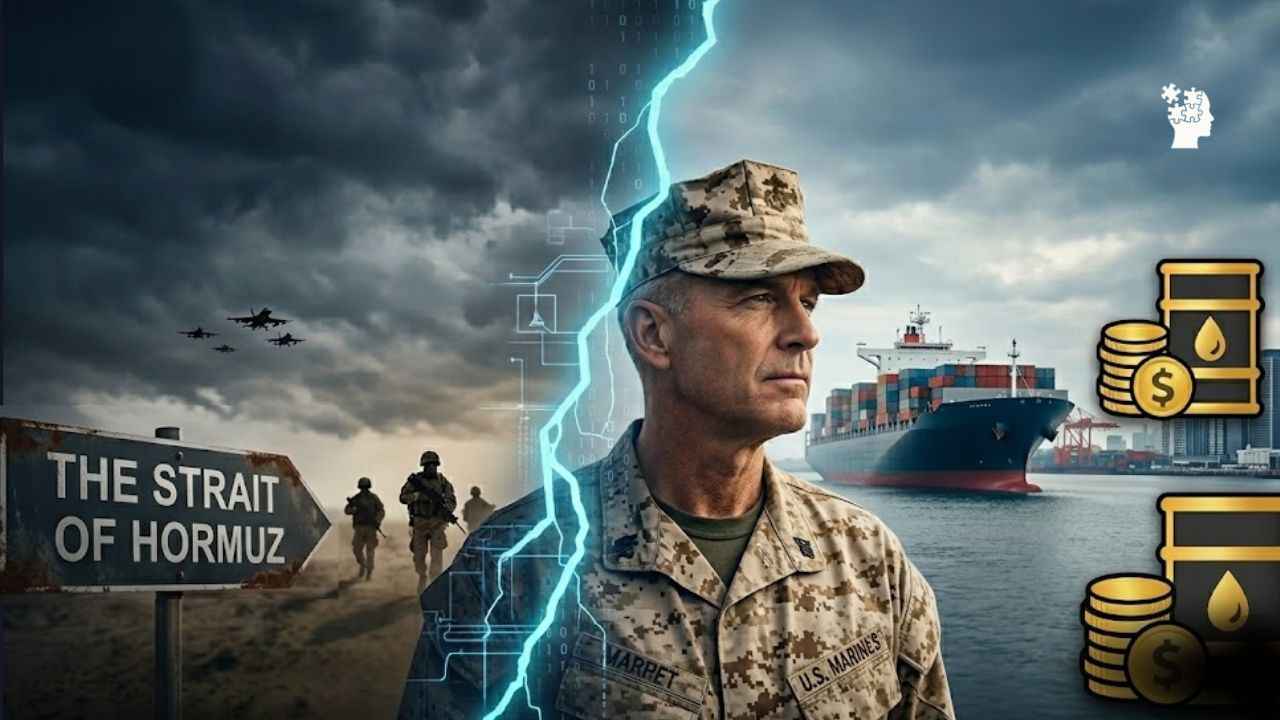
For nearly three weeks, Operation Epic Fury has been an aerial and naval campaign: precision strikes, drone swarms, and missile barrages hammering Iranian military sites, leadership targets, and infrastructure. Launched February 28, 2026, the U.S.-Israeli operation has already claimed over 7,000+ strikes, destroyed much of Iran’s navy and missile production, and inflicted heavy casualties—while keeping American forces largely at a distance.
Wisdom Imbibe Insight:
The most dangerous moment in war is not escalation—it’s commitment. Airpower can be reversed; ground deployment cannot. Once soldiers step onto foreign soil, strategy gives way to consequence. In modern conflict, the real tipping point isn’t firepower—it’s presence. And when presence begins, wars stop being optional and start becoming irreversible realities.
But now, the war’s next phase is under intense discussion—and it’s far riskier.
Multiple U.S. officials and sources briefed on deliberations confirm: The Pentagon has prepared detailed contingency plans for ground troops inside Iran. This isn’t abstract contingency planning. It’s active consideration of scenarios that could put American boots on Iranian soil for the first time since the 1979 hostage crisis.
Table of Contents
The Turning Point: When Remote War Becomes Direct Occupation
Airstrikes degrade capabilities. Sanctions starve economies. Ground deployment? It shifts from punishment to control—and all the chaos that follows.
Key elements reportedly in play:
- Deployment of rapid-response units like the 82nd Airborne Division or Marine Expeditionary Units (MEUs)
- Options to secure strategic chokepoints, including Kharg Island (handling ~90% of Iran’s oil exports)
- Potential missions to seize or safeguard Iran’s highly enriched uranium stockpiles
- Activation of amphibious forces (e.g., USS Boxer and accompanying warships rerouted with ~2,500 Marines each)
U.S. troop numbers in the Middle East already hover around 50,000, bolstered by recent surges. Three additional MEUs (totaling thousands more Marines and sailors) are en route or recently accelerated, adding amphibious assault ships and rapid-response capacity. This buildup—described as the largest since the 2003 Iraq invasion—creates the logistical foundation for escalation.
No final order has been given. But as one U.S. official told Reuters: “The president wisely keeps all options at his disposal.” Preparation lowers the threshold for action.
Mixed Signals from the Top: Ambiguity as Strategy
President Trump has publicly downplayed full-scale invasion while leaving doors open:
- “If I were [sending troops], I certainly wouldn’t tell you.”
- Refusals to rule out “boots on the ground,” emphasizing he is “not afraid” of comparisons to past quagmires.
- Recent hints at “winding down” operations—yet paired with fresh deployments and threats to “knock the hell out of” Kharg Island if Iran persists in closing the Strait of Hormuz.
This isn’t inconsistency—it’s classic Trump: Keep adversaries guessing, maintain maximum flexibility, and let military planners run ahead. History shows once forces are positioned and options detailed, political decisions often follow logistics.
Why Iran Would Be Unlike Iraq or Afghanistan
A ground push into Iran wouldn’t mirror past U.S. occupations. Key differences:
- Geography and scale — Vast terrain, mountainous interior, urban density in key areas.
- Military strength — Iran retains resilient IRGC forces, asymmetric tactics (drones, missiles, proxies), and deep alliances (Hezbollah, Houthis, PMF militias).
- Strategic stakes — Controlling Kharg Island or the Strait of Hormuz could bankrupt Iran’s economy overnight—but invites massive retaliation, regional spillover, and global oil shocks.
- Proxies and escalation — Any landing risks drawing in wider actors, turning a bilateral conflict into a multi-front war.
Seizing Kharg (or blockading it) might force Tehran to reopen shipping lanes—but experts warn it would expose U.S. forces to relentless drone/missile attacks, high casualties, and no clear off-ramp.
The Escalation Trap: Once Troops Land, Everything Changes
Ground wars are notoriously unpredictable:
- Casualties spike (already 13+ U.S. killed, 200+ wounded in air/naval phases)
- Missions expand (secure ports → hold territory → regime pressure)
- Exit becomes elusive (no quick “victory” declaration)
Regional fallout is already visible: Proxy attacks on U.S. bases, Houthi disruptions, oil price volatility. A ground incursion could ignite broader chaos—potentially involving Gulf states, Russia/China responses, or cyber/nuclear brinkmanship.
Economic Ripples: Beyond the Battlefield
Markets are pricing in worst-case scenarios:
- Oil spikes from Hormuz threats
- Supply chain shocks
- Inflation resurgence
- Defense stocks booming (as seen in prior windfalls)
War isn’t just military—it’s an economic multiplier. Ground escalation amplifies every risk.
Public Sentiment vs. Strategic Momentum
Polls paint a stark divide:
- ~65% of Americans believe Trump will order large-scale ground troops (Reuters/Ipsos, March 2026)
- Only ~7% support it; majorities oppose any deployment (55-74% across polls)
- Even among Republicans, views split (roughly even or slim majority against full invasion)
This gap—public war-weariness vs. administration momentum—echoes historical turning points where policy outpaces consent.
A Blurred Battlefield: The New Normal
Today’s wars blend domains:
- Air/cyber dominance in phase one
- Ground as the ultimate escalation
- Economic/financial warfare running parallel
If boots hit Iranian soil, the conflict evolves from targeted strikes to something far more invasive—and irreversible.
What Happens Next?
No decision yet. But signals are converging:
- Detailed Pentagon plans submitted
- Forces repositioned
- Options actively weighed
In geopolitics, readiness often becomes reality. The line between “limited” air campaign and full-spectrum war is thinning fast.
Final reality: History pivots not on the first bomb, but on the first soldier stepping ashore. If that moment comes, the Iran conflict won’t stay contained—it will reshape alliances, economies, and global security for decades.
The world is watching. So is the next chapter.
Final Thought: The Moment Before the Shift
History often changes not with the first strike—but with the first step on the ground.
The planning underway by the Pentagon may or may not lead to deployment.
But it marks a critical moment:
👉 The line between limited conflict and full-scale war is getting thinner.
And if that line is crossed, the consequences won’t stay confined to one region.
They will ripple across the world—militarily, economically, and politically.