
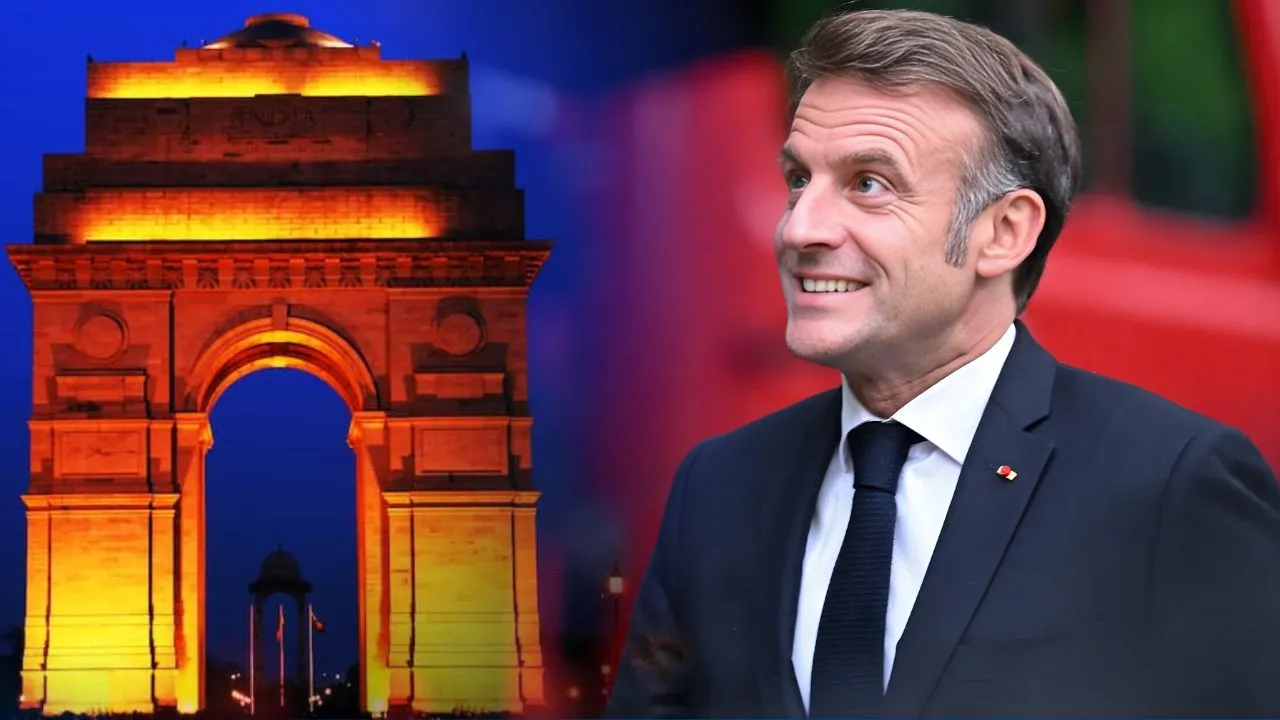
In a landmark moment for European diplomacy, President Emmanuel Macron recently chose a podcast platform in Mumbai to articulate a vision that traditional statecraft usually reserves for closed-door summits. Appearing as the Chief Guest for India’s Republic Day—a role of immense diplomatic weight—Macron’s presence in India was a calculated move to signal the rise of a “Third Way.” As the world navigates the hardening rivalry between the United States and China, the curiosity is no longer just about how middle powers survive, but how they architect a multipolar order. In an intelligent, conversational exchange, Macron revealed that the future of French and European influence hinges on a sophisticated blend of technological sovereignty, strategic alliances, and a cultural “nexus” that Silicon Valley simply cannot replicate.
Table of Contents
1. The “Third Way” of Strategic Autonomy
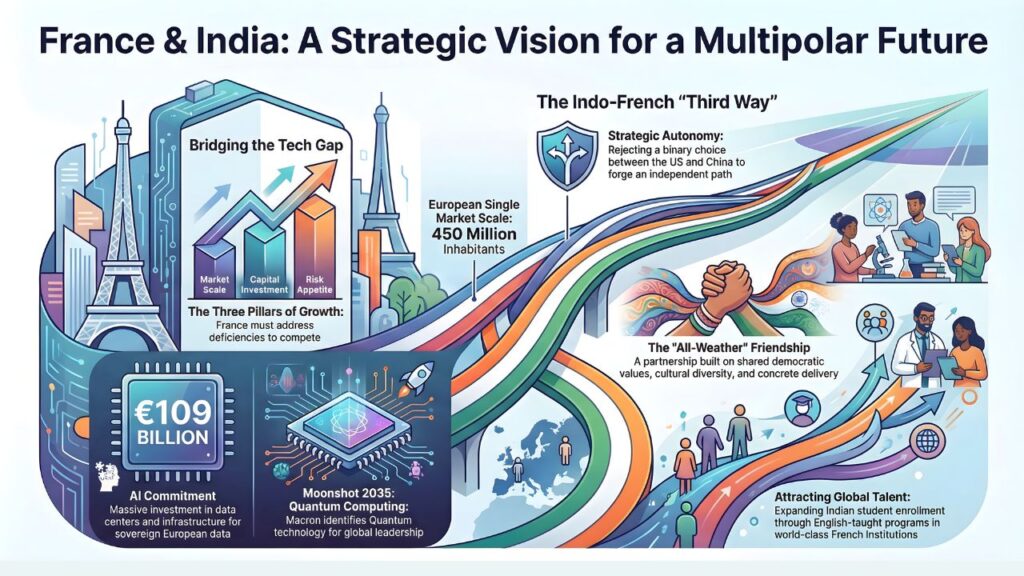
Macron frames the France-India relationship as a partnership of “all-weather friends,” a bond that transcends mere transactional diplomacy. This is the cornerstone of his “Third Way”—a philosophy of Strategic Autonomy designed to prevent nations from becoming vassals to either Washington or Beijing. For Macron, this isn’t just about geopolitics; it is a fundamental requirement for democracy. He argues that if a nation is technologically or defensively dependent on a foreign power, its citizens’ right to vote becomes a “bias”—a choice without real agency. To move from theory to reality, Macron pointed to concrete results like the International Solar Alliance and the India-Middle East-Europe Economic Corridor (IMEC) as blueprints for this independent path.
“Having an ally having a friend doesn’t mean that you’re dependent on your friend.”
2. The Three Missing Ingredients in European Tech
Macron’s analysis of Europe’s tech lag is both blunt and structural. He acknowledges the historical irony that while “entrepreneur” is a French word, the continent has struggled to scale the giants that dominate the modern era. He identifies three specific deficiencies:
- Scale: The European market is historically fragmented. Macron insists that founders must treat the 450-million-strong European single market as their domestic base, rather than just France or the UK.
- Capital: Macron identifies a frustrating paradox: Europe possesses significantly more savings than the U.S., yet these funds are channeled into the bond market or flee the continent in search of profitability. The financing system remains unadapted to the high-stakes needs of the tech sector.
- Risk Appetite: Innovation requires a cultural acceptance of failure. Macron argues that Europe must rediscover its “appetite for risk,” moving away from a culture that penalizes those who try and fail.
3. The 2035 Moonshot: Quantum Supremacy
When asked to place a single, definitive bet on which technology France will dominate by 2035, Macron’s answer was unequivocal: Quantum Computing. He views this as the ultimate field for “disruptive back-end technologies” that allow a nation to leapfrog existing digital leaders. While acknowledging that India currently “trains more engineers every year than the US and Europe together,” Macron believes France’s specific intellectual assets provide a unique advantage in the race for quantum supremacy.
France’s Assets for Quantum Leadership:
- Mathematical Excellence: A world-class tradition of mathematicians who provide the theoretical logic essential for quantum development.
- Performing Labs: A network of high-level research institutions like the École Normale Supérieure (ENS) and Polytechnique.
- Specialized Startup Ecosystem: A vibrant crop of deep-tech founders capable of translating complex physics into industrial applications.
4. Sovereignty is About Location, Not Just Funding
The President addressed the complex optics of France’s €109 billion AI investment, which includes substantial funding from the UAE and technology often sourced from the U.S. Macron argues that sovereignty is not defined by isolationism but by control. By ensuring that data centers are physically located on French soil, they must comply with European regulations, effectively “forcing” U.S. hyperscalers to play by local rules. The goal is to move from “buying a solution” to a “transfer of technology,” allowing local champions like Mistral (the premier European alternative to U.S. large language models) to thrive within a protected ecosystem.
5. The “Nexus” of Taste, Culture, and Innovation
In a move that highlights his persona as a strategist of both tech and soft power, Macron argued that France’s competitive edge is its “unique mix” of high technology and lifestyle. He frames this as a deliberate global talent attraction strategy to compete with the UK and the U.S.
The “French Taste” as a Competitive Advantage Macron posits that innovation is most potent when it intersects with art. France offers founders an ecosystem where elite engineering schools (Polytechnique, Paris-Sorbonne) exist alongside world-leading industries in fashion, gastronomy, and cinema. This “French Taste”—the capacity to mix technical competence with the “art of living”—creates a “unique nexus” that attracts global creators who value creativity as much as code.
6. Leadership is Defined by Respect, Not Just Power
Reflecting on the volatility of modern diplomacy—specifically the leaking of private messages and threats of massive tariffs—Macron offered a stern defense of the “civilization process.” He views the rise of hatred and disrespectful discourse as a “backward” step that endangers the fragility of democratic institutions. If leaders disregard the basic tenets of respect, they undermine the very system that allows citizens to change their leadership through the ballot rather than through violence.
“You can share ideas or not you can disagree but you have to do it in a respectful way within democracies as well.”
7. The Closing Window and “Uncharted Territories”
With 15 months remaining in his current term, Macron describes himself in “action mode.” He is deeply concerned by the erosion of the international security framework, characterizing Russia’s invasion of Ukraine as a “19th-century war”—a neo-colonial revision of borders by a permanent member of the Security Council. His priority for the remainder of his term is to build “defense credibility” for France and Europe while simultaneously engaging with global partners to establish a new framework that limits the misuse of arms in these “uncharted territories.”
8. Conclusion: A World of Brains and Enthusiasm
Despite the looming threats to global security, Macron remains fundamentally optimistic, rooted in the fact that the world has never been more educated. With billions of young people equipped with “brains and enthusiasm,” he believes the next generation is uniquely prepared to solve the crises of climate change and biodiversity.
However, as the “order of the strongest” increasingly threatens to replace the rule of law, a sharp question remains for the global community: Is strategic autonomy a survival necessity for every modern nation, or will it remain a luxury of the elite few who can successfully master the next wave of technological innovation?
Recommended for you :