
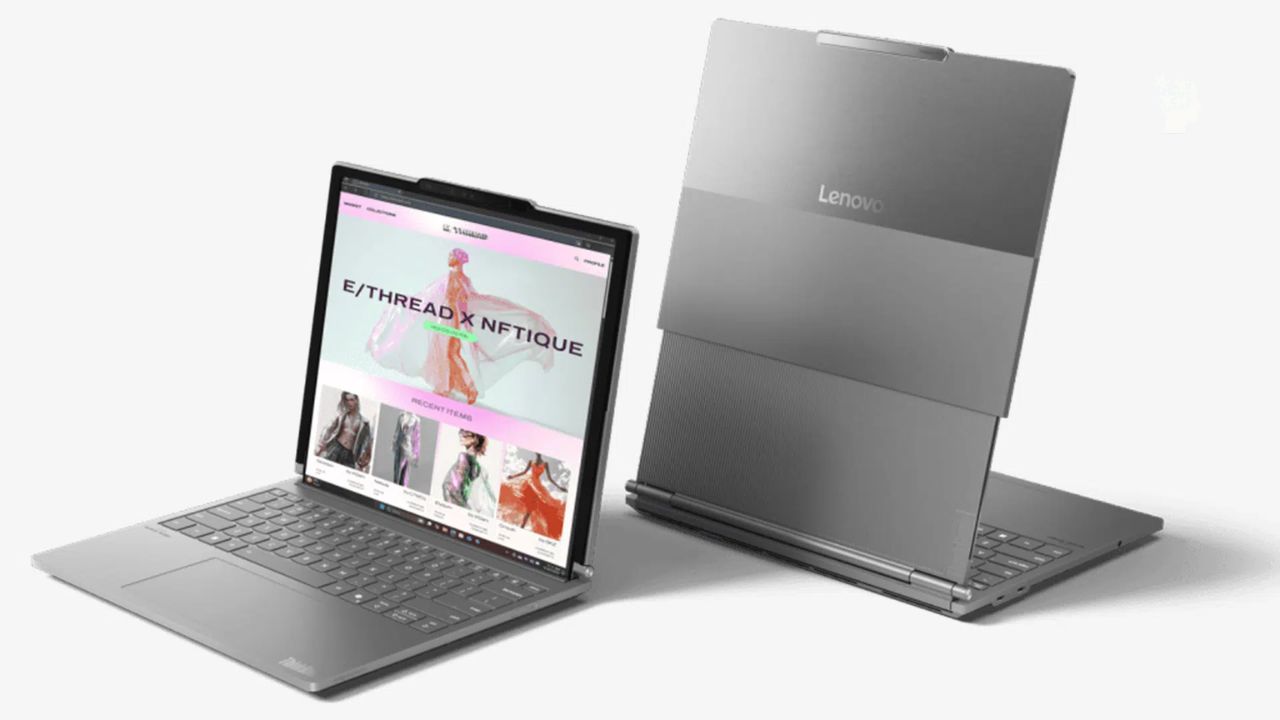
In a world where laptops are constantly evolving to balance portability and performance, Lenovo has pushed the boundaries with the ThinkBook Plus Gen 6 Rollable, the world’s first commercially available rollable OLED laptop. Announced in mid-2025, this innovative device features a motorized OLED display that expands vertically from a compact 14 inches to a spacious 16.7 inches, offering up to 50% more screen real estate without sacrificing mobility. This isn’t just a gimmick; it’s a thoughtful solution for professionals who crave extra workspace on the go.
Table of Contents
Key Features and Specifications
At its core, the ThinkBook Plus Gen 6 Rollable is powered by an Intel Core Ultra 7 258V processor, paired with up to 32GB of LPDDR5X RAM and 1TB SSD storage, making it a powerhouse for multitasking and demanding applications. The star of the show is the flexible POLED (Plastic OLED) display, which supports a smooth 120Hz refresh rate, 400 nits of brightness, and full DCI-P3 color coverage for vibrant visuals. When extended, the screen shifts from a 2000 x 1600 resolution (5:4 aspect ratio) to 2000 x 2350 (8:9 aspect ratio), with minimal visible creases thanks to advanced engineering. Weighing under 2kg, it’s remarkably lightweight for its capabilities, and the motor mechanism feels solid and reliable, deploying the extra screen space in seconds.
Other highlights include a haptic touchpad, a precise keyboard, and AI-enhanced features for productivity. File transfer speeds clock in around 1,075 MBps, competitive with similar ultrabooks like the HP OmniBook. The webcam is strategically placed for better ergonomics, and the overall build emphasizes durability without needing extra adapters for ports. It’s available without a pre-installed OS, appealing to Linux users, and its minimalist design stands out in a sea of flashy consumer laptops.
Lenovo ThinkBook Plus Gen 6 Rollable Specifications Chart
Here’s a detailed specifications table for the Lenovo ThinkBook Plus Gen 6 Rollable, based on official Lenovo details and reviews as of late 2025. This is primarily a fixed-configuration premium laptop.
| Category | Specification |
|---|---|
| Display | Rollable OLED – Compact: 14 inches, 2000 x 1600 resolution (5:4 aspect ratio) – Expanded: 16.7 inches, 2000 x 2350 resolution (8:9 aspect ratio) – 120Hz refresh rate – 400 nits brightness – Full DCI-P3 color coverage – Touch support, minimal crease |
| Processor | Intel Core Ultra 7 258V (Lunar Lake, Series 2) |
| Graphics | Integrated Intel Arc Xe2 |
| Memory | 32GB LPDDR5X-8533 RAM (soldered) |
| Storage | 1TB PCIe Gen 4 SSD |
| Battery | 66Wh |
| Dimensions | 303 x 230 x 19.9-20 mm (11.9 x 9.1 x 0.78-0.8 inches) |
| Weight | Approximately 1.69-1.7 kg (3.73 lbs) |
| Webcam | 5MP IR with privacy shutter |
| Audio | Stereo speakers (2x 2W Harman Kardon) with Dolby Atmos |
| Keyboard & Trackpad | Backlit Chiclet keyboard Haptic touchpad |
| Ports | 2x Thunderbolt 4 (USB-C) |
| Connectivity | Wi-Fi 7 (Intel BE201) Bluetooth 5.4 |
| Security | Fingerprint reader IR camera TPM 2.0 ThinkShield features |
| Other Features | Motorized rollable mechanism (button or gesture control) AI enhancements (Copilot+ PC) Lenovo Vantage and ThinkBook Workspace software |
| Operating System | Windows 11 Pro |
| Price | Starting at ~$3,499 (single configuration) |
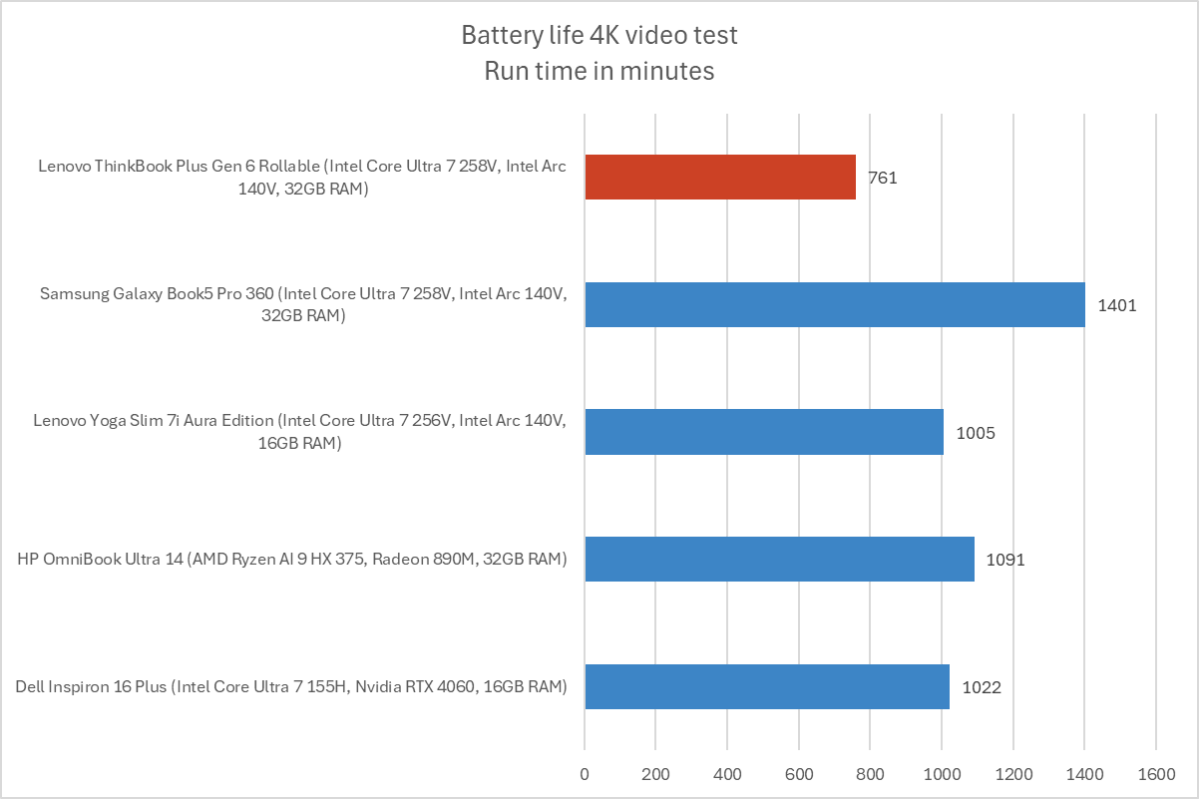
Lenovo ThinkBook Plus Rollable review: A sci-fi laptop you can buy …
This example shows a battery life comparison chart from a review (PCWorld), illustrating real-world performance against competitors.
Launch and Availability
Lenovo unveiled the ThinkBook Plus Gen 6 Rollable at CES 2025, with shipments starting in mid-2025. Priced at around $3,499, it’s positioned as a premium device for business professionals and creatives. Reviews poured in shortly after, praising its innovative form factor despite the high cost. Looking ahead, Lenovo teased the ThinkPad Rollable XD concept at CES 2026 previews, which adds a transparent back panel for even more futuristic appeal, hinting at broader adoption of rollable tech in their lineup.
How Users Are Responding: Praise and Critiques
User feedback has been largely positive, with many hailing it as a game-changer for productivity. On platforms like X (formerly Twitter), users and reviewers describe it as “the rollable laptop of the future,” perfect for content creators, coders, and finance pros who need to view more lines of code or multiple documents simultaneously. One reviewer noted, “The extendable display changed my understanding of working on the go,” emphasizing how it reduces scrolling and enhances multitasking. Tech enthusiasts appreciate its rugged build—droppable without major issues—and the fact that it maintains a small footprint when compact.
That said, not all feedback is glowing. The premium price tag has deterred some, and early adopters mention minor drawbacks like the screen getting warm during extended use or a slightly slippery surface compared to traditional displays. On X, discussions highlight its reliability and fun factor, with posts like “It’s just fun. Ergonomically sound. Bright, colorful, and fast OLED screen.” Overall, users rate it highly for innovation, with scores from sites like SoundsNerdy recommending it for those willing to invest in cutting-edge tech. It’s seen as durable, easy to repair, and a step above foldables in practicality.
Why This Innovation? Pushing the Boundaries of Display Technology

Lenovo’s foray into rollable displays stems from years of prototyping flexible screens, evolving from concepts like foldables to this motorized extension system. Unlike horizontal expansions in upcoming gaming models like the Legion Pro Rollable, the vertical roll here targets productivity workflows. This innovation addresses the limitations of static screens: why carry a bulky 17-inch laptop when you can have a compact 14-incher that grows as needed? It’s part of a broader trend where esnek OLED panels are maturing, making prices more accessible and integration seamless. Lenovo aims to redefine hybrid work, blending AI-powered features with hardware that adapts to user needs, proving that flexible tech can be practical rather than gimmicky.
What Need Does It Fulfill? Bridging Portability and Power
The ThinkBook Plus Gen 6 Rollable fills a critical gap for remote workers and travelers who need monitor-like space without external setups. In an era of multitasking—editing timelines, analyzing spreadsheets, or coding—extra vertical real estate means less scrolling and more efficiency. It’s ideal for professionals in creative fields, finance, or software development, where viewing multiple apps side-by-side boosts output by 20-30%. With remote work on the rise, this laptop eliminates the need for clunky portable monitors, offering a self-contained solution that’s lightweight and battery-efficient. Ultimately, it caters to the demand for devices that evolve with our workflows, making “working on the go” truly limitless.
Looking to the Future
As Lenovo continues to innovate, the ThinkPad Rollable XD concept suggests rollable tech is here to stay, potentially expanding to tablets, phones, and monitors. While the Gen 6 sets the benchmark, future iterations could address warmth issues and lower prices, broadening accessibility.
In conclusion, the Lenovo ThinkBook Plus Gen 6 Rollable isn’t just a laptop; it’s a glimpse into the future of computing. For those who value innovation and productivity, it’s a worthwhile investment that redefines what’s possible in a portable package.
Read More: Google Launches Managed MCP Servers: Streamlining AI Agent Connections to Cloud Services