

AI is transforming industries, creating new fortunes and attracting unprecedented investment. But as infrastructure spending approaches $1 trillion a year, rising debt, electricity constraints and disappointing enterprise returns are exposing a dangerous gap between the promise of artificial intelligence and the economics of building it.
The artificial intelligence revolution is creating two very different stories.
In one, AI is the defining technology of our generation. It is helping developers write software, assisting doctors with research, automating business operations and opening possibilities that seemed impossible only a few years ago.
In the other, some of the world’s largest technology companies are spending hundreds of billions of dollars building the infrastructure needed to power that revolution. Data centres are multiplying, semiconductor orders are surging, electricity demand is climbing and financial institutions are finding new ways to finance the expansion.
Both stories are true. And that is precisely what makes the current AI boom so complicated.
In October 2025, journalist Derek Thompson published an analysis titled This Is How the AI Bubble Will Pop, exploring a fundamental contradiction in the technology industry: companies were investing extraordinary amounts of money in AI infrastructure, but the revenue generated directly from AI services appeared nowhere near large enough to justify the scale of investment.
His conversation with investor and technology analyst Paul Kedrosky raised another concern. AI infrastructure was becoming a magnet for capital, potentially drawing money away from other industries that also needed investment.
A year later, the debate has become considerably more serious.
According to J.P. Morgan Global Research, global AI-related capital expenditure could reach approximately $900 billion in 2026, while the International Energy Agency estimates that the world’s largest data-centre operators alone will spend more than $700 billion this year.
Meanwhile, on October 30, 2026, Reuters reported that the Nasdaq 100 had fallen more than 5.8% during October, putting more than $2 trillion in market value at risk as investors questioned whether escalating AI investments would generate adequate returns.
The warning signs are becoming harder to ignore.
But this is not necessarily the beginning of the end of artificial intelligence. It could instead be the beginning of a difficult financial adjustment in an industry whose technology is advancing faster than its business models.
The real question is no longer whether AI will change the world. It is whether the companies financing that transformation can afford to wait until it does.
Table of Contents
1. The numbers behind the AI boom have become extraordinary
To understand the potential bubble, it is important to understand the scale of the infrastructure being constructed.
AI does not operate on software alone. Behind every chatbot response, AI-generated image, coding assistant and autonomous agent is a complex network of semiconductor chips, servers, networking equipment, electricity infrastructure, cooling systems and enormous data-centre buildings.
The largest technology companies are racing to secure these resources because access to computing power is increasingly becoming a competitive advantage.
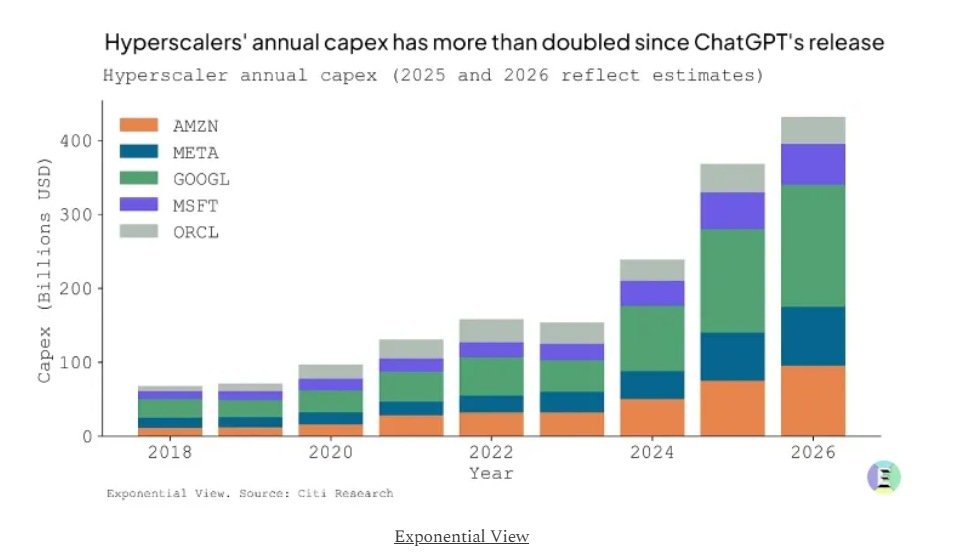
In October 2025, Thompson highlighted an estimated $400 billion in annual AI infrastructure spending. That figure now looks considerably smaller than the scale of investment being discussed in 2026.
J.P. Morgan’s October 19 research projected global AI capital expenditure of around $900 billion in 2026, with cumulative investment potentially reaching $5.5 trillion by 2030.
The five major American hyperscalers—Amazon, Alphabet, Meta, Oracle and Microsoft—are collectively spending at a pace that illustrates how dramatically the investment cycle has accelerated.
The International Energy Agency also estimates that major data-centre operators will spend more than $700 billion in capital expenditure in 2026, much of it directed towards new facilities.
These estimates have different scopes and should not be added together. They nevertheless point towards the same conclusion: AI infrastructure has become one of the largest investment programmes in the global economy.
The scale raises an uncomfortable question.
What happens if companies build computing capacity faster than customers are willing to pay for it?
That is the central risk behind the AI bubble argument.
2. The biggest problem is not AI revenue. It is the return on investment.
One of the weaknesses in the AI bubble debate is the tendency to compare total infrastructure expenditure with consumer subscriptions alone.
That comparison is incomplete.
AI companies earn money through several channels:
- Individual subscriptions to AI assistants.
- Enterprise software and AI subscriptions.
- Cloud computing services.
- API access and usage-based billing.
- AI-powered advertising and recommendation systems.
- Coding, automation and productivity products.
- Licensing and specialised industry applications.
For example, Microsoft’s AI business, cloud infrastructure and enterprise services generate revenue in ways that cannot be captured simply by counting consumer chatbot subscriptions.
Similarly, Amazon’s AWS business benefits from demand for cloud infrastructure, while Google’s AI investments can support advertising, search, cloud and other products.
Nevertheless, revenue growth does not automatically mean that infrastructure investments are profitable.
A company can generate billions in additional sales while spending even more on the computing capacity, electricity, research and maintenance required to deliver those services.
The important financial measure is not simply how much revenue AI generates. It is how much profitable cash flow remains after the full cost of delivering AI services.
This distinction matters because running AI models is expensive. Every additional user, request or automated task can create computing costs. Some services may become cheaper as hardware and software improve, but more sophisticated models and autonomous agents can also consume substantially more computing resources.
A successful AI product must eventually demonstrate that its customers are willing to pay enough to cover those costs while leaving a sustainable profit.
That business model is still developing.
3. The enterprise AI adoption problem: Companies are experimenting, but where are the financial returns?
Perhaps the most important evidence supporting Thompson’s original argument comes from businesses themselves.
Companies around the world are adopting AI tools. Employees are using them to write reports, analyse information, generate code, prepare presentations and automate repetitive tasks.
However, individual productivity improvements are not necessarily translating into measurable company-wide financial gains.
McKinsey’s August 25, 2026 State of AI survey provides an important illustration.
Its findings reveal that:
- 80% of respondents said AI improved their individual productivity.
- 37% reported at least some enterprise-level EBIT impact from AI.
- Only around 6% qualified as AI high performers, reporting significant impact and attributing at least 5% of EBIT to AI.
- Around 20% said AI-related operating costs, including token expenses, were constraining usage.
These numbers reveal an important gap.
Employees may save 30 minutes every day using AI, but that does not automatically mean their employer can reduce operating expenses by an equivalent amount.
Productivity gains become financial returns only when businesses can convert them into higher output, reduced costs, increased sales, better customer retention or new revenue streams.
Consider a company employing 500 people.
If AI helps each employee complete certain tasks faster, the company may initially experience improved productivity. But if it continues paying the same salaries, maintains the same workforce and adds expensive AI subscriptions and computing costs, the financial benefit may remain limited.
The situation becomes more complicated when AI requires human supervision, fact-checking, security controls and integration with existing software.
This does not mean enterprise AI is failing. It means the transition from experimentation to profitable deployment is taking longer than some investment expectations may assume.
Gartner’s September 2026 survey adds another warning: only 22% of organisations had successfully scaled AI across multiple business units or adopted an AI-first approach.
That is a significant gap between enthusiasm and widespread operational transformation.
The AI industry does not necessarily need every company to become an AI-first business. But it does need enough customers to use AI consistently and profitably to support the infrastructure being constructed.
4. The hidden financial risk: AI infrastructure is becoming a debt-funded business
This is one of the most important developments since Thompson’s original analysis.
Initially, the AI infrastructure boom was largely associated with the enormous cash reserves of major technology companies.
Companies such as Microsoft, Alphabet, Amazon and Meta had powerful balance sheets and substantial cash-generating businesses. They could finance large infrastructure programmes without immediately depending on external borrowing.
But the investment requirements have grown so large that the financing structure is changing.
Reuters reported on October 30, 2026, that investors were increasingly concerned about the industry’s growing reliance on debt.
Microsoft was reportedly planning an approximately $25 billion US investment-grade bond sale, while major technology companies have already issued substantial amounts of debt over recent years.
Meta’s plans for a record $97.5 billion fundraising also heightened concerns about shareholder dilution and the ability of companies to finance expanding infrastructure programmes.
Why does this matter?
Because debt changes the economics of an investment.
A company financing a data centre through its own cash reserves can absorb a temporary period of weak returns more easily than a company that must make regular interest payments and eventually repay borrowed capital.
If AI demand grows more slowly than expected, the consequences could include:
- Higher financing costs.
- Pressure on free cash flow.
- Delayed construction projects.
- Lower returns on invested capital.
- Reduced shareholder buybacks and dividends.
- Asset impairments if infrastructure becomes economically unviable.
There is another important development: the growing involvement of private capital.
In August 2026, Nvidia announced partnerships with Apollo, BlackRock, Blackstone, Brookfield, Goldman Sachs and KKR to establish AI compute infrastructure financing platforms intended to mobilise more than $500 billion in third-party capital over time.
This is significant because it shows that AI infrastructure is becoming an investment category for a much broader financial ecosystem.
It also creates a question that deserves greater attention: who ultimately carries the financial risk if the infrastructure fails to generate the expected returns?
The answer may not be limited to the technology companies building the facilities. It could also involve lenders, institutional investors, private capital funds and other infrastructure financiers.
The more complex the financing structure becomes, the more important transparency about ownership, debt obligations, revenue commitments and asset valuations becomes.
This does not mean that these financing arrangements are inherently dangerous. It means that the financial system is becoming more deeply connected to the success of the AI infrastructure cycle.
5. Nvidia’s position reveals both the strength and vulnerability of the AI economy
No company illustrates the extraordinary economics of the AI boom better than Nvidia.
The company has become one of the most important suppliers of the computing infrastructure powering modern AI systems.
Its GPUs are used to train and operate advanced models, while its networking technologies and software ecosystem help connect enormous computing clusters.
Nvidia’s fiscal 2026 results demonstrated just how strong this demand had become.
The company reported:
- Annual revenue of $215.9 billion.
- Year-over-year revenue growth of 65%.
- Data-centre revenue growth of 59%.
- Gross margin of 71.1%.
These figures are important because they challenge the simplistic argument that the AI boom is supported by nothing but speculation.
There is genuine demand. There are real customers. There is substantial revenue and extraordinary profitability.
But Nvidia’s success also exposes a concentration risk.
A large part of the AI infrastructure investment cycle depends on the ability of a relatively small number of companies to continue buying advanced computing hardware.
If hyperscalers slow their infrastructure expansion, chip demand could weaken. That could affect semiconductor suppliers, networking businesses, data-centre developers and companies providing supporting equipment.
The reverse is also true. Continued investment can sustain enormous demand for the entire supply chain.
This creates a potentially fragile relationship: the financial performance of several interconnected industries increasingly depends on whether a small group of technology companies continues spending at an extraordinary rate.
There is also a longer-term question.
What happens when the same AI workloads can be completed using fewer chips, cheaper hardware, more efficient models or alternative processors?
Better efficiency is good for customers and the broader economy. But it could reduce the amount of computing infrastructure required to generate a given level of AI output.
The industry may therefore face an unusual contradiction: the technology becomes more successful and efficient, while the financial assumptions behind some infrastructure investments become less attractive.
6. The electricity problem could become bigger than the semiconductor problem
Thompson and Kedrosky also identified an important consequence of the AI infrastructure boom: its impact on the wider economy.
Data centres require enormous quantities of electricity.
Unlike ordinary office buildings, AI facilities operate with dense computing equipment that must run continuously and be kept within strict temperature limits.
As AI hardware becomes more powerful, the electricity and cooling requirements of individual facilities increase.
The International Energy Agency’s April 2026 analysis found that electricity demand from data centres increased by 17% in 2025, while electricity demand from AI-focused data centres grew even faster.
Its newer research indicates that the largest data-centre operators are expected to spend more than $700 billion in capital expenditure during 2026.
This creates a challenge that cannot be solved simply by ordering more GPUs.
Data centres need:
- Reliable electricity generation.
- High-capacity transmission networks.
- Transformers and electrical equipment.
- Cooling infrastructure.
- Water management.
- Grid connections and regulatory approvals.
In many locations, the electricity grid is not expanding quickly enough to accommodate new facilities.
This could become one of the biggest bottlenecks for the AI industry.
A data centre may have financing, land, servers and customers, but without sufficient electricity it cannot operate at full capacity.
There is also a political dimension.
Local communities may oppose new facilities because of noise, land use, water consumption and concerns about electricity prices.
The economic benefits of data centres are often national or global, while some of their costs are experienced locally.
That creates a difficult question for governments: should households and existing businesses bear the costs of expanding electricity infrastructure primarily to support private technology companies?
This debate could become increasingly important as AI infrastructure expands.
7. The AI bubble could create winners even if the technology stocks crash
One mistake investors and commentators often make is treating the AI industry as a single business.
It is not.
AI is an entire economic ecosystem.
It includes chip manufacturers, data-centre operators, cloud platforms, software companies, electricity producers, construction firms, networking suppliers, cooling specialists and businesses developing AI-powered products.
A correction in one part of the industry would not necessarily destroy the others.
Consider the dot-com bubble.
During the late 1990s, investors poured money into internet companies, many of which had weak business models and unsustainable valuations.
When the bubble burst, numerous companies disappeared. Investors suffered substantial losses.
But the internet itself did not disappear.
The infrastructure built during that period helped support the growth of companies that eventually transformed commerce, communication and entertainment.
The AI industry could follow a similar pattern.
Some infrastructure projects may become unprofitable. Some startups may fail to attract customers. Some AI companies may discover that their operating costs are higher than their revenue.
However, the underlying technology could continue improving.
A financial correction could even make AI more accessible by reducing the cost of computing capacity, forcing suppliers to compete more aggressively and encouraging businesses to focus on practical applications rather than speculative promises.
The distinction is crucial:
An AI investment bubble can burst without the AI revolution ending.
The biggest losers may be investors who paid too much for future growth, rather than customers who continue benefiting from increasingly capable technology.
8. The overlooked danger: AI infrastructure could starve other industries of capital
One of the most interesting arguments in Thompson’s interview with Kedrosky was not about technology at all.
It was about capital allocation.
Kedrosky compared the current AI investment cycle with the telecommunications infrastructure boom of the 1990s.
During that period, enormous amounts of capital flowed into telecom networks. Investors were excited by the potential of a connected world, and companies invested heavily in fibre-optic infrastructure.
The problem was that the investment boom became excessive relative to the returns being generated.
The result was a painful correction.
Kedrosky argues that something similar could happen with AI.
When investors see the possibility of enormous returns from data centres, GPUs and AI infrastructure, other industries may struggle to attract financing.
A private equity firm may prefer investing billions in a small number of large data-centre projects rather than distributing smaller investments across dozens of manufacturing businesses.
This is not necessarily because manufacturing has become less important.
It may simply be because large infrastructure investments are easier for financial institutions to evaluate, finance and manage at scale.
The consequences could extend beyond the technology sector.
Small manufacturers, industrial businesses, energy projects and other capital-intensive industries could face higher financing costs or reduced access to investment.
This creates a broader economic risk.
If too much capital flows into one fashionable industry, the economy may underinvest in other sectors that are essential for long-term productivity and employment.
The irony is that governments may simultaneously encourage domestic manufacturing, industrial development and technological independence while private investment becomes increasingly concentrated in AI infrastructure.
AI could therefore create economic opportunities while unintentionally making other industries more difficult to finance.
9. What happens if the AI bubble bursts? Five possible consequences
A correction would probably not unfold as one dramatic event. It could emerge through several interconnected developments.
First: Technology valuations could fall sharply.
Companies whose share prices depend heavily on future AI growth could face a reassessment if revenue and profit growth fail to match expectations.
The October 2026 market reaction suggests investors are already becoming more sensitive to the relationship between capital expenditure and financial returns.
Second: Data-centre projects could be delayed or cancelled.
If demand projections are revised downward, developers may postpone construction, reduce planned capacity or renegotiate financing agreements.
This could affect construction companies, equipment suppliers and infrastructure investors.
Third: Semiconductor demand could become more volatile.
Companies supplying GPUs, memory, networking equipment and advanced semiconductor manufacturing could experience slower order growth if major customers reduce spending.
This does not mean semiconductor demand will disappear. It means the industry could move from extraordinary growth to a more normal investment cycle.
Fourth: Debt and private investment could become a source of financial stress.
Projects dependent on optimistic assumptions about future computing demand may struggle to generate enough revenue to service their financing.
The risk would be particularly important where ownership, financing and revenue commitments are spread across multiple entities.
Fifth: The broader economy could experience a slowdown in investment.
If AI-related spending has become a major contributor to business investment and economic growth, a sudden slowdown could affect construction, equipment manufacturing, electricity infrastructure and financial markets.
The effects would not necessarily be limited to Silicon Valley.
They could spread across countries and industries connected to the AI supply chain.
10. Why India could be caught in the middle of the AI infrastructure boom
India presents a particularly interesting case.
The country is not just a potential consumer of AI services. It is also positioning itself as a destination for data centres, digital infrastructure and AI-related investment.
According to India’s Ministry of Electronics and Information Technology, installed data-centre capacity increased from approximately 375 MW in 2020 to around 1,575 MW by August 2026.
The government’s September 2026 update also highlighted approximately 8 GW of projected data-centre capacity by 2030, with nearly $70 billion in investments already underway and another $90 billion in announced projects.
These figures demonstrate the scale of India’s ambitions.
States including Maharashtra, Tamil Nadu, Telangana, Karnataka, Gujarat and West Bengal are among the locations involved in the country’s expanding data-centre ecosystem.
For India, the opportunity is significant.
More infrastructure could support:
- Domestic cloud computing capacity.
- AI research and development.
- Indian startups and technology companies.
- Digital public infrastructure.
- Financial services and enterprise automation.
- Data sovereignty and local data processing.
- New construction, engineering and technical employment.
But there is another side to the opportunity.
India must ensure that infrastructure investment is supported by actual commercial demand rather than expectations that AI adoption will automatically grow forever.
Electricity availability, grid reliability, land, water, financing costs and access to advanced hardware will all influence whether planned projects become commercially successful.
There is also a strategic question.
If global AI investment slows, will international companies continue building data centres in India at the expected pace?
Some projects may remain attractive because India has a large digital economy, growing enterprise demand and strategic importance as a technology market.
Others could face delays if their economics depend heavily on overseas financing or speculative demand forecasts.
For Indian policymakers, the lesson is that data-centre capacity should not become a success metric by itself.
The real measure should be how much economic value the infrastructure creates.
Does it improve productivity? Does it help Indian businesses compete globally? Does it create skilled employment? Does it reduce dependence on overseas cloud infrastructure? Does it generate sustainable returns without placing unnecessary pressure on electricity and water resources?
Those are more important questions than simply counting how many data centres are announced.
11. The jobs question: AI may become more valuable even as companies employ fewer people
There is another important angle that the financial bubble debate often overlooks.
AI could produce enormous economic value without necessarily creating employment at the same rate as previous technological revolutions.
Companies are increasingly using AI to automate coding, customer support, research, documentation, data analysis and administrative tasks.
McKinsey’s 2026 survey found that 39% of respondents expected AI-related reductions in their organisations’ total employment over the following year.
However, the survey also cautioned against treating those expectations as confirmed job losses. Expectations of workforce reductions were considerably higher than the proportion of respondents reporting actual reductions in the preceding year.
The longer-term economic question is more complicated.
If AI allows a company to generate the same output with fewer employees, productivity may improve while labour demand changes.
That could increase corporate profitability, but it could also affect wages, hiring and consumer purchasing power.
There is a potential feedback loop here.
Companies invest in AI to reduce costs. If automation reduces employment or wage growth across large parts of the economy, consumer spending could weaken. That could eventually affect demand for the products and services sold by businesses.
In other words, the success of AI cannot be measured only by how much money businesses save. It must also be considered in the context of how economic gains are distributed.
A technology that increases productivity but concentrates its financial benefits among a relatively small group of companies and investors could create significant social and economic tensions.
12. How to recognise whether the AI boom is turning into a bubble
Instead of trying to predict the exact date of a market crash, investors and observers should watch a collection of measurable indicators.
Here are seven worth following.
1. AI revenue versus capital expenditure
Are cloud and AI revenues growing quickly enough to justify infrastructure spending?
A persistent gap between investment and commercial returns would increase financial pressure.
2. Free cash flow
Are hyperscalers generating sufficient cash after paying for their expanding infrastructure?
Rising debt and falling free cash flow deserve particular attention.
3. Enterprise adoption and profitability
Are companies moving from pilot programmes to organisation-wide AI deployment?
More importantly, are they reporting measurable improvements in operating profit?
4. Data-centre utilisation
Are newly constructed facilities being used at the capacity assumed in their financial projections?
An empty or underutilised data centre can become an expensive asset.
5. Financing conditions
Are AI infrastructure developers increasingly dependent on borrowing, external investors and complex financing structures?
Higher interest rates could expose projects that were viable only under unusually favourable financing conditions.
6. Semiconductor order growth
Are major AI customers continuing to increase their hardware purchases?
A slowdown in orders could reveal that infrastructure demand is normalising.
7. Electricity and grid constraints
Are power availability, connection delays and energy costs preventing new facilities from operating profitably?
The AI industry cannot grow indefinitely without sufficient energy infrastructure.
These indicators are more useful than simply watching whether an AI company’s stock price rises or falls on a particular day.
13. The real AI bubble may not be in the technology. It may be in the expectations.
The most important lesson from Derek Thompson’s original argument is that technological revolutions and financial bubbles can happen at the same time.
Railways transformed transportation, but railway investors suffered enormous losses when infrastructure investment exceeded what businesses could profitably support.
The internet transformed communication and commerce, but many dot-com companies disappeared because their valuations were built on expectations rather than sustainable business models.
AI could follow a similar path.
The technology is already delivering real benefits. Businesses are using it, consumers are adopting it, and developers are building applications that would have been difficult to imagine a few years ago.
But none of that guarantees that every AI company, data centre, semiconductor investment or infrastructure project will produce attractive financial returns.
The October 2026 market reaction is an important reminder. Investors are beginning to demand stronger evidence that the enormous sums being invested will translate into sustainable profits.
There are two possible outcomes.
In the first, AI adoption accelerates, enterprise revenue expands, computing costs decline and the infrastructure investments eventually generate attractive returns.
In the second, AI continues to improve, but commercial adoption and monetisation fall short of expectations. Infrastructure spending slows, valuations decline, debt becomes more expensive to service and weaker companies disappear.
A combination of these outcomes is also possible: AI succeeds technologically while many investors lose money financially.
That may ultimately be the most realistic scenario.
The next great AI story may not be about which company builds the smartest model. It may be about which companies can turn intelligence into sustainable profits without spending more money than the technology can ever earn back.
And when the AI investment cycle eventually cools, the world may discover that the technology was never the bubble. The bubble was believing that every dollar invested in it would become a dollar of future profit.
Also Read: