
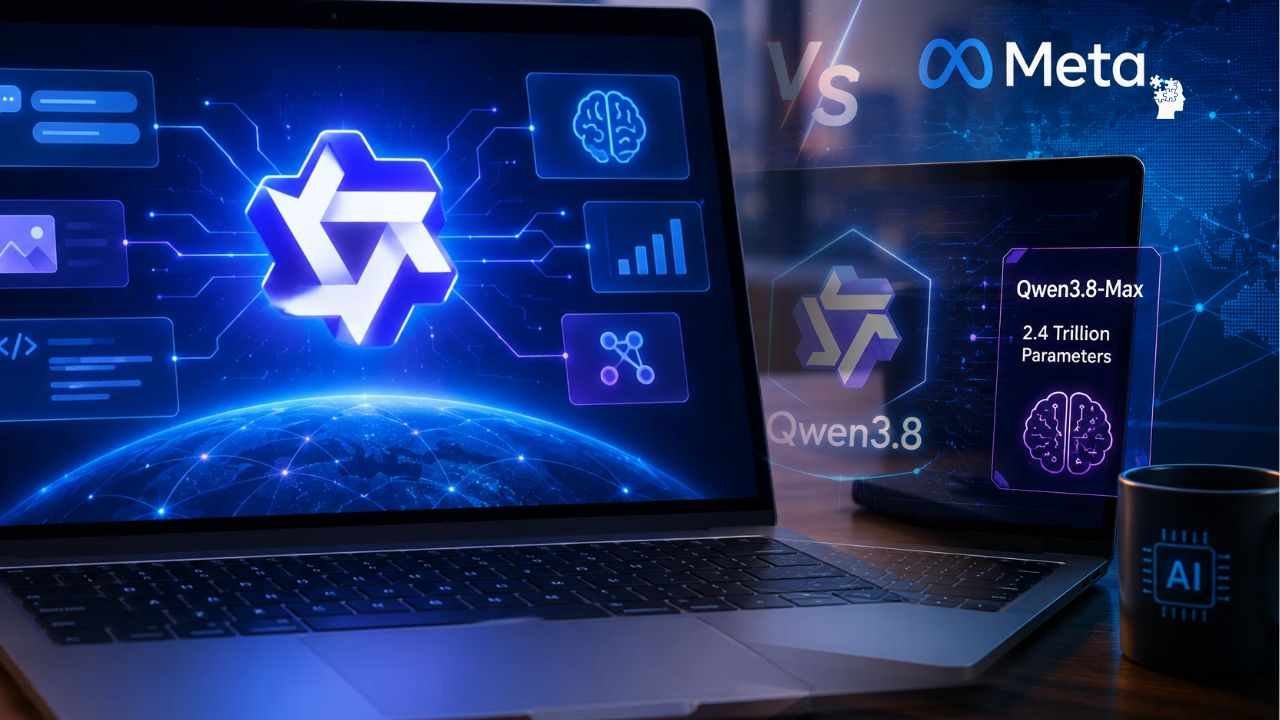
Alibaba is pushing AI in a direction that could matter more than another record-breaking benchmark: powerful models are becoming small enough to run closer to the user.
For years, the AI race was largely about building bigger models and putting them behind enormous data centers. Alibaba’s latest Qwen releases suggest the competition is increasingly moving somewhere else — onto laptops, consumer GPUs and developers’ own machines.
The Chinese technology giant has released Qwen3.8-27B, a 27-billion-parameter model designed for local deployment, while also opening the weights of its much larger Qwen3.8-Max, a 2.4-trillion-parameter flagship.
Together, the releases send a striking message: Alibaba does not want Qwen to be merely another AI service. It wants Qwen to become infrastructure that developers can download, modify and build on.
Table of Contents
The 27B model is arguably the more important release
The headline-grabbing number is Qwen3.8-Max’s 2.4 trillion parameters.
But for everyday developers, Qwen3.8-27B may be the more interesting model.
Why?
Because size has traditionally been one of the biggest barriers to running advanced AI locally. A model can be impressive in the cloud but practically useless to an individual developer if it requires an expensive server cluster.
Qwen3.8-27B attacks that problem from the other direction.
In quantized form, the model can be brought down to a size suitable for high-end consumer hardware, making local experimentation far more realistic. Independent reporting has highlighted its ability to run on relatively accessible hardware, while Alibaba’s Qwen ecosystem provides official model releases and deployment resources.
That changes the question from:
“Which company owns the biggest AI data center?”
to:
“How much AI can you fit inside an ordinary computer?”
That could become one of the most important AI battles of the next few years.
Why local AI is suddenly becoming a big deal
Running AI locally has several advantages.
The first is privacy.
When an AI model runs on a user’s machine, sensitive documents, source code or internal data do not necessarily have to be sent to a remote AI provider for every task.
The second is cost.
Cloud AI is convenient, but heavy usage can become expensive. A capable local model can potentially reduce recurring inference costs for developers and businesses that already own suitable hardware.
The third is control.
Developers can experiment with models, customize them, fine-tune them and integrate them into applications without depending entirely on a company’s cloud interface.
And there is another advantage that is easy to overlook:
AI can continue working even when the internet connection is limited or unavailable.
That makes local models particularly interesting for coding assistants, private enterprise workflows, research tools and autonomous agents.
Qwen3.8-27B is positioned for coding, research, multimodal interaction and agent-style workloads, according to the model’s published materials.
Alibaba is playing two different games at once
The Qwen3.8 launch is clever because Alibaba is not betting everything on one model size.
At one end is Qwen3.8-27B: relatively compact and designed for local deployment.
At the other is Qwen3.8-Max: an enormous 2.4-trillion-parameter flagship with roughly 95 billion active parameters, according to Alibaba’s technical description. The company says the model improves coding, real-world work, research and long-horizon tasks.
The strategy is therefore broader than simply trying to build the world’s largest model.
Alibaba can offer:
Small enough to run locally → large enough for demanding workloads → open enough for developers to build around.
That is a powerful combination.
And this is where Meta enters the picture
The timing makes the competition even more interesting.
Meta recently returned aggressively to the open-weight AI field with Muse Glimmer, a 30-billion-parameter model aimed at local AI workloads.
Meta describes Glimmer as a model for consumer hardware and local inference, while the model has been released under the permissive Apache 2.0 license.
That puts Alibaba and Meta in an unusually direct contest.
Both are pursuing models that developers can actually download and run.
Both are targeting local AI.
And both understand something important:
The company that controls the developer ecosystem does not necessarily need to control every AI server.
If millions of developers build applications, fine-tunes and tools around a model family, that model can become an industry standard even when the original company isn’t charging for every inference.
Qwen’s biggest advantage may already be its developer ecosystem
There is another reason Alibaba’s latest move deserves attention.
Qwen has developed a substantial presence on Hugging Face, one of the world’s major platforms for AI models and developer collaboration.
According to figures reported from Hugging Face’s recent open-model analysis, Qwen models accumulated more than 3 billion downloads over a six-month period, significantly ahead of Google’s reported 418 million and Meta’s 227 million during the same period.
The Qwen ecosystem has also generated a huge number of derivative models, showing that developers are not merely downloading the models — they are building on them.
That distinction matters.
A model with impressive benchmarks can disappear when the next generation arrives.
A model embedded in thousands of developer projects is much harder to displace.
Open weights are becoming a strategic weapon
There is an important distinction here.
People often use the terms “open-source AI” and “open-weight AI” interchangeably, but they are not necessarily the same thing.
Open weights generally mean developers can access and run the trained model parameters under the applicable license. Fully open-source AI can imply much broader access to the underlying code, training data and complete development process.
Alibaba’s Qwen3.8-Max announcement specifically describes the release as its first open-weight Max-class model, rather than simply treating the model as conventional proprietary software.
That matters because open-weight releases allow developers to take the technology beyond the original company’s cloud platform.
And that is precisely why the strategy is becoming so competitive.
The AI race may be moving from “bigger” to “everywhere”
The most interesting part of this story isn’t the 2.4-trillion-parameter figure.
It is the contrast between that giant model and the 27B model sitting beside it.
One represents enormous centralized AI infrastructure.
The other represents AI that could increasingly live on personal hardware.
That could eventually produce an AI landscape with three layers:
1. Giant cloud models
These will continue handling the hardest and most expensive workloads.
2. Local professional models
Models such as Qwen3.8-27B and Meta’s Muse Glimmer make sophisticated local AI increasingly practical for developers and power users.
3. Tiny models embedded everywhere
Smaller AI systems could eventually become standard components of laptops, phones, applications, vehicles and other devices.
That is why local AI is more than a hardware trick.
It could become a new distribution model for artificial intelligence.
But there is a catch
Running a model locally doesn’t mean everyone can suddenly run frontier AI on a cheap laptop.
Memory remains a major limitation.
Quantization can dramatically reduce model size, but users still need sufficient RAM or GPU memory, and performance depends heavily on the hardware, software stack and model configuration.
A model that technically fits on a machine may not necessarily run at a speed that feels comfortable.
This is one reason the hardware ecosystem around local AI is becoming just as important as the models themselves.
GPUs, high-memory laptops, unified-memory systems and optimized inference software could become increasingly valuable as developers move more AI workloads away from the cloud.
What Alibaba is really fighting for
It would be easy to describe this as another Alibaba vs Meta AI battle.
But the bigger competition is probably over something more valuable:
developer mindshare.
If developers choose Qwen when starting a new AI project, fine-tuning a model, building a coding assistant or deploying an offline agent, Alibaba gains influence far beyond its own cloud business.
Meta understands the same dynamic.
Google understands it.
And other Chinese AI laboratories are competing for it as well.
The winner may not ultimately be the company with the single smartest model.
It could be the company whose models developers find easiest to download, run, modify and deploy everywhere.
What Qwen3.8 means for ordinary users
For most people, the immediate impact may not be obvious.
You probably won’t wake up tomorrow and replace every cloud AI service with Qwen3.8.
But the underlying shift could eventually become visible in everyday products.
Imagine a laptop that can summarize private files without uploading them.
A coding assistant that works without a monthly subscription.
A research tool that runs entirely on a local machine.
A business AI assistant that processes confidential documents internally.
Or an application whose AI features continue functioning when the internet disappears.
Those possibilities become more realistic as capable models get smaller and more efficient.
The bigger picture
Alibaba’s latest Qwen release therefore represents more than another entry in an endless AI-model leaderboard.
It is a bet on distribution.
The company is simultaneously pushing an enormous flagship model and a much more accessible model designed to bring powerful AI closer to individual machines.
Meta’s Muse Glimmer shows that the United States’ largest technology companies recognize the same opportunity.
And that could make the next phase of the AI race very different from the last one.
The first phase was about building bigger models.
The next phase may be about making powerful models small enough, cheap enough and open enough to exist everywhere.
If that happens, the biggest AI breakthrough of the late 2020s may not be a model with another trillion parameters.
It may be the moment when users stop asking:
“Which AI company has the most powerful computer?”
and start asking:
“Why do I need their computer at all?”
FAQ Section
What is Alibaba Qwen3.8-27B?
Qwen3.8-27B is a 27-billion-parameter AI model from Alibaba’s Qwen family designed to provide strong capabilities while being practical to deploy on consumer-grade hardware.
Can Qwen3.8-27B run on a laptop?
With appropriate quantization and sufficient memory, the model can be deployed on high-end consumer hardware. Actual performance depends on the laptop’s RAM, GPU, memory bandwidth and inference software.
What is Qwen3.8-Max?
Qwen3.8-Max is Alibaba’s flagship Qwen3.8 model with 2.4 trillion total parameters and approximately 95 billion active parameters. Alibaba describes it as its first open-weight model at the Max scale.
Is Qwen3.8 open source?
It is more precise to describe the relevant releases as open-weight models. Open weights provide access to model parameters, but that does not automatically mean every component of the AI’s development process is open source.
How is Qwen competing with Meta?
Both Alibaba and Meta are increasingly targeting open-weight models that developers can download and run locally. Meta’s Muse Glimmer is a 30-billion-parameter model aimed at local AI workloads.
Why is local AI becoming important?
Local AI can offer greater privacy, potentially lower recurring inference costs, offline functionality and more control for developers and businesses.
Recommended for you: