
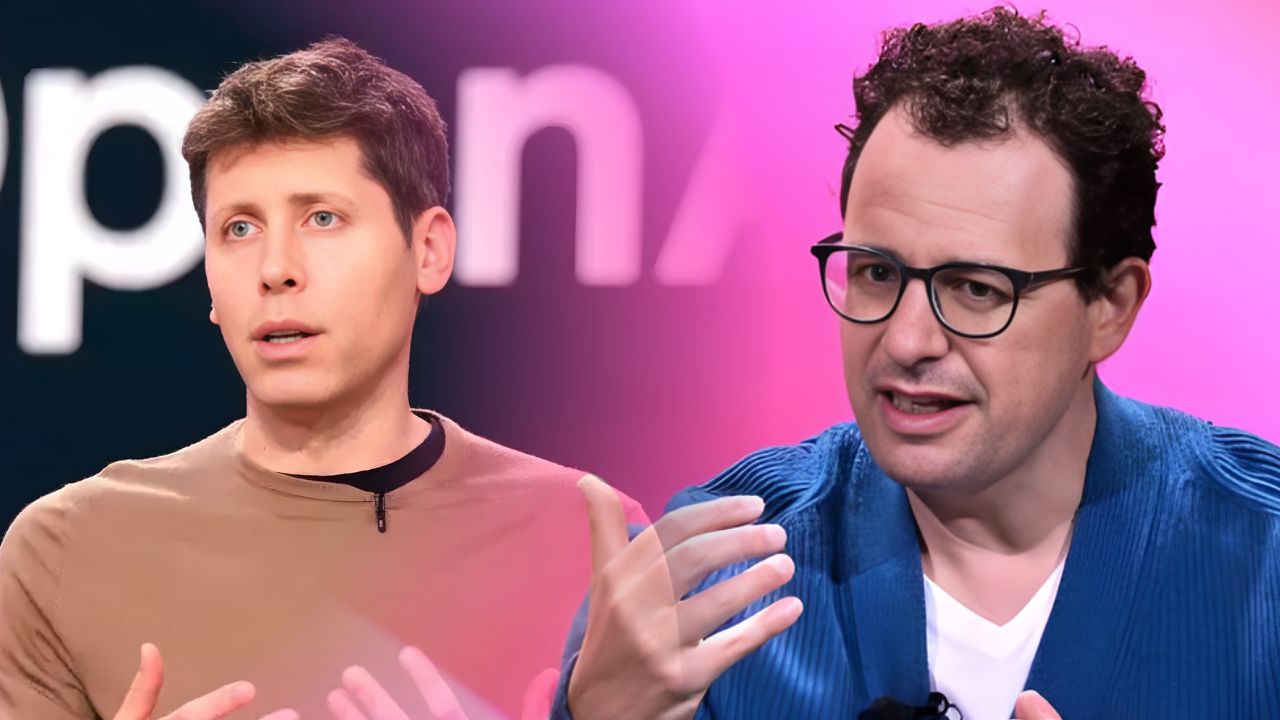
Two of the world’s most valuable AI companies—OpenAI and Anthropic—are locked in a bitter rivalry that goes far beyond business competition. At its core lies a deeply personal and philosophical clash between CEO Sam Altman and Anthropic CEO Dario Amodei, a feud that has simmered for a decade and recently exploded into public view.
Wisdom Imbibe Insight:
The AI race isn’t just about code—it’s about ideology. Altman and Amodei represent two visions: rapid deployment versus cautious control. When personal rivalry merges with philosophical divide, strategy becomes emotional. In trillion-dollar industries, leadership psychology can shape global outcomes. The future of AI may depend not only on technology—but on trust between its creators.
A new investigative report from The Wall Street Journal, drawing on journalist Keach Hagey’s biography of Altman, reveals the raw intensity behind closed doors. Amodei has privately likened OpenAI and its competitors to “tobacco companies selling products they know are harmful,” while describing OpenAI President Greg Brockman’s $25 million donation to a pro-Trump super PAC as “evil” and comparing the long-running legal battle between Altman and Elon Musk to a “Hitler vs. Stalin” conflict.
Table of Contents
The Pentagon Deal That Lit the Fuse
Tensions reached a boiling point in late February 2026 when OpenAI struck a deal with the Pentagon for deploying AI in classified environments—mere hours after Anthropic walked away from its own negotiations. Anthropic had pushed hard for strict limits on using its models for domestic surveillance or autonomous weapons. Amodei, in an internal Slack message to employees, didn’t hold back: he called OpenAI “mendacious,” accused Altman’s public statements of being “straight up lies” and “safety theater,” and pointed to a long-seen “pattern of behavior” in Altman.
Altman later admitted the announcement was rushed, writing on X that OpenAI was “genuinely trying to de-escalate things.” Amodei reportedly expressed some regret over the leaked memo, but the damage to the relationship was done.
Roots of the Rivalry: From Shared House to Separate Empires
The animosity traces back to 2016, when Amodei, his sister Daniela, and Greg Brockman lived in the same San Francisco house and debated AI’s future late into the night. Philosophical differences—particularly around transparency versus controlled disclosure to governments—soon evolved into power struggles over research direction and pace of development.
By late 2020, when Amodei departed OpenAI, he told friends he “felt psychologically abused by Altman.” Altman, for his part, confided to colleagues that the tension was making him “hate his job.” In early 2021, Amodei, Daniela, and roughly a dozen colleagues left to found Anthropic, positioning it as the more safety-conscious “healthy alternative” to OpenAI.
Branding the Rivalry: “Healthy Alternative” vs. “Safety Theater”
Anthropic has leaned heavily into this positioning. During Super Bowl LX in February 2026, the company aired high-profile ads that took a thinly veiled swipe at OpenAI’s decision to introduce advertising in ChatGPT. The punchline: “Ads are coming to AI. But not to Claude.” Altman fired back, calling the ads “clearly dishonest.”
Both companies have grown into giants. OpenAI is valued around $500 billion, while Anthropic recently raised funds at a $380 billion post-money valuation. Both are eyeing public listings, turning their personal and ideological rift into a high-stakes contest for talent, customers, and market dominance.
The depth of the divide was captured vividly at an AI summit in India in February 2026. When Prime Minister Narendra Modi called for a group photo and raised his hands, urging leaders to join in unity, Altman and Amodei—standing side by side—refused to hold hands. Instead, they offered an awkward elbow-bump-style fist raise, a moment that quickly went viral as a symbol of their fractured relationship.
What This Feud Means for the Future of AI
This isn’t just Silicon Valley drama. The Altman-Amodei rift reflects deeper divides in the industry: how fast to push capabilities, how much emphasis to place on safety guardrails, and how willingly to partner with governments—including defense agencies.
Amodei’s camp frames Anthropic as the responsible player unwilling to compromise on core principles. OpenAI portrays itself as pragmatic, focused on broad deployment while still implementing safeguards. Critics on both sides accuse the other of hypocrisy or performative safety.
As both companies race toward AGI-level systems and prepare for potential IPOs, their decade-long personal feud continues to shape strategy, hiring, partnerships, and public perception. In an industry where trust, talent, and narrative matter as much as raw technical performance, this rivalry could influence which vision of AI ultimately prevails.
The question hanging over the entire sector remains: Can two companies born from the same roots—and scarred by the same history—coexist peacefully as they reshape the world? Or will their founders’ personal wounds accelerate the very risks they both claim to fear?
One thing is certain: in the AI race, the personal is now unmistakably political—and potentially trillion-dollar.
Recommended for you: