
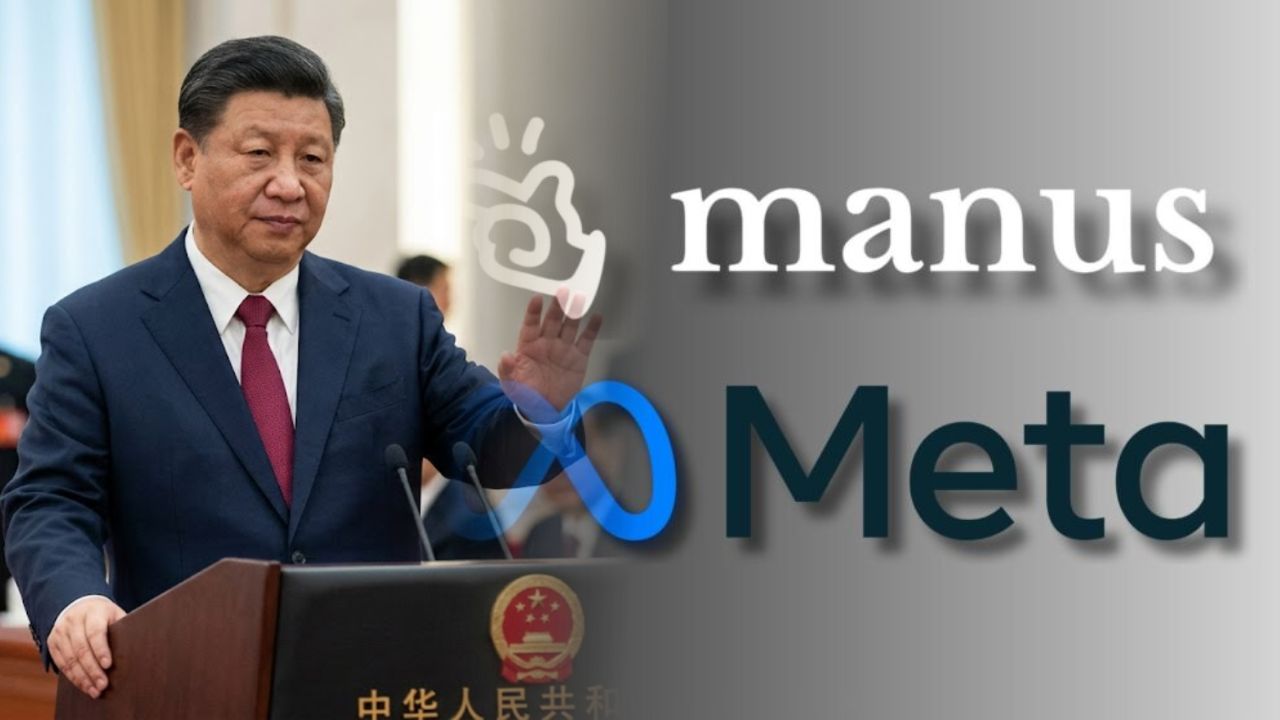
In a sharpening contest for artificial intelligence supremacy, China is moving decisively to stem the outward flow of its most advanced AI talent and capabilities. Beijing’s latest intervention—restricting the co-founders of AI agent startup Manus from leaving the country amid scrutiny of its acquisition by Meta—underscores a strategic pivot: keeping homegrown innovation firmly within borders, even as Western firms seek to buy in.
Table of Contents
The Manus Flashpoint
Meta announced its acquisition of Manus (a Singapore-based AI startup with Chinese roots) in late December 2025, in a deal reportedly valued at around $2 billion to $2.5 billion. The startup specializes in autonomous AI agents designed to function as “digital employees,” capable of handling complex, multi-step tasks—technology Meta aims to integrate into platforms like WhatsApp and Instagram.
However, the deal has hit a significant regulatory wall. Chinese authorities have barred Manus CEO Xiao Hong and chief scientist Ji Yichao (also referred to as co-founders) from leaving the country. The executives were summoned to Beijing for questioning by bodies including the National Development and Reform Commission (NDRC) and the Ministry of Commerce. Regulators are examining potential violations of:
- Foreign direct investment and reporting rules related to Manus’s Chinese operations
- Technology export controls
- National security implications around the transfer of sensitive AI capabilities to a U.S. company
No formal charges have been filed, and the acquisition has not been canceled, but the review process has placed the founders in a form of professional limbo—they can move freely inside China but cannot exit. Meta has maintained that the transaction complies with all applicable laws and that there will be no ongoing Chinese ownership in the company post-deal.
Analysts view this as more than a one-off review. It sends a clear signal: Beijing is increasingly wary of Chinese AI talent and technology relocating offshore (Manus had reportedly shifted operations toward Singapore) only to be acquired by Western giants, potentially bypassing domestic oversight.
A Broader Pattern of Technological Self-Reliance and Control
The Manus intervention fits into a consistent pattern of measures designed to protect and prioritize China’s domestic AI ecosystem:
- Chip Restrictions: In November 2025, China ordered state-funded data centers to use only domestically produced AI chips, requiring early-stage projects to remove foreign (primarily U.S.) components from Nvidia, AMD, and Intel. This effectively sidelines advanced foreign hardware in government-backed infrastructure.
- Prioritizing Domestic Suppliers: In February 2026, Chinese AI lab DeepSeek withheld early access to its upcoming flagship model (V4) from U.S. chipmakers Nvidia and AMD. Instead, it granted a multi-week head start to domestic players, including Huawei, allowing Chinese hardware to optimize performance ahead of foreign competitors.
- Export Controls and “Going Out” Scrutiny: Since enacting its Export Control Law in 2020, China has expanded restrictions multiple times. Officials are now closely watching “offshore restructuring” tactics that could move strategic AI assets abroad.
These steps reflect Beijing’s dual approach: reducing dependence on U.S. technology while preventing the leakage of Chinese advancements. Chinese firms like Alibaba, Baidu, and ByteDance continue to push forward with domestic alternatives, including Huawei’s latest AI chips, narrowing performance gaps despite U.S. export curbs.
Implications for the Global AI Race
This escalation highlights a deepening bifurcation of the AI landscape:
- Western companies like Meta face higher barriers when trying to acquire or access cutting-edge Chinese talent and applied AI capabilities.
- Chinese policymakers appear determined to maintain a “self-reinforcing competitive advantage,” particularly in open-source and agentic AI, where China has shown rapid progress.
- The Manus case could set a precedent, deterring other Chinese-founded startups from seeking overseas exits or capital that might trigger technology transfer concerns.
For the U.S. and its allies, the message is equally stark: buying into China’s AI ecosystem is becoming more difficult, pushing firms toward heavier in-house development or alliances within trusted supply chains.
The Bigger Picture: AI as Strategic Asset
In the intensifying U.S.-China technology competition, AI is no longer just a commercial race—it is treated as a matter of national power and security. China’s actions suggest a hardening stance: advanced models, talent, and enabling technologies are too valuable to flow freely outward at this critical juncture.
Whether the Meta-Manus deal ultimately proceeds, gets restructured, or stalls remains uncertain. What is clear is that Beijing is rewriting the rules of engagement for cross-border AI deals. As both sides pour resources into compute, models, and talent, the global AI supply chain is fragmenting further—with access, rather than raw innovation alone, becoming a decisive battleground.
The image of Chinese AI founders grounded in Beijing while a $2 billion U.S. acquisition hangs in review captures the new reality: in today’s tech cold war, even talent has borders.
Recommended for you: