
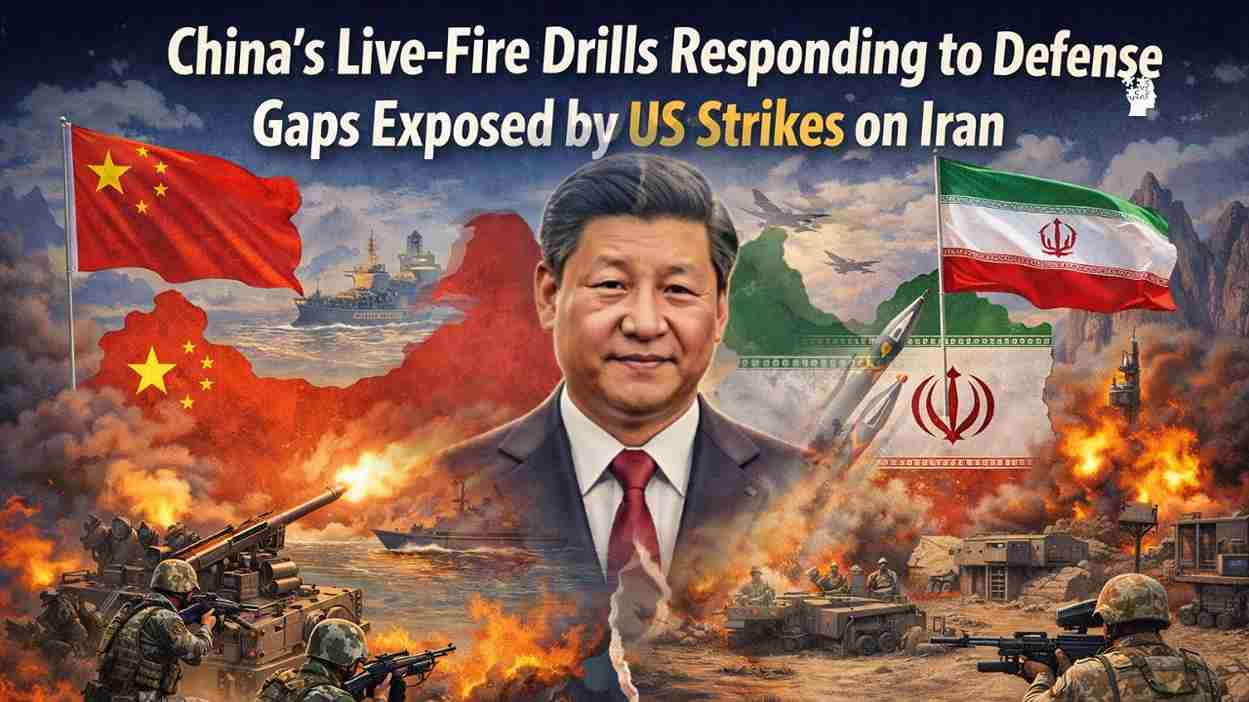
The ongoing US-Israeli military campaign against Iran, Operation Epic Fury, has delivered a stark lesson to Beijing’s military planners. The coordinated strikes—launched February 28, 2026—overwhelmed Iranian air defenses, including systems supplied by China, prompting swift action from the People’s Liberation Army (PLA) to test and strengthen its own capabilities.
In direct response, the PLA conducted an integrated live-fire air defense drill on March 2, focusing on operations in a complex electromagnetic environment. This exercise involved army air defense units and Air Force radar teams coordinating layered intercepts with systems like the HQ-16 medium-range surface-to-air missiles. The drill emphasized resilience against electronic jamming, disruption, and other tactics mirroring those used in the Iran operation.
Failures of Chinese-Export Systems Highlight Vulnerabilities
A key trigger for Beijing’s concern is the apparent underperformance of Chinese-made defenses exported to Iran. Systems such as the HQ-9B surface-to-air missiles and YLC-series anti-stealth radars—acquired by Tehran to enhance protection after prior conflicts—failed to prevent or significantly blunt the US-Israeli assault. The strikes targeted over 1,000 sites using stealth aircraft, Tomahawk cruise missiles, bombers, and advanced electronic warfare.
Retired PLA Colonel Zhou Bo, cited in the South China Morning Post, described the operation as a “wake-up call” for China. He urged heightened vigilance against “internal infiltration and intelligence leaks” while calling for reinforced security around critical targets. Taiwanese analyst Su Tzu-yun noted that while these radars claimed anti-stealth detection, their anti-jamming capabilities were overcome in real combat conditions.
This echoes patterns seen in earlier US actions, such as the Venezuela operation in early 2026, where Chinese-supplied systems also struggled. The real-world data from Iran’s defenses provides valuable insights for PLA engineers to refine designs, improve electronic countermeasures, and address integration weaknesses before any potential Taiwan contingency.
Broader Strategic Implications for Beijing
The Institute for the Study of War highlights China’s keen interest in tactical lessons from the US success in penetrating Iranian air defenses. Achieving air superiority over the Taiwan Strait remains a core PLA objective, and the survivability of China’s own layered air defense network against advanced US assets is seen as essential.
The conflict accelerates Beijing’s drive for technological self-reliance, particularly in military AI, semiconductors, and electronic warfare tools. US use of AI-assisted targeting in the Iran strikes underscores the gap China seeks to close. Analysts warn that prolonged US commitment in the Middle East could embolden Beijing by stretching American resources, potentially accelerating preparations for a 2027 Taiwan scenario outlined in US intelligence assessments.
From Observation to Action
While China has publicly condemned the strikes as violations of international law and urged ceasefires—without providing military support to Iran—the PLA’s rapid drill signals proactive adaptation rather than passive observation. The exercise tests not just hardware but integrated command, control, and resilience in contested electromagnetic environments.
As the Iran war enters its early phase with no quick resolution in sight, Beijing is turning battlefield lessons into immediate training. The message is clear: exposed gaps in allied defenses serve as a direct prompt for the PLA to evolve, ensuring its systems can withstand similar high-intensity, tech-heavy assaults in future flashpoints.
Recommended for you: