
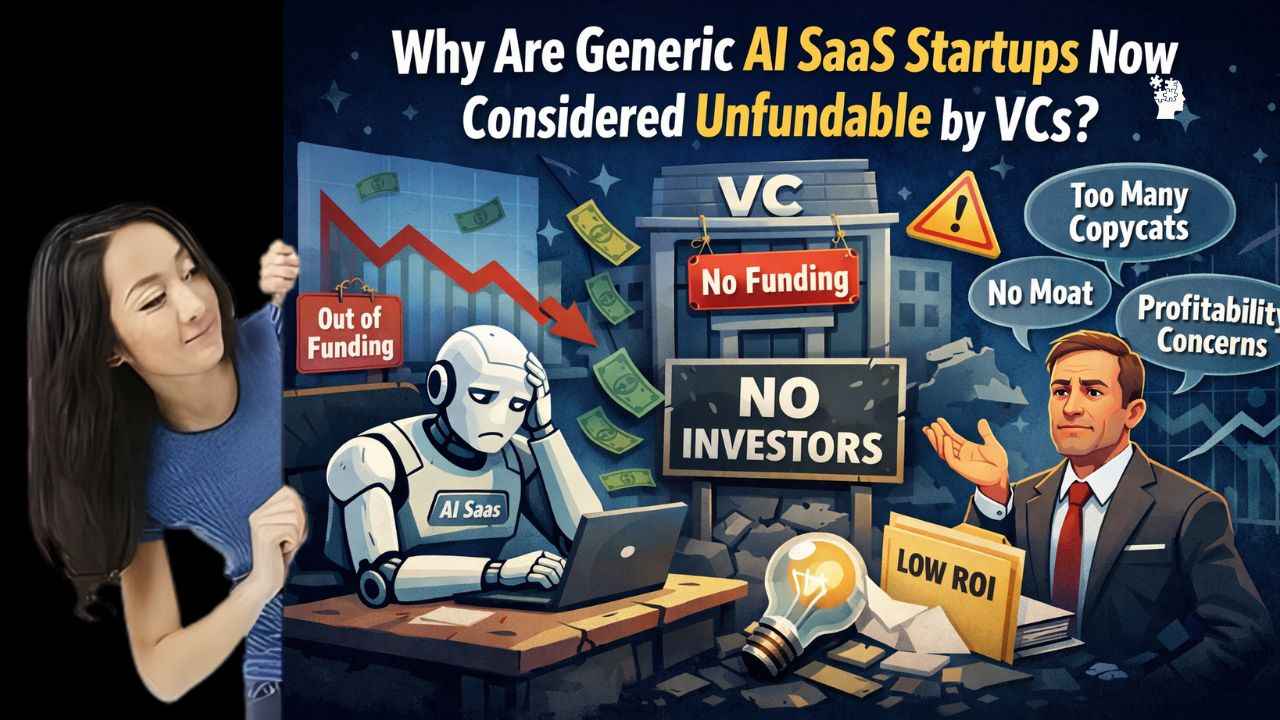
The recent surge in generative AI has transformed the startup landscape, but not every “AI-powered” pitch still excites venture capitalists. In fact, many generic AI SaaS startups—those relying primarily on slick user interfaces, basic automation, or lightweight integrations with public large language models (LLMs)—are increasingly viewed as unfundable by investors.
This shift marks a move from hype-driven experimentation to a demand for real defensibility. Here’s why VCs are drawing hard lines and what that means for founders in 2026.
Wisdom Imbibe Insight
In 2026, “AI-powered” is not a moat — it’s a minimum requirement. The real currency is proprietary context, embedded workflows, and outcomes competitors can’t clone overnight. Thin wrappers fade; deep systems endure. Venture capital is no longer funding interfaces — it’s funding control over data, distribution, and mission-critical decisions. In AI, defensibility is destiny.
Table of Contents
The Rise and Fall of the “Thin Layer” Model
In the early days of the AI boom, building an AI SaaS product was relatively straightforward: wrap a powerful LLM (like those from OpenAI or Anthropic) in a polished interface, add some prompt engineering or simple orchestration, and market it as a productivity booster. Tools for project management, basic analytics, CRM enhancements, or workflow automation proliferated quickly because the barriers to entry were low.
But that ease of replication has become the problem. As AI models advance and agents become more capable, these “thin layers” offer little lasting advantage. Investors now see that well-resourced teams—or even incumbents—can rebuild similar products rapidly, often at lower cost.
Aaron Holiday, managing partner at 645 Ventures, recently highlighted this in conversations with TechCrunch. He described a category of startups that investors now find “boring”: those building thin workflow layers, generic horizontal tools, lightweight product management, and surface-level analytics. These are essentially features that modern AI agents can handle directly, often without needing a dedicated human-centered UI.
Other investors echo this view. Igor Ryabenky of AltaIR Capital pointed to generic productivity tools, project management software, basic CRM clones, and thin AI wrappers built on existing APIs as losing appeal. If the product is mostly an interface layer without deep integration, proprietary data, or embedded domain knowledge, it lacks a moat.
The core fear? Clone risk is sky-high. What once felt like a competitive edge—UI polish and light automation—has become table stakes, not a differentiator.
Why This Matters Now
Several factors have accelerated this reckoning:
- Advancing AI agents — Autonomous agents can increasingly complete tasks end-to-end, reducing the need for human-in-the-loop SaaS workflows.
- Rapid commoditization — Open-source models, cheaper inference, and tools like Claude Code make it easier for competitors to replicate functionality.
- Market maturation — After years of experimentation, investors want evidence of sustainable value, not just demos. Enterprise spending on AI may rise in 2026, but it’s expected to consolidate around fewer, more defensible vendors.
This isn’t the death of AI SaaS—far from it. Funding continues to pour into the space, but it’s concentrating on bets with stronger barriers to entry.
What VCs Are Still Excited to Fund
The bar is higher, but opportunities remain for startups that solve hard problems in defensible ways. Holiday and others emphasize categories like:
- AI-native infrastructure — Tools that power the underlying AI ecosystem, rather than sitting on top of it.
- Vertical SaaS with proprietary or advantaged data — Solutions tailored to specific industries (e.g., healthcare, finance, legal) where exclusive datasets, compliance needs, or domain expertise create real moats.
- Systems of action — Products that don’t just analyze or suggest but actively complete tasks and drive outcomes.
- Deeply embedded, mission-critical workflows — Tools integrated into essential processes where trust, auditability, and reliability matter most, especially in regulated or high-stakes domains.
In short, investors want startups that control proprietary context, own end-to-end workflows, and deliver measurable ROI that general-purpose models can’t easily replicate.
The New Fundraising Reality
For AI application-layer founders, “AI-powered” alone no longer cuts it as a pitch-deck hook. Differentiation must go beyond interfaces, orchestration, or basic automation. Teams need to demonstrate:
- Proprietary data rights or unique process knowledge.
- Barriers that protect against fast followers or tech giants.
- Clear paths to enterprise adoption and retention.
The market has evolved from “build fast and iterate” to “build something hard to copy.” Generic AI SaaS plays may struggle to raise, but those proving real defensibility—through data, vertical depth, or workflow ownership—remain very fundable.
As the AI landscape matures, the winners will be those that aren’t just riding the wave but shaping it in ways that endure.
Recommended for you: