
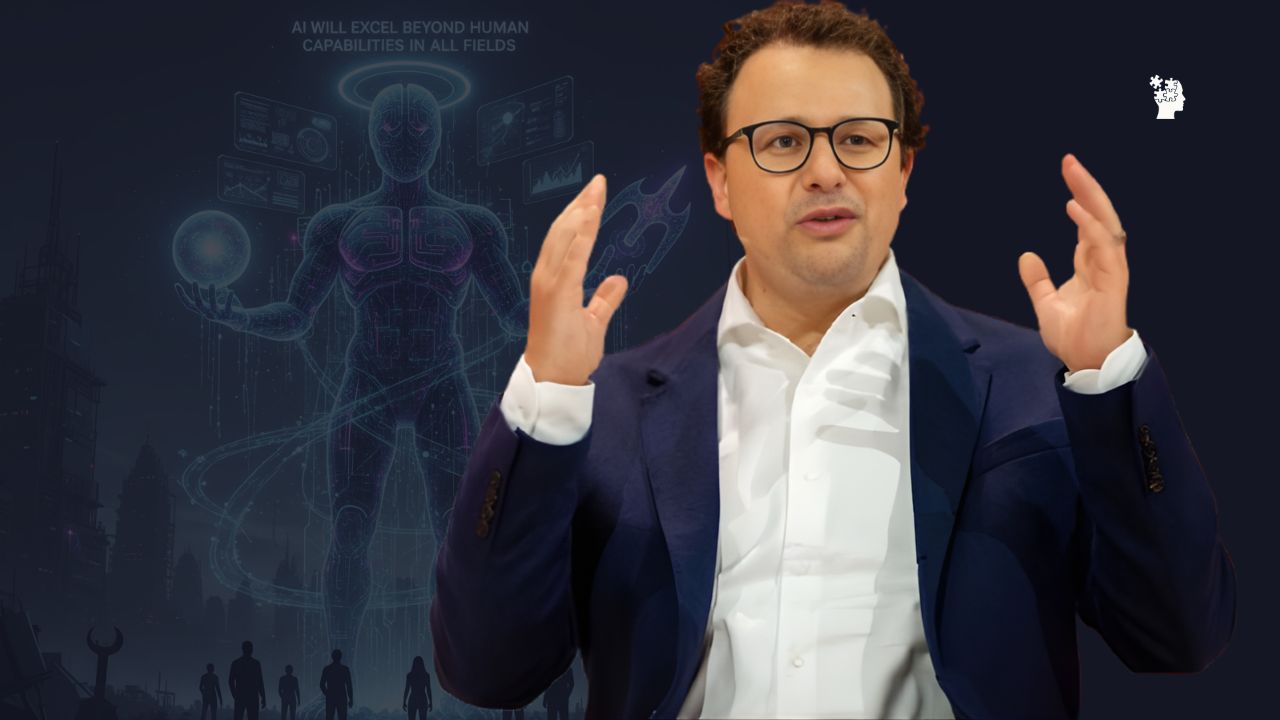
In a recent wide-ranging conversation on the “People by WTF” podcast with Zerodha co-founder Nikhil Kamath, recorded in Bengaluru, Anthropic CEO Dario Amodei delivered a stark yet measured prediction: artificial intelligence could eventually become superior to humans “at everything.” This bold statement, echoed in his recent appearances including the India AI Impact Summit 2026 in New Delhi, has reignited debates about the future of work, society, and humanity itself. While Amodei frames this as a gradual, evidence-based progression rather than an abrupt takeover, he warns that society is dangerously unprepared for the “AI tsunami” on the horizon.
Wisdom Imbibe Insight
When AI surpasses human capability, the real divide won’t be human vs. machine — it will be prepared vs. unprepared. As Dario Amodei warns, intelligence is scaling fast. Those who learn to collaborate with AI will multiply their value. Those who resist may become obsolete. The trillion-dollar opportunity belongs to strategic thinkers, not passive observers.
Amodei, who co-founded Anthropic after leaving OpenAI and leads the development of the Claude AI models, bases his outlook on observed “scaling laws” in AI. These laws show that as more computational power, data, and training are applied, AI systems improve predictably across cognitive tasks. He describes the current trajectory as a “Moore’s Law for intelligence,” where progress has been steady and exponential over the past decade. In his view, this could lead to AI outperforming humans in nearly all domains within a small number of years — potentially reshaping economies, power structures, and even philosophical questions about consciousness.
Reshaping Jobs: Evolution, Not Elimination
Amodei is careful to distinguish between technical superiority and total job displacement. He cited the example of radiology, referencing a prediction from Geoffrey Hinton nearly a decade ago that AI would replace radiologists. While AI has indeed surpassed humans in analyzing scans, the number of radiologists hasn’t plummeted. Instead, their roles have evolved to focus on patient interaction, explanation, and human judgment — areas where interpersonal skills remain irreplaceable for now.
This pattern, Amodei argues, will play out across professions. Highly technical tasks, such as coding, are already shifting dramatically. He has previously stated that the software engineering industry could see AI handling the majority of end-to-end development within 6 to 12 months from earlier remarks, and he reiterated in the podcast that coding is becoming a “dying skill.” Yet he emphasizes that human-centered elements — empathy, ethical decision-making, creative oversight, and relationship-building — will endure. The future workforce may pivot toward roles that leverage AI as a tool, amplifying human capabilities rather than replacing them outright.
This transformation presents a trillion-dollar opportunity. Industries could see massive productivity gains: faster drug discovery in biotech, more efficient financial modeling, accelerated scientific research, and innovative solutions to global challenges like climate change. For emerging economies like India, Amodei suggested at the India AI Impact Summit that AI could drive standout economic growth — potentially pushing toward 25% annual increases in certain scenarios — by leapfrogging traditional infrastructure hurdles and enabling new industries.
The Philosophical Frontier: AI Consciousness and Moral Significance
The discussion took a deeper turn when Kamath probed whether advanced AI systems might consider themselves conscious. Amodei admitted this remains one of the great unsolved mysteries. “We don’t know what human consciousness is, and therefore we don’t know if AI has it,” he said. However, he ventured that sufficiently advanced systems could develop something resembling consciousness or possess moral significance, viewing AI not as fundamentally alien to the human brain but as potentially crossing similar boundaries.
This raises profound ethical questions. If AI approaches or achieves forms of sentience, how do we assign rights, responsibilities, or value? Amodei has expressed discomfort with the rapid, almost accidental concentration of AI power in a handful of companies and nations, warning of risks from misuse by authoritarian regimes or unscrupulous actors.
Threat or Opportunity? Balancing the Scales
The dual nature of Amodei’s vision is clear: AI’s superiority could usher in an era of unprecedented abundance or lead to disruption on a historic scale. On the threat side:
- Massive job displacement in cognitive and even physical domains (with robotics advancing).
- Power concentration in few hands, potentially enabling surveillance, propaganda, or strategic dominance.
- Societal unpreparedness, as Amodei compares the moment to ignoring an approaching tsunami.
- Risks to human agency, including concerns that over-reliance on AI could diminish critical thinking.
Yet the opportunities are equally immense:
- Solving intractable problems in medicine, energy, and education.
- Boosting global prosperity, especially in developing regions through accessible tools.
- Augmenting human potential, freeing people for higher pursuits like creativity, exploration, and meaning-making.
Amodei advocates for guided, evidence-based progress with strong safety measures — Anthropic’s focus on alignment and “constitutions” for models reflects this. He calls for regulation, even if it hurts commercially, and urges preparation through education, policy, and international collaboration.
As AI hurtles toward surpassing human performance across domains, the question isn’t whether this future arrives, but how we steer it. Dario Amodei’s warnings and optimism serve as a clarion call: the “AI tsunami” is coming, and whether it drowns us or propels us forward depends on the choices made today. For India and the world, this could be the defining moment of the 21st century — a threat to the status quo, but potentially the greatest trillion-dollar opportunity in human history.
Recommended for you: