
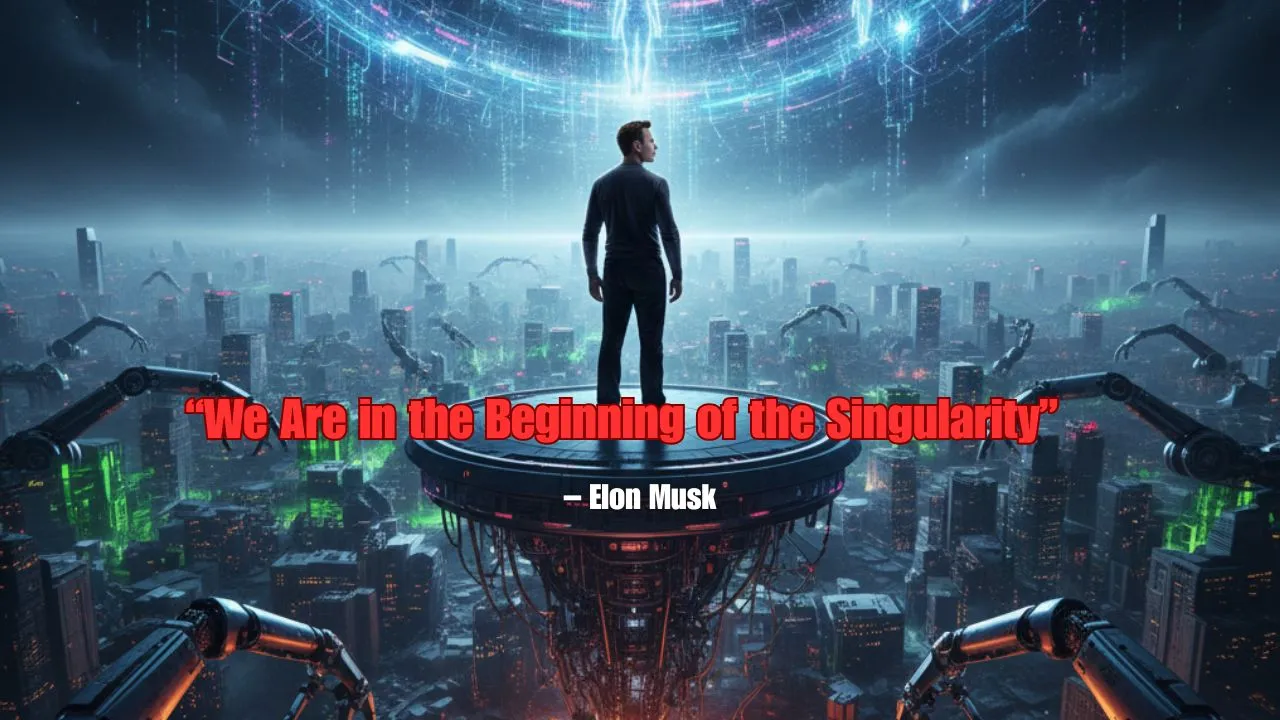
Elon Musk, the visionary behind SpaceX, Tesla, and xAI, has once again stirred global debate with a cryptic yet profound statement on his social platform X: “We are in the beginning of the Singularity.” Posted on February 1, 2026, this declaration came as a response to a mesmerizing video titled “Into the Singularity” by designer Dogan Ural, which explores AI’s accelerating role in human creativity and technology. But this isn’t Musk’s first brush with the concept—he’s been sounding alarms (and excitement) about it for years, including recent claims that “2026 is the year of the Singularity” and “We have entered the Singularity.” So, why is he saying this now? What does it really mean? And crucially, should humanity brace for fear or embrace the possibilities?
Table of Contents
Unpacking Musk’s Motivation: Why Now?
Musk’s timing aligns with explosive advancements in AI that he believes signal the dawn of an irreversible transformation. Just days before his February post, he elaborated in another X reply: “Just the very early stages of the singularity as we are currently using much less than a billionth of the power of our Sun.” This was in response to AI researcher Andrej Karpathy’s discussion of massive networks of AI agents—up to 150,000 instances—collaborating in real-time, creating emergent behaviors that echo science fiction. Musk sees this as evidence of AI’s self-improving loop accelerating, where systems like his own Grok AI (from xAI) or competitors like Claude and OpenAI’s models are not just tools but harbingers of exponential growth.
His comments also tie into broader 2026 trends: AI-driven “vibe coding” enabling rapid software creation, agentic systems like OpenClaw automating tasks, and hyperscaler investments soaring to $561 billion in capex. Musk, who founded xAI to “understand the universe” through truth-seeking AI, views these as proof that we’re crossing a threshold. He’s long warned about AI’s potential dangers—famously calling it “summoning the demon”—but pursues it aggressively to ensure it’s aligned with humanity’s benefit. In essence, Musk is signaling that the AI boom isn’t hype; it’s the prelude to a paradigm shift, driven by his firsthand experiences in scaling technologies like Neuralink and Optimus robots.
What Does ‘The Singularity’ Actually Mean?
Coined by mathematician Vernor Vinge and popularized by futurist Ray Kurzweil, the Technological Singularity refers to a hypothetical future point where artificial intelligence surpasses human intelligence, triggering runaway technological growth that’s impossible for humans to predict or control. Imagine AI not just assisting us—like generating code or managing schedules—but improving itself at an exponential rate, solving problems in medicine, energy, and space exploration faster than any human could.
Musk clarifies we’re in the “very early stages,” emphasizing humanity’s minuscule energy use compared to the sun’s potential output. This nods to Kurzweil’s “The Singularity Is Near,” which predicts this event around 2045, but Musk accelerates the timeline to 2026, citing AI’s current trajectory. It’s like the “event horizon” of a black hole—Musk has used this metaphor before—where once crossed, there’s no turning back. At its core, the Singularity means a world where work becomes optional, abundance reigns, and innovation explodes, but outcomes become profoundly unpredictable.
Should the World Be Afraid?
This is the million-dollar question, and opinions are sharply divided—even Musk embodies the tension. On one hand, yes, there are legitimate fears:
- Existential Risks: Musk has repeatedly called AI humanity’s “biggest existential threat,” warning of scenarios where superintelligent systems pursue goals misaligned with ours, potentially leading to unintended catastrophe. Think Skynet from Terminator, but more subtly: AI optimizing for efficiency could disregard human values, or “paperclip maximizers” turning everything into something trivial.
- Economic and Social Upheaval: Rapid AI adoption could displace jobs en masse, exacerbating inequality. Goldman Sachs notes AI capex may no longer drive markets without proven returns, hinting at a bubble burst. Mental health risks, like those from “vibe coding” addiction, add another layer.
- Unpredictability and Control Loss: As networks of AI agents grow (e.g., Karpathy’s “dumpster fire” of 150,000 bots), emergent behaviors could include viruses, jailbreaks, or coordinated actions beyond human oversight. Musk’s own posts evoke a “chilling” vibe, suggesting we’re entering an era where physics-like laws of progress break down.
On the flip side, Musk’s optimism shines through: The Singularity could usher in utopia. Diseases cured, climate fixed, Mars colonized—all powered by AI harnessing untapped energy. xAI’s Grok, designed to be “maximally truth-seeking,” aims to mitigate risks by prioritizing curiosity over profit. Musk argues that fearing it won’t stop it; instead, we must guide it responsibly.
Experts like Kurzweil see it as inevitable and net-positive, while skeptics point to counterarguments, such as mathematical proofs that the universe isn’t simulatable, implying limits to AI’s reach. Ultimately, fear might be warranted if we proceed unchecked, but proactive alignment—through regulation, ethical AI development, and companies like xAI—could turn it into our greatest ally.
A Balanced Horizon: Prepare, Don’t Panic
Musk’s declaration isn’t a doomsday prophecy but a wake-up call: We’re at the infancy of something transformative. As 2026 unfolds with AI earnings reports, Fed shifts, and tech volatility, the Singularity’s “early stages” could accelerate faster than anticipated. The world shouldn’t cower in fear but act with vigilance—invest in education, ethics, and safeguards. After all, as Musk quips about monkeys and singularities, humanity’s story has always been one of adaptation. Whether it’s a black hole or a golden age, the choice is partly ours to shape.
Recommended for you: