
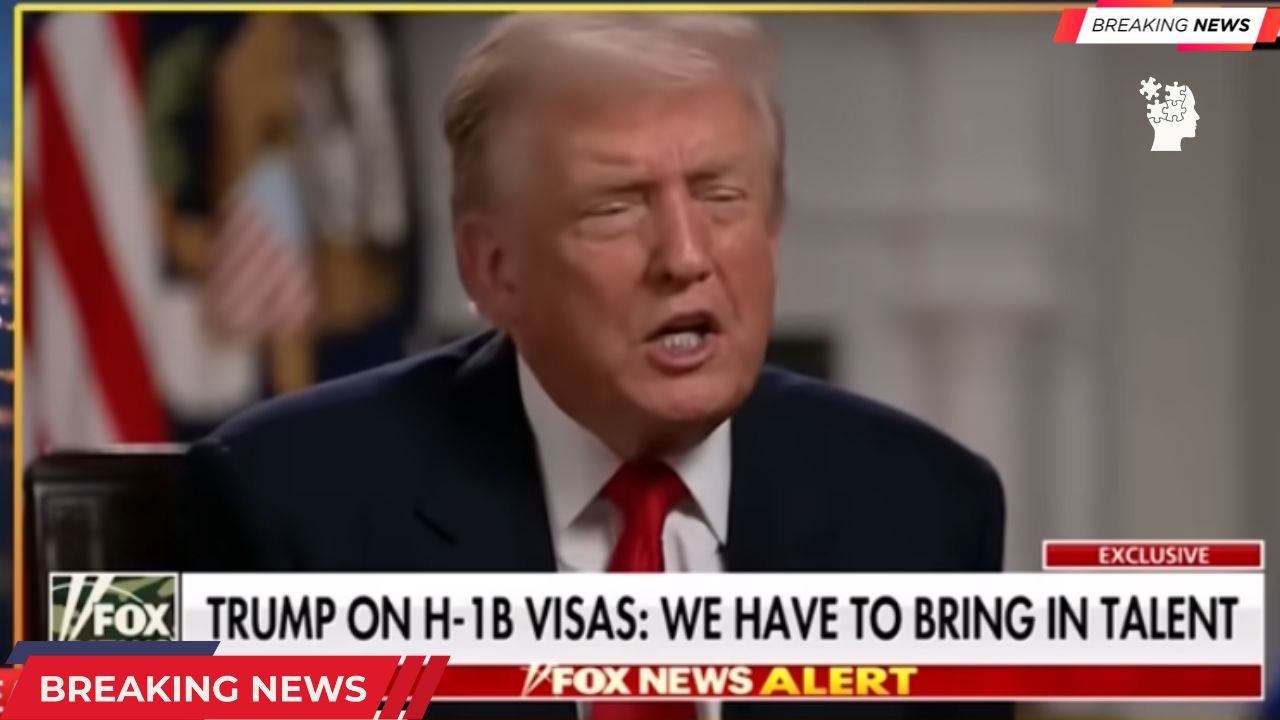
In a candid exchange on Fox News that aired Tuesday night, President Donald Trump defended the H-1B skilled worker visa program, bluntly stating that the United States lacks the domestic talent to fill certain high-tech and specialized manufacturing roles. Responding to host Laura Ingraham’s concerns about the program potentially depressing American wages, Trump remarked, “No, you don’t… you don’t have certain talents, and people have to learn.
You can’t take people off an unemployment line and say, ‘I’m going to put you into a factory where we’re going to make missiles.’” He cited a recent Immigration and Customs Enforcement (ICE) raid at a Hyundai electric vehicle (EV) battery plant in Georgia as a prime example, where hundreds of South Korean experts were deported despite their critical role in training U.S. workers for complex battery production.
This statement marks a nuanced evolution in Trump’s immigration stance. While his administration has aggressively cracked down on unauthorized immigration—including signing an executive order in September imposing a $100,000 application fee for H-1B visas—Trump’s comments underscore a pragmatic recognition of America’s reliance on foreign expertise in STEM (science, technology, engineering, and mathematics) fields.
But is the president right? Does the U.S. truly face a talent deficit, or is this rhetoric masking broader economic pressures? This analysis dives into the data, examining labor market trends, visa statistics, and the real-world fallout from policies like the Georgia raid to provide a comprehensive picture.
Table of Contents
The Context: Trump’s Defense of H-1B Amid Immigration Crackdowns
The H-1B visa program, established in 1990, allows U.S. companies to temporarily employ foreign workers in “specialty occupations” requiring at least a bachelor’s degree, such as software engineering, data science, and advanced manufacturing. The annual cap is 85,000 new visas (65,000 regular plus 20,000 for U.S. master’s degree holders), but renewals and certain exemptions push total approvals far higher—often exceeding 300,000 annually.
Trump’s Fox interview comes amid escalating tensions over skilled immigration. Just two weeks prior, during a trip to South Korea, he expressed opposition to the September ICE raid at Hyundai’s Metaplant America facility in Ellabell, Georgia, calling it a misstep in his broader worksite enforcement push. That operation, targeting suspected unauthorized Hispanic workers, resulted in the detention and deportation of over 300 South Korean contractors—experts in EV battery assembly—who had been brought in to build and train for the $7.6 billion plant. Hyundai, in partnership with LG Energy Solution, argued the workers were essential for a process involving hazardous materials and precision engineering, where “explosions and problems” are common risks, as Trump noted.
The raid has sparked diplomatic friction with Seoul and economic ripple effects. Hyundai delayed plant operations by months, costing an estimated $500 million in lost production and forcing the company to scramble for replacements. Korean American communities, reeling from the “historic” enforcement action, have raised alarms about chilling effects on foreign investment. Trump’s comments appear aimed at reassuring allies and businesses that his administration values “talent” over blanket restrictions, even as the new H-1B fee—intended to deter abuse—threatens to raise hiring costs by up to 50% for tech giants like Google and Tesla.
Evidence of a Talent Shortage: Low Unemployment and Projected Gaps
Trump’s assertion aligns with mounting evidence of structural mismatches in the U.S. labor market, particularly in STEM sectors. While overall unemployment hovered at 4.1% in October 2025, rates in high-skill fields tell a different story. In computer and mathematical occupations—core H-1B domains—the unemployment rate stood at just 3.0% in August 2025, down from 3.4% a year prior and well below the national average. This historically low figure signals acute demand: Employers are hiring aggressively, but qualified candidates are scarce.
Broader data reinforces the gap. The Bureau of Labor Statistics (BLS) projects STEM employment to grow by 10.4% from 2024 to 2034, adding nearly 1.1 million jobs—far outpacing the 3.3% growth in non-STEM roles. Yet, a 2024 report from the National Science Foundation estimates the U.S. STEM workforce at 36.8 million in 2021 (24% of total employment), with over half lacking bachelor’s degrees, highlighting a reliance on advanced-degree holders. By 2030, analysts predict a shortfall of 1.4 million STEM professionals, driven by retirements, insufficient domestic graduates (only 20% of U.S. bachelor’s degrees are in STEM), and rapid tech evolution like AI and clean energy.
Critics, including some economists, counter that low unemployment doesn’t equate to a “shortage”—wages in STEM fields rose only 4.2% year-over-year in 2024, suggesting ample supply. However, this overlooks geographic and skill-specific bottlenecks: Rural manufacturing hubs like Georgia struggle to attract urban-trained engineers, and specialized niches (e.g., battery chemistry) require years of hands-on experience not easily replicated domestically.
| Key STEM Labor Indicators (2024-2025) | Value | Source |
|---|---|---|
| Unemployment Rate: Computer/Math Occupations | 3.0% (Aug 2025) | BLS |
| Projected STEM Job Growth (2024-2034) | +10.4% (1.1M jobs) | BLS |
| Estimated STEM Shortfall by 2030 | 1.4 million professionals | Harvey Law Corporation |
| Share of U.S. Workforce in STEM (2021) | 24% (36.8M workers) | NSF |
These metrics suggest Trump’s point: Blanket training programs can’t instantly bridge expertise gaps in volatile industries like defense (missiles) or EVs (batteries).
The Rising Demand for H-1B Visas: A Chart of Approvals Over Time
No metric better illustrates the U.S.’s appetite for foreign talent than H-1B approval trends. Despite the fixed cap on new visas, total petitions approved—including renewals—have surged, reflecting companies’ dependence on extending skilled workers’ stays. The chart below tracks approvals from fiscal year (FY) 2010 to 2024, showing volatility tied to economic cycles (e.g., a dip in 2017 due to tightened scrutiny) but an overall upward trajectory, peaking at 442,425 in FY2022 amid post-pandemic tech booms.

This visualization reveals a near-doubling from FY2010’s 192,276 approvals to FY2024’s 399,395, with renewals comprising 65% in recent years. The spike in FY2020-2022 correlates with remote work enabling global hiring during COVID, while the 2017 drop followed Trump’s “Buy American, Hire American” order, which increased denials by 20%. Economists argue this demand sustains U.S. competitiveness: H-1B holders contribute $158 billion annually to GDP and create 1.8 jobs per visa, per the American Immigration Council.
Policy Implications and the Path Forward
Trump’s remarks highlight a tension in his agenda: Robust enforcement versus economic pragmatism. The $100,000 H-1B fee, effective September 2025, could price out smaller firms, exacerbating shortages—Hyundai alone may face $30 million in added costs for its Georgia team. Yet, as the president noted in his interview’s opener, welcoming “outside countries” like China for university enrollment (despite IP theft risks) boosts innovation; H-1B functions similarly for industry.
To address the deficit without over-relying on visas, experts recommend tripling STEM education funding ($10 billion annually) and apprenticeships, targeting underserved regions. Trump’s Georgia example underscores the urgency: Deporting 300 battery specialists delayed U.S. EV goals under the Inflation Reduction Act, handing advantages to competitors like China’s BYD.
In sum, data validates Trump’s core claim—a genuine talent crunch in niche, high-risk fields—though solutions must balance protectionism with openness. As he quipped about the French versus Chinese students, not all imports are equal; skilled visas may be the exception proving America’s rule of innovation through immigration.
Sources: BLS, USCIS, Pew Research Center, NSF, and media reports on the Hyundai raid.