
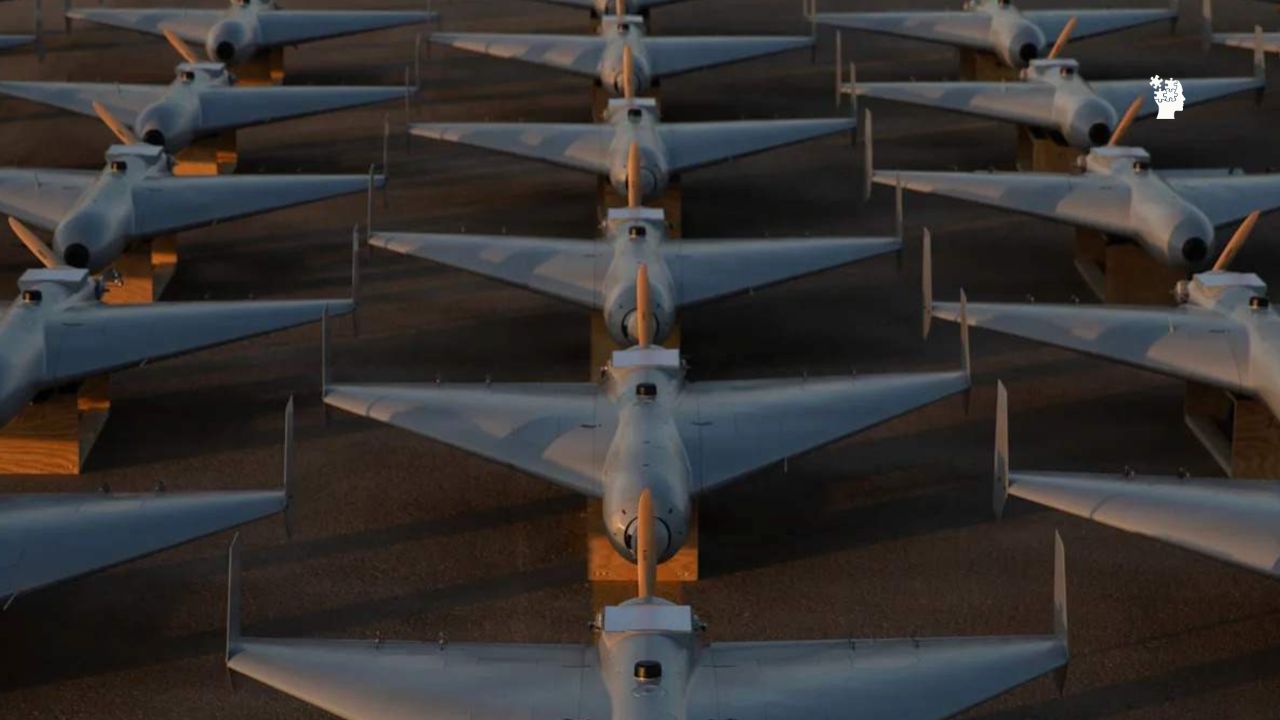
The U.S. military has marked a historic milestone in drone warfare by deploying the Low-cost Unmanned Combat Attack System (LUCAS)—a reverse-engineered copy of Iran’s own Shahed-136 kamikaze drone—for the first time in combat during Operation Epic Fury, the ongoing U.S.-Israeli strikes on Iran that began February 28, 2026.
Wisdom Imbibe Insight
Modern warfare is no longer defined by the most expensive missile — but by the most scalable intelligence network. A low-cost drone with satellite connectivity can rival legacy weapons in strategic impact. The lesson is clear: commercial technology has become military infrastructure. In the age of AI and space-based internet, connectivity is power projection.
The revelation came not from official briefings but from wreckage: A LUCAS drone crashed in Iraq and was recovered largely intact by local civilians, with footage showing a prominent Starlink (or Starshield) satellite antenna mounted on the airframe. Russian military bloggers and analysts quickly highlighted the find, warning that the integration enables precise, hard-to-jam guidance and advanced swarm coordination.
Irony of the Design: Turning Iran’s Weapon Against It
LUCAS, developed by Arizona-based contractor SpektreWorks, directly stems from U.S. capture and reverse-engineering of a Shahed-136 drone. Officials have openly described it as following the Iranian blueprint but with American enhancements: smaller dimensions (about 10 feet long, 8-foot wingspan, 180-pound max takeoff weight), a 40-pound warhead (roughly twice a Hellfire’s explosive yield), and a 500-mile range.
Priced at around $35,000 per unit, LUCAS offers “affordable mass”—more than 50 drones for the cost of one Tomahawk cruise missile—while supporting autonomous operations, swarm tactics, and beyond-line-of-sight control. This low-cost, scalable approach addresses lessons from Ukraine, where cheap Shahed drones have overwhelmed defenses through sheer volume.
The drones were launched by the newly established Task Force Scorpion Strike, a dedicated one-way attack drone squadron under U.S. Special Operations Command-Central. The task force, formed in December 2025 following Defense Secretary Pete Hegseth’s directive to accelerate affordable autonomous systems, conducted its first shipboard launch from the USS Santa Barbara that same month. CENTCOM described the capability as providing “cutting-edge” effects at a fraction of traditional long-range strike costs, with Admiral Brad Cooper noting it “sets the conditions for using innovation as a deterrent.”
The Starlink Factor: Advanced Comms in a Low-Cost Package
The crashed drone’s exposed Starlink terminal—a white circular dish—drew immediate attention. Russian commentators, including blogs like “Obsessed with War,” argued the antenna’s narrow-beam, low-detectability satellite link makes the drone resistant to conventional electronic warfare jamming and enables real-time video feeds, dynamic retargeting, and cooperative swarm behavior while keeping human operators in the loop.
This mirrors—and potentially improves upon—Russia’s own adaptations of Shahed drones with Starlink terminals in Ukraine, a practice that led SpaceX to impose connectivity restrictions earlier in 2026. For the U.S., Starlink integration enhances LUCAS beyond basic inertial/GPS guidance, allowing resilient, over-the-horizon operations in contested environments like Iran’s defended airspace.
The crash in Iraq (likely during transit or a mission abort) provided unintended transparency: Multiple videos and images circulated on social media showed the intact wreckage with the antenna clearly visible, confirming earlier reports of Starlink-equipped variants.
Broader Context and Strategic Shift
Operation Epic Fury has already struck over 1,000 Iranian targets in its opening phase, including IRGC facilities, air defenses, missile sites, and leadership compounds. LUCAS deployments complement high-end strikes with fighters, bombers, and missiles, embodying a push toward “drone dominance” amid rising threats from low-cost unmanned systems.
As of March 1, the conflict has claimed three U.S. service members killed and five seriously wounded. The LUCAS debut underscores a doctrinal evolution: embracing “good enough” precision at scale to counter adversaries’ asymmetric advantages—ironically, by adopting and upgrading their own playbook.
The Starlink discovery amplifies concerns in Moscow and elsewhere about proliferating satellite-enabled drones, highlighting how commercial tech is reshaping modern warfare. For now, the crashed LUCAS serves as both battlefield evidence and a stark symbol of technological adaptation in a high-stakes conflict.
Recommended for you: