
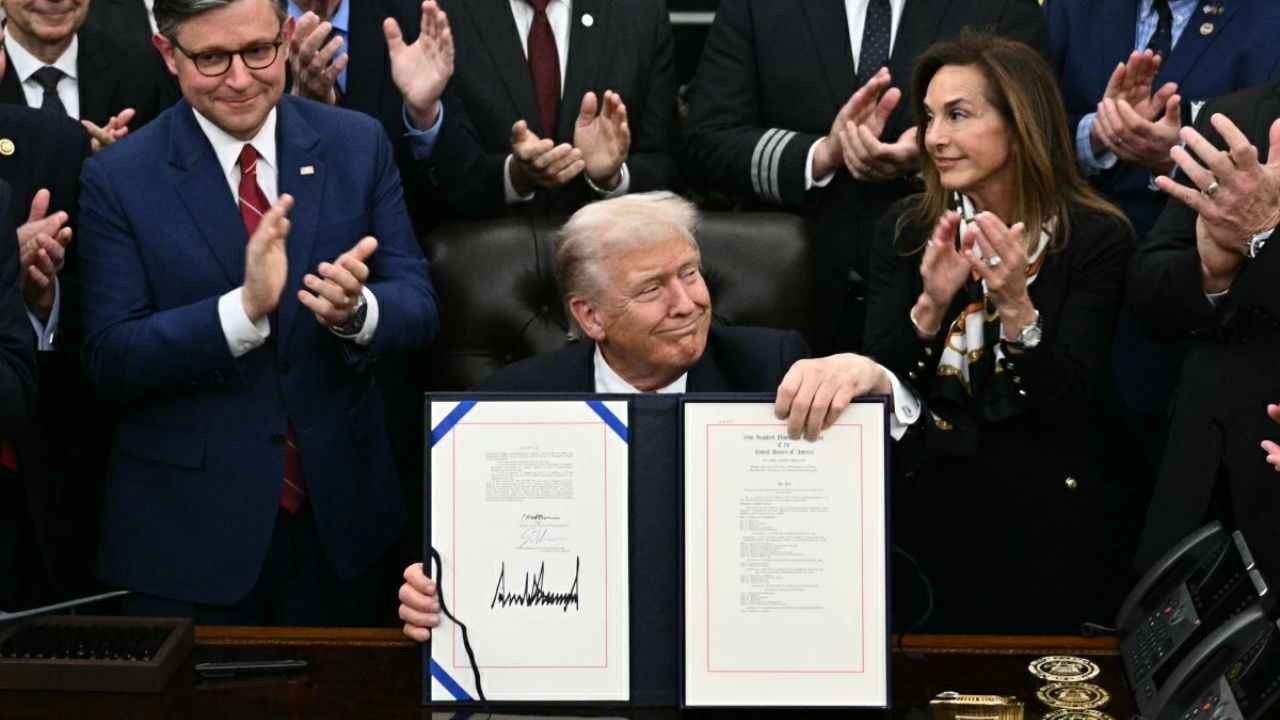
WASHINGTON – President Donald Trump signed legislation late Wednesday night to reopen the federal government, bringing an abrupt end to the longest shutdown in U.S. history after 43 days of political gridlock that disrupted millions of lives, crippled air travel, and threatened food assistance programs.
The bill, passed by the House 222-209 earlier in the evening, funds the government through January 30 and ensures retroactive pay for hundreds of thousands of furloughed federal workers. Trump inked the measure at 10:24 p.m. in the Oval Office, surrounded by Republican lawmakers and industry leaders, before delivering pointed remarks blaming Democrats for the impasse.
“The extremists in the other party insisted on creating the longest government shutdown in American history, and they did it purely for political reasons,” Trump said. “I just want to tell the American people: Don’t forget, when we come up to midterms and other things, don’t forget what they did to our country.”
The shutdown, which began at midnight on October 1 over a bitter dispute on extending expiring Affordable Care Act (ACA) subsidies, surpassed the previous record of 35 days set during Trump’s first term in 2019. It shuttered national parks, halted economic data releases, and exacerbated chaos in air travel and food benefits.
Table of Contents
Bipartisan Breakdown and Key Votes
The House vote exposed deep fractures: All but two Republicans supported the bill, while only six Democrats crossed party lines to back it. The dissenting Republicans were Reps. Thomas Massie of Kentucky and Greg Steube of Florida.
The six Democrats – moderates from swing districts – were Reps. Henry Cuellar (Texas), Don Davis (North Carolina), Jared Golden (Maine), Adam Gray (California), Marie Gluesenkamp Perez (Washington), and Tom Suozzi (New York). Golden has announced he will not seek reelection in 2026.
In the Senate, the deal cleared earlier after eight Democrats joined Republicans on November 9, infuriating party leaders. Those senators, many moderates not facing 2026 reelection, included Catherine Cortez Masto and Jacky Rosen (Nevada), Dick Durbin (Illinois), John Fetterman (Pennsylvania), Maggie Hassan and Jeanne Shaheen (New Hampshire), Tim Kaine (Virginia), and independent Angus King (Maine).
House Minority Leader Hakeem Jeffries, D-N.Y., vowed the fight continues. “There’s only two ways that this fight will end: either Republicans finally decide to extend the Affordable Care Act tax credits this year, or the American people will throw Republicans out of their jobs next year,” he said on the floor.
House Speaker Mike Johnson, R-La., celebrated the reopening but called the shutdown “wrong and cruel” and “pointless.” “We got the government open. Let’s celebrate tonight,” he told reporters.
Immediate Impacts and Economic Toll
Federal workers will return in coming days with back pay. Shuttered agencies, preschools, and landmarks like national parks will reopen. Crucial economic data from agencies like the Bureau of Labor Statistics will resume flowing.
The Congressional Budget Office estimated a 1.5% drop in real GDP by November 12, with $11 billion in permanent losses. Air travel remained chaotic: The FAA imposed flight cuts rising to 8% on November 13 and 10% on November 14 due to staffing shortages. Wednesday saw over 880 cancellations and 650 delays, per FlightAware.
SNAP benefits for 42 million Americans faced unprecedented lapses after funding expired November 1. Legal battles ensued, but the Supreme Court on November 11 declined to force full funding, deferring to Congress.
Controversial Provisions Spark Outrage
The funding package included a last-minute clause allowing senators whose phone records were subpoenaed in the January 6 investigation to sue the government – benefiting several Republicans probed by Special Counsel Jack Smith.
Johnson, furious upon discovery, pledged a House vote next week to repeal it. “I was very angry about it… That was way out of line,” he said after speaking with Senate Majority Leader John Thune. Democrats lambasted it as “brazen theft”: Rep. Jim McGovern, D-Mass., called it “the most brazen theft and plunder of public resources ever proposed,” while Rep. Jamie Raskin, D-Md., deemed it “the single-most corrupt provision for legislative self-dealing.”
Johnson also signaled tough negotiations ahead on ACA subsidies, expiring December 31. “Republicans would demand a lot of reforms before anything like that was ever possible,” he said, criticizing Obamacare for failing to lower costs.
Political Theater and New Faces
Debate on the House floor devolved into yelling, underscoring Washington’s dysfunction. Newly sworn-in Rep. Adelita Grijalva, D-Ariz. – who waited 50 days due to the shutdown after winning a September special election to replace her late father – code-switched between English and Spanish in her remarks. “Este momento es histórico para nuestra comunidad,” she said (“This is a historic moment for our community”). She immediately signed a discharge petition to release more Jeffrey Epstein files.
In a separate development, Democrats on the House Oversight Committee released Epstein emails claiming Trump “spent hours at my house” with a victim and “knew about the girls,” referencing Ghislaine Maxwell. The White House dismissed it as a “smear”; Trump has denied knowledge of Epstein’s crimes.
Rep. Mikie Sherrill, D-N.J., announced her resignation post-vote after winning the governorship; she’ll depart next week.
What’s Next?
With government lights back on, attention shifts to January 30’s funding deadline. Democrats vow to force ACA extensions; Republicans eye reforms. A YouGov/Economist poll showed 41% want Democrats to hold firm, with blame split: 36% on Republicans, 34% on Democrats.
Transportation Secretary Sean Duffy warned of escalating air disruptions without action, predicting grounded fleets if delayed further.
As workers return and services resume, the shutdown’s scars – economic losses, eroded trust, and heightened partisanship – linger, setting the stage for 2026 midterms.